
There are two kinds of people in the classic-car world: the ones who romanticize “character,” and the ones who
have pushed a dead classic off the shoulder while whispering prayers to the gods of carburetors. The first group
loves the smell of vintage vinyl and the thrill of wondering if the brakes are more of a suggestion than a feature.
The second group loves the look of a classicminus the surprise pop quizzes in mechanical engineering.
That’s the gap restomods were born to fill: keep the soul, update the stuff that makes modern driving… modern.
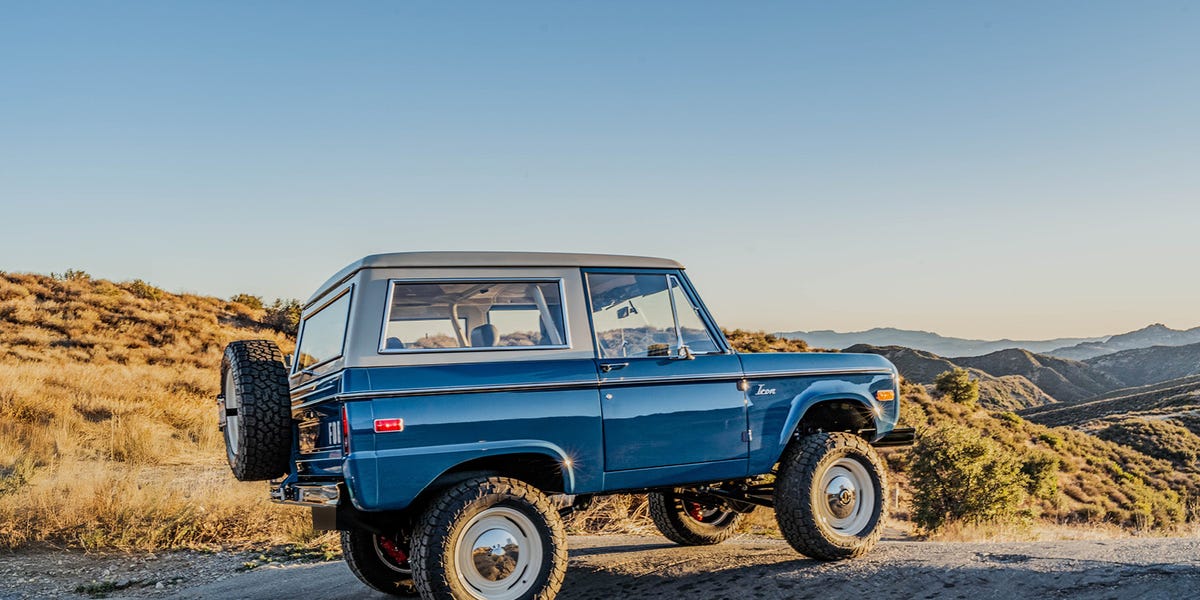
And when a high-end restomod outfit decides to electrify a first-generation Ford Bronco properlyproperly
meaning engineered like an OEM would do itit becomes something bigger than a trend. It becomes a statement:
vintage can be timeless and usable. And yes, it can also be hilariously quick.
Why the Original Bronco Still Matters (and Why It Needed Help)
The first-generation Bronco (1966–1977) is one of those designs that somehow looks tough, friendly, and
ready for adventure all at once. It’s compact, upright, and instantly recognizable. It also came from a time when
“infotainment” meant a radio that occasionally found music, and “driver assistance” meant a passenger who could
read a paper map without starting a family argument.
Early Broncos weren’t fast by modern standards. The original inline-six was famously modest, and even when Ford
added V8 power, you were still dealing with old-school brakes, old-school steering, and old-school everything.
That’s charming when you’re cruising to a weekend cars-and-coffee. It’s less charming when you’re merging onto
a busy highway surrounded by modern vehicles that stop, turn, and accelerate like they were designed in the same century.
Enter the restomod philosophy: upgrade the chassis, improve braking, tighten the build quality, add creature comforts,
and keep the classic vibe intact. Now add EV powernot as a novelty, but as a full system designed to work together.
That’s where this Bronco earns the “masterpiece” label.
Meet the ICON EV Bronco (and the Moment Motor Company Secret Sauce)
ICON 4×4 is already a heavyweight name in the high-end restomod world, known for obsessive craftsmanship and a deep
respect for original design. For its EV Bronco program, ICON teamed up with Moment Motor Company, a specialist outfit
with experience electrifying a wide variety of platforms. The goal wasn’t to build an electric noveltyit was to build
an electric Bronco that feels like an ICON Bronco first… just with electrons doing the heavy lifting.
This isn’t a mass-market idea, either. The EV Bronco project has been positioned as an ultra-limited runthink
collector-grade, bespoke builds, not a new trim level you casually add to your shopping cart. In other words: it’s the
kind of vehicle that’s as much art project as transportation, except the art project can also climb a dirt trail and
then glide into a valet line without dripping oil.
Under the Skin: What Makes This Electric Bronco a Big Deal
A Real EV Architecture (Not a “We’ll Figure It Out Later” Swap)
The headline numbers get attention, but the engineering choices are what make this build special. ICON and Moment’s
approach leans into OEM-style integration: a cohesive control strategy, thoughtful packaging, and a finished result
that looks intentional rather than improvised.
The EV Bronco is built around a high-voltage architecture and a serious battery packreported around 105 kWh,
split front and rear to preserve balance. That split-pack idea matters because classic SUVs are short-wheelbase and tall.
Add weight in the wrong place and you can ruin the feel. Done right, you get stability and composure without losing the
classic proportions.
Power: Classic Shape, Modern Punch
Depending on which reporting you’re reading (and how the prototype was tuned), the ICON EV Bronco sits in the neighborhood of
500+ horsepower and roughly 440 lb-ft of torquewith at least one outlet noting it can be higher,
but is intentionally dialed back for drivability. Either way, those numbers land far beyond anything a stock first-gen Bronco
ever dreamed of. This isn’t “a little quicker.” This is “your passengers suddenly respect your seatbelt talk.”
Performance claims put 0–60 mph in the mid-to-high 4-second range, which is wild for a boxy vintage SUV. But the more
important piece is how EV torque changes the experience: smooth, immediate pull with no gear hunting, no lag, and no dramaunless you
select the sporty mode and let the drama RSVP.
One Motor, Clever Layout, and Full-Time Traction
Here’s a detail that separates this Bronco from a lot of modern EV SUVs: it’s been described as using a single
center-mounted drive unit rather than multiple motors at each axle. Instead of relying on a conventional transmission and transfer case,
the layout sends power fore and aft through the drivetrain to front and rear axles. The upshot is a simplified mechanical system with fewer
traditional failure pointsyet still designed to deliver confident all-wheel traction.
Off-road capability is treated as a first-class feature, not a marketing sticker. Reports describe serious hardware like
upgraded axles, a locking front differential option, and the kind of build quality that keeps rattles and squeaks out of the conversation.
That last part matters more than people thinknothing kills “masterpiece energy” like a dashboard that sounds like a tambourine solo.
Stopping, Steering, and Suspension: The “Don’t Forget Physics” Package
Making an old Bronco fast is easy if you ignore the parts that stop and steer. ICON didn’t ignore them. Braking upgrades include
modern, high-performance components (frequently cited as Brembo), because “500 electric horses” is not the time to trust nostalgia.
Suspension is another place this build earns credibility. The EV Bronco retains solid-axle character, but pairs it with modern dampers
and tuningcommonly reported as advanced Reiger shocks. The mission is simple: keep the classic stance and capability, while making the truck
feel planted instead of chaotic.
Steering also gets modern attention. One piece of reporting highlights a contemporary electric steering rack influence, and other reporting notes
that the team refined geometry and stability to improve on-road confidence. Translation: it’s still a tall, short-wheelbase, vintage-style SUV
but it’s not supposed to feel like you’re negotiating with it at 70 mph.
Range and Charging: The Real-World EV Conversation
Every EV story eventually arrives at the same questions: “How far?” and “How long to charge?” The ICON EV Bronco is reported with
about 175–200 miles of range, depending on configuration and estimates. That’s not a cross-country numberand it isn’t trying to be.
It’s a “drive it, enjoy it, use it” number for a vintage-styled off-roader that weighs like a real truck.
Charging is described as CCS-compatible DC fast charging, with reports suggesting around 100 kW peak capability and a
20–80% window in under an hour. That’s slower than cutting-edge new EVs, but very reasonable for the kind of vehicle this is.
It’s not meant to replace your long-haul family road-trip crossover. It’s meant to be the coolest thing in your garage that you actually feel
comfortable driving.
A practical bonus: multiple outlets also mention a Level 2 onboard charger (often cited around 6.6 kW)the kind of setup that supports
overnight charging at home. If you’re shopping in the “half-million-dollar restomod” aisle, odds are good you have a garage, a charger, and a
lifestyle that doesn’t involve commuting 220 miles a day in a vintage-shaped brick.
Inside the Cabin: Vintage Looks, Modern Life
The best restomods don’t shout. They whisper. ICON’s approach is to keep the cabin looking era-appropriate while quietly layering in modern
functionality. That means climate control, modern audio, and a user interface that can handle EV-specific data without turning the dashboard into
a sci-fi movie prop.
Several reports highlight modern infotainment capability including smartphone integration (think Apple CarPlay and Android Auto), plus classic-style gauges
adapted to show EV metrics like state of charge and power output. The overall theme: you get the vibe of a classic Bronco, without living like it’s 1968.
The “No-Tell” Aesthetic: How to Hide an EV in Plain Sight
One of the funniestand most ICONdetails is the commitment to subtlety. The idea is that most people shouldn’t know it’s electric until it moves.
No loud “EV” badges. No futuristic add-ons that fight the original design. In some reporting, the EV “tell” is literally the absence of a tailpipe.
That’s it. A stealthy, classic silhouette… that just happens to be powered by the future.
Even the charging solution is engineered to keep the illusion intact, with reporting describing a CCS plug tucked behind the fuel door.
It’s a small touch that communicates a bigger point: this build is curated, not slapped together.
So… How Much Is This Masterpiece?
Let’s address the elephant in the room wearing a custom leather jacket: price. Reporting places the ICON EV Bronco in the ballpark of
$449,000 to $499,000 depending on how the build and limited-edition program is described. In that price band, you’re not comparing it
to a new SUV. You’re comparing it to other coach-built collectibles, rare restomods, and bespoke vehicles made in tiny numbers with obsessive attention
to detail.
What you’re really buying is the combination of vintage design, modern engineering, and the confidence that the whole package has been thought through:
battery packaging, thermal management, braking, suspension, controls, and fit-and-finish. Plenty of EV conversions exist. Far fewer feel like they could
be driven daily without the owner carrying a tool roll and a backup plan.
How It Stacks Up: ICON vs. Other Electric Broncos (and Ford’s Not-Here-Yet EV Gap)
ICON isn’t alone in electrifying classic Broncos. Companies like Kindred Motorworks have showcased electric Broncos at a lower (still premium) price point,
and earlier efforts like Zero Labs helped prove there’s an appetite for electrified vintage 4x4s. The spectrum is broad: some builds emphasize modern comfort,
others chase performance, and some focus on making the conversion platform scalable across multiple vehicles.
ICON’s lane is different. It’s aimed at the top of the mountain: limited production, design cohesion, OEM-grade integration, and a “drives like a finished product”
feel. That’s a meaningful distinction when you’re dealing with high voltage systems, drivetrain harmonics, cooling needs, and the simple reality that a vintage truck
was never designed around a battery pack.
There’s also a wider context: Ford hasn’t offered a mainstream electric Bronco in the U.S. lineup (at least not yet), even as electrified Bronco-branded models have
appeared in other markets. That vacuum is one reason the restomod world is so active: enthusiasts want the Bronco look and capability with a modern powertrainand they
don’t want to wait.
Is It Really a Masterpiece? The Verdict
Calling a vehicle a “masterpiece” is a bold claimright up there with “this will only take five minutes” and “I’ll just have one chip.” But in this case,
the label fits because the EV Bronco isn’t a single flashy trick. It’s a complete composition: power, packaging, suspension, brakes, comfort, and design restraint.
It honors what made the first Bronco lovableits shape, its spirit, its sense of adventurewhile removing the parts that made classic ownership feel like a
part-time job. And it does it with a level of engineering that makes the whole thing feel inevitable, like this is what the Bronco would have become if the 1960s
had better batteries and fewer bell-bottoms.
Experiences: What People Notice When a Classic Bronco Goes Electric (500+ Words)
The first “experience” most drivers report with a high-end electric restomod isn’t speedit’s calm. With a classic Bronco, the startup ritual
is part of the theater: the key turn, the mechanical churn, the idle that feels like the vehicle is clearing its throat before speaking. With an EV Bronco,
the theater flips. You get quiet. Not appliance-quietstill a vintage body with vintage aerodynamicsbut drivetrain-quiet. The absence of engine vibration changes
the vibe immediately. The cabin feels less like a machine you’re babysitting and more like a vehicle you’re simply operating.
Then comes the weirdly delightful part: you start moving, and you realize how much of “old car stress” comes from transitions. Shifting. Hesitation. Waiting.
Listening for odd noises that might mean something important. EV power smooths the transitions. It’s not that the truck loses character; it’s that the character
stops demanding constant attention. Owners and reviewers often describe the sensation as vintage style with modern competencea classic silhouette that behaves like
it’s been to therapy.
The next experience is torquespecifically, the way torque arrives without drama. In a gas restomod, you still have the buildup: revs, gears, and the
“now it’s really pulling” moment. In an EV restomod, the pull is there the instant you ask for it. That can feel almost comically strong in a short-wheelbase,
body-on-frame truck. Reviewers note that it’s quick in a way that makes you recalibrate your right foot, especially in the sportiest drive mode.
The smart ones treat it like a power tool: incredibly useful, but you don’t casually wave it around.
Interestingly, the experience isn’t purely futuristic. Many reports emphasize that premium restomods like ICON’s are tuned to keep an analog feel:
you still sit upright, you still see that classic hood line, you still feel the body shape pushing air like a billboard in a wind tunnel.
Wind noise is still part of the soundtrack. And in some cases, that’s the point. A “perfectly silent” classic can feel uncanny; a tasteful amount of
old-truck sensation helps preserve the emotional connection.
On-road, the experience is often described as more composed than a stock classic but not numb. The suspension does the heavy liftingliterallyby managing
battery weight without making the truck feel clumsy. When the dampers are well sorted, reviewers say the EV Bronco can ride and handle similarly to a
high-end gas restomod, just with different power delivery. Brakes also become a confidence boost: modern stopping power changes how relaxed the driver feels,
especially in traffic where “adequate drum brakes” are no longer adequate.
Off-road, the experience becomes quietly nerdy in a good way. Instead of relying only on gearing and throttle finesse, EV torque and software control can
help with smooth crawling. The best setups don’t feel like a gadget; they feel like traction that shows up right when you need it. And because so much
of the drivetrain behavior is controlled electronically, the vehicle can be tuned to deliver power in a predictable waysomething that’s useful when
you’re trying to place tires precisely rather than auditioning for a mud-slinging highlight reel.
Finally, there’s the experience no spec sheet captures: the social gravity of a classic Bronco that happens to be electric. It pulls in two crowds at once:
the vintage purists who want to know every detail about the build, and the EV-curious folks who never expected to care about a 1960s SUV.
The best reactions tend to be the same: a pause, a grin, and a sentence that starts with “Okay, I didn’t think I’d like this, but…”
That’s the hallmark of a true masterpiece: it changes minds without begging for approval.
Conclusion
The ICON EV Bronco isn’t trying to be a practical commuter, a bargain buy, or a mass-market vehicle. It’s trying to be the ultimate expression of an idea:
a beloved classic made genuinely usableand exhilaratingthrough modern engineering. With serious power, thoughtful battery packaging, real braking and suspension
upgrades, and a cabin that respects the original design, it’s a high-end restomod that feels cohesive from nose to tail (even though it doesn’t have a tailpipe).
In a world where “EV conversion” can sometimes mean “we bolted in parts and hoped,” the ICON EV Bronco stands out because it looks like it was designed this way
from the beginning. That’s why it earns the headline. Not just revived. Reimagined.
SEO Tags (JSON)