
Counterfeit money has one job: to look normal long enough for someone to stop paying attention. The good news is that genuine U.S. currency is packed with security features designed for everyday peoplenot just bankers with magnifying glasses and dramatic lighting. Whether you run a small business, work a cash register, sell items online for local pickup, or just want to avoid getting stuck with a suspicious bill, learning how to identify counterfeit money is a smart life skill.
The trick is not to rely on just one sign. A counterfeit detection pen can help in some situations, but it is not magic. A bill that passes one quick test can still be fake, and a real bill can sometimes look strange if it is old, worn, dirty, or damaged. The better approach is to use a simple routine: feel the paper, tilt the note, hold it to the light, compare details, and know what to do if something seems off.
Below are 15 practical steps to help you spot fake money with more confidence, fewer awkward moments, and less “Wait, is this Monopoly money?” panic.
Step 1: Start With the Feel of the Paper
Real U.S. currency is not printed on ordinary paper. It has a distinct texture because of its special composition and printing process. When you run your fingers across a genuine bill, it should feel slightly rough in areas with raised printing, especially around the portrait, large numerals, and other dark printed areas.
Counterfeit bills often feel too smooth, too waxy, too thin, or too much like regular printer paper. Some fake notes may feel stiff, while others may feel oddly limp. If the bill feels like it came out of a home office printer five minutes ago, your suspicion meter should politely wake up.
Step 2: Compare It With a Bill You Know Is Genuine
One of the easiest ways to identify counterfeit money is to compare the questionable bill with another bill of the same denomination and series style. Place them side by side and look at the portrait, borders, serial numbers, seals, colors, and paper texture.
A fake bill may look “close,” but close is not good enough. The portrait may look flat, the details may appear blurry, or the borders may lack sharpness. Genuine bills have crisp design elements, while counterfeits often lose fine detail during copying or printing.
Step 3: Hold the Bill Up to the Light
Light is your friend. For most modern U.S. bills, holding the note up to a light source reveals features that are difficult to imitate convincingly. Look for the watermark and security thread. These features are embedded into the note, not printed on top like a sticker or decoration.
If the bill has a “watermark” that looks printed on the surface, appears only on one side, or does not match the portrait or denomination, be careful. A genuine watermark should be visible from both sides when held to light.
Step 4: Check the Watermark
Many genuine U.S. notes have a watermark that becomes visible when the bill is held to light. The watermark usually matches the portrait or the denomination, depending on the bill. This is one of the most useful features because counterfeiters may print a faint image on the paper rather than embedding it properly.
For example, if you are checking a $20 bill, the watermark should match the expected design for that bill style. If the watermark is missing, printed too dark, placed strangely, or shows the wrong image, the bill deserves extra scrutiny.
Step 5: Find the Security Thread
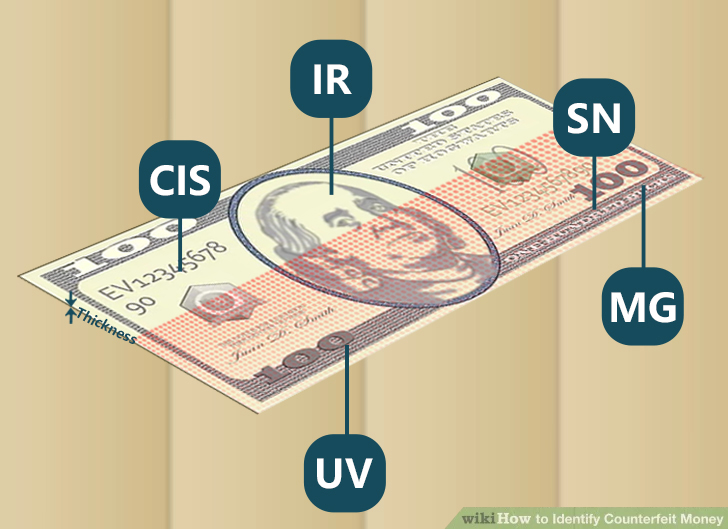
Genuine U.S. notes of $5 and higher include a security thread embedded vertically in the paper. The thread is placed in different positions depending on the denomination and includes tiny text identifying the bill’s value.
Hold the note to light and look for a thin vertical strip inside the paper. It should not look like a line printed on the surface. If it appears drawn, copied, or missing entirely, that is a warning sign. A true security thread is built into the bill, which makes it much harder to fake convincingly.
Step 6: Tilt the Bill to See Color-Shifting Ink
On many modern U.S. notes, the numeral in the lower right corner changes color when you tilt the bill. This color-shifting ink is a key feature on denominations such as $10, $20, $50, and $100 bills.
Do not just glance at ittilt the bill slowly. The color should shift clearly. If the number stays flat, looks painted, or changes in an odd way, compare it with a genuine note. Counterfeiters may imitate the look of color-shifting ink, but the effect is often weaker or less precise.
Step 7: Inspect the $100 Bill’s 3-D Security Ribbon
The modern $100 bill includes a blue 3-D security ribbon woven into the paper. When you tilt the bill back and forth, images on the ribbon appear to move. This is not a printed blue stripe. It is an advanced feature built into the note.
If a $100 bill has a flat blue line printed on the surface with no movement effect, that is a serious red flag. Because $100 bills are high-value targets for counterfeiters, take a few extra seconds to check this feature carefully.
Step 8: Look Closely for Microprinting
Microprinting is tiny text placed in specific areas of genuine currency. You may need a magnifying glass to read it clearly, but even without one, you can often tell whether the tiny print is sharp or just a blurry line.
Counterfeit bills frequently fail this test because ordinary printers struggle to reproduce ultra-fine text. Instead of clear microprinting, you may see smudges, dots, or wavy lines. Think of it as the bill whispering its identity. If the whisper sounds like printer static, keep checking.
Step 9: Examine the Portrait
The portrait on genuine U.S. money should look sharp, detailed, and lifelike. On counterfeit bills, the portrait may look flat, fuzzy, washed out, or slightly cartoonish. The eyes, hair, clothing, and background details are especially useful areas to inspect.
Do not worry if an old bill looks worn; normal circulation can fade currency. Instead, look for poor printing quality, uneven shading, or a portrait that seems to float awkwardly against the background. Genuine portraits are carefully engraved and printed with depth.
Step 10: Check the Borders and Fine Lines
The borders on real bills contain fine, detailed patterns. These lines should be clear and unbroken. Counterfeit money often has blurry borders because copying or scanning loses precision.
Look at the outer frame, scrollwork, and background patterns. If the lines bleed together, look pixelated, or appear uneven, the bill may not be genuine. A real bill should have the kind of detail that says, “A very serious government printing process made me,” not “Someone’s inkjet had a busy afternoon.”
Step 11: Verify Serial Numbers and Seals
Serial numbers on genuine bills should be evenly spaced, aligned, and printed in the correct color for that note style. The Treasury seal and Federal Reserve seal should also be clear and properly positioned.
Watch for serial numbers that are crooked, mismatched, oddly spaced, or printed in the wrong shade. Also be suspicious if two bills of the same denomination have identical serial numbers. That is not a fun coincidence; it is a major warning sign.
Step 12: Know the Denomination-Specific Features
Different denominations have different security features. A $1 bill does not have the same features as a $20 bill. A $5 bill does not behave exactly like a $100 bill. Before declaring a bill fake, make sure you know what features are supposed to appear on that specific denomination and design series.
This is especially important with older bills. U.S. currency designs have changed over time, and older genuine notes may lack features found on newer notes. In general, older Federal Reserve notes remain legal tender, so “old-looking” does not automatically mean counterfeit.
Step 13: Use a UV Light as a Secondary Check
Under ultraviolet light, the security thread in many genuine U.S. notes glows a specific color depending on the denomination. This can be helpful for cash-heavy businesses, event vendors, and retail workers.
However, UV light should not be your only test. A counterfeit bill might imitate one feature while failing others. Use UV checks together with the feel of the paper, watermark, security thread, color-shifting ink, and printing quality.
Step 14: Be Careful With Counterfeit Detection Pens
Counterfeit detection pens can identify some suspicious notes, especially those printed on ordinary wood-based paper. But they are not always accurate. A pen can produce false results, and some counterfeiters use paper that reacts differently.
In other words, a detection pen is a tool, not a judge in a black robe. Use it as one part of a larger inspection routine. If a pen says the bill is fine but the watermark, security thread, and printing look wrong, trust the full inspectionnot the pen alone.
Step 15: Know What to Do If You Suspect a Counterfeit Bill
If you think you have received counterfeit money, do not return it to the person who gave it to you. If you are working for a business, follow your organization’s reporting procedures. Individuals can contact local law enforcement or ask a bank for help identifying the note.
Handle the bill as little as possible, place it somewhere safe, and write down helpful details if you can do so safely, such as where and when you received it. Do not put yourself in danger or accuse someone aggressively. Many people pass counterfeit bills without realizing they are fake.
Common Signs of Counterfeit Money
The Paper Feels Wrong
Fake bills may feel too smooth, too glossy, too light, or too much like copy paper. Real currency has a distinctive texture that becomes easier to recognize with practice.
The Printing Looks Blurry
Genuine bills have sharp details. If the portrait, borders, or tiny text look smeared, fuzzy, or pixelated, inspect the bill more carefully.
The Watermark Is Missing or Printed
A watermark should be visible when held to light and should appear embedded in the paper. A printed imitation is a common counterfeit clue.
The Security Thread Is Wrong
The thread should be inside the paper, not drawn on the surface. It should also match the denomination.
The Bill Fails Multiple Checks
One unusual feature does not always prove a bill is fake, especially if the bill is old or damaged. But if several features look wrong, treat the note as suspicious.
How Businesses Can Reduce Counterfeit Risk
Businesses that accept cash should create a simple, repeatable process for checking bills. Employees do not need to become currency detectives with trench coats and theme music. They just need a routine that is fast, respectful, and consistent.
For higher denominations, train staff to check at least three features: feel the paper, hold the bill to light, and tilt it for color-shifting ink or other denomination-specific features. At busy registers, speed matters, but skipping every check can be expensive. A fake $100 bill can erase the profit from many small sales.
Businesses can also keep a small reference card near the register, use UV lights where appropriate, and train employees on how to respond calmly if a bill seems suspicious. The goal is not to embarrass customers. The goal is to protect the business and keep transactions safe.
How to Identify Counterfeit Money in Everyday Situations
At a Yard Sale
Yard sales and garage sales are casual, which makes them easy places to forget basic checks. If someone pays with a large bill for a small item, take a moment to inspect it. You can say, “Let me make sure I have change,” while you check the bill naturally.
During a Local Marketplace Sale
If you sell a phone, bike, game console, or furniture item in person, meet in a safe public place and check cash before handing over the item. For high-value sales, consider meeting at a bank where the cash can be verified.
At a Restaurant or Food Truck
Fast-paced environments are common targets because workers are busy. A quick feel-tilt-light routine can help catch suspicious bills without slowing the line too much.
When Receiving Change
Counterfeit risk is not limited to accepting payment. You can also receive a fake bill as change. Glance at larger bills before putting them away, especially in crowded or rushed settings.
Why Old Money Can Be Confusing
Older U.S. bills can confuse people because they may lack modern features such as color-shifting ink or newer security ribbons. That does not automatically make them fake. U.S. currency has gone through many design updates, and older notes can still be valid.
The best approach is to compare the bill against the correct design series. Do not compare a very old $20 bill to a modern $20 bill and panic because they look different. Instead, focus on whether the features match what that older design should have.
Extra Experience Section: Real-World Lessons for Spotting Counterfeit Money
One of the most useful lessons about identifying counterfeit money is that confidence comes from repetition. The first time you inspect a bill, you may feel awkward, as if everyone in line is silently judging your detective skills. After a while, the process becomes natural. You touch the paper, glance at the portrait, hold it to light, tilt it, and move on. It takes seconds.
In retail settings, the biggest challenge is pressure. A line forms, a customer is in a hurry, the card reader is acting dramatic, and suddenly a $100 bill appears for a $7 purchase. That is exactly when a quick routine matters most. A calm employee can say, “I just need to check large bills,” and inspect the note without making an accusation. The wording matters. You are checking the bill, not blaming the person.
For small business owners, training is often more valuable than expensive equipment. A UV light or detection pen may help, but employees need to understand what they are looking for. If a cashier knows where the security thread should be, how color-shifting ink should behave, and what raised printing feels like, they are much less likely to rely on one imperfect tool.
Another real-world lesson is that counterfeit bills often succeed because people are distracted. At outdoor markets, concerts, school events, and fundraisers, cash moves quickly. Lighting may be poor, tables may be crowded, and volunteers may not have experience handling large bills. A simple rule can help: check larger denominations before placing them in the cash box. Once a suspicious bill is mixed with others, it becomes harder to remember who passed it and when.
Local online sales create another common situation. Imagine selling a used laptop for cash. The buyer arrives, counts out the money, and everyone wants the exchange to be quick. This is not the time to feel shy. Count the cash slowly, check the larger bills, and meet somewhere safe. Many police departments and banks encourage safer transaction locations, and a bank can be especially helpful when large amounts of cash are involved.
It is also important to remember that not every suspicious bill is counterfeit. Real money can be torn, washed, faded, stained, or worn down after years of use. Some bills look strange because they have been through pockets, cash drawers, washing machines, and possibly a mysterious life story we do not need to know. That is why multiple checks matter. A worn bill with correct embedded features may be genuine, while a clean, crisp bill with printed-on security features may be fake.
The most practical habit is to slow down for unusual transactions. A customer paying with a large bill for a very small purchase, someone rushing the transaction, or a bill that simply feels wrong are all reasons to check more carefully. You do not need to be rude or suspicious of everyone. Just be consistent.
Finally, if you do receive a counterfeit bill, do not try to pass it to someone else. That can create legal trouble and simply moves the loss to another innocent person. Report it properly, learn from the experience, and improve your checking routine. Counterfeit detection is not about paranoia; it is about paying attention. Cash may be old-school, but your inspection skills can be modern, sharp, and quietly powerful.
Conclusion
Learning how to identify counterfeit money is mostly about building a reliable habit. Instead of relying on one test, check several features together: feel the paper, inspect the printing, hold the bill to light, look for the watermark and security thread, tilt for color-shifting ink, and compare suspicious notes with genuine ones. For businesses, a clear staff routine can prevent costly mistakes. For individuals, a few seconds of attention can protect your wallet during cash transactions.
Counterfeit bills are designed to pass quickly, not to survive careful inspection. So give your money a polite little inspection before you accept it. Real bills can handle the attention.