
Two-player board games are the unsung heroes of game night. You do not need a crowd, a snack committee, or one friend who spends 40 minutes reading the rules aloud like a courtroom witness. All you need is one opponent, teammate, sibling, parent, partner, or brave child who believes they can defeat you at tile placement, word clues, deduction, or pure luck wearing a tiny cardboard hat.
This guide brings together the best 2-player board games for adults and kids, from light family favorites to strategic head-to-head masterpieces. Some are designed strictly for two players, while others simply shine when played by a pair. Whether you want a quick 15-minute game before bedtime, a clever date-night challenge, or a screen-free weekend activity, these 50 picks offer something for every table.
How to Choose the Best Two-Player Board Game
The best two-player board game depends on who is playing. Adults may want deeper strategy, elegant decisions, and replay value. Kids usually need simple rules, quick turns, colorful components, and enough fun to survive the dangerous phrase “Let’s play again.” Mixed-age pairs need games where adults stay interested without quietly calculating how soon bedtime arrives.
Look for three things: a suitable age range, a playtime that fits your schedule, and a style both players enjoy. Cooperative games are great when adults and kids want to win together. Competitive games work better for players who enjoy friendly rivalry and can survive a dramatic loss without demanding a rematch, a recount, and possibly legal representation.
Top 50 Best 2-Player Board Games for Adults & Kids
- Patchwork – A cozy but clever quilting puzzle where two players buy fabric tiles and fit them onto personal boards. It feels gentle, but the strategy has tiny teeth.
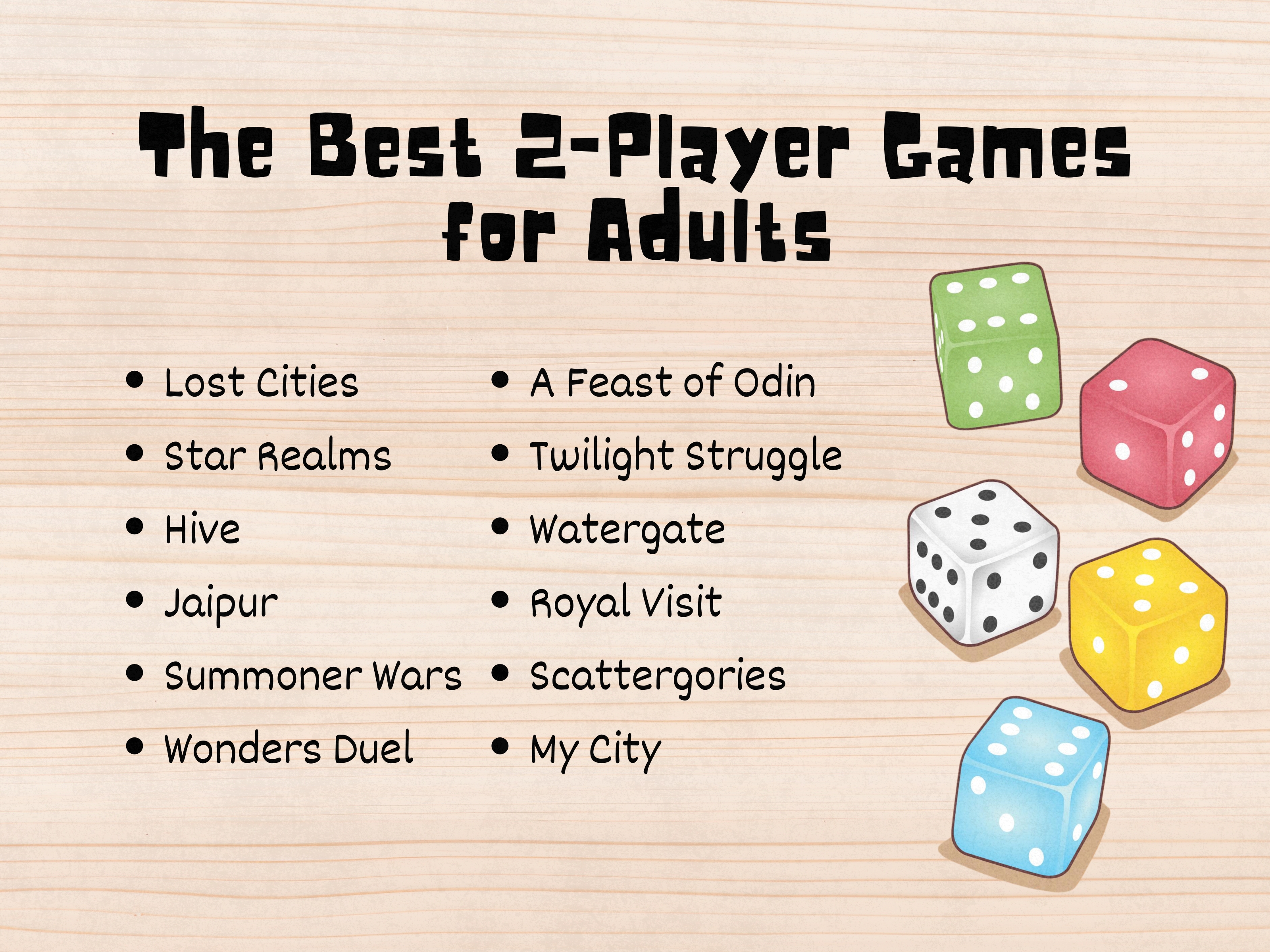
- 7 Wonders Duel – One of the best 2-player board games for adults who want civilization-building, military pressure, science paths, and tense card drafting in about 30 minutes.
- Codenames: Duet – A cooperative word game where two players give one-word clues to find secret agents. Great for couples, friends, and older kids who enjoy language puzzles.
- Jaipur – A fast trading card game about camels, goods, timing, and the quiet panic of realizing your opponent just made the perfect market move.
- Hive – A chess-like abstract game with chunky insect tiles and no board. Easy to learn, highly portable, and wonderfully ruthless.
- Lost Cities – A classic two-player card game about risky expeditions. It teaches planning, probability, and the emotional cost of drawing exactly the card you needed three turns ago.
- Azul – A beautiful tile-drafting game that plays smoothly with two. It is colorful enough for families and sharp enough for adults who enjoy elegant strategy.
- Splendor Duel – A compact jewel-collecting engine builder made specifically for two players. It adds tighter interaction than the original Splendor.
- Kingdomino – A simple tile-laying game where players build tiny kingdoms. It is especially good for kids because the rules are friendly and the scoring is visual.
- Carcassonne – A tile-placement classic that works well at two players, offering cities, roads, farms, and just enough meeple mischief.
- Ticket to Ride – A route-building favorite for families. With two players, the board feels open but still competitive, especially when someone blocks your perfect train line.
- Onitama – A minimalist martial-arts strategy game with shared movement cards. It is quick, elegant, and excellent for players who like chess but want less homework.
- Santorini – A 3D strategy game where players move workers and build towers. Kids love the toy-like pieces; adults love the sneaky tactical depth.
- Connect 4 – A classic for kids and adults. Simple rules, instant setup, and surprisingly satisfying moments when someone finally sees the diagonal trap too late.
- Guess Who? – A kid-friendly deduction game built around yes-or-no questions. It is simple, funny, and perfect for younger players practicing logic.
- Scrabble – The classic word board game remains a strong two-player choice for adults, teens, and word-loving kids.
- Bananagrams – A fast, flexible word game without a board. Great for travel, classrooms, and players who like Scrabble but prefer speed over scorekeeping.
- Qwirkle – A tile-matching game about colors and shapes. It is easy for kids to understand but gives adults plenty of pattern-planning decisions.
- Rummikub – A number-tile game based on runs and sets. It supports logic, sequencing, and the ancient family tradition of rearranging the table dramatically.
- Forbidden Island – A cooperative adventure where players collect treasures and escape before the island sinks. It is one of the best family-friendly co-op games for two.
- Pandemic – A cooperative strategy game where players fight global outbreaks together. Best for older kids and adults who enjoy planning under pressure.
- Horrified – A cooperative monster game where players work together to defeat classic creatures. The theme is spooky but accessible, making it fun for families with older kids.
- Disney Villainous – An asymmetric game where each villain has a unique goal. At two players, it becomes a focused duel with plenty of personality.
- Star Wars: The Deckbuilding Game – A head-to-head card game for Star Wars fans, with Rebel and Empire sides clashing in a streamlined format.
- Star Realms – A fast deck-building card game with ships, bases, and explosive turns. Great for adults and teens who like combo-driven play.
- Hero Realms – Similar to Star Realms but with a fantasy theme. It is quick, affordable, and easy to teach to older kids.
- The Fox in the Forest – A two-player trick-taking card game with charming art and clever card powers. Excellent for adults who want a compact strategy game.
- The Fox in the Forest Duet – A cooperative version where two players move through a shared forest path. Better for pairs who prefer teamwork over rivalry.
- Sky Team – A cooperative two-player game about landing an airplane. It is tense, focused, and wonderfully dramatic without needing a giant table.
- Watergate – A historical tug-of-war for two players, with one side as the Nixon administration and the other as the press. Best for adults and history-minded teens.
- Targi – A two-player worker-placement card game set around desert trade. It offers deep strategy in a small box.
- Hanamikoji – A quick card game about earning favor through careful gifts. Every decision feels small until it ruins your entire plan.
- Mandala – A beautiful card game about building shared patterns and timing your scoring. Strong for adults who enjoy tactical elegance.
- Schotten Totten – A compact card battle where players create formations to win boundary stones. Simple cards, big brain burn.
- Air, Land & Sea – A tiny tactical card game about winning theaters of war through clever timing. Best for teens and adults.
- Radlands – A stylish post-apocalyptic card duel with strong tactical choices. Great for adults who want something bold, fast, and replayable.
- Unmatched – A skirmish game where legendary characters fight in cinematic duels. Kids love the theme; adults enjoy the matchup variety.
- Dice Throne – A dice-battling game with unique heroes. It is energetic, colorful, and ideal for players who like big swings and dramatic rolls.
- Battle Line – A classic card strategy game with poker-like formations. It is excellent for two adults who enjoy clean tactical contests.
- Cribbage – A traditional card-and-board game full of counting, pegging, and satisfying arithmetic. It remains one of the best classic games for two players.
- Chess – The ultimate abstract strategy duel. Not every child will love it immediately, but the right kid may become terrifyingly good by next Tuesday.
- Checkers – A simpler abstract classic that works well for younger players. Easy to teach, quick to play, and still rewarding.
- Blokus Duo – A two-player version of Blokus focused on spatial planning. Great for kids, adults, and anyone who enjoys fitting shapes into impossible spaces.
- Tak – A clean abstract strategy game about building roads and controlling stacks. Best for adults and older kids who like pure tactics.
- Quarto – A brilliant abstract game where you choose the piece your opponent must play. It sounds generous until it becomes deeply suspicious.
- Abalone – A marble-pushing abstract game that rewards planning and positioning. It is tactile, attractive, and satisfying for both kids and adults.
- Labyrinth – A shifting-maze game that works well for two and helps kids practice planning. The board changes constantly, which keeps it lively.
- Monopoly Deal – A quick card-game version of Monopoly that avoids the four-hour property marathon. Better for casual two-player family play.
- Exploding Kittens – A silly, quick card game full of take-that moments. It is best for players who enjoy chaos and cartoon-style humor.
- Jenga – A physical dexterity classic. It is not deep strategy, but it delivers suspense, laughter, and the universal sound of bad decisions collapsing.
Best Picks by Player Type
Best 2-Player Board Games for Adults
Adults should start with 7 Wonders Duel, Patchwork, Splendor Duel, Watergate, Targi, Radlands, and Sky Team. These games offer meaningful decisions without demanding an entire evening. They also reward repeat plays, which matters because the best adult board games are not just fun once; they are fun after your opponent has learned your tricks and started using them against you.
Best 2-Player Board Games for Kids
For kids, try Connect 4, Guess Who?, Kingdomino, Qwirkle, Labyrinth, Blokus Duo, and Forbidden Island. These games are colorful, easy to teach, and forgiving enough for younger players. They also help develop pattern recognition, memory, planning, communication, and turn-taking without making the game table feel like school wearing a cardboard disguise.
Best 2-Player Board Games for Families
Mixed adult-and-child pairs should look at Azul, Carcassonne, Ticket to Ride, Santorini, Horrified, and Codenames: Duet. These games strike a helpful balance: children can participate confidently, while adults still get real choices. Cooperative games are especially useful when a parent wants a peaceful evening instead of a miniature courtroom debate about whether a move was “fair.”
Quick Buying Tips for Two-Player Board Games
Choose short games if the players are new. A 15- to 30-minute playtime makes it easier to say, “Let’s try again,” instead of, “Let us never speak of this cardboard incident.” For younger kids, avoid games with too much hidden text or long-term planning. For adults, look for replayability, asymmetry, variable setup, or different paths to victory.
Also consider whether the game is truly designed for two players or simply supports two players. Some multiplayer games technically work with two but feel empty. The best two-player board games feel complete at that count. Every turn should matter, downtime should be minimal, and both players should feel involved until the end.
My Experience With 2-Player Board Games: What Actually Works at the Table
The real magic of two-player board games is that they create a small, focused conversation. With big group games, half the fun comes from noise: jokes, alliances, snacks, accusations, and someone asking whose turn it is for the seventh time. With two players, there is nowhere to hide. Every move is personal. Every mistake is visible. Every victory feels like you have solved a tiny puzzle while maintaining eye contact.
For adults, the best experiences often come from games that offer tension without exhausting the brain. Patchwork is a perfect example. It looks calm, almost suspiciously wholesome, but the timing decisions can be brutal. Do you take the perfect tile now and spend too many buttons, or wait and let your opponent grab it? That kind of small dilemma is exactly what makes a two-player game memorable. 7 Wonders Duel creates a different feeling. It is bigger, sharper, and more dramatic. You are not just collecting cards; you are watching military pressure, science symbols, resources, and money all at once like a tiny empire manager who forgot to drink water.
Playing with kids teaches a different lesson: clarity matters more than cleverness. A child may enjoy strategy, but they usually do not enjoy sitting through a rulebook that sounds like tax software. Games such as Connect 4, Guess Who?, Kingdomino, and Qwirkle work because the goal is obvious. The child can look at the board and understand what is happening. That confidence is important. Once kids feel capable, they start experimenting, predicting, and proudly explaining your defeat to nearby furniture.
Cooperative games can be especially powerful for adult-and-child pairs. Forbidden Island, Codenames: Duet, and Horrified turn the table into a team. Instead of one person winning and the other pretending to be fine, both players share the same problem. This reduces frustration and encourages communication. The trick is for adults not to “quarterback” every move. Let the child suggest ideas, make choices, and occasionally lead the team into glorious disaster. Shared failure is still a great game-night memory.
For couples and friends, two-player games can become rituals. A quick round of Jaipur after dinner, Azul on a rainy afternoon, or Sky Team when you want cooperative tension can turn ordinary downtime into something memorable. The best part is convenience. You do not need to schedule six people, clean the entire house, or buy enough chips to feed a youth soccer team. Two chairs, one table, one box, and you are ready.
My biggest advice is to build a small two-player collection with variety. Keep one quick game, one cooperative game, one deeper strategy game, one kid-friendly game, and one classic. That gives you options for different moods. Some nights call for clever planning. Some nights call for word clues. Some nights call for Jenga, because nothing says family bonding like everyone staring at a wooden tower and whispering, “Bad idea.”
Conclusion
The best 2-player board games for adults and kids prove that great game nights do not need a crowd. From strategic duels like 7 Wonders Duel and Hive to family favorites like Kingdomino, Qwirkle, and Forbidden Island, there is a two-player game for nearly every age, mood, and attention span.
If you are buying your first two-player game, start simple: Patchwork for cozy strategy, Codenames: Duet for teamwork, Jaipur for fast competition, or Kingdomino for family play. Once you know what your table enjoys, expand from there. The right game can turn a quiet evening into a clever little adventure, no group chat scheduling required.
SEO Tags