
At first glance, a deck of playing cards looks like the world’s most ordinary rectangle party: 52 tiny slabs of paper, four suits, a few royal faces, and a pair of mischievous Jokers waiting to ruin somebody’s poker night. But look closer. That humble deck on your coffee table carries centuries of global history, hidden symbolism, mathematical chaos, wartime spycraft, design tricks, and enough myths to make a magician grin like he just found your card in his shoe.
The standard deck of playing cards is one of the most familiar objects in American homes, casinos, classrooms, magic shops, and game nights. Yet most people never notice its little secrets: why the Ace of Spades looks fancy, why only some Jacks show one eye, why the Joker is the troublemaker, why the suits look the way they do, and why a properly shuffled deck may be more unique than your fingerprint after eating barbecue wings.
So grab a deck, fan the cards like you know what you’re doing, and let’s uncover the top 10 secrets in a deck of playing cards.
1. The Deck Is Older Than It Looks
One of the biggest secrets in a deck of playing cards is that it did not simply appear one day in a smoky saloon beside a cowboy saying, “I raise.” Playing cards have a long, winding history that likely began in Asia. Many historians connect early card games to China, where paper, printing, money cards, domino-like cards, and gaming culture developed centuries before the familiar Western deck.
By the late Middle Ages, playing cards had reached Europe through trade routes, cultural exchange, and the very human desire to gamble on anything smaller than a goat. Early European cards were not standardized. Some decks had different suit symbols, different numbers of cards, and lavish hand-painted artwork. Wealthy players could own luxury cards that were basically pocket-sized art galleries.
The modern 52-card deck became popular over time because it was practical. It was easy to print, easy to teach, and flexible enough for many games. That flexibility is the reason one deck can power poker, bridge, rummy, solitaire, blackjack, Go Fish, and your uncle’s mysterious “house rules” game that nobody fully understands but everyone loses.
2. The Four Suits Were Not Always Hearts, Diamonds, Clubs, and Spades
Today, a standard deck has four suits: hearts, diamonds, clubs, and spades. But those symbols are not universal, and they were not the first suit system. Earlier cards in Europe and the Islamic world used suit signs such as cups, coins, swords, and polo sticks. Spanish and Italian decks kept versions of cups, coins, swords, and clubs. German decks developed suits such as acorns, leaves, hearts, and bells. In other words, the deck had a wardrobe phase before settling on its current outfit.
The French suit system became especially influential because its simple shapes were easy to reproduce with stencils and printing methods. Hearts, diamonds, clubs, and spades were clean, recognizable, and cheap to manufacture. That mattered. A deck that could be produced quickly and sold widely had a major advantage over one that required a medieval artist to paint every tiny royal eyebrow.
When French-suited cards spread to England, the designs evolved into the English pattern, which heavily influenced the cards now common in the United States. That is why the deck in your junk drawer carries traces of French design, English adaptation, and international history, all while being used to decide who has to do the dishes.
3. The Ace of Spades Is Fancy Because of Taxes
The Ace of Spades often looks more dramatic than the other aces. It may carry a large ornate spade, the manufacturer’s name, flourishes, scrollwork, or enough decoration to suggest it has its own publicist. That tradition is not just about style. It is tied to tax history.
In England, playing cards were taxed for centuries. At different points, official marks or specially printed “duty” cards showed that the tax had been paid. The Ace of Spades became strongly associated with this legal proof, and its design grew more elaborate. Eventually, even after the tax system changed, card makers kept treating the Ace of Spades as the deck’s showpiece.
That is why the Ace of Spades became the card most likely to display a brand identity. It is the deck’s business card, badge, and dramatic entrance music all in one. The next time you see an oversized Ace of Spades design, remember: behind that cool look is a long history of government paperwork. Somehow, taxes accidentally made one card look awesome.
4. The Joker Is an American Wild Child
The Joker feels ancient, like it should have been laughing in a castle tower since the Middle Ages. Surprisingly, the Joker is a relatively recent addition to the standard deck. It developed in the United States during the 19th century and is strongly linked to the card game Euchre.
In Euchre, players used powerful trump cards called bowers. Over time, an extra top trump card appeared, sometimes called the “Best Bower.” This card eventually evolved into the Joker. From there, the Joker escaped into other games and became a wild card, a top trump, a replacement card, a comic figure, or a chaos gremlin, depending on the rules.
The Joker is also one of the least standardized cards in the deck. One company may draw a jester. Another may use a clown, a magician, a devilish grin, a brand mascot, or something so strange it looks like it was designed during a very intense lunch break. That freedom makes Jokers especially collectible. They are the deck’s reminder that rules are important, but breaking them can be profitable.
5. The Court Cards Have Lost, Changed, and Borrowed Identities
The Kings, Queens, and Jacks are called court cards, face cards, or picture cards. They look familiar, but their identities are more complicated than many people think. In some French traditions, court cards were linked with legendary or historical figures such as Charlemagne, Julius Caesar, King David, Alexander the Great, Judith, Rachel, and others. However, these associations were not perfectly consistent across countries, printers, or time periods.
Modern English-pattern cards, the kind most Americans know, usually do not print names on the court cards. Over generations of copying, simplifying, and redesigning, many original details changed. Some weapons shifted position. Some faces turned. Some symbols disappeared. The result is not a precise royal family tree but a beautiful design fossil.
The Jack itself has an interesting secret. In older English decks, the lowest male court card was often called the Knave. But once corner indices became common, using “K” for both King and Knave would have created confusion. The word Jack became standard in English-speaking decks partly because “J” solved the problem. In short, the Jack got promoted by typography.
6. Some Royals Have Only One Eye
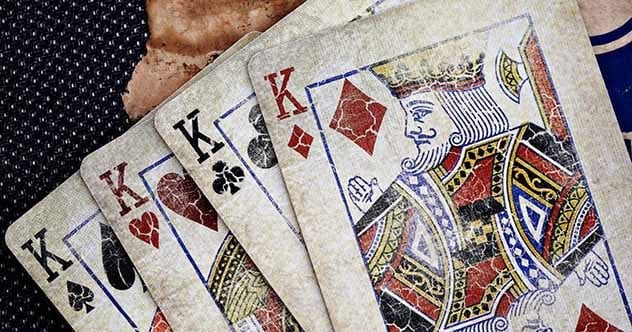
Look closely at the court cards. The Jack of Spades and Jack of Hearts are commonly known as the “one-eyed Jacks” because they are shown in profile, revealing only one eye. The King of Diamonds is also often shown in profile, which is why some players call him a one-eyed royal.
These visual quirks matter in certain card games. Some home rules make one-eyed Jacks wild. Poker variations may use the “one-eyed Jacks and the man with the axe,” referring to the King of Diamonds, who traditionally carries an axe. This is exactly the kind of phrase that makes card games sound like a secret society formed in a basement.
Another famous royal oddity is the King of Hearts, sometimes called the “Suicide King.” His sword appears to go behind or into his head, depending on the deck design. The name comes from that visual illusion, not from an official story. He is also often the only King without a mustache. Card historians generally explain that the missing mustache came from repeated copying and design changes over time. So the King of Hearts is not necessarily tragic. He may just be the victim of bad reproduction and medieval graphic design drift.
7. The Deck Has a Calendar-Like Coincidence
One of the most popular secrets in a deck of playing cards is its calendar symbolism. A standard deck has 52 cards, just as a year has 52 weeks. There are four suits, which people often compare to the four seasons. Each suit has 13 cards, which can be linked to the roughly 13 weeks in a season. There are 12 court cards, which people compare to the 12 months of the year.
The math gets even more fun. If you assign Ace as 1, Jack as 11, Queen as 12, and King as 13, the total value of one suit is 91. Multiply that by four suits, and the full deck totals 364. Add one Joker, and you get 365. Add a second Joker, and you get 366, the number of days in a leap year.
Now, before we put on wizard robes and declare the deck an ancient calendar machine, here is the sensible part: historians generally treat this as a later symbolic interpretation, not a proven original purpose. Still, it is a fantastic coincidence and a great conversation starter. It also makes the deck feel less like random paper and more like a tiny calendar wearing a poker face.
8. A Shuffle Creates a Mathematical Monster
Here is one of the most mind-bending playing card facts: a 52-card deck can be arranged in 52 factorial, written as 52!, different ways. That means 52 × 51 × 50 × 49 and so on, all the way down to 1. The result is about 8.07 × 1067, a number so large it looks like a calculator sneezed.
What does that mean in real life? If you thoroughly shuffle a deck, there is a very good chance that exact order has never existed before in history. Not in Vegas. Not in your grandma’s bridge club. Not in a pirate tavern. Not even during that one family game night that lasted four hours because someone kept “checking the rules.”
This is why cards are so powerful for games and magic. The deck is small enough to fit in your hand but mathematically enormous. Every shuffle is a private universe of possibilities. That is not poetic exaggeration; it is combinatorics wearing a red-and-black tuxedo.
9. Seven Good Riffle Shuffles Are a Big Deal
Most people shuffle cards until they feel emotionally satisfied. Mathematicians, naturally, had to make it complicated. Research on riffle shuffling has shown that around seven good riffle shuffles are enough to mix a standard 52-card deck very well. Fewer shuffles may leave more order than players realize.
A riffle shuffle splits the deck into two packets and interlaces them. It is common in casinos and serious card play because it mixes more effectively than many casual methods. An overhand shuffle, where small clumps are pulled from one hand into another, can look convincing but may preserve more original order unless repeated many times. In other words, your relaxed kitchen-table shuffle may be less random than you think.
This matters in games where fairness matters. It also matters in magic, where controlled shuffling can look random while secretly preserving key cards. The secret is not that shuffling is fake; it is that shuffling is a skill. A deck can be mixed, tracked, stacked, cut, controlled, or disguised depending on the hands holding it. The cards may be innocent. The shuffler, however, deserves a side-eye.
10. Playing Cards Have Been Used for Espionage
One of the coolest real secrets in playing card history comes from World War II. Special decks were created to help Allied prisoners of war escape from German camps. These decks looked ordinary, but some cards could be moistened and peeled apart to reveal hidden map pieces. When assembled, the pieces could help prisoners find routes to safety.
That sounds like something from a spy movie, except it actually happened. The U.S. Playing Card Company worked with American and British intelligence efforts on these secret map decks. A harmless pack of cards was an ideal disguise because playing cards were common in prisoner camps. Guards expected men to pass time with games. They did not necessarily expect the cards to contain escape geography.
This is the deck at its most dramatic: not just a tool for games, but a tool for survival. It proves that playing cards are more than entertainment. They can carry messages, hide information, boost morale, and become part of history. Not bad for paper rectangles.
Bonus Secret: The Back Design Matters More Than You Think
The backs of playing cards are usually symmetrical for a reason. If a card back had an obvious one-way design, a sharp-eyed player could identify whether a card was upside down. In magic and cheating, this kind of detail can matter. A truly two-way back helps protect fairness by making every face-down card look identical from either direction.
Modern card backs often include detailed patterns, borders, wheels, angels, flowers, diamonds, or geometric designs. These patterns are not just decoration. They can hide tiny printing variations, make handling more pleasant, and create a recognizable brand identity. Borderless backs, common in casino-style decks, can make certain moves less visible, while bordered backs can make misalignment easier to spot.
Even card finish matters. Many paper playing cards have coatings or embossed textures that help them slide, fan, and shuffle smoothly. Magicians and cardists care about this deeply. A cheap sticky deck can turn a graceful card flourish into a tragic paper traffic jam.
Experiences and Lessons From a Deck of Playing Cards
The best way to understand the secrets in a deck of playing cards is not just to read about them. It is to sit at a table and use them. A deck changes personality depending on where it appears. In a casino, it feels formal and sharp, like every card is wearing a suit. At a family gathering, it becomes loud, funny, and suspiciously connected to arguments over rules. In a magician’s hands, it becomes slippery reality. In a collector’s display case, it becomes art.
One common experience is the instant familiarity of a deck. Almost everyone recognizes the suits. Even a child who does not know poker can sort red cards from black cards, match numbers, or find the Queens. That simple structure is one reason playing cards have lasted so long. They are easy to enter but hard to exhaust. You can learn War in minutes, spend years improving at bridge, and spend a lifetime studying card magic without running out of surprises.
Another experience is how cards reveal personality. Some players are cautious, holding every card like it contains state secrets. Some bluff with the confidence of a movie villain. Some organize their hand perfectly by suit and rank. Others hold cards in a chaotic fan that looks like a raccoon sorted them. Watching people play cards can tell you who is patient, who is competitive, who laughs under pressure, and who absolutely should not be trusted with snacks near the table.
Cards also teach probability in a way textbooks often fail to do. Drawing an Ace from a shuffled deck is not abstract when you are waiting for one. The odds suddenly have a heartbeat. Poker players learn expected value, memory, risk, and emotional discipline. Rummy players learn sequencing and pattern recognition. Solitaire players learn that sometimes the universe simply refuses to cooperate, and no amount of clicking “undo” will change fate.
For magicians, the deck teaches attention. A spectator may think the secret is a hidden device or supernatural power, but much of card magic depends on timing, psychology, misdirection, and practiced handling. The audience remembers the impossible ending, not the tiny moment when the method happened. That is a useful lesson beyond magic: people often miss what happens right in front of them when their attention is guided elsewhere.
For collectors, a deck teaches appreciation for design. The paper stock, tuck box, seal, court-card style, back pattern, Joker art, Ace of Spades, and even the smell of a new deck can matter. Vintage decks show how printing technology, advertising, politics, fashion, and entertainment changed over time. A deck from one era may feel stiff and formal; another may be colorful, experimental, or hilariously strange.
Most of all, playing cards create shared moments. They bring people together without needing batteries, Wi-Fi, or a software update that ruins everything. A deck can fit in a pocket and turn a dull evening into a tournament, a magic show, a storytelling session, or a friendly disaster. That may be the greatest secret of all: the deck is small, but it makes room for people.
Conclusion
A deck of playing cards is easy to underestimate because it is so familiar. But behind those 52 cards are centuries of travel, printing innovation, game design, symbolism, mathematics, military history, and visual quirks. The suits evolved through cultures. The Ace of Spades became fancy because of taxation. The Joker grew out of American card play. The court cards carry design accidents and old traditions. A shuffle opens a number of possibilities too large to comfortably imagine.
That is why the standard deck remains one of the most brilliant inventions in everyday life. It is cheap, portable, beautiful, mysterious, and endlessly reusable. Whether you use it for poker, magic, solitaire, bridge, probability lessons, or dramatic fortune-telling at a sleepover, the deck always has one more secret waiting under the top card.
Note: This article synthesizes real historical, mathematical, and design information from reputable references on playing card history, museum collections, card manufacturers, mathematics publications, and public history resources. It is rewritten in original language for web publication.