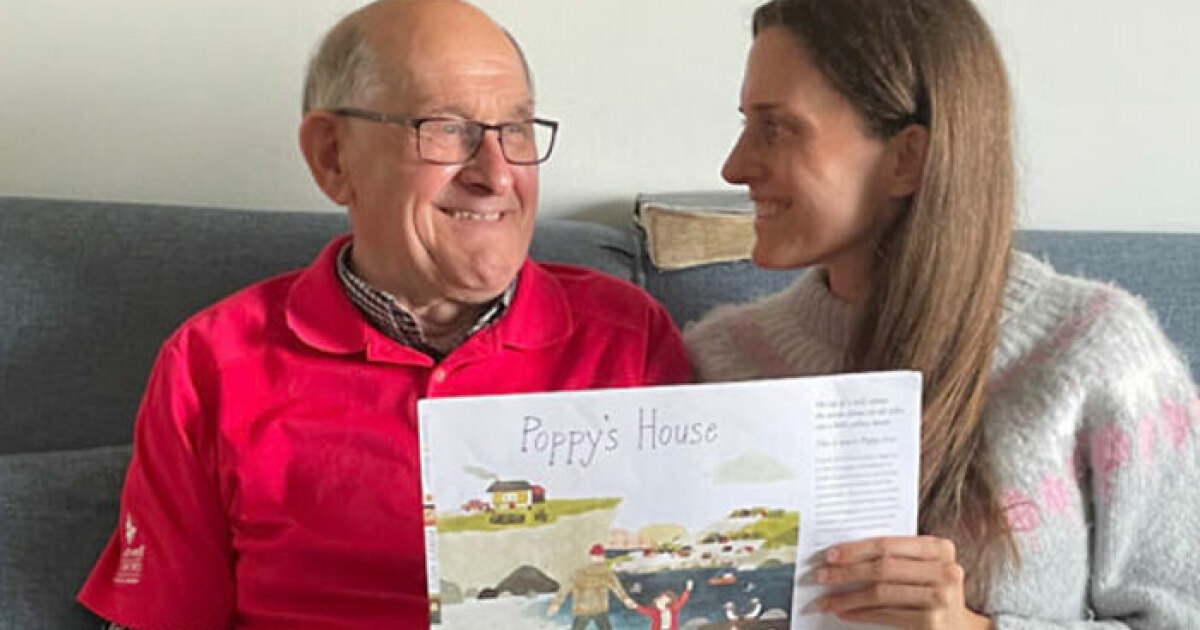

There are moments in life that do not arrive with fireworks, marching bands, or dramatic movie music. Sometimes they arrive quietly, in a living room, with a 93-year-old grandfather holding a book in both hands and realizing, slowly and beautifully, that the story inside is his.
That was the moment: my grandfather saw the book I wrote about him for the first time. Not a school essay. Not a few notes stuffed in a drawer. Not a social media post with three heart emojis and one questionable filter. A real book. A book with pages, chapters, memories, photographs, old jokes, hard years, soft wisdom, and the kind of family history that usually lives in half-finished sentences at the dinner table.
Writing a book about a grandparent is not simply a writing project. It is part memoir, part time machine, part emotional ambush. You begin by asking, “What year was that?” and suddenly you are holding the weight of a century. At 93, my grandfather has lived through eras most of us only understand through documentaries, black-and-white photos, and stories that begin with, “Back then, we did not have all this.” By “all this,” he usually means smartphones, delivery apps, heated debates about oat milk, and people taking pictures of lunch like it might run away.
This article is about what it feels like to preserve someone’s life in words, why family storytelling matters, and what happens when the person you wrote about finally sees himself reflected on the page. Spoiler: there may be tears. There may also be laughter. In our case, there was both, plus one very grandfatherly complaint about the photo I chose for Chapter Two.
Why I Decided To Write A Book About My Grandfather
The idea did not arrive as a grand artistic revelation. I did not sit beside a window during a thunderstorm, clutch a fountain pen, and whisper, “I must preserve the legacy.” It began with ordinary conversations.
My grandfather would tell stories in pieces. A childhood memory here. A wartime memory there. A funny story about his first job, followed by a serious pause that told me the funny version was only the top layer. Like many older relatives, he carried an entire library inside him, but the books were not cataloged. You had to ask the right question, at the right time, with patience.
I started recording notes after visits. Then I asked if I could interview him. At first, he acted like this was unnecessary. “Who wants to read about me?” he asked. This is, I have learned, a classic grandparent response. A person can survive nine decades, raise a family, witness history, work through hardship, and still believe their life is “nothing special.”
But family stories are special because they are personal history. They show how ordinary people move through extraordinary times. They teach younger generations where they come from, not just in terms of names and dates, but in habits, values, humor, resilience, and family legends that are probably 70 percent true and 30 percent improved for dramatic effect.
The Power Of Family Stories
Family storytelling gives shape to identity. It turns ancestors from framed photographs into human beings with bad haircuts, bold dreams, mistakes, talents, stubborn opinions, and favorite foods. When we record the memories of older relatives, we are not only saving information. We are saving voice.
A grandfather’s story is more than a timeline. It is the way he describes the street where he grew up. It is the way he remembers his mother’s cooking, his first paycheck, the sound of a radio in the house, the price of something that now sounds impossibly cheap, and the neighbor who borrowed tools but never returned them. Some details are historically important. Others are emotionally important. The best family memoirs make room for both.
Oral history experts often recommend asking open-ended questions rather than treating the conversation like a police interrogation. “Where were you born?” is useful. But “What did your childhood home smell like?” can open a door. “What were you afraid of when you were young?” may lead to a story no one has ever heard. “Who made you laugh?” can bring back a person who has been gone for decades.
That was the magic of the process. I thought I was collecting facts. Instead, I was collecting texture. I learned not only what happened, but how it felt.
How I Turned Memories Into A Book
Step One: Listening Before Writing
The first rule of writing about someone you love is simple: listen more than you speak. This is harder than it sounds, especially if you are the kind of person who believes every silence must be filled with helpful commentary. During my interviews with my grandfather, silence often did the best work.
Sometimes he needed time to remember. Sometimes one story unlocked another. Sometimes he would stop in the middle of a sentence and look away, not because he had forgotten, but because he had remembered too clearly. Those moments taught me that memory is not a filing cabinet. It is more like an old house. You open one door and find another hallway.
Step Two: Organizing A Long Life
Writing about a 93-year-old means facing a practical problem: where do you begin? Birth is the obvious answer, but it is not always the most interesting one. A life is not just a sequence of years. It has themes.
I organized the book around major chapters of his life: childhood, work, love, family, hardship, faith, humor, aging, and the lessons he wanted future generations to remember. This structure helped the book feel less like a history assignment and more like a conversation across time.
Some chapters were funny. Some were tender. Some were difficult. I resisted the temptation to polish everything until it became too perfect. Real lives have rough edges. My grandfather’s story deserved honesty, not a glossy brochure version where everyone smiles under suspiciously good lighting.
Step Three: Keeping His Voice Alive
The most important part was preserving his voice. I did not want the book to sound like me explaining him. I wanted readers to hear him. That meant keeping certain phrases, rhythms, and expressions exactly as he used them.
Every family has sayings that do not make sense to outsiders but carry deep emotional meaning. My grandfather has a way of delivering wisdom as if he is commenting on the weather. He can summarize a major life lesson in one sentence, then immediately ask whether anyone has eaten the last cookie. This balance became part of the book’s personality.
The Day He Saw The Book
When the printed copy arrived, I was nervous in a way I did not expect. I had spent months writing, editing, checking dates, choosing photos, and wondering whether I had done justice to his life. But a book about someone is not complete until that person sees it.
I handed it to him carefully, as if it were fragile. In truth, I was the fragile one.
He looked at the cover first. His name was there. His photo was there. He touched it with his fingers and smiled in a way that was small at first, then grew. For a few seconds, he did not say anything.
Then he said, “That’s me?”
Yes. That was him.
He opened the book slowly. He turned the pages with the seriousness of a man reviewing an important document. He paused at photographs. He laughed at a story he had told me months earlier and apparently forgotten telling. He corrected one detail immediately, because no family history project is safe from live fact-checking by a 93-year-old witness.
Then came the moment I will never forget. He reached a passage about his early years, about the sacrifices he made and the people he loved. He read quietly. His eyes filled. He closed the book for a moment and held it against his chest.
No review, no award, no online comment could ever mean more than that gesture.
What His Reaction Taught Me
Watching my grandfather read his own story taught me something about recognition. Many older people spend their later years feeling invisible. The world moves quickly. Technology changes. Families get busy. Conversations become shorter. People who once carried everyone else may begin to feel like background characters in the lives they helped build.
A book says the opposite. It says: you were here. You mattered. Your choices shaped us. Your stories are worth keeping.
My grandfather did not need fame. He did not need a bestseller badge. He needed to see that his life had been noticed. That is the quiet power of a family memoir. It gives dignity to memory.
Why Writing About Grandparents Matters
Grandparents often connect generations that would otherwise feel far apart. Through them, history becomes personal. A textbook can explain an era, but a grandparent can tell you what dinner tasted like when money was short, what people wore to church, how neighbors helped each other, and what kind of trouble children got into before the internet generously made trouble available 24 hours a day.
Writing about grandparents also helps families preserve emotional inheritance. We often think inheritance means property, jewelry, recipes, or that one mysterious box in the closet nobody wants to open. But stories are inheritance too. They explain why a family values education, hard work, kindness, humor, faith, courage, independence, or always bringing too much food to gatherings.
When those stories are not recorded, they fade. Names remain, but the human details disappear. A book, even a simple privately printed one, can protect those details for children, grandchildren, and great-grandchildren who may one day want to know, “What was he really like?”
How To Write A Book About A Loved One
Start Small
You do not need to begin with a 300-page masterpiece. Start with one conversation. Ask about one photograph. Record one memory. Write one page. Family history projects become overwhelming when we imagine the finished book before we have captured the first story.
Ask Better Questions
Instead of only asking for dates and places, ask questions that invite reflection. What was your proudest moment? What mistake taught you the most? Who changed your life? What did you believe when you were young that you see differently now? What do you hope our family never forgets?
Use Photos As Memory Keys
Old photographs can unlock stories faster than direct questions. A picture of a house, a uniform, a wedding, a car, a kitchen, or a family picnic may bring back details no one expected. Just be prepared: one photo can lead to a 45-minute explanation of who stood next to whom and why Aunt Linda was not speaking to Uncle Joe that summer.
Preserve The Imperfections
Do not turn your loved one into a statue. Statues are admired from a distance. People are loved up close. Include humor, contradictions, habits, favorite expressions, and human complexity. A meaningful legacy book should feel alive, not embalmed.
Share It While They Can Receive It
This may be the most important lesson. Do not wait too long. Many people regret not asking questions sooner or not preserving memories while a loved one was still able to respond. Giving my grandfather the book while he could hold it, read it, laugh at it, correct it, and feel loved by it made the project complete.
The Emotional Side Of Preserving A Life
Writing about a grandparent can be joyful, but it can also be emotional. You become aware of time. You notice the fragility of memory. You realize that every story has a limited number of tellings unless someone writes it down.
There were days when the work felt heavy. Some stories involved loss, disappointment, and sacrifice. But even those chapters mattered. A family book should not pretend life was easy. It should show how a person kept going anyway.
My grandfather’s story reminded me that resilience is rarely dramatic in the moment. It often looks like waking up, going to work, feeding a family, forgiving someone, trying again, and making jokes at the exact moment everyone else is about to cry.
Specific Experiences That Made The Book More Meaningful
At the end of the writing process, I added a personal section that captured the experience of making the book, because the journey itself became part of the story. The first experience that stands out is the afternoon we sat together with a box of old photographs. I had expected a simple labeling session. Instead, it became a treasure hunt. He remembered people by their posture, by the shape of their smile, or by the car parked behind them. One photo of a young man leaning against a fence led to a story about friendship, work, and a practical joke involving a missing hat. The hat, according to my grandfather, was never truly missing. It had been “relocated for educational purposes.”
Another unforgettable experience was hearing him describe his younger self. To me, he had always been Grandpa: steady, wise, a little stubborn, and highly suspicious of unnecessary buttons on remote controls. But as he spoke, I met a different version of him. He had been nervous on his first day at work. He had made mistakes. He had fallen in love. He had worried about money. He had dreamed about the future without knowing whether the future would be kind. Suddenly, he was not only my grandfather. He was a young man trying to become himself.
The writing also changed our conversations. Instead of asking quick questions like “How are you?” I began asking questions that gave him room. What did you learn from your father? What did your mother do when she was angry? What did happiness look like when you were twenty? These questions slowed us down. They turned ordinary visits into meaningful exchanges. Sometimes the answers were funny. Sometimes they were practical. Sometimes they were so honest that I had to stop taking notes and simply be present.
One of the most touching experiences happened after he saw the finished book. He began telling new stories. It was as if seeing his life in print gave him permission to remember more. He corrected dates, added names, and pointed out that one chapter made him sound “too serious.” He wanted more jokes included, which is fair, because if a man has spent 93 years perfecting his timing, the historical record should respect that.
The book also affected the rest of the family. Relatives who had heard some stories before suddenly saw them connected. Younger family members asked questions they had never asked. The book became more than an object; it became a bridge. It gave everyone a shared place to begin conversations about identity, gratitude, aging, and love.
Most of all, the experience taught me that honoring someone does not require perfection. The book had small flaws. I probably overthought the chapter titles. I definitely spent too long choosing fonts, which my grandfather did not notice at all. But he noticed the care. He noticed that someone had listened. He noticed that his life had been treated as worthy of attention.
That is the heart of the experience. A legacy book is not only about preserving the past. It is about giving love in a form someone can hold. When my 93-year-old grandfather saw the book I wrote about him for the first time, he did not just see paper and ink. He saw proof that his stories had landed safely in the hands of the people he loved.
Conclusion
Writing a book about my 93-year-old grandfather was one of the most meaningful projects I have ever completed. It reminded me that every family has a living archive, often sitting in a favorite chair, telling the same story for the tenth time while everyone forgets to press record. The day he saw the book for the first time, I understood that family storytelling is not just about memory. It is about honor, connection, gratitude, and love.
If you have an older relative with stories to tell, start now. Ask the questions. Save the photographs. Record the laughter. Write down the phrases only they say. One day, those details will become priceless. And if you are lucky, you may get to hand someone a book and watch them realize that their ordinary, extraordinary life has become a legacy.
SEO Tags