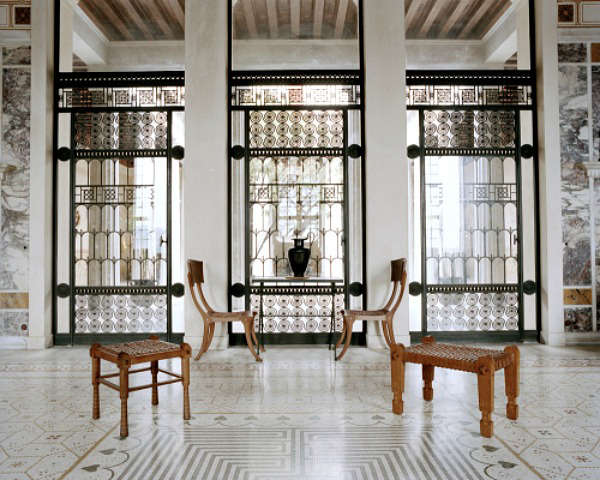

Some furniture simply fills a room. Virginia White’s furniture collection does something more interesting: it starts a conversation with the art, the architecture, and the slightly odd little objects that make a home feel human. In a design world where “timeless” is often used to describe beige sofas with commitment issues, White’s work has a firmer point of view. Her collection draws from Greek Klismos chairs, Georgian elegance, Regency drawing rooms, English craft, Pop color, and the quietly radical idea that furniture should live with art rather than compete against it.
The phrase “living with art” fits White’s design philosophy neatly. She is not treating furniture as background noise or as a showroom prop waiting for someone to remove the plastic. Her pieces are meant to sit beside paintings, ceramics, books, sculpture, rugs, family heirlooms, and the everyday evidence of life. A chair can be graceful and useful. A bench can nod to the fifth century BC without looking as if it escaped from a museum after closing time. A table can carry historical references and still hold a coffee cup, a stack of catalogs, or the remote control no one admits they lost.
Who Is Virginia White?
Virginia White is a London-based interior designer and the founder of the Virginia White Collection, a line that includes fabrics, wallpapers, and furniture. Her background helps explain the unusual intelligence of the collection. She studied Art History at the University of St Andrews, worked in the Antiquities Department at Sotheby’s, spent time with the Guggenheim in Venice and the Venice Biennale, and later studied Interior Design at Chelsea College of Art in London. She also trained under the celebrated interior designer John Stefanidis before establishing her own interior design and art consultancy.
That résumé matters because White’s furniture is not merely “inspired by history” in the decorative sense. It is informed by close looking. Her pieces show the eye of someone who has spent time around real objects: antiques, paintings, sculpture, textiles, and interiors that were assembled slowly rather than bought in one weekend with a panic cart and a measuring tape.
White’s interiors often begin with what she has called the anchors of a home: good furniture, good pictures, and good sculpture. That approach can sound almost old-fashioned, but in practice it feels refreshingly modern. Instead of chasing trends, she builds rooms around objects with presence. The result is layered, personal, and calm without becoming sleepy.
The Launch: A Furniture Collection Built Around Art
Virginia White’s first furniture collection was introduced through the idea of a “Living with Art” environment, a pop-up setting designed to feel like a home rather than a conventional showroom. That choice says a lot. Furniture often looks impressive when isolated under perfect lighting, but the real test is whether it can survive the company of other things: a bold painting, a cracked antique pot, a lamp with attitude, or a rug that has clearly seen several generations of shoes.
White’s collection was designed to pass that test. It includes Klismos-inspired seating, Regency and Georgian-influenced pieces, lacquered stools, sofas, benches, side tables, and playful sculptural designs. The overall effect is not one strict historical period but a cultured mix. Think classical bones, British craftsmanship, art-historical references, and just enough color to prevent the room from taking itself too seriously.
The Klismos Influence: Ancient Greece Meets Modern Comfort
The most recognizable thread in the collection is the Klismos form. The ancient Greek Klismos chair is known for its curved back, outward-sweeping legs, and elegant proportions. It appears in classical art and has influenced furniture designers for centuries. White’s interpretation does not simply copy the form; she refines it for contemporary rooms.
Her Klismos pieces include dining chairs, benches, slipper chairs, and a day bed. Many feature blackened or ebony-stained beechwood, leather strapping, oak options, upholstered seats, and traditional construction methods. The lines are slim and poised, but the pieces are not precious. They are made to be used. That is important because nothing ruins a beautiful room faster than a chair that looks stunning but feels like punishment after seven minutes.
The Klismos Day Bed and Klismos Bench are especially strong examples of White’s approach. They carry the silhouette of ancient design but work in modern settings: at the end of a bed, near a fireplace, along a hallway, or in a living room where extra seating is needed without visual heaviness. The leather-strapped seats bring a craft detail that feels tactile and architectural at once.
Villa Kerylos and the Romance of Classical Design
One of White’s major inspirations was Villa Kerylos in Cap Ferrat, a Greek Revival villa built in the early twentieth century. The villa’s interiors include furniture based on ancient Greek models, including Klismos forms. For a designer trained in art history and surrounded by antiquity from childhood, the attraction is easy to understand. Villa Kerylos is not just a pretty reference point; it is a lesson in how the past can be reconstructed, reinterpreted, and lived with.
White’s furniture takes that lesson and makes it lighter. Her pieces do not demand a villa, a marble colonnade, or a dramatic sea view. They can work in a city apartment, a country house, or a modern interior that needs an object with history in its posture. The magic is in the balance: classical inspiration without costume drama.
Georgian, Regency, and Irish Country House Notes
Alongside the Klismos designs, White’s furniture collection includes pieces influenced by eighteenth-century Georgian furniture and Irish country houses. The Temple House Sofa, Irish Sofa in Two Parts, Georgian Bench, Carrig Chair, and Irish Run Up Stool show this side of the collection. These pieces often feature slim legs, hand-stitched upholstery, deep buttoning, horsehair-filled seats, jute webbing, and antique-style bronze castors.
The appeal here is not nostalgia for formality. It is the refinement of proportion. Georgian-inspired furniture tends to understand scale, line, and restraint. White uses those qualities to create pieces that can anchor a room without shouting. A Temple House Sofa, for example, has enough structure to look elegant but enough comfort to avoid becoming the furniture equivalent of a stern aunt.
The Irish Sofa in Two Parts is especially practical because it offers flexibility. It can create a conversational arrangement, fit into more complex rooms, or provide modular seating without the chunky look of many modern sectionals. White’s corner armchairs and sofa-like arrangements also suit smaller homes, where furniture must earn its keep and preferably not block every pathway like a decorative road closure.
Materials That Tell a Story
White’s collection places strong emphasis on traditional materials and craft. The furniture is handmade in London and uses methods associated with fine upholstery and cabinetmaking. Horsehair filling, jute webbing, hand stitching, beechwood frames, oak finishes, leather strapping, bronze-style castors, lacquer, scagliola, marble, onyx, and hand-finished surfaces all appear across the range.
These details matter because they give the furniture physical depth. In a world full of flat-pack pieces that seem to develop emotional damage after one house move, construction quality is not a luxury detail; it is the difference between furniture that ages and furniture that merely deteriorates.
Horsehair upholstery, for instance, has long been used in traditional seating because it provides resilience and structure. Leather strapping connects White’s Klismos pieces to ancient seating techniques while adding a handsome graphic rhythm. Lacquer brings a high-gloss Pop quality to tables and stools, giving the collection a modern snap.
The Pop Side: Color, Lacquer, and Playfulness
White’s collection is not all classical restraint and polite Georgian manners. There is also a lively Pop influence, especially in pieces such as the Hexagonal Drum Table, Coral Table, Large Tray Top Table, Small Tray Top Table, and Black Lacquer Stools. These designs introduce saturated color, shiny finishes, sculptural bases, and a sense of fun.
The Hexagonal Drum Table is a smart example: compact, bold, colorful, and practical. It can be moved easily, used as a side table, and customized in different RAL colors. The Coral Table, designed with sculptural influence, turns a functional surface into something closer to an art object. Depending on its finish, it can feel coastal, surreal, glamorous, or slightly mischievousin the best possible way.
This mix of classical and Pop references keeps the collection from becoming too reverent. White understands that serious design does not have to be humorless. A room can include an antique-style chair, a modern artwork, a lacquered table, and a funny little object picked up while traveling. In fact, that is often when a room starts to breathe.
Kettle’s Yard and the Art of Harmonious Display
Another key influence on White’s design philosophy is Kettle’s Yard in Cambridge, the former home of Jim and Helen Ede. Kettle’s Yard is famous for arranging modern art, furniture, ceramics, textiles, and natural objects in a domestic setting. It is not a house where art hangs above life; it is a place where art and life are woven together.
White has often returned to this principle: furniture should be edited, objects should have breathing room, and beauty can come from the relationship between things. A chipped glass, a stone, a painting, and a chair can all belong in the same visual conversation if they are placed with care.
This is one reason her furniture works well in art-filled interiors. The pieces have enough character to hold their own, but they do not bully the artwork. They are strong supporting actors. Nobody wants a chair that walks into the room wearing jazz hands unless that is explicitly the plan.
Why the Collection Matters Now
White’s furniture collection feels especially relevant at a time when many homeowners are tired of interiors that look over-styled, over-matched, and under-lived-in. The current direction in interior design favors personality, layered rooms, meaningful objects, and furniture with longevity. People want homes that look collected rather than delivered by algorithm.
White’s work answers that desire with intelligence. Her furniture is rooted in history but not trapped by it. It values craftsmanship without becoming fussy. It is art-aware without turning a living room into a gallery where guests are afraid to sit down. The pieces suggest that a home can be cultured and comfortable at the same time.
How to Decorate with Virginia White’s Approach
Start with Anchors
Begin with the pieces that give the room structure: a sofa, a bench, a pair of chairs, a dining table, or a strong artwork. White’s philosophy favors substance first. Get the bones right before adding the decorative frills. This does not mean a room must be plain. It means the room needs a clear foundation before the fun begins.
Let Art Lead the Mood
If you own art, let it influence the room without forcing every cushion to match the painting. A large abstract work might call for simpler furniture lines. A traditional portrait might become more interesting beside a lacquered side table. The goal is dialogue, not costume coordination.
Mix Periods Without Apologizing
White’s collection shows that a Klismos chair, a Georgian bench, and a Pop-inspired table can coexist beautifully. The trick is proportion and editing. Avoid making every piece equally loud. Give the eye places to rest, then add one or two moments of surprise.
Use Plain Backdrops When Objects Are Strong
White has recommended plain walls and curtains when a room contains art and many objects. This is wise advice. A calm backdrop lets furniture, paintings, ceramics, and books provide the drama. White and off-white walls are not boring when the room is full of texture and character. They are the stage, not the whole performance.
Choose Furniture That Can Move
Castors, stools, small tables, benches, and modular seating make a room adaptable. This matters in real homes, where a living room may host reading, entertaining, working, board games, and the occasional dramatic search for phone chargers. Flexible furniture keeps the room alive.
Specific Pieces Worth Noticing
The Klismos Leather Dining Chair captures White’s classical inspiration most directly. With its curved form, leather strapping, and oak or ebony options, it brings elegance to a dining room without looking overly formal.
The Temple House Sofa is a strong anchor piece. Its Georgian inspiration, slim lines, hand-stitched upholstery, and traditional construction make it suitable for rooms that need refinement and comfort in equal measure.
The Georgian Bench is versatile and graceful. It can sit at the end of a bed, beneath a window, in front of a fireplace, or in an entryway. It is the sort of piece that quietly improves a room without demanding applause.
The Hexagonal Drum Table brings the collection’s Pop personality into focus. It is compact, colorful, practical, and a useful way to add energy to a more restrained interior.
The Coral Table works almost like sculpture. Its base, color possibilities, and tabletop options make it a design statement for rooms that need one brave note.
The Robin Side Table is a charming example of White’s ability to combine elegance and wit. Its slim legs, leather inset, and castors make it practical, while the bird-inspired detail gives it personality.
Living with Art: The Bigger Lesson
The best lesson from Virginia White’s furniture collection is not simply “buy better chairs,” although that is rarely bad advice. The larger lesson is to build rooms around meaning. A home becomes memorable when it contains objects that carry references, craft, memories, and visual pleasure.
Living with art does not require owning museum-level paintings or sculpture. It can mean arranging a drawing, a ceramic bowl, a family photograph, a stack of books, and a well-made chair so they feel connected. It can mean choosing a bench because its shape makes you happy every time you pass it. It can mean letting a room evolve rather than finishing it in one heroic shopping sprint.
White’s collection gives homeowners and designers a vocabulary for that kind of living. It says that furniture can be elegant, functional, historical, playful, and personal. It can honor the past without becoming stiff. It can support art without fading into beige obedience. Most importantly, it can help a house feel less like a display and more like a life.
of Experience: What It Feels Like to Live with Art and Furniture That Has Character
Living with art is different from decorating around art. Decorating around art can become a nervous exercise in matching colors: blue painting, blue pillow, blue vase, blue throw, blue existential crisis. Living with art is looser and more rewarding. It is about letting objects become part of the daily rhythm of a home. You notice a painting in morning light. You drop your bag on a bench that has beautiful legs. You move a small table closer to your chair because tea is not going to levitate across the room, no matter how refined the interior is.
A furniture collection like Virginia White’s encourages that kind of relationship because the pieces are not anonymous. They have references. A Klismos-inspired chair reminds you that design history is long, practical, and surprisingly stylish. A Georgian-style sofa suggests ceremony, but if it is properly made, it also invites actual sitting. A lacquered table adds a spark of color that can change the mood of a room faster than a fresh playlist.
In real homes, this matters. A living room should not feel frozen. The most appealing rooms are often the ones with a little tension: old beside new, curved beside straight, quiet beside bold, handmade beside polished. White’s collection works because it understands this balance. The furniture does not arrive as a matching set, and that is a blessing. Matching sets can make a room feel as if it was purchased by someone afraid of making a decision. A mix of pieces feels more confident.
Imagine a small apartment with plain white walls, a modern painting, and a pair of Klismos leather dining chairs pulled up to a round table. Add a low bookcase so the wall above can hold pictures. Place a lacquered drum table beside an armchair for a flash of color. Suddenly the room has shape and personality without feeling cluttered. Or picture a country house with a Temple House Sofa, an old rug, a Georgian bench near the fireplace, and a collection of ceramics on a simple shelf. The room becomes layered, comfortable, and quietly intelligent.
The real experience of living with art is that your eye keeps finding new relationships. A black chair leg echoes a picture frame. A coral-colored table picks up a small tone in a painting. The curve of a bench softens the hard line of a window. These details are not always obvious at first, but they make a room feel satisfying over time.
There is also emotional value in furniture that feels made rather than manufactured into forgetfulness. Handmade pieces carry evidence of decisions: the choice of wood, the curve of a leg, the firmness of upholstery, the finish of lacquer, the placement of a castor. Those choices create intimacy. You live not just with objects, but with someone’s eye, hand, and judgment.
Virginia White’s furniture collection reminds us that a beautiful home is not about perfection. It is about attention. It asks us to slow down, choose better, mix more bravely, and let art and furniture become companions. That may sound grand, but in daily life it is wonderfully simple: a good chair, a good picture, a good lamp, and a place to put your coffee. Civilization has been built on less.
Conclusion
Virginia White’s furniture collection is a thoughtful study in how historic forms can become fresh again when handled with intelligence, craft, and wit. From Klismos chairs and Georgian-inspired sofas to lacquered Pop tables and sculptural accents, the collection invites homeowners to think beyond trends. It is furniture for rooms with art, books, objects, conversation, and real life. In other words, it is furniture that knows how to behave beautifully without becoming boring.
Note: This article synthesizes publicly available information from reputable design, interiors, museum, and official collection sources. It is written as original editorial content for web publication.