I Documented How Women Protest The New Law That Bans Abortion In Poland (11 Pics)

Some protests begin with a speech. Others begin with a chant, a handmade sign, or the quiet decision to step into the street when staying home feels impossible. In Poland, after a 2020 Constitutional Tribunal ruling removed one of the country’s few remaining legal grounds for abortion, women and their supporters filled streets, squares, intersections, and city centers with a message that was hard to miss: reproductive rights are not a footnote.
This photo-essay style article looks at how women protested the new law that effectively banned abortion in Poland, why the demonstrations mattered, and what 11 powerful protest images can reveal about fear, anger, solidarity, and stubborn hope. The story is not only about law. It is also about faces in a crowd, red lightning-bolt symbols, traffic brought to a standstill, and people who seemed to say, “Fine, if you won’t listen politely, we brought signs.”
At the center of the protests was a simple truth: when a law changes the most intimate decisions in people’s lives, the response is rarely quiet. Poland’s abortion restrictions did not land in an empty room. They landed in a society already debating church influence, women’s autonomy, judicial independence, public health, and the meaning of democracy. The streets became the country’s loudest comment sectionand unlike the internet, everyone had to wear shoes.
What Happened in Poland?
Poland already had one of the most restrictive abortion laws in Europe before the 2020 ruling. Until then, abortion was legally permitted in limited situations: when the pregnancy resulted from rape or incest, when the pregnant person’s life or health was at risk, or when severe fetal abnormalities were diagnosed. The Constitutional Tribunal ruling removed the fetal abnormality ground, which had accounted for the overwhelming majority of legal abortions performed in the country.
When the ruling took effect in early 2021, abortion became legal only in cases of rape, incest, or danger to the pregnant person’s life or health. In practice, activists and human-rights organizations argued that even those remaining exceptions could be difficult to access because doctors and hospitals feared legal consequences. That uncertainty became one of the protest movement’s central concerns: a law does not need to shout to scare people; sometimes it only needs to be vague enough that everyone starts whispering.
The decision sparked mass demonstrations across Poland. Protesters gathered in Warsaw, Kraków, Wrocław, Gdańsk, Szczecin, and many smaller towns. The movement was widely associated with Ogólnopolski Strajk Kobiet, or All-Poland Women’s Strike, a grassroots network that had already organized against earlier attempts to tighten abortion laws. Its red lightning-bolt symbol became one of the most recognizable signs of resistance.
Why These 11 Protest Photos Matter
Photographs of protest are not just records of where people stood. They capture posture, tension, emotion, and the small human details that written summaries often miss. A photograph can show a young woman holding a sign with tired eyes. It can show a grandmother wrapped in a scarf, standing in cold weather because she has seen enough history to know silence has a price. It can show a street blocked by bodies, bicycles, banners, and the kind of collective stubbornness that makes traffic apps lose their will to live.
The 11 images connected to this story are not merely “pictures of a protest.” They are pieces of a civic mood. They show how Polish women and allies turned public space into a stage, a courtroom, a memorial, and sometimes a comedy club with extremely sharp punchlines. The signs were often angry, witty, raw, and impossible to mistake for a polite suggestion box.
1. The Face of Refusal
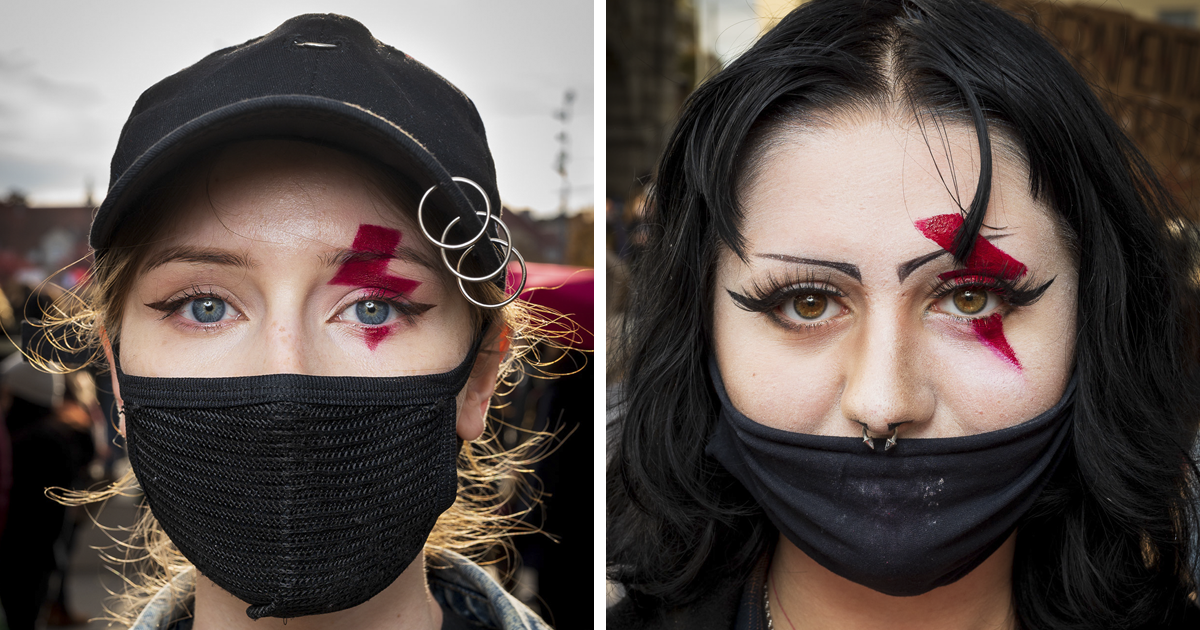
The first kind of image that stands out is the close-up portrait: a protester looking directly into the camera, surrounded by noise but visually still. These portraits matter because they turn a national issue into a human one. The law may be written in formal language, but the people affected by it have names, faces, families, plans, fears, and morning coffee preferences like everyone else.
2. The Red Lightning Bolt
The red lightning bolt became a visual shorthand for the Women’s Strike. It appeared on masks, posters, jackets, windows, and social media graphics. As protest symbols go, it was efficient: small enough to draw quickly, bold enough to recognize from a distance, and dramatic enough to look like the weather forecast had joined the opposition.
3. Streets Turned Into Statements
Many protests involved blocking roads or gathering in major intersections. This was not random inconvenience for the sake of being annoying, although commuters may have had opinions. Blocking traffic transformed ordinary city infrastructure into a political message. The point was clear: if the law interrupts women’s lives, women can interrupt the city.
4. Handmade Signs With Sharp Edges
Some of the most memorable protest images show handmade signs. These signs often mixed anger with humor, using short slogans, sarcasm, and direct language. That mix is powerful because humor can keep people going when the subject itself is heavy. A good protest sign is basically a tweet that learned carpentry.
5. Masks, Scarves, and Pandemic-Era Protest
The demonstrations took place during the COVID-19 pandemic, which made public gatherings more complicated and emotionally charged. Protesters wore masks, not only for safety but also as part of the visual language of the moment. The images show people balancing public health concerns with the urgency of public dissent.
6. Young Women at the Front
Many photos from the protests highlight young women standing at the front of marches, chanting, raising signs, or facing police lines. Their presence challenged a familiar stereotype that young people are politically passive. In these images, they are not background characters. They are organizers, witnesses, and narrators of their own future.
7. Men as Allies, Not Main Characters
The protests also included male allies. In the strongest images, men appear not as rescuers but as supportersstanding beside women, carrying signs, joining chants, and recognizing that reproductive rights affect entire communities. A protest movement does not need everyone to take the microphone; sometimes the most useful thing is to hold the banner straight.
8. Intergenerational Anger
Some protest images show older women and younger women marching together. That intergenerational presence matters. It suggests that the issue was not only about one age group or one political trend. It was about memory, progress, and the fear that rights can move backward if people assume they are permanent.
9. The City as a Backdrop
Polish cities gave the protests a powerful visual setting: apartment blocks, church facades, government buildings, crosswalks, tram lines, and old streets filled with new signs. The contrast made the images stronger. They showed that the fight was happening not in theory but in familiar places where people shop for groceries, meet friends, and wait for buses that are now delayed because democracy is having a moment.
10. Anger Without Apology
One of the most striking features of the movement was its refusal to soften its language for comfort. Protesters were angry, and many did not try to make that anger cute. The images reflect a broader cultural shift: women demanding not only rights but also the freedom to be furious when those rights are threatened.
11. Hope in the Crowd
Despite the seriousness of the issue, many protest photographs carry a strange kind of hope. It appears in the way people stand together, in the glow of phone screens, in the repetition of symbols, and in the knowledge that thousands of strangers have shown up for the same reason. Hope does not always look soft. Sometimes it looks like cold hands gripping cardboard.
The Power of Women’s Strike in Poland
The Women’s Strike protests were about abortion access, but they also became about much more: the role of courts, the influence of the Catholic Church in politics, the power of conservative parties, police response to demonstrations, and the place of women in public life. That is why the protests resonated beyond Poland’s borders.
For many observers, the demonstrations represented a wider struggle over democracy and bodily autonomy. Poland’s ruling sparked criticism from international human-rights groups, European institutions, and reproductive-rights advocates. But inside Poland, the movement’s power came from something more immediate: people felt personally affected. When politics enters the doctor’s office, the family conversation, and the private fear of medical crisis, it stops feeling abstract.
The protests also showed how quickly visual identity can unite a movement. The red lightning bolt, black clothing, posters, and repeated slogans created a shared language. Someone could look across a square and immediately understand who was there and why. In modern protest culture, visibility is not decoration. It is strategy.
How Protest Photography Changes the Story
Words explain a protest. Photographs make people feel its temperature. A written report can say thousands marched, but a photograph shows how close they stood, how their breath fogged in cold air, how signs bent in the wind, and how a single person’s expression can carry exhaustion and determination at the same time.
Documenting protests also comes with responsibility. A photographer must decide when to step closer and when to step back. Some protesters want to be seen; others may risk harassment, arrest, or online abuse if their faces are identifiable. Strong protest photography respects the people it captures. It does not treat them like props in a dramatic news painting. It recognizes that each person in the frame has a life outside the frame.
The best images from Poland’s abortion-ban protests do not sensationalize women’s anger. They honor it. They show anger as civic participation, as moral clarity, and as a refusal to let official language erase lived experience.
Why the Protests Still Matter Today
Although Poland’s government changed after the 2023 parliamentary election, abortion reform has remained politically difficult. Lawmakers have debated liberalization and decriminalization proposals, while legal and institutional obstacles have continued. In 2024, Polish parliament moved some reform proposals forward, but another bill seeking to decriminalize abortion assistance was narrowly rejected. By 2026, abortion remained highly restricted in law, even as authorities took some steps to clarify access to legal procedures and address hospital refusals.
That ongoing tension is one reason the protest images remain relevant. They are not museum pieces from a finished argument. They are part of a continuing story about law, medicine, politics, and public pressure. The women in the photographs were not only reacting to one court decision. They were building a visual archive of resistance.
Field Notes: Experiences Related to Documenting Women’s Protests in Poland
Documenting a protest like this requires more than a camera and comfortable shoes, though comfortable shoes deserve their own medal. The experience is emotional, unpredictable, and full of tiny decisions. Where do you stand? Whose face do you photograph? Do you capture the biggest crowd or the quietest person? Do you focus on the banner, the police line, the woman crying, the friend holding her hand, or the handmade sign that somehow manages to be both furious and funny?
One of the strongest experiences connected to this topic is the feeling of being surrounded by ordinary people doing something extraordinary. Many protesters do not look like professional activists. They look like students, office workers, parents, artists, nurses, teachers, neighbors, and people who probably had laundry waiting at home. That ordinariness is exactly what makes the scene powerful. A protest is not a movie set. It is real life refusing to continue as usual.
In a women-led protest, the emotional rhythm can shift quickly. One moment, the crowd is chanting with such force that the street seems to vibrate. The next, someone is standing silently with a sign pressed against their chest. Then laughter breaks out because somebody’s poster has delivered a joke sharp enough to cut through the cold. That mix of grief, humor, rage, and solidarity is difficult to capture, but it is the heart of the story.
Another experience is noticing how protest signs become personal diaries in public form. Some signs make legal arguments. Others make moral arguments. Some are blunt. Some are poetic. Some are clearly made five minutes before leaving the house, with markers that were not emotionally prepared for this level of responsibility. Yet each sign says, “I needed to be here badly enough to write this down and carry it through the city.”
There is also the experience of watching public space change meaning. A crosswalk becomes a stage. A traffic circle becomes a meeting point. A government building becomes a backdrop for anger. A church wall becomes part of a national argument about power and conscience. Streets are usually designed to move people along. During protests, they ask people to stop and look.
For a photographer, the hardest part is avoiding the temptation to reduce everything to drama. Protest is dramatic, yes, but it is also made of care. People share water, adjust each other’s masks, translate slogans for foreigners, check whether strangers are okay, and help someone climb onto a ledge for a better view. These small gestures matter because they show the movement’s social fabric. Resistance is not only the loud chant. It is also the person saying, “Here, take my extra gloves.”
Documenting women protesting Poland’s abortion restrictions ultimately means documenting a society arguing with itself in public. It means seeing how law travels from courtrooms into bodies, families, hospitals, and streets. It means understanding that an image of one woman holding one sign can carry the weight of thousands who feel the same way but could not be there. And it means recognizing that photography, at its best, does not speak over protesters. It helps make sure they are not ignored.
Conclusion
The protests against Poland’s near-total abortion ban were not just a reaction to a legal ruling. They were a nationwide expression of frustration, grief, courage, and defiance. Through 11 protest images, we can see how women and allies transformed public space into a visual argument for bodily autonomy and democratic accountability.
The story remains important because the debate is not over. Poland’s abortion laws continue to shape medical decisions, political promises, and public trust. Yet the images of women marching, chanting, laughing, grieving, and refusing to disappear show something that no court ruling can easily erase: when people believe their rights are being taken away, they often find new ways to be seen.