
Editor’s note: This original article is written for web publishing and is based on publicly available information about Selvaggia Armani’s design practice, her Trento duplex, Italian contemporary craft, and the architectural character of Trento, Italy.
A Trento Home Where Architecture Wears a Smile
Some homes whisper. Some homes shout. Selvaggia Armani’s duplex in Trento, Italy, does something far more charming: it sketches a thought bubble above your head and fills it with black lines, white space, a dash of yellow, and one mischievous wink. This is not the kind of interior that begs visitors to remove their shoes and speak in museum voices. It is considered, yes. Precise, absolutely. But it also has the rare confidence to be playful without turning into a design circus.
The title “Architect Visit: Selvaggia Armani in Trento, Italy” points to a residence that feels like a self-portrait in three dimensions. Armani is an architect by training, a textile designer by practice, and a painter by instinct. Her work moves naturally between architecture, graphic art, hand-painted surfaces, fashion accessories, lighting, and 3D-printed objects. In her home, these disciplines do not sit in separate rooms like awkward relatives at a wedding. They mingle. They borrow each other’s chairs. They probably share espresso.
Located in Trento, a city where Alpine atmosphere meets Renaissance facades, the duplex reflects the same duality: rigorous structure softened by human gesture. The palette is famously restrainedblack, white, pale yellow, glossy concrete, stainless steelbut the spirit is anything but cold. Armani’s hand is everywhere: in artwork, in lettering, in textile sensibility, and in the way each room seems to understand that minimalism should never mean personality has been sent to storage.
Who Is Selvaggia Armani?
Selvaggia Armani was born in Trento in 1968 and studied architecture at the Politecnico di Milano, graduating in 1994 with a thesis related to new exhibition spaces in museums. That background matters. A museum designer learns how people move, how objects are framed, how blankness can make a single gesture feel louder. Armani’s interiors and objects often carry that same gallery-like clarity, but with a livelier pulse.
During her university years, she also explored graphic arts and illustration, including studies at the European Institute of Design in Milan. This combinationarchitecture plus illustrationis the secret sauce. Architecture gives her discipline; drawing gives her nerve. The result is a body of work that treats surfaces as opportunities rather than boundaries.
Since the late 1990s, Armani has designed and produced home textiles, informal clothing, and accessories. Her work expanded into painted fabrics, linen, cotton, jersey, embroidery, ceramics, leather, lighting, and jewelry. She has collaborated with companies such as .exnovo and .bijouets, using 3D printing to create lamps, home accessories, and jewelry. She has also worked with Edelman Leather, painting hides, furniture, and accessories. In other words, she is not a designer who politely stays in her lane. She repaves the lane, paints it by hand, and turns the traffic cones into jewelry.
Inside the Trento Duplex: Black, White, and a Little Theatrical Mischief
The most memorable aspect of Selvaggia Armani’s Trento home is its disciplined black-and-white language. Black and white can easily become stiff, especially in interiors that confuse “minimal” with “please do not touch anything.” Here, the contrast works differently. It behaves like ink on paper: graphic, crisp, expressive, and ready for improvisation.
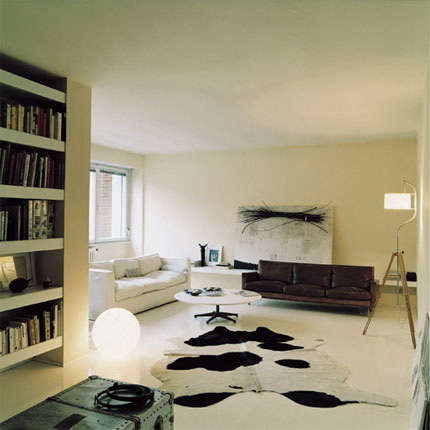
The living room includes pale yellow walls and high-gloss white concrete floors, a pairing that feels both warm and polished. The floor gives the room a modern, almost gallery-like brightness. The yellow keeps it from turning icy. A collage painting by Armani adds a personal anchor, reminding visitors that this is not a showroom assembled by algorithm. It is a working creative’s home, where art is not decoration after the fact but part of the architecture’s conversation.
In the kitchen, stainless steel suspension lighting designed by Armani’s husband, architect Massimo Deutsch, takes inspiration from billiard room fixtures. That reference is telling. A billiard lamp is functional, directional, and social. It illuminates action. In a kitchen, that logic makes sense: food is prepared, conversations happen, guests hover, and someone inevitably says, “I’ll just have a small piece,” before returning for a second slice.
The bathroom is another moment where Armani’s hand becomes unmistakable. Hand lettering appears as decoration, turning the space into something closer to a page, a note, or a private graphic installation. Many bathrooms are designed to disappear into neutrality. This one has handwriting. It has mood. It knows the mirror is not the only thing worth looking at.
Why the Home Works: Discipline First, Whimsy Second
The reason this interior succeeds is balance. Armani does not begin with whimsy and hope structure will arrive later wearing a cape. She starts with order: a limited palette, clear materials, strong contrasts, and disciplined spatial thinking. Then she introduces surprise. The result is lively, not chaotic.
1. The Palette Creates Calm
Black and white are not merely colors here; they are the grammar of the home. They organize the eye. They create rhythm. They allow small gesturesa pale wall, a hand-drawn word, a stainless fixture, a textile textureto stand out without shouting across the room like a chair auditioning for Broadway.
2. The Surfaces Invite Art
Because Armani’s practice includes painting and textiles, the surfaces of the home feel active. Walls, floors, furniture, and objects are not treated as passive backdrops. They are participants. This is an important lesson for anyone interested in Italian interior design: personality does not have to come from clutter. It can come from touch, line, texture, proportion, and one brave graphic decision.
3. The Home Reflects a Real Creative Life
There is a difference between a styled interior and a lived creative environment. A styled interior often looks complete in a photograph but slightly nervous in real life. Armani’s duplex feels like a home that can absorb ongoing work. It has room for making, testing, painting, hosting, and thinking. It is polished, but not precious. That is a difficult trick, and it deserves applausepreferably quiet applause, because the acoustics of glossy concrete can be enthusiastic.
Trento: The Perfect Backdrop for Armani’s Design Language
To understand the apartment, it helps to understand Trento. The city sits in northern Italy in the Adige Valley, surrounded by mountains and shaped by layers of Roman, medieval, Renaissance, and modern history. It is not Rome with its cinematic chaos, nor Milan with its fashion-week velocity. Trento has a more measured rhythm: frescoed facades, arcades, stone streets, Alpine air, and a sense that history is present but not pushy.
The city’s architectural landscape includes the Romanesque-Gothic Cathedral of San Vigilio, the Renaissance Church of Santa Maria Maggiore, and the Castello del Buonconsiglio, a major castle complex that served for centuries as the residence of the prince-bishops of Trento. These landmarks give the city a strong historical backbone. Even a contemporary interior in Trento has to respond, consciously or not, to a place where stone, fresco, civic ritual, and mountain light have been collaborating for centuries.
At the same time, Trento is not frozen in postcard mode. The MUSE science museum and the Le Albere district, designed by Renzo Piano Building Workshop, brought major contemporary architecture into the city’s fabric. Built on a former industrial area near the Adige River, Le Albere reconnects Trento with its landscape and demonstrates how modern design can respect scale, sustainability, and civic life. This is the broader environment in which Armani’s work makes sense: a city where old and new do not have to duel dramatically at sunset. They can, when handled well, share the table.
Italian Minimalism, But Make It Human
The phrase “Italian minimalism” can sound like an expensive sofa staring at you judgmentally. Armani’s version is more generous. Her Trento duplex shows that minimalism can be warm, witty, and handmade. It can include shine without becoming flashy. It can use white without becoming sterile. It can use black without becoming severe. It can even use lettering in the bathroom without feeling like a café menu wandered into the wrong room.
This is especially relevant for homeowners and designers who love clean spaces but fear they will end up with rooms that resemble an art gallery after closing time. Armani’s home offers a better path: reduce the palette, not the emotion. Simplify the materials, not the story. Choose fewer objects, but make sure they have presence.
The duplex also shows the value of cross-disciplinary design. Armani’s architectural training gives the home its bones. Her textile work brings softness and pattern intelligence. Her painting adds spontaneity. Her interest in 3D printing and object design connects the home to contemporary craft and technology. This blend is increasingly important in modern interiors, where the most memorable spaces often come from designers who can think across scalesfrom room layout to lamp detail, from floor finish to the curve of a bracelet.
Design Lessons from Selvaggia Armani’s Trento Home
Use Contrast as Structure
Black and white are not just decorative choices. In Armani’s duplex, contrast organizes space. It frames views, sharpens edges, and makes the interior feel intentional. For your own home, this does not mean painting everything black and white and hoping your toaster becomes architectural. It means choosing a clear visual system and letting it guide decisions.
Let One Handmade Detail Change the Room
A hand-lettered wall, a painted textile, or a custom artwork can transform a restrained room. The key is restraint around it. Armani’s home gives handmade gestures room to breathe. That is why they feel poetic instead of busy.
Mix Industrial Materials with Personal Marks
Glossy concrete, stainless steel, and clean-lined furniture can look hard on their own. Armani softens them through art, color, lettering, and textile thinking. This mix prevents the interior from becoming too mechanical. The lesson: when using industrial materials, add something unmistakably human.
Design for Real Life, Not Just the Photograph
The best interiors survive daily use. Armani’s duplex feels designed for living, working, and experimenting. It is elegant, but it does not seem terrified of a coffee cup. That may be the highest compliment a home can receive.
The Role of Craft and Technology in Armani’s Work
Selvaggia Armani’s career is particularly interesting because it does not treat craft and technology as enemies. Her collaborations with .exnovo and .bijouets explored 3D printing for lighting, objects, and jewelry. This technology makes it possible to create forms that would be difficult or impossible with traditional techniques. Yet Armani’s work often retains hand-finished, hand-painted, or materially expressive qualities.
This combination is very much in tune with the future of design. The strongest contemporary craft is not afraid of machines. It asks better questions of them. What can digital fabrication do that handwork cannot? What can handwork add that machines cannot fake? Armani’s practice lives in that productive middle space, where the computer may shape the form, but the human hand gives it character.
Her work with leather follows the same logic. Painted hides and accessories bring a graphic, artistic layer to a material often associated with luxury and durability. Rather than treating leather as a neutral surface, Armani turns it into a canvas. The result feels personal, tactile, and slightly rebellious in the best way.
Why This Architect Visit Still Feels Fresh
Although the original visit to Selvaggia Armani’s Trento duplex appeared years ago, the home has aged well as an idea. That is because it does not rely on a trend checklist. There is no desperate chase for the color of the year, no decorative gimmick begging for attention, no furniture arrangement that looks good only if nobody owns keys, books, or snacks.
Instead, the duplex is built around principles that remain useful: clarity, contrast, personal authorship, material intelligence, and humor. These qualities do not expire. They are the design equivalent of a good white shirt: adaptable, enduring, and better when worn by someone with personality.
The home is also a reminder that small acts can have large visual impact. A room does not need twenty statement pieces. Sometimes it needs one strong light fixture, one painted surface, one carefully chosen color, or one piece of art that makes the architecture feel awake.
Experiences Inspired by “Architect Visit: Selvaggia Armani in Trento, Italy”
Visiting Trento with Selvaggia Armani’s design language in mind changes the way you see the city. You begin to notice contrast everywhere: dark arcades against pale facades, mountain shadows against sunlit piazzas, old stone beside contemporary glass. The city becomes a lesson in layered composition. It is not loud, but it is deeply visual. A walk through Trento feels like moving through a sketchbook where every page has been edited carefully but not overworked.
Start in the historic center, where Piazza Duomo offers one of the clearest introductions to Trento’s personality. The cathedral, fountain, frescoed buildings, and surrounding streets create a civic room at urban scale. For anyone interested in architecture, this is the kind of place that teaches proportion without announcing the lesson. You see how public space works when buildings define edges, when stone holds memory, and when people are allowed to become part of the composition. Add a cappuccino and suddenly urban planning feels much more approachable.
From there, the Castello del Buonconsiglio provides a deeper historical counterpoint. Its walls, towers, courtyards, and frescoed rooms show how architecture can accumulate time. This is not minimalism; it is density, symbolism, and power. Yet seeing it helps explain why Armani’s home feels so controlled. In a city with such historical richness, a contemporary interior may need restraint to create breathing room. The duplex’s black-and-white clarity becomes a modern response to Trento’s ornate memory.
A visit to MUSE and the Le Albere district adds another layer. Renzo Piano’s architecture brings mountain forms, glass, water, sustainability, and urban renewal into conversation. After experiencing the historic core, Le Albere feels like Trento looking forward without abandoning its sense of place. It also makes Armani’s interest in technology and craft feel local rather than random. Trento is not only a picturesque Alpine city; it is also a place where research, design, fabrication, and environmental thinking matter.
For design lovers, the most rewarding experience is to borrow Armani’s way of looking. Notice lettering on signs, shadows under balconies, the rhythm of windows, the texture of plaster, the gloss of a café counter, the line of a chair in a quiet corner. Imagine how these details could become textiles, lamps, ceramics, or hand-painted leather. That is the real lesson of the architect visit: a home is not created only by buying beautiful things. It is created by paying attention.
Travelers often leave Italian cities with photos of monuments. Trento encourages something subtler: memory of atmosphere. The coolness of stone streets in the morning. The way mountains appear at the end of an urban view. The pleasure of finding modern architecture a short walk from Renaissance facades. The feeling that design does not have to choose between seriousness and charm. Selvaggia Armani’s duplex captures that same feeling. It is thoughtful, graphic, disciplined, and unexpectedly funlike Trento itself wearing excellent black glasses and telling a very dry joke.
Conclusion: A Home That Draws Its Own Rules
Selvaggia Armani’s Trento duplex is memorable because it refuses to separate architecture from art, craft from technology, or minimalism from humor. It is a home shaped by discipline but animated by the hand. The black-and-white palette gives it structure; the paintings, lettering, textiles, and custom objects give it soul. In the context of Trentoa city of Roman traces, Renaissance surfaces, Alpine light, and contemporary designthe duplex feels both rooted and inventive.
For anyone searching for Italian interior design inspiration, this architect visit offers a refreshing lesson: you do not need more stuff to create a richer home. You need stronger ideas, better contrast, meaningful materials, and at least one detail that makes visitors smile before they can explain why.