
Note: This article is written for web publishing in original wording, based on verified 2025 reporting, official episode descriptions, and public reaction around South Park Seasons 27 and 28.
In 2025, South Park did what South Park has always promised to do: walk directly into the cultural thunderstorm carrying a metal rake and a suspicious grin. After a long gap between traditional episodes, Trey Parker and Matt Stone returned with a season that turned Donald Trump into one of the year’s most outrageous recurring characters. The result was not simply another round of political jokes. It became a full comic arc involving Satan, Jesus, corporate media panic, Paramount, streaming wars, deepfake absurdity, tariff jokes, culture-war exhaustion, and enough anatomy humor to make middle schoolers feel intellectually overqualified.
The big question is not whether South Park mocked Trump in 2025. It very much did. The better question is which Trump jokes actually worked, which ones became instant modern South Park chaos, and which ones started to feel like the show was leaning on the same squeaky rubber chicken until even the chicken asked for union representation.
Below is a careful look at the best and worst Trump jokes on South Park in 2025, with context, examples, and analysis of why some gags landed like precision satire while others landed like a snowball thrown by Cartman after eating too many cheesy poofs.
Why Trump Became South Park’s Main Character Again
The 2025 run began with “Sermon on the ’Mount,” the Season 27 premiere that aired on July 23, 2025. Official episode listings described the story as one where South Park residents, frustrated by the president’s policies and actions, make a bold statement, while Jesus returns with advice as the town faces ruin. That polite description is technically accurate in the way “a raccoon entered the kitchen” is technically accurate when the raccoon has started a small business in your pantry.
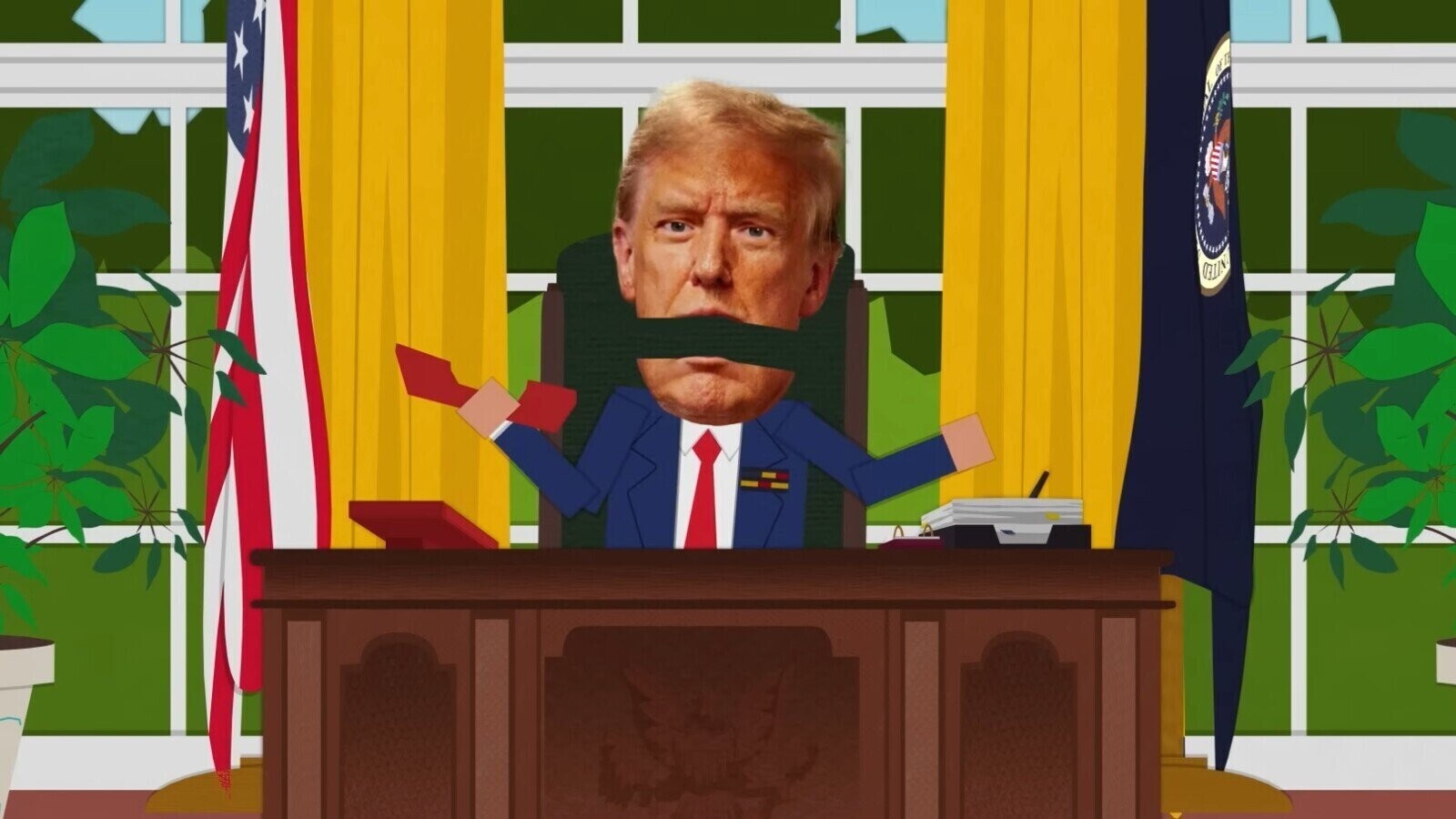
The episode took aim at Trump, Paramount, CBS, the cancellation of The Late Show With Stephen Colbert, the settlement between Paramount and Trump, religion in schools, and the broader fear that corporations might fold under political pressure. It also featured a version of Trump in bed with Satan, a shocking deepfake-style public-service-announcement parody, and a running gag about Trump suing anyone who opposed him.
The reaction was immediate. The White House criticized the show, while Parker’s Comic-Con response “We’re terribly sorry” became its own punchline. The premiere’s controversy helped drive huge interest, with reports putting its first three days of cross-platform viewership near 5.9 million. In other words, the official position that the show was irrelevant arrived at roughly the same time millions of people proved the opposite by watching it.
The Best Trump Joke: Trump And Satan As A Toxic Political Romance
The strongest Trump joke of 2025 was not a single line. It was the season-long decision to frame Trump’s power as a grotesque relationship with Satan. On paper, that sounds like the laziest bumper sticker in the parking lot: “Politician I dislike equals devil.” But South Park made it sharper by turning the metaphor into a domestic farce.
Trump is not just “evil” in the joke. He is needy, vain, manipulative, lawsuit-happy, and emotionally exhausting. Satan, one of the show’s long-running supernatural characters, becomes trapped in a relationship that is somehow both apocalyptic and embarrassingly mundane. That is where the joke works best. Instead of merely yelling, “Trump bad,” the show turns power into a bedroom melodrama, then makes the melodrama progressively more ridiculous.
By the time Season 28 continued the storyline with Satan’s pregnancy and the possibility of an Antichrist child, the bit had evolved from shock gag to serialized comic engine. “Twisted Christian” pushed the idea through religious panic and tech-billionaire prophecy satire. “Conflict of Interest” kept Trump and Satan preparing for the baby while the kids dealt with prediction-market chaos. “The Crap Out,” the December finale, brought the arc to a darkly absurd conclusion involving Satan’s due date, Jesus, Stan, and a Christmas-miracle structure.
Why It Worked
The Trump-Satan relationship worked because it combined several classic South Park strengths: outrageous visual escalation, current-event speed, and a childish premise hiding adult analysis. The joke was not subtle, but subtlety has never been the show’s house wine. Its real insight was that 2025 politics felt less like ideology and more like reality television with legal filings, religious branding, and streaming rights attached.
In that sense, Satan became the perfect comic partner. He is morally compromised enough to be in the room, but emotionally normal enough to look exhausted by Trump. That reversal gave the show one of its funniest angles: when Satan starts to look like the reasonable person in the relationship, the satire has already kicked the door off its hinges.
The Runner-Up Best Joke: The Paramount And CBS Meta-Jokes
The second-best Trump joke was really a corporate-media joke wearing a Trump mask. South Park made the president’s lawsuit culture part of a larger story about fear, ownership, and entertainment companies trying not to anger powerful people. The show’s own parent-company situation made the satire feel especially dangerous. It was not just punching outward; it was also poking the people who sign the checks.
That is vintage Parker and Stone. The funniest part of “Sermon on the ’Mount” was not only that Trump sues the town. It was that everyone in South Park begins calculating what can and cannot be said because of corporate consequences. Jesus showing up as part of a larger social and political bargain turned the episode into a satire of institutional cowardice, not just one politician.
In 2025, that meta-layer made the Trump jokes feel bigger than Trump. The subject became the entire ecosystem around him: networks, settlements, executives, political pressure, late-night television, streaming platforms, public-relations statements, and audiences who want comedy to be fearless until it makes their side uncomfortable.
The Best Simple Gag: Cartman Realizing He Is No Longer The Worst Person In The Room
One of the sneakiest jokes of the 2025 run was Cartman’s crisis. For decades, Eric Cartman has functioned as a tiny, round, manipulative hate machine. Then the world around him becomes so loud, so shameless, and so extreme that Cartman starts to lose his brand identity. It is like watching a supervillain discover that the city council has legalized volcano lairs.
This worked beautifully as a Trump-adjacent joke because it avoided simple imitation. Instead of making Trump say something outrageous, the show asked what happens to South Park when outrageousness becomes ordinary politics. Cartman’s panic over “woke” being dead is funny because he is not having a moral awakening. He is upset that his special talent for being horrible has been devalued by inflation.
That is more clever than another impersonation. It uses Trump-era politics to change the emotional temperature of the town. The joke also respects the show’s history: Cartman remains awful, but the world has caught up with him in ways even he finds professionally insulting.
The Best Topical Joke: Tariffs Meet Labubu Madness
“Wok Is Dead,” the fourth episode of Season 27, found a surprisingly effective way to connect Trump’s tariff politics with the 2025 Labubu craze. Butters needing to buy a trendy doll for his girlfriend’s birthday may sound like a low-stakes schoolyard plot, which is exactly why it works. South Park has always been strongest when enormous national issues crash into children’s dumb little problems.
The tariff joke worked because it translated economic policy into the language of playground desperation. Butters does not care about trade theory. He cares about getting the toy, surviving social expectations, and not disappointing someone. That smallness gives the satire texture. Instead of writing a lecture about tariffs, the show makes a child suffer through the practical weirdness of a consumer fad colliding with political decision-making.
That is smart satire: take the abstract and make it stupidly specific.
The Worst Trump Joke: Repeating The Anatomy Bit Too Often
The weakest Trump joke of 2025 was the repeated anatomy gag. In the premiere, the explicit deepfake-style PSA parody was shocking, technically memorable, and designed to provoke. It worked once because it arrived at the end of an episode already loaded with corporate satire, legal satire, religious satire, and political panic. The crudeness had a purpose: it turned Trump’s image management into a ridiculous visual meltdown.
But later repetitions did not always add much. After the initial shock, additional references to Trump’s body sometimes felt like the show was hitting the same button because it knew the button made noise. To be fair, South Park has never been allergic to juvenile humor. This is a series that built an empire partly on fart jokes, talking towels, and children saying things that would get a substitute teacher transferred to another district.
Still, juvenile humor works best when it reveals something. The first Trump anatomy joke revealed vanity, insecurity, media control, and the absurdity of political image-making. Repeating the same basic idea risked turning satire into playground chanting. Funny playground chanting, sure, but still chanting.
Why It Got Old
The problem was not that the joke was offensive. Offense is practically the show’s gym membership. The problem was that the joke became predictable. Once viewers understood the target, the rhythm, and the punchline, the surprise drained away. A shocking joke without surprise is just a loud object sitting in the room.
By late 2025, the show’s richer Trump material involved power, media submission, religious branding, tech panic, and political celebrity. Compared with those layers, another body-size joke felt like a microwave burrito next to a full holiday dinner: technically edible, but not the reason anyone came over.
The Most Divisive Joke: Trump, J.D. Vance, And The White House Bedroom Farce
Season 28’s later episodes pushed Trump’s relationships into even more outrageous territory, including a provocative J.D. Vance storyline connected to AI, fake videos, and political denial. This material was divisive because it combined two of the season’s biggest concerns: sexual humiliation and the collapse of truth in a deepfake world.
The idea was not merely that politicians could be caught in a scandal. It was that, in 2025, any image could be denied as fake and any fake could become politically useful. That made the Vance material more interesting than it first appeared. Under the graphic absurdity was a serious point about how public reality becomes negotiable when everyone can blame artificial intelligence, hostile media, or partisan editing.
Did every second of the gag need to last as long as it did? Probably not. But as a satire of “nothing is real unless my team says it is,” the joke had bite.
The Darkest Joke: “The Crap Out” And The End Of The Baby Arc
The Season 28 finale, “The Crap Out,” brought the Trump-Satan baby storyline to a bleak close. Official descriptions framed the episode around Satan’s due date, Stan’s prayers, and the need for a Christmas miracle. Reports and recaps noted that the episode revealed a grim fate for the unborn Antichrist, leaving Satan devastated while Trump reacted with relief and celebration.
This was among the darkest jokes of the year, and it divided viewers for obvious reasons. Some saw it as a brutal extension of the show’s apocalyptic political satire. Others found it anticlimactic or simply too bleak. The best reading is that South Park used the ending to show Trump escaping consequences yet again, while someone else absorbs the emotional damage. That is not exactly cheerful comedy, unless your holiday tradition includes eggnog and existential dread.
Still, the finale did what finales should do: it closed the arc, reset part of the show’s world, and left viewers arguing. For South Park, that counts as a clean landing, even if the runway was made of dynamite.
What South Park Got Right About Trump Comedy In 2025
The best Trump jokes on South Park in 2025 worked because they were not really about impersonation. They were about systems. The show mocked how corporations respond to pressure, how political identity becomes entertainment, how religion can be used as branding, how lawsuits can chill speech, and how audiences react when comedy attacks their preferred team.
That is why the Paramount and CBS jokes felt so alive. They placed Trump inside the machinery of modern media. The president was not floating in a vacuum. He was connected to executives, lawsuits, streaming platforms, late-night hosts, press statements, and public outrage cycles. That made the satire feel less like a sketch and more like a map of how power moves through pop culture.
What South Park Got Wrong About Trump Comedy In 2025
The weaker jokes leaned too heavily on humiliation for its own sake. South Park can absolutely do gross-out humor, and often brilliantly. But political comedy becomes thinner when the punchline is only, “Look, this person is physically embarrassing.” That kind of joke may get an immediate reaction, but it rarely ages as well as jokes about behavior, hypocrisy, cowardice, or institutional failure.
The Trump-Satan arc had enough imagination to carry the season. The legal jokes had enough precision. The media jokes had enough real-world context. The body jokes, after the initial blast, simply did not need to keep showing up like an uninvited guest who brought potato salad to a fire drill.
Audience Experience: Watching The 2025 Trump Jokes Land In Real Time
Watching the 2025 South Park Trump material unfold felt less like following a normal TV season and more like checking a cultural seismograph that had been drawn by a fourth grader with a sugar problem. Each episode seemed to arrive with its own controversy, delay, reaction cycle, and social-media argument. That made the viewing experience unusually active. You were not just watching jokes; you were watching jokes collide with headlines while the headlines were still warm.
The premiere had the strange thrill of old-school appointment television. People talked about it the next morning not because it was polished in the prestige-TV sense, but because it felt dangerous. Comedy rarely feels dangerous now. It often feels pre-approved, focus-tested, or carefully angled to offend the correct people in the correct way. “Sermon on the ’Mount” felt messier and more alive than that. It was rude, timely, excessive, and clearly designed to make executives sweat through expensive shirts.
For longtime fans, the season also created a familiar tension: loving the boldness while occasionally wishing the show would stop admiring its own flamethrower. The best South Park episodes usually mix stupidity with insight. The 2025 Trump arc often did that. Cartman’s identity crisis, Butters facing tariff chaos through a toy craze, and Satan becoming the emotionally trapped partner in a political nightmare all had that classic blend of dumb surface and sharp center.
But the experience could also be exhausting. Political satire in 2025 arrived in an already overloaded environment. Many viewers were tired of Trump jokes before the season started. Some wanted South Park to return to smaller stories about the boys, school, parents, and local absurdity. Others felt the show was finally saying out loud what mainstream comedy had become too cautious to say. That split became part of the season’s identity.
The strongest experience was seeing how the jokes changed depending on what kind of viewer you were. If you came for shock, the premiere delivered. If you came for media criticism, the Paramount material gave you plenty to chew on. If you came for character comedy, Cartman and Butters quietly carried some of the smartest moments. If you came hoping politics would disappear for 22 minutes, the season probably felt like being trapped in a group chat where everyone keeps sending cable-news clips.
In the end, the 2025 Trump jokes proved that South Park still knows how to dominate conversation. Not every joke was fresh. Not every swing connected. But the season understood one essential truth: in modern America, politics, entertainment, religion, celebrity, tech, and corporate fear are no longer separate channels. They are one giant malfunctioning remote, and South Park spent 2025 pressing every button at once.
Conclusion
The best Trump jokes on South Park in 2025 were the ones that treated him not just as a person to parody, but as a force moving through media, religion, corporate power, and public absurdity. The Trump-Satan relationship was the year’s most memorable comic invention because it turned politics into toxic romance, supernatural farce, and institutional satire all at once. The Paramount jokes were nearly as strong because they showed the show biting its own corporate hand with impressive dental confidence.
The worst jokes were the repeated anatomy gags after the premiere. They were shocking at first, but repetition dulled the blade. Fortunately, the season had enough bigger ideas to survive its own cruder instincts. In 2025, South Park reminded viewers that it can still be childish, fearless, uneven, brilliant, exhausting, and weirdly necessary sometimes all before the first commercial break.