
Note: Body-only HTML. SEO JSON block is placed at the end for easy copying.
If Los Angeles had an official lighting mood, it would probably be this: a little steel, a little brass, a little sun-faded cool, and just enough drama to make your kitchen island feel like it deserves an agent. Industrial-chic pendant lights from LA do not lean into the cold, gritty, “abandoned factory but make it expensive” cliché. Instead, the best California-made pendants blend honest materials with a softer West Coast attitude. Think spun metal shades, warm wood interiors, exposed hardware that feels intentional rather than unfinished, and silhouettes that look sharp without shouting for attention like an overcaffeinated trend forecast.
That mix is exactly why LA-made pendant lighting feels so relevant right now. It carries the utility of workshop lighting, the refinement of modern design, and the sunlit ease that California interiors do better than almost anywhere else. In one fixture, you can get task lighting, sculpture, atmosphere, and a subtle reminder that yes, the room has taste.
And there is real craft behind the look. Los Angeles and the wider California design scene have long supported independent makers who work in metal, wood, polymer, glass, and concrete. Some are clearly industrial in spirit. Others soften the category with warm materials and quieter forms. Together, they create a local lighting language that feels practical, architectural, and just polished enough to keep your house from looking like a very stylish loading dock.
Why LA Does Industrial-Chic Differently
Industrial style in Los Angeles is not the same as industrial style in a drafty East Coast loft. LA design tends to borrow from warehouses, workshops, studios, and old commercial buildings, but it filters all of that through brighter light, cleaner lines, and a more relaxed relationship with space. The result is less “heavy machinery” and more “beautiful object that happens to know how to work.”
That is why so many successful LA pendants combine hard and soft elements. A metal shade may be paired with brass detailing. A shop-light silhouette may be updated with LEDs, cleaner geometry, or a cloth-covered cord. A piece inspired by old-school utility lighting may still cast a flattering glow that makes countertops, oak cabinets, and plaster walls look like they got eight hours of sleep.
In other words, industrial-chic from LA is about restraint. The fixture should have a backbone, but it should not stomp around the room wearing steel-toe boots.
What Makes a Pendant Feel Industrial-Chic?
Honest Materials
The style usually starts with materials that do not pretend to be something else. Metal is allowed to look like metal. Brass is brushed, waxed, or burnished rather than lacquered into oblivion. Concrete shows up as a socket, a canopy detail, or a grounding accent. Wood appears as a structural or visual counterweight, adding warmth so the whole piece does not feel emotionally unavailable.
Utility-Inspired Shapes
Dome shades, cone pendants, linear suspensions, exposed-bulb forms, and cage-like profiles all come from practical lighting traditions. The industrial-chic version refines those shapes. Edges get slimmer. Proportions get better. Hardware becomes part of the composition. Suddenly the fixture still feels hardworking, but now it also knows what a mood board is.
Focused, Functional Light
A pendant should do more than look cool while floating above your island like a decorative UFO. Good pendant lighting brings light where you actually need it: counters, tables, prep areas, reading corners, and entry zones. That is especially important in industrial-style fixtures, where the downward beam and shade shape often help define the room.
The LA Makers That Give the Style Real Credibility
Brendan Ravenhill: The Name That Keeps Coming Up for Good Reason
If you spend any time looking at California interiors, one name pops up again and again: Brendan Ravenhill. His Los Angeles studio has become a reference point for lighting that feels industrial in spirit but refined in execution. Ravenhill’s work often plays with classic typologies like shop lamps, spun metal pendants, and directional spot forms, then updates them with better materials, better balance, and better light quality.
The Grain Pendant is a strong example. It takes the familiar spun metal pendant and gives it warmth and character, with shades formed in Los Angeles over wooden molds that reveal a natural grain effect inside. That combination is pure California: industrial process on the outside, tactile warmth on the inside. It is not trying to cosplay as an old factory fixture. It is evolving the idea.
Then there is the Beam Pendant, which rethinks the classic shop light through plywood, aluminum, acrylic, and efficient LEDs. It nods to utility lighting without trapping itself in nostalgia. The Peek Pendant, with its sculptural sheet-metal form and adjustable reach, proves that even a simple suspended light can feel dynamic. And the Pivot Pendant, made in Los Angeles, shows how a balanced arm-and-shade composition can feel both graphic and calm.
This is a big part of LA’s appeal in lighting: the work respects industrial history, but it is not stuck there. It knows the past. It just does not need to wear vintage goggles about it.
Wrk-Shp: Concrete, Simplicity, and Quiet Edge
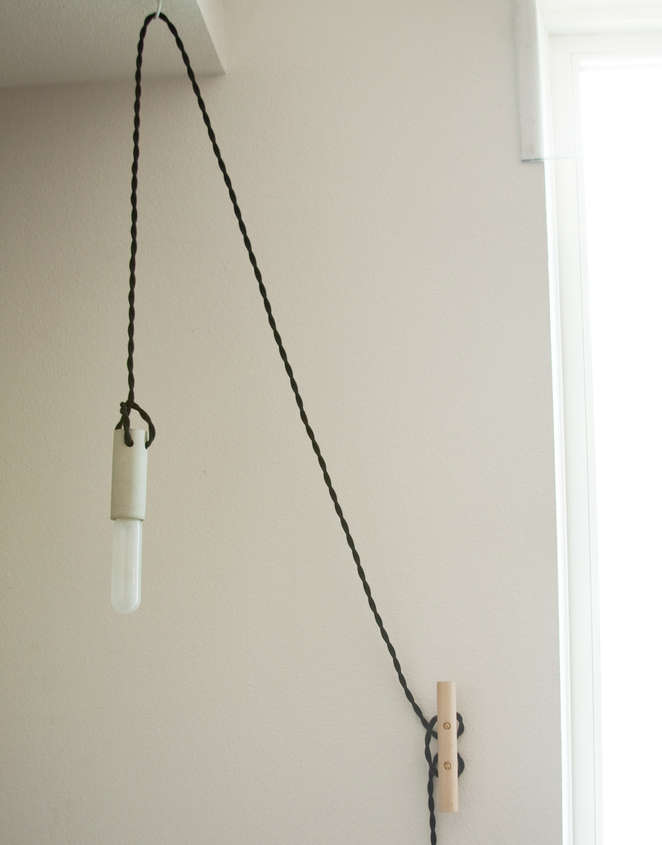
Another memorable LA example comes from Wrk-Shp, the Los Angeles multidisciplinary studio known for bringing a subtle industrial quality to lighting and furniture. Their concrete pendant lamps are a reminder that industrial-chic does not need to be oversized or aggressive. Sometimes all it takes is a fabric-covered wire, a cast concrete socket, and a shape so simple it almost feels obvious. Which, of course, means it was probably very hard to get right.
That palette of concrete, wood, and steel feels especially at home in Southern California interiors, where raw texture is often balanced by daylight, white walls, and natural materials. A piece like this can look at home in a minimalist apartment, a creative office, or a kitchen that wants a little edge without full biker-bar energy.
The Wider California Bench Is Strong Too
LA may lead the vibe, but California as a whole gives the category more depth. Cerno, based in Laguna Beach, has built a strong reputation around lighting designed and made in California. Many of its pendants combine solid wood with clean, modern forms, proving that an industrial-adjacent fixture does not have to be harsh. It can be architectural, warm, and deeply livable.
Gantri adds another California-made angle through local digital manufacturing and plant-based materials. Its aesthetic often leans softer than classic industrial, but it still contributes to the larger story: California lighting is not just about style, it is also about how things are made. Local production, made-to-order thinking, and material experimentation all help explain why California-made lighting feels distinct.
Even commercial manufacturers in the region, such as Los Angeles Lighting, reinforce the point that industrial lighting is not just an aesthetic costume. In California, it still has real roots in performance, specification, and utility. That authenticity matters. People can tell when a light fixture has actual industrial DNA and when it merely wants credit for owning a black powder-coated finish.
How to Use Industrial-Chic Pendants at Home Without Overdoing It
Above a Kitchen Island
This is where pendant lights earn their paycheck. Designers continue to favor pendants over islands because they provide focused light, define the zone, and create rhythm across the room. The key is scale. Too small, and the fixtures disappear like shy extras in the background. Too large, and they dominate the room like they are auditioning for a reality show.
A good rule is to hang pendants roughly 24 to 36 inches above the countertop and to give them enough spacing to breathe. Two or three pendants can work beautifully on a standard island, while one strong linear suspension can create a more architectural look. If the shades are opaque and directional, they can double as task lighting and decorative lighting at the same time. That is multitasking we can all support.
Over a Dining Table
In dining spaces, industrial-chic pendants can feel intimate rather than hard-edged. Lower the fixture enough to create a visual relationship with the table, but not so low that guests have to play peekaboo through the hardware. Warm light matters here. A dimmable bulb in the 2700K to 3000K range usually creates the best glow for residential spaces, especially if you want dinner to feel cozy rather than clinically evaluated.
In Entryways, Breakfast Nooks, and Workspaces
A single pendant can do a lot of heavy lifting in a smaller zone. In an entry, it establishes the tone immediately. In a breakfast nook, it helps carve out a place that feels separate from the rest of the kitchen. In a home office or studio corner, a pendant can add structure without chewing up floor or surface space.
Here is the trick: use industrial-chic lighting as a punctuation mark, not as a room-wide shouting match. One thoughtful fixture often has more impact than six trendy ones trying to out-cool each other.
Layering Matters More Than the Pendant Itself
This is where many people mess up. They buy a beautiful pendant, install it, admire it for eleven minutes, and then realize the room still needs actual lighting. Design experts keep coming back to the same idea: good kitchens and living spaces need layers. Ambient lighting provides the overall glow. Task lighting helps you do things without slicing a tomato in existential darkness. Accent lighting highlights details. Decorative lighting adds personality.
Industrial-chic pendants often live at the intersection of task and decorative lighting. That is part of their magic. But they work best when supported by the rest of the room: under-cabinet lights, recessed or surface-mounted ambient fixtures, sconces, interior cabinet lighting, or a subtle wash of accent light. A pendant should not be expected to save a bad lighting plan by itself. It is a hero, not a miracle worker.
Consistency also matters. Mixing bulb temperatures can make a room feel off, especially in kitchens. Warm white light is usually the safer, more welcoming choice in residential interiors. Unless you are deliberately aiming for “premium sandwich shop at 11:45 a.m.,” there is rarely a reason to make your island lighting feel too cold.
Materials That Make the Look Feel Expensive
Not all industrial-style pendants are created equal. The difference between “beautifully restrained” and “internet warehouse special” often comes down to material quality and finish.
Spun metal shades with depth and texture feel richer than flimsy stamped versions. Burnished or waxed brass develops character over time instead of looking suspiciously plastic. Cloth cords add softness. Wood-lined interiors create warmth and dimension. Matte black can be elegant, but only when the rest of the fixture earns it. Otherwise it just looks like the light is trying very hard to seem mysterious.
The best California-made pendants understand contrast. Metal plus wood. Concrete plus textile. A strict silhouette plus a nuanced finish. That tension gives the fixture personality.
Why “Made in California” Still Means Something
In a design market flooded with lookalikes, local production still matters. California-made lighting often comes with a clearer point of view, better material storytelling, and a stronger connection between concept and execution. You are not just buying a shape. You are buying a process, a maker’s vocabulary, and, often, a fixture that feels more considered because it actually was.
That does not automatically make every locally made pendant better than every mass-market option. Let us remain calm. But it often means there is more intention in the details: the way a shade is formed, the way a finish will age, the way the light falls, the way the piece holds up in everyday use. In the best cases, California-made lighting feels like it was designed by people who understand both architecture and actual life.
Final Thoughts
California-made industrial-chic pendant lights from LA are compelling because they solve a design problem elegantly. They bring edge without heaviness, function without boredom, and craftsmanship without unnecessary fuss. They look good in modern kitchens, relaxed dining rooms, creative workspaces, and homes that want a little structure without losing warmth.
The smartest versions do not scream “industrial.” They whisper it with confidence. A spun metal shade. A sheet-metal gesture. A concrete detail. A wood interior. A warm pool of light on stone, oak, or plaster. That is the LA difference: utility, edited. Precision, softened. Industrial, but with very good manners.
And honestly, that may be the whole point. In a city that understands image better than almost anywhere else, the best pendant lights are not just pretty objects overhead. They are proof that practical things can still have charisma.
Experiences Related to California-Made Industrial-Chic Pendant Lights from LA
There is a particular experience that happens when you live with this kind of lighting for a while. At first, you notice the fixture itself. You admire the shape, the finish, the satisfying little details in the metalwork or cord. But after a few days, what really stays with you is not the object. It is the atmosphere the object creates.
In the morning, an industrial-chic pendant from LA tends to feel calm rather than dramatic. Sunlight pours in, the metal reads softer, and the light fixture becomes part of the architecture instead of a separate event. A spun shade over a kitchen island can make the first cup of coffee feel more intentional. Not in a fake “my life is a lifestyle campaign” way, but in a small, daily way. The counter becomes a destination. The room has a center of gravity.
Later in the day, the experience changes. As natural light fades, the pendant starts doing what a great fixture should do: shaping the mood. A warm beam lands on a countertop and suddenly the mess of real life looks a little more cinematic. The cutting board, the cookbook, the bowl of lemons, the child’s homework, the unopened mail you are pretending not to see; everything becomes part of one lit zone. Good pendants do not just brighten a room. They tell your eyes where to go.
That is especially true in open-plan homes, where one pendant can quietly define a kitchen, a breakfast nook, or a dining corner without walls. You feel the room working better. Conversations gather under the light. Guests drift toward it. Family members stand there longer than they need to, leaning on the island, talking about nothing urgent. This may sound suspiciously poetic for a ceiling fixture, but people underestimate how much lighting affects behavior.
There is also a tactile side to the experience. California-made fixtures often reward close looking. You notice the grain inside a shade, the gentle patina on brass, the way a concrete detail makes a piece feel grounded, or the way a matte finish absorbs light instead of bouncing it around. Those details age well. They tend to look better with use, not worse. A little wear becomes character instead of damage. That is a very LA attitude, honestly: polished enough to be beautiful, relaxed enough to let materials be themselves.
Then there is the practical experience, which is less glamorous but equally important. A well-chosen pendant makes rooms easier to use. You can chop vegetables without shadows in the wrong place. You can sit at the table and still see the person across from you. You can work at the island, then dim the same light for dinner, and the room still feels appropriate for both. The best industrial-chic pendants are versatile like that. They are not one-note props.
Perhaps the most surprising experience is that these lights rarely feel trendy once they are in place. The good ones feel settled, almost inevitable, as if the room was waiting for them all along. And that may be the strongest argument for California-made industrial-chic pendant lights from LA: they do not just decorate a space. They help a space behave better, look warmer, and feel more lived in. Which is exactly what great design is supposed to do, even when it happens to look very cool while doing it.