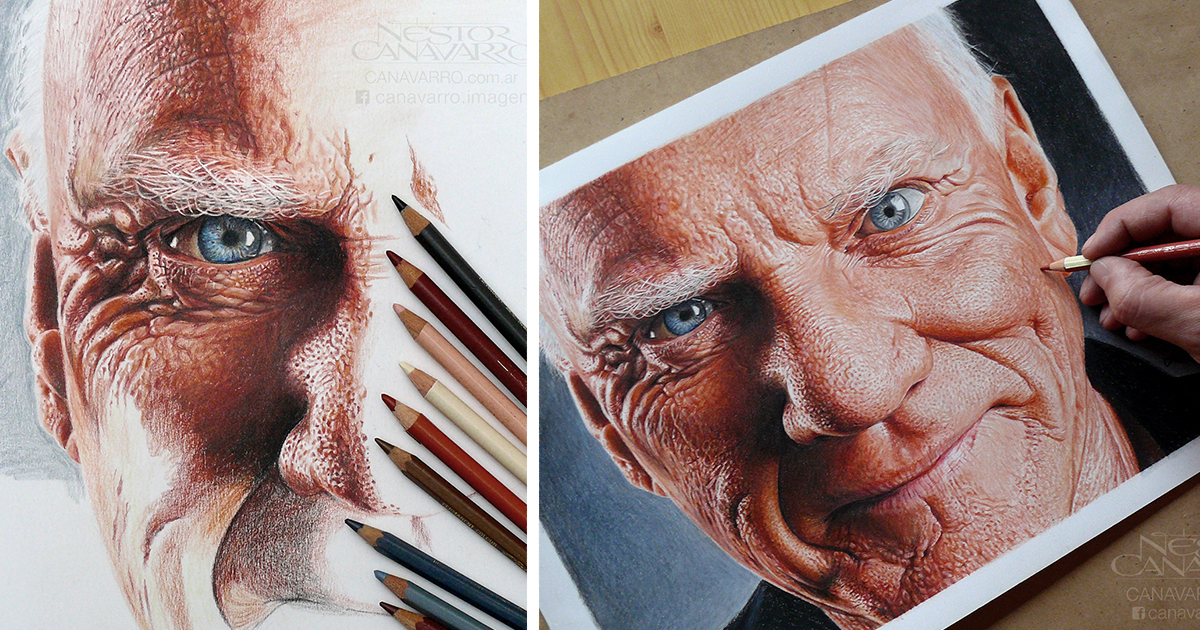

Some portraits politely ask to be drawn. Malcolm McDowell’s face does not. It leans across the table, raises one eyebrow, and says, “Are you quite sure you have enough pencils for this?” That was the feeling I had when I decided to spend 50 hours drawing Malcolm McDowell’s portrait with color pencils: excitement, fear, and the strange confidence of someone who has not yet sharpened the 17th pencil of the evening.
McDowell is one of those actors whose face carries cinema history like a well-worn leather jacket. Best known to many viewers for his unforgettable role as Alex in Stanley Kubrick’s A Clockwork Orange, he also built a long, varied career through films and television projects such as if…, O Lucky Man!, Time After Time, Caligula, Star Trek Generations, Halloween, and Son of a Critch. His expressions can turn from charming to dangerous to hilariously dry in half a second. For a portrait artist, that is both a gift and a trap. The gift is personality. The trap is that you cannot fake it.
This drawing was not just about copying a famous face. It was about translating screen presence into pigment, pressure, paper texture, and patience. Color pencil portrait art is slow by nature. Unlike digital painting, there is no “undo” button, unless you count staring at the ceiling and whispering, “Why did I press so hard?” The process forced me to study values, skin tones, facial planes, hair texture, and the tiny emotional architecture around the eyes.
Why Malcolm McDowell Was the Perfect Portrait Subject
A strong portrait begins with a subject who has visual character. Malcolm McDowell has plenty. His face is expressive, angular, theatrical, and full of contrast. He has the kind of features that make an artist stop scrolling reference photos and say, “That one. That is the face.”
McDowell’s career adds another layer of interest. His screen image has never been flat or predictable. He can play menace, wit, intelligence, arrogance, warmth, and eccentricity without looking like he is trying too hard. In a colored pencil portrait, this matters because likeness is not only about measuring the distance between the eyes or shaping the nose correctly. Likeness is also attitude. A technically accurate drawing can still feel empty if it misses the subject’s energy.
That was the main challenge: not just drawing Malcolm McDowell, but drawing the feeling of Malcolm McDowell. The slight tension in the mouth. The knowing look. The bright, mischievous spark that suggests the man has seen things, remembered everything, and probably has a very funny comment about your choice of paper.
The Planning Stage: Before the First Pencil Mark
The first few hours of the project were not glamorous. No dramatic shading. No satisfying skin tones. Just planning, measuring, erasing, remeasuring, and accepting that portraits punish arrogance quickly.
Choosing the Reference Image
I wanted a reference that showed McDowell’s age, expression, and personality clearly. Younger references from his early film career are iconic, but I was more interested in a mature portrait with texture, depth, and storytelling. Older faces are wonderful for colored pencil work because they give the artist more forms to describe: lines, folds, highlights, shadows, and subtle color shifts. In other words, a landscape with eyebrows.
The best reference had strong lighting, visible facial structure, and a direct expression. Good lighting is essential for realistic colored pencil portraits because it separates the planes of the face. Without clear light and shadow, skin can become muddy or flat, and the drawing starts to resemble a beige potato wearing a celebrity mask. Nobody wants that, least of all Malcolm McDowell.
Mapping the Portrait
I began with a light sketch. At this stage, pressure control mattered more than speed. I used faint lines to map the head shape, eye placement, nose angle, mouth width, and major shadow zones. The goal was not to create a beautiful sketch. The goal was to build a reliable skeleton for the color pencil layers that would follow.
Portrait drawing is brutally honest. Move one eye slightly too high, and the person looks surprised. Make the mouth too wide, and suddenly the actor has become a game show host. Shift the nose angle, and the likeness quietly leaves the room. I checked proportions repeatedly before adding serious color.
The Materials: Pencils, Paper, and the Tiny War Against Grain
For this Malcolm McDowell portrait, I used artist-grade color pencils, a smooth but slightly toothed drawing paper, a kneaded eraser, a sharpener, blending pencils, and a clean sheet of paper under my drawing hand to prevent smudging. Color pencils may seem simple, but the paper surface changes everything. A paper with too little tooth will not hold enough layers. A paper with too much tooth can leave a grainy texture unless you are patient enough to fill it.
The paper tooth became both enemy and friend. It grabbed pigment well, but it also demanded many light layers. Realistic colored pencil drawing is not about attacking the paper. It is about negotiating with it. Press too hard too early, and the surface becomes slick, making later layers difficult. Build slowly, and the color gains depth, glow, and control.
Building the Skin Tones Layer by Layer
Skin is not one color. That sounds obvious, but it becomes painfully clear when you are ten hours into a portrait and realize “peach” is not a strategy. Realistic skin contains warm tones, cool shadows, reflected light, reds, yellows, browns, muted violets, grays, and tiny shifts that make a face feel alive.
I started with pale base layers, keeping the pressure light. Then I built midtones around the cheeks, forehead, nose, and chin. For the shadow areas, I avoided jumping straight to dark brown or black. Instead, I used muted blues, purples, and warm browns in thin layers. This helped create more believable depth. Shadows on skin are rarely just darker skin; they often contain cooler temperatures and reflected colors.
The slow layering process was where most of the 50 hours went. A viewer may look at the final portrait and say, “Nice drawing.” An artist sees the invisible mountain of tiny decisions: soften this edge, cool that shadow, warm this cheek, sharpen that eyelid, reduce that highlight, please do not ruin the nose today.
The Eyes: Where the Portrait Either Lives or Becomes Furniture
Every portrait has a make-or-break zone. For Malcolm McDowell, it was the eyes. His gaze is one of his strongest visual signatures. It can feel sharp, playful, calculating, amused, or theatrical depending on the role and the moment. Capturing that intensity was essential.
I spent a surprising amount of time around the eyes, not only on the iris and pupil but also on the eyelids, under-eye shadows, crow’s feet, and reflected highlights. The whites of the eyes were not pure white. They needed soft grays, creams, and subtle warm tones. Pure white would have looked artificial, like a freshly cleaned bathtub installed in the middle of a human face.
The highlight placement had to be exact. A tiny white mark in the wrong place can change the direction of the gaze. Once the eyes began to work, the portrait finally started looking back at me. That is always the strange moment in portrait drawing: one minute you are coloring paper, and the next minute the paper appears to have opinions.
Drawing Hair, Wrinkles, and Texture Without Overcooking It
Texture is addictive. Once you start drawing wrinkles, hair strands, and skin details, it is easy to keep going until the portrait looks like it has been carved from tree bark. The goal was not to draw every line. The goal was to suggest enough detail for the viewer’s eye to complete the rest.
For McDowell’s hair, I used directional strokes, layering dark and light values to create volume. I avoided drawing individual hairs everywhere. Instead, I grouped the hair into larger shapes first, then added selected strands where they mattered most. This kept the hair from looking like a bowl of spaghetti with acting credits.
For wrinkles and facial texture, I used a similar approach. The most important lines were placed carefully, but many were softened with light layering. Older faces have history, but a portrait should not turn every texture into a headline. The trick is balance: enough detail to show character, enough restraint to keep the drawing elegant.
The Emotional Challenge of a 50-Hour Drawing
Spending 50 hours on one drawing sounds peaceful until you are in hour 31, questioning your life choices while sharpening a pencil the size of a breadstick. Long portrait projects are emotional marathons. There are stages.
Stage one is enthusiasm. Everything is possible. The paper is clean. The pencils are sharp. You imagine the finished portrait glowing like museum treasure. Stage two is doubt. The face looks strange. The colors feel wrong. You wonder whether Malcolm McDowell has somehow turned into a tired geography teacher. Stage three is recovery. The layers begin to connect. The likeness returns. You apologize silently to the drawing for doubting it. Stage four is obsession. You spend 45 minutes adjusting a shadow that no normal human will ever notice.
That emotional rhythm is part of the work. A detailed colored pencil portrait does not reveal itself all at once. It goes through awkward phases. The artist has to keep building even when the drawing looks temporarily worse. This is where patience becomes a real tool, not just a motivational poster word.
What I Learned About Color Pencil Portrait Realism
The biggest lesson was that realism comes from relationships, not details alone. The value relationship between cheek and shadow matters. The temperature shift between forehead and jaw matters. The softness of one edge compared with the sharpness of another matters. A realistic portrait is a network of small agreements.
I also learned that burnishing should be saved for the final stages. Burnishing can create a smooth, polished look by pressing layers together, but using heavy pressure too early can flatten the paper tooth and limit future corrections. In this drawing, I waited until the forms were already established before smoothing selected areas. That helped preserve depth while giving the skin a finished surface.
Another important lesson was to take breaks. After staring at the same face for hours, your brain stops seeing errors. A five-minute walk can reveal more than 30 minutes of stubborn squinting. The fresh-eye test saved the portrait several times, especially around the mouth and jawline.
Why Colored Pencils Are Perfect for Celebrity Portrait Art
Colored pencils are sometimes underestimated because they are familiar. Many people used them as children, so they assume they are simple. But artist-grade colored pencils can produce rich, complex, highly realistic portraits when handled with patience. They are ideal for celebrity portrait art because they allow precise control over expression, edges, and subtle color transitions.
For a subject like Malcolm McDowell, that precision matters. His portrait needed sharpness in the eyes, softness in the skin transitions, firmness in the facial structure, and expressive texture in the lines. Colored pencils made it possible to move slowly and deliberately. The medium rewards observation. It does not reward panic. I tested that personally.
The Final Result: More Than a Fan Art Portrait
By the end of 50 hours, the portrait felt less like a drawing exercise and more like a conversation with a screen legend. Malcolm McDowell’s face had become a study in contrast: charm and danger, humor and severity, elegance and rebellion. That is what made the project satisfying.
The final piece was not perfect, and that is fine. Handmade art should carry evidence of the hand. A few pencil marks, slight texture, and visible layering remind viewers that the portrait was built slowly by a person, not generated instantly by a machine. The imperfections are part of the proof of time.
Spending 50 hours drawing Malcolm McDowell with color pencils taught me that portrait art is not only about technical skill. It is about attention. It is about staying with a face long enough to understand its rhythm. It is about choosing patience when speed would be easier. And yes, it is also about owning a very reliable pencil sharpener.
Extra Experience: What 50 Hours With Malcolm McDowell’s Face Actually Felt Like
After finishing the portrait, I realized that the experience had changed how I look at faces in general. Before this project, I saw portraits mostly as combinations of features: eyes, nose, mouth, hair, shadows. After spending 50 hours with Malcolm McDowell’s face, I started noticing how expression lives in the tiny spaces between features. A small crease beside the mouth can change the entire mood. A slightly raised brow can add wit. A shadow under the cheekbone can make the face feel more cinematic. Drawing forced me to become a better observer, and possibly a slightly more intense person at coffee shops.
One of the most memorable parts of the experience was learning when to stop. Artists love to say, “Just one more layer,” which is usually a lie told right before disaster. There were moments when the portrait looked complete, but I kept finding small areas to improve. The lower eyelid needed softening. The temple needed warmth. The shadow under the chin needed depth. But every adjustment carried risk. Colored pencils are forgiving only up to a point. Eventually, the paper says, “We are done here.” Learning to respect that limit was one of the most valuable lessons of the project.
The portrait also reminded me that fan art can be serious art. Drawing a famous actor is not simply copying celebrity culture. When done thoughtfully, it becomes a study of performance, memory, and visual identity. Malcolm McDowell has played characters that audiences remember because they feel electrically alive on screen. Trying to capture even a fraction of that presence with pencils was a creative challenge worth taking seriously. It made me think about how actors use their faces as instruments, and how portrait artists translate that instrument into stillness.
There were funny moments too. At one point, I became so focused on matching skin tones that my workspace looked like a tiny pencil crime scene. Peach, cream, sepia, terracotta, lavender, gray, and indigo were scattered everywhere. I had pencil shavings on my sleeve and a suspicious smudge on my face. If someone had walked in and asked what I was doing, the honest answer would have been, “Trying to make a cheekbone behave.”
Another experience I will remember is how the drawing changed under different lighting. In daylight, the warm tones looked balanced. Under a desk lamp, some shadows appeared too strong. Under cooler light, the skin looked slightly pale. This taught me to check the portrait in multiple conditions before calling it finished. Since many people will view artwork on screens, in rooms, or through photos, lighting can change the impression dramatically.
Most of all, the project gave me a deeper respect for slow art. In a world where images are consumed in seconds, spending 50 hours on one portrait feels almost rebellious. It says that attention still matters. Craft still matters. Looking closely still matters. The finished Malcolm McDowell portrait became more than a tribute to an actor; it became a reminder that patience can create a kind of intimacy with the subject. By the final hour, I was tired, proud, and very aware that colored pencils are not cute little school supplies. They are tiny wooden endurance tests with pigment inside.
Conclusion
Drawing Malcolm McDowell’s portrait with color pencils for 50 hours was a lesson in patience, observation, and artistic nerve. His face offered everything a portrait artist could want: intensity, character, history, humor, and structure. The process demanded careful planning, slow layering, accurate values, realistic skin tones, and a willingness to keep going through the awkward middle stage when every portrait briefly looks like it has made poor life decisions.
In the end, the project proved that colored pencil portrait drawing can be rich, expressive, and surprisingly powerful. With the right paper, controlled pressure, thoughtful layering, and a subject as visually magnetic as Malcolm McDowell, a simple set of pencils can become a serious storytelling tool.
Note: This article is an original editorial-style blog draft based on publicly available biographical information about Malcolm McDowell and established colored-pencil portrait techniques. No source links are embedded in the article body.