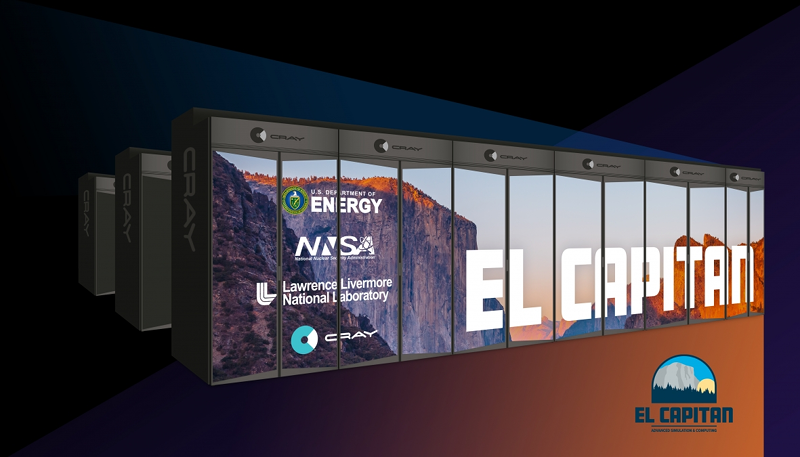

There are fast computers, and then there are machines so absurdly powerful that calling them “computers” feels like calling a Saturn V rocket “a vehicle.” The new Cray exascale supercomputer promised to reach 1.5 ExaFLOPS belongs firmly in the second category. It is not the kind of machine you buy to check email, run a spreadsheet, or open 47 browser tabs while pretending that one of them is work. It is the kind of machine built to simulate nuclear physics, model climate systems, accelerate artificial intelligence, and answer scientific questions that would make an ordinary laptop quietly close itself and reconsider its career choices.
The phrase “1.5 ExaFLOPS” means 1.5 quintillion floating-point operations per second. That is 1,500,000,000,000,000,000 calculations every second, assuming the workload is designed to keep the machine fed. The Cray system most closely associated with this milestone is El Capitan, the National Nuclear Security Administration’s first exascale supercomputer at Lawrence Livermore National Laboratory. Announced as a Cray-built system and later delivered under Hewlett Packard Enterprise after HPE acquired Cray, El Capitan represents the modern age of high-performance computing: CPUs, GPUs, memory, storage, networking, software, cooling, and scientific ambition all packed into one extremely serious machine.
What Does 1.5 ExaFLOPS Actually Mean?
FLOPS stands for floating-point operations per second, a standard way to measure how quickly a computer performs certain mathematical calculations. A gigaflop is a billion operations per second. A teraflop is a trillion. A petaflop is a quadrillion. An exaflop is a quintillion. By the time we get to exascale computing, the prefixes sound less like engineering terms and more like creatures guarding the final level of a video game.
Still, the meaning is simple: an exascale supercomputer can perform at least one quintillion calculations per second on benchmarked scientific workloads. When Cray’s new system was projected above 1.5 ExaFLOPS, it signaled a leap beyond the petascale era. This was not a mild upgrade, like replacing your old phone and discovering the new one takes slightly better pictures of lunch. It was a new class of machine built for scientific problems that require enormous parallelism and huge data movement.
Meet El Capitan: The Cray System Behind the Headline
El Capitan was contracted by the U.S. Department of Energy’s National Nuclear Security Administration for Lawrence Livermore National Laboratory. The original contract with Cray was valued at about $600 million and described a system expected to exceed 1.5 ExaFLOPS. Its mission was never casual computing. El Capitan was designed primarily for stockpile stewardship, which means using advanced simulation to help maintain the safety, security, and reliability of the U.S. nuclear weapons stockpile without underground nuclear testing.
That may sound narrow, but the technology underneath is broadly important. The same class of computing used for national security simulations also supports research in materials science, high-energy-density physics, fusion energy, manufacturing, artificial intelligence, and complex engineering. In other words, the machine is built for problems where “let’s just try it and see what happens” would be either impossible, unsafe, expensive, or all three.
From Cray Shasta to HPE Cray EX
The system was originally tied to Cray’s Shasta architecture, a platform designed for exascale and data-intensive workloads. After Hewlett Packard Enterprise completed its acquisition of Cray in 2019, the system became part of the HPE Cray EX family. That branding shift matters because it shows where supercomputing has gone: the legendary Cray name did not disappear into nostalgia; it evolved into a platform for massive, GPU-accelerated scientific systems.
Modern Cray supercomputers are not just rows of processors. They are complete ecosystems. El Capitan uses high-density compute blades, AMD processors and accelerators, HPE Slingshot networking, a specialized software stack, and direct liquid cooling. A supercomputer at this level is less like one giant PC and more like a tightly choreographed city where every road, power line, water pipe, and traffic signal must work perfectly together. If one part is slow, the whole city gets a traffic jam.
Why AMD Matters in the Exascale Race
One of the most important details behind El Capitan is its AMD-powered design. The system uses AMD EPYC processors and AMD Instinct MI300A accelerators, combining CPU and GPU capabilities for workloads that demand huge parallel processing power. This follows the same broad trend seen in Frontier at Oak Ridge National Laboratory, another HPE Cray EX system powered by AMD technology and recognized as the first publicly ranked exascale supercomputer.
For many years, supercomputing performance depended heavily on traditional CPUs. Today, GPUs and accelerated processors do much of the heavy lifting. Scientific simulations, AI models, and data-heavy workloads often involve millions or billions of similar operations that can be performed in parallel. GPUs are excellent at that. The trick is not simply adding accelerators, though. The real engineering magic is getting CPUs, GPUs, memory, storage, and network fabric to work together without wasting time waiting for data. At exascale, waiting is expensive.
The Network Is the Secret Sauce
People love talking about processors because chips are glamorous. They get product launches, benchmarks, and dramatic slide decks. But in a supercomputer, the interconnect is just as critical. El Capitan relies on HPE Cray Slingshot networking, designed to move data between nodes at extraordinary speed and scale. When thousands of processors are working on one problem, they constantly need to exchange information. A slow network would be like trying to run a Formula 1 race on a road full of school-zone speed bumps.
The interconnect allows different parts of the machine to coordinate efficiently. This is especially important for simulation workloads, where one region of a model may depend on what is happening in another region. Climate modeling, fluid dynamics, nuclear physics, and materials simulations all require communication across the system. The faster the machine can compute and communicate, the more realistic and detailed the simulation can become.
Storage: Because Exascale Machines Create Exascale Messes
A supercomputer capable of 1.5 ExaFLOPS can generate shocking amounts of data. That data must be stored, moved, analyzed, and sometimes visualized. Cray’s storage plans for exascale systems included massive ClusterStor-based storage solutions and high-throughput architectures intended to support simulation, analytics, and AI workloads at the same time. This is not optional. A supercomputer that can calculate faster than it can save or retrieve data becomes a very expensive waiting room.
Think of storage as the machine’s long-term memory and I/O as its ability to speak. If the compute nodes are shouting discoveries at the speed of a hurricane, the storage system must be ready to write them down without dropping half the sentence. In exascale computing, storage is not an accessory. It is part of the scientific instrument.
Cooling the Beast
Performance at this scale produces heat. A lot of heat. Enough heat that air cooling alone becomes impractical. HPE Cray EX systems use advanced direct liquid cooling to remove heat efficiently from densely packed components. This allows more computing power to fit into a smaller footprint while improving energy efficiency.
Energy efficiency is one of the biggest challenges in modern supercomputing. It is not enough to win a benchmark by building a machine that consumes power like a small thunderstorm. The goal is to deliver enormous performance within a manageable power envelope. El Capitan and Frontier both show that the future of supercomputing depends not only on speed, but on performance per watt. In the exascale era, electricity is not a footnote. It is a design constraint, budget issue, and engineering obsession.
Why Scientists Need This Much Power
The obvious question is: what do you do with 1.5 quintillion calculations per second? The answer is not “open Chrome faster,” although that would be emotionally satisfying. Exascale systems are built for scientific and national-scale problems. They can model the behavior of materials at the atomic level, simulate plasma physics, improve climate and weather models, explore energy systems, and train or support advanced AI tools for research.
For stockpile stewardship, El Capitan helps researchers simulate complex physical processes with greater fidelity. For materials science, machines in this class can help researchers predict how new alloys, batteries, catalysts, or semiconductors might behave before they are built. For climate science, exascale computing can improve resolution and detail. For medicine and biology, similar high-performance computing techniques can accelerate modeling, screening, and data analysis. The machine is not just faster; it makes different questions practical.
How El Capitan Compares With Frontier
Frontier at Oak Ridge National Laboratory is another major HPE Cray EX system and an important part of the same exascale story. Frontier was announced with expected performance greater than 1.5 ExaFLOPS, later became the first publicly acknowledged system to break the exascale barrier on the TOP500 list, and reached more than one exaflop on the High Performance Linpack benchmark. It uses AMD EPYC CPUs, AMD Instinct MI250X GPUs, HPE Slingshot networking, and a huge high-performance storage system.
El Capitan then pushed the crown higher. TOP500 results show El Capitan reaching 1.742 ExaFLOPS in 2024 and later being remeasured at 1.809 ExaFLOPS on the HPL benchmark in November 2025. Its theoretical peak performance is higher still. That means the original “will reach 1.5 ExaFLOPS” promise was not merely reached; it was surpassed. In supercomputing terms, that is the rare sequel that actually improves on the trailer.
The Cray Legacy: From Vector Machines to Exascale Titans
The Cray name carries history. The original Cray-1 became an icon of 1970s supercomputing with its distinctive circular design and legendary performance for its time. Compared with today’s exascale systems, the Cray-1 is tiny in raw speed, but historically it was a monster. It helped establish the idea that specialized machines could expand the frontier of science and engineering.
That legacy continues in systems like El Capitan and Frontier. They look very different from Seymour Cray’s early machines, but the philosophy is familiar: build the fastest practical scientific instrument possible, then give researchers access to problems that were previously out of reach. The difference is that today’s machines operate with millions of cores, accelerated computing, liquid cooling, high-speed network fabrics, and software ecosystems that must tame a small computational galaxy.
Why Exascale Computing Matters for AI
Artificial intelligence has changed the public conversation about computing power. Everyone now talks about GPUs, training clusters, data centers, and foundation models. Exascale supercomputers are not identical to commercial AI factories, but the overlap is growing. Systems like El Capitan combine simulation, AI, analytics, and scientific computing in ways that allow researchers to use machine learning alongside traditional models.
This matters because AI can help identify patterns, speed up analysis, build surrogate models, and guide simulations. For example, instead of running every possible physics simulation from scratch, scientists may use AI models trained on high-fidelity simulations to explore a larger design space. The supercomputer becomes both a simulator and a teacher. That combination may be one of the most important scientific tools of the next decade.
The Human Side of a 1.5 ExaFLOPS Machine
It is tempting to describe El Capitan only through numbers: exaflops, cores, watts, cabinets, benchmarks. But the real story includes thousands of people: chip designers, system architects, network engineers, cooling specialists, software developers, facility planners, physicists, mathematicians, and researchers who know how to turn raw horsepower into useful results. A machine this powerful does nothing by itself. Someone has to write the code, prepare the models, debug the software, manage the data, and interpret the output.
In that sense, exascale computing is not just a hardware achievement. It is a collaboration achievement. The code must scale across millions of parallel operations. Researchers must rethink algorithms. System teams must keep the machine stable. Facilities teams must deliver power and cooling. A successful exascale system is not a solo act. It is a symphony, although one where the percussion section is made of GPUs and the conductor owns several thermal cameras.
Challenges: Speed Is Hard, Useful Speed Is Harder
Benchmarks matter because they provide a common standard, but real scientific productivity is more complicated. A machine may perform brilliantly on Linpack and still require major work to run diverse applications efficiently. Memory bandwidth, communication patterns, storage bottlenecks, numerical precision, software libraries, and code portability all affect real-world results.
That is why exascale projects include extensive software preparation. Scientific teams often spend years adapting applications before the machine is fully available. They refactor code, improve parallelism, test new programming models, and tune performance. The hardware may arrive in cabinets, but the scientific value arrives through software maturity. In supercomputing, “plug and play” is usually replaced by “compile, profile, optimize, curse gently, repeat.”
Experiences and Lessons From the Exascale Era
One of the most interesting experiences related to the new Cray reaching 1.5 ExaFLOPS is how it changes the way people think about scale. Most of us understand speed through personal devices. A laptop boots quickly. A phone opens an app. A game loads faster after installing a better graphics card. Exascale computing asks us to think differently. It is not about one task becoming a little snappier. It is about turning previously impossible research into scheduled work.
Imagine a team studying a new material for cleaner energy technology. On a smaller system, they may be forced to simplify the model so much that the result is useful but incomplete. With exascale power, they can include more atoms, more time steps, more physical effects, and more uncertainty. The simulation becomes closer to reality. That does not magically replace experiments, but it helps researchers decide which experiments are most promising. The lab bench and the supercomputer begin working as partners.
Another lesson is humility. A machine with more than 1.5 ExaFLOPS sounds invincible, yet it can still be bottlenecked by a poorly optimized program. That is both funny and profound. Even the world’s fastest supercomputer needs good code. A sloppy algorithm can turn a billion-dollar-class system into a very warm calculator. This is why computational scientists are so valuable. They are not merely users; they are translators between scientific questions and machine architecture.
The exascale experience also shows that infrastructure matters. Power delivery, cooling, storage, networking, scheduling, security, and user support are part of the achievement. The public sees the headline number, but the machine’s daily success depends on quiet operational excellence. Someone has to make sure the jobs run, the data moves, the system stays healthy, and researchers can get meaningful results without needing to personally negotiate with 11 million cores.
There is also a cultural shift. Exascale systems encourage collaboration across fields. A climate scientist may work with applied mathematicians, AI researchers, visualization experts, and computer scientists. A materials team may need help from compiler experts and GPU programmers. The science becomes more interdisciplinary because the tool itself is interdisciplinary. No one person understands every layer from transistor to theorem, and that is perfectly fine. The point is to build teams that do.
Finally, the new Cray milestone is a reminder that computing history is not slowing down; it is changing shape. The old rhythm of simply waiting for faster processors is gone. The future is accelerated, parallel, energy-aware, data-heavy, and deeply connected to AI. El Capitan’s 1.5 ExaFLOPS promise, and its later performance beyond that mark, tells a larger story: the next breakthroughs may come from machines that do not just calculate faster, but allow humans to ask bigger, stranger, more useful questions.
Conclusion
The headline “New Cray Will Reach 1.5 ExaFLOPS” captures more than a speed record. It marks a turning point in high-performance computing. El Capitan and related HPE Cray EX systems show how far supercomputing has moved beyond raw processor bragging rights. These machines combine accelerated computing, advanced networking, massive storage, liquid cooling, and carefully prepared scientific software to tackle problems too large for ordinary computing.
For readers outside the HPC world, the key takeaway is simple: exascale computing is not just about bigger numbers. It is about better science, safer national security stewardship, faster materials discovery, stronger AI-assisted research, and more detailed simulations of the physical world. The Cray name has traveled from the classic supercomputer era into the exascale age, and it is still doing what it has always done best: making impossible calculations slightly less impossible, one quintillion operations at a time.