
Every few decades, humanity looks up at the Moon and collectively says, “We should really visit that place again.” Then engineers sharpen pencils, politicians sharpen speeches, and aerospace companies sharpen PowerPoint decks until someone finally has to build the machine that does the terrifying part: land gently on another world instead of turning several billion dollars into a very expensive crater.
That is where Lockheed Martin enters the story. Best known in the Artemis era as the prime contractor behind NASA’s Orion spacecraft, Lockheed has also pitched an ambitious idea for the next-generation lunar lander: a reusable, single-stage vehicle that could ferry astronauts from lunar orbit to the Moon’s surface and back again. The idea is not merely “Apollo, but with better screens.” Lockheed’s concept imagines a lander tied to NASA’s broader Moon-to-Mars architecture, using the lunar Gateway as a parking garage, refueling depot, and general deep-space lobby.
The result is a fascinating mix of old-school aerospace discipline and new-space thinking. It borrows from Orion, aims for reuse, supports longer stays, and treats the Moon less like a photo op and more like a place where people might actually work. In short, Lockheed wants to build the next lunar landerand the pitch tells us a lot about where lunar exploration is headed.
Why the Next Lunar Lander Matters
The Apollo Lunar Module was one of the most brilliant machines ever built. It was also extremely specialized. It carried two astronauts, landed once, lifted off once, and left part of itself behind like a heroic aluminum camping stove. That was perfectly reasonable for Apollo’s goal: beat the Soviet Union, collect samples, plant flags, make history, and get home before anyone asked too many budget questions.
Artemis is different. NASA’s modern lunar program is not designed around a single “there and back” stunt. The agency wants recurring missions, more science, more cargo, longer stays, and eventually a sustainable human presence near the lunar south pole. That changes the engineering problem completely. A future lunar lander must be safer, more flexible, more reusable, and better integrated with orbiting infrastructure.
Lockheed’s lander concept fits that shift. Instead of copying Apollo’s two-stage lander, the company proposed a large reusable vehicle operating from the Gateway. The lander would descend from lunar orbit, support astronauts on the surface for up to two weeks, then return to Gateway for servicing and refueling. Think of it less as a disposable taxi and more as a rugged lunar shuttleexcept the road is vacuum, the gas station is in orbit, and the potholes are older than dinosaurs.
The Lockheed Lunar Lander Concept
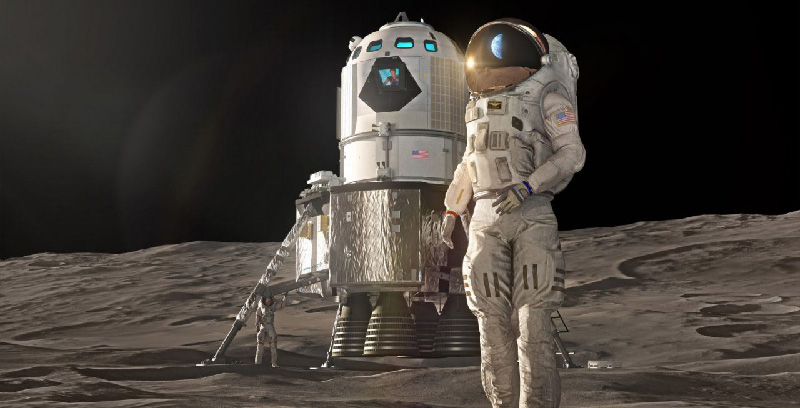
Lockheed Martin revealed its crewed lunar lander concept in 2018 at the International Astronautical Congress. The company described it as a single-stage, fully reusable system that would use technologies developed for NASA’s Orion spacecraft. The initial design would carry four astronauts and roughly 2,000 pounds of cargo to the lunar surface for missions lasting up to two weeks.
The “single-stage” part is important. Apollo’s Lunar Module had a descent stage that stayed on the Moon and an ascent stage that lifted astronauts back into orbit. Lockheed’s proposal would bring the whole lander back to Gateway. That means the vehicle could be inspected, refueled, updated, and reused instead of being abandoned after one mission. Reuse is not just fashionable space jargon; it is central to making lunar missions less painfully expensive over time.
Lockheed’s lander would also be big. Reports at the time described a vehicle far larger than Apollo’s Lunar Module, with enough scale to support a crew of four, carry meaningful cargo, and include an elevator or crew access system. Yes, an elevator on the Moon sounds like something a billionaire would install after discovering stairs, but for astronauts wearing bulky spacesuits and moving tools, samples, and equipment, a reliable surface-access system matters.
Why Use Orion Technology?
One of Lockheed’s strongest arguments is heritage. Orion is designed for human deep-space missions, meaning its avionics, communications, navigation, life support, and pressure-vessel knowledge are directly relevant to a crewed lunar lander. Lockheed’s proposal was essentially saying: “We already built a lot of the hard human-spaceflight stuff. Let’s not reinvent every bolt while the Moon waits.”
That does not make the lander easy. Nothing involving cryogenic propellants, lunar dust, deep-space operations, docking, and human safety should ever be called easy unless you enjoy making engineers twitch. But using proven systems can reduce development risk. In aerospace, “flight heritage” is not just a nice phrase. It is the difference between confidence and a very tense meeting with twelve people named “Mission Assurance.”
Gateway: The Space Station That Makes Reuse Possible
Lockheed’s lander concept depends heavily on the lunar Gateway, a small outpost planned for lunar orbit. Gateway is designed to serve as a staging point for astronauts traveling between Orion and the lunar surface. In the Lockheed architecture, the lander would live at Gateway between missions, much like a reusable ferry docked at a harbor.
The Gateway idea gives reusable landers a reason to exist. Without an orbital base, a reusable lander has nowhere convenient to refuel, dock, wait, or receive maintenance. With Gateway, a lander can make repeated trips, support different landing sites, and potentially become part of a long-term lunar transportation network.
This is where Lockheed’s concept becomes bigger than one vehicle. The company was not only pitching a lander; it was pitching a transportation architecture. Orion brings astronauts to lunar orbit. Gateway hosts them and their hardware. The lander carries them down and back. Over time, cargo missions, surface habitats, rovers, and science payloads could plug into the same system.
NASA’s Human Landing System Race
Lockheed’s standalone lunar lander concept did not become NASA’s selected Artemis lander. Instead, NASA’s Human Landing System program evolved into a competitive commercial effort. In 2020, NASA selected three teams for early lander development: Blue Origin’s National Team, Dynetics, and SpaceX. Lockheed was part of Blue Origin’s National Team, responsible for the ascent element in that original Integrated Lander Vehicle proposal.
Then, in 2021, NASA selected SpaceX’s Starship Human Landing System for the first crewed Artemis lunar landing demonstration. SpaceX’s approach is radically different: an enormous Starship variant refueled in Earth orbit before traveling to lunar orbit, landing on the Moon, and returning astronauts to Orion. It is bold, huge, and very SpaceXwhich is to say it makes engineers both excited and mildly concerned.
NASA later added a second provider. In 2023, the agency selected Blue Origin to develop the Blue Moon lander for Artemis V under the Sustaining Lunar Development program. That contract brought Lockheed back into the broader lunar lander story through the Blue Origin-led team, alongside other partners. NASA’s reason was straightforward: two lander providers create redundancy, competition, and a better chance of building a regular cadence of Moon missions.
Lockheed’s Role Today: Not the Whole Lander, But Still Central
Lockheed may not be building the entire Artemis lander under its original 2018 concept, but it remains deeply embedded in NASA’s return-to-the-Moon strategy. Orion is the crew spacecraft for Artemis missions, and Lockheed is the prime contractor behind it. Every astronaut who heads toward the Moon aboard Orion is riding in hardware shaped heavily by Lockheed engineering.
The company’s lunar ambitions also show up in its partnership work. In NASA’s 2020 HLS awards, Lockheed was named as the builder of the ascent element for Blue Origin’s National Team concept, with commonality to Orion. In the modern Blue Moon architecture, Lockheed’s deep-space systems experience still matters because lunar landing is not just about touching down. It is about crew safety, docking, avionics, communications, abort modes, redundancy, and the art of making machines behave politely in places where repair shops do not exist.
So the headline “Lockheed wants to build the next lunar lander” is best understood in two layers. First, Lockheed genuinely proposed a reusable lander architecture. Second, even when NASA selected other prime lander providers, Lockheed remained one of the key companies supplying the human-spaceflight backbone of Artemis.
Why Reusability Is the Big Idea
The biggest difference between Apollo and Artemis is not the logo. It is the ambition to return again and again. Reusability is central to that plan. A reusable lunar lander could lower mission costs, reduce manufacturing bottlenecks, and support more frequent landings. It could also help NASA and its partners learn from each flight, upgrade systems, and build operational experience.
But reusability on the Moon is not the same as landing a booster on a drone ship. A lunar lander must deal with abrasive regolith, extreme temperature swings, radiation, vacuum, limited rescue options, and the need for reliable cryogenic propellant storage. Lunar dust is especially unpleasant. It is sharp, clingy, electrostatically annoying, and generally behaves like glitter invented by a villain.
Lockheed’s concept tried to solve the reuse challenge by keeping the lander in space. Since the vehicle would not reenter Earth’s atmosphere, it would avoid the brutal heat and aerodynamic forces that make refurbishment difficult. After each mission, the lander would return to Gateway, where it could be checked and refueled. That is elegant in theory. In practice, it requires dependable orbital infrastructure and a propellant supply chain that does not yet fully exist.
The Technical Hurdles Nobody Can Ignore
Cryogenic Propellant Management
Many lunar lander concepts rely on liquid oxygen and liquid hydrogen because they offer strong performance. The challenge is that cryogenic propellants are extremely cold and difficult to store for long periods in space. Hydrogen, in particular, has a talent for escaping tanks like it has somewhere better to be. Long-duration storage, transfer, and refueling are essential technologies for reusable lunar transportation.
Surface Operations
Landing is only the beginning. Astronauts must exit safely, carry tools, collect samples, deploy instruments, manage dust contamination, and return to the cabin. The taller the lander, the more complicated crew access becomes. Elevators and platforms may sound like luxury features until you imagine climbing a ladder in a pressurized suit while holding geological samples and trying not to trip in one-sixth gravity.
Mission Safety
Human lunar landers need robust abort options and redundant systems. If something goes wrong on the surface, the lander must get astronauts back to orbit. If something goes wrong near Gateway or Orion, docking and transfer systems must still work. This is one reason Lockheed emphasizes Orion-derived systems: human-rated reliability is painfully difficult and extremely valuable.
How Lockheed’s Proposal Compares With Starship and Blue Moon
SpaceX’s Starship HLS is the giant in the room. It offers huge internal volume, large cargo capability, and a long-term path toward full reusability. But it depends on multiple refueling flights and major demonstrations before NASA can trust it with astronauts. Starship is ambitious in the way a skyscraper is ambitious when someone says, “Let’s land it sideways on another world, except upright.”
Blue Origin’s Blue Moon takes a more compact approach. The crewed Mark 2 version is designed for NASA’s sustained lunar missions and is intended to support crew and cargo delivery. Its cabin sits closer to the surface than Starship’s, which may simplify astronaut access. Blue Origin’s system also depends on cryogenic propulsion and development milestones that must be proven before crewed missions.
Lockheed’s 2018 lander sits conceptually between traditional aerospace and modern reusability. It is larger and more capable than Apollo, smaller than Starship, tied closely to Gateway, and built around heritage systems from Orion. Its strength is architectural discipline. Its weakness is that it depends on infrastructure and budgets that have shifted over time.
The Business Behind the Moon Machines
NASA is no longer trying to own every part of the lunar transportation chain. The agency increasingly acts as a customer, using fixed-price contracts and commercial partnerships to encourage multiple providers. This approach helped reshape cargo and crew transport to the International Space Station, and NASA hopes it can do the same for lunar access.
For Lockheed, lunar landers are not just a prestige project. They are part of a broader market in deep-space logistics, crew vehicles, habitats, navigation systems, communications, surface infrastructure, and eventually Mars preparation. A company that helps solve lunar transportation can compete for decades of follow-on work. The Moon may not have a stock exchange, but the lunar economy is already being priced into aerospace strategy.
That is why Lockheed’s concept remains important even if the exact vehicle never flies. It helped frame reusable lunar landing as an infrastructure problem rather than a one-off mission. It showed how Orion-derived technology might support surface access. And it kept Lockheed in the conversation as NASA moved from Apollo nostalgia to commercial lunar operations.
Why the Moon Is a Testbed for Mars
Lockheed’s lander pitch was also connected to Mars. The company has long discussed Mars Base Camp, a concept for a crewed orbital station around Mars. A lunar lander operating from Gateway would let engineers practice many of the same skills needed for Mars missions: orbital staging, reusable descent vehicles, long-duration cryogenic propulsion, remote operations, navigation, and crew survival far from Earth.
The Moon is not Mars. It has lower gravity, no atmosphere, and a much shorter communication delay. But it is close enough to test deep-space habits before betting human lives on a months-long journey to the Red Planet. If something breaks on the Moon, Earth is still nearby. If something breaks at Mars, the troubleshooting call has a delay long enough for everyone to regret their career choices.
That makes Artemis more than a lunar program. It is a rehearsal space. Lunar landers are the stage equipment. Lockheed, SpaceX, Blue Origin, NASA, and other partners are all trying to answer the same question: what kind of transportation system lets humans work beyond Earth repeatedly, safely, and affordably?
Experience Notes: What Watching the Lunar Lander Race Teaches Us
Following the next lunar lander story feels a bit like watching several brilliant chefs attempt to cook dinner in a kitchen that is falling through space. Everyone agrees on the menureturn astronauts to the Moonbut the recipes are wildly different. Lockheed’s approach feels like a careful engineering cookbook: start with proven Orion ingredients, add Gateway operations, season with reusability, and avoid unnecessary drama. SpaceX’s approach is more like showing up with a warehouse-sized pressure cooker and saying, “Trust us, it scales.” Blue Origin’s approach lands somewhere between infrastructure builder and methodical systems integrator.
The most useful lesson is that space exploration is rarely about one perfect machine. It is about architecture. Apollo succeeded because Saturn V, the Command and Service Module, the Lunar Module, mission control, spacesuits, tracking stations, and thousands of procedures worked together. Artemis will succeed only if Orion, SLS, commercial landers, spacesuits, Gateway or other staging systems, surface power, rovers, communications, and refueling technologies mature together. A lander by itself is impressive. A lander inside a working transportation network is civilization-level engineering.
Another experience from watching this race is that timelines in space should be treated with optimism, caution, and perhaps a small fire extinguisher. The Moon has a way of punishing calendar confidence. A design can look beautiful in renderings, pass early reviews, and still face delays when tanks, engines, valves, software, thermal systems, or safety reviews reveal new problems. That does not mean failure. It means spaceflight is difficult in a very literal, very expensive way.
Lockheed’s lunar lander concept is compelling because it feels operational. It imagines astronauts using the lander more than once, returning it to orbit, checking it out, and flying again. That is the mindset needed for a real lunar future. The Moon cannot become a serious scientific and industrial destination if every mission throws away half the vehicle. Reuse is not a luxury; it is the path from exploration to presence.
At the same time, Lockheed’s concept reminds us that “heritage” and “innovation” must work together. Rely too much on heritage, and you risk building yesterday’s spacecraft at tomorrow’s prices. Chase only innovation, and you may discover that physics has a strict refund policy. The best lunar lander will likely combine proven human-spaceflight systems with bold new operations such as refueling, reuse, and commercial service models.
For readers, the fun part is that the next Moon landing will not simply repeat Apollo. It will involve new vehicles, new companies, new political pressure, new safety debates, and new technology demonstrations. The astronauts may step onto the same Moon, but the machines getting them there will represent a completely different era. Lockheed’s proposal belongs in that story because it helped push the conversation toward reusable, Gateway-based, sustainable lunar access. Even if the exact lander never becomes the final Artemis ride, its ideas are already part of the blueprint.
Conclusion
Lockheed Martin’s dream of building the next lunar lander is really a dream about making Moon travel routine enough to be useful. The company’s reusable, Orion-influenced lander concept offered a serious answer to a serious problem: how do you move astronauts between lunar orbit and the surface again and again without rebuilding the entire system every time?
NASA’s Artemis program has since moved through several lander choices, with SpaceX and Blue Origin now carrying the main HLS contracts. Still, Lockheed remains central through Orion, human-spaceflight systems, and lunar architecture partnerships. Its original lander concept continues to matter because it captured the shift from Apollo-style missions to reusable lunar transportation.
The next lunar lander may not look exactly like Lockheed’s 2018 proposal. It may be a towering Starship, a Blue Moon vehicle, a future hybrid, or something not yet fully revealed. But the core idea is here to stay: the Moon is no longer just a destination. It is becoming a proving ground, a workplace, and perhaps the first stop in a larger human expansion into deep space. Not bad for a dusty rock that has been quietly photobombing Earth for 4.5 billion years.