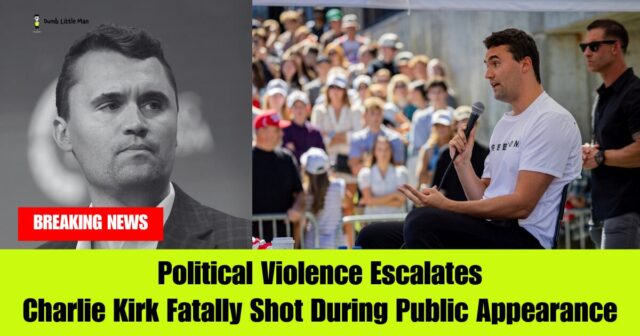

Note: This article is written for publication in standard American English and avoids graphic details while summarizing verified public reporting, legal updates, and the misinformation storm surrounding Charlie Kirk’s death.
Every so often, the internet wakes up, spills coffee on itself, and decides to ask a question in the most dramatic way possible: “Is Charlie Kirk dead?” In this case, the answer is not a vague rumor, a recycled celebrity hoax, or one of those “RIP” posts launched by a bored account with 12 followers and too much free time. Charlie Kirk, the conservative activist, Turning Point USA co-founder, podcast host, and major figure in youth conservative politics, was killed on September 10, 2025, during a public event at Utah Valley University in Orem, Utah.
But that simple answer barely scratches the surface. What actually went down includes a public campus event, a fast-moving investigation, a suspect later charged in court, national debate over political violence, questions about event security, and a tidal wave of misinformation that spread online almost as quickly as the original news. The phrase “Charlie Kirk dead” became more than a search query. It became a case study in how modern news travels: part fact, part rumor, part outrage machine, and part digital telephone game played by people who really should pause before hitting “post.”
So let’s sort it out clearly, calmly, and with fewer conspiracy corkboards than the internet usually prefers.
Who Was Charlie Kirk?
Charlie Kirk was best known as the co-founder of Turning Point USA, a conservative youth organization launched in 2012. He became one of the most recognizable conservative media personalities in the United States, especially among younger Republican voters and campus activists. Through speeches, conferences, podcasts, social media clips, and college tours, Kirk built a brand around direct debate, conservative organizing, and combative political messaging.
Supporters saw him as a bold voice for free speech, limited government, religious values, and conservative youth engagement. Critics viewed him as a polarizing figure whose rhetoric often intensified culture-war battles. Either way, he was not a fringe name. He was a major player in conservative politics, closely associated with Donald Trump-era Republican messaging and youth mobilization.
That public profile is part of why his death became instant national news. When a political figure with a large following is killed at a public event, the story is not simply about one person. It immediately touches debates about safety, speech, extremism, political polarization, media responsibility, and the unsettling speed at which people online turn tragedy into team sport.
So, Is Charlie Kirk Dead?
Yes. Charlie Kirk died on September 10, 2025, after being shot during an outdoor event at Utah Valley University. Authorities described the attack as targeted. Because the event took place in a public campus setting and involved a nationally known political activist, the case drew immediate attention from local officials, federal investigators, national media outlets, political leaders, and millions of people online.
That said, it is important to separate the confirmed fact of his death from the many claims that appeared afterward. In the hours and days following the incident, social media filled with speculation about the suspect, motive, security failures, political blame, supposed hidden clues, fake screenshots, edited videos, and “breaking news” claims that were not actually broken news so much as shattered guesses.
The reliable version is this: Kirk was killed at Utah Valley University; a suspect, Tyler Robinson, was later arrested and charged; prosecutors have alleged political motivation and are pursuing serious charges; and the court process is ongoing. Robinson is accused, not convicted. That distinction matters, even when the internet would rather sprint past due process wearing roller skates.
What Actually Happened at Utah Valley University?
Kirk was appearing at Utah Valley University as part of a public speaking and debate event. The event drew a large crowd, as his campus appearances often did. During the event, he was fatally shot. Officials later said the attack appeared to have been carried out from a distance, and law enforcement began an urgent search for the person responsible.
Two people were reportedly detained early in the confusion and later released, which added fuel to online speculation. That kind of detail matters because it shows how chaotic breaking news can be. Early reports are often incomplete, and sometimes wrong. In a major incident, authorities may question people, clear them, change timelines, or update details as evidence comes in. Unfortunately, social media tends to treat “early and uncertain” as “final and shareable.”
After a manhunt, Tyler Robinson, a Utah man in his early twenties, was identified as the suspect. He was arrested and later charged with aggravated murder and other offenses. Prosecutors have said they intend to seek the death penalty. The case is now moving through the court system, where evidence, arguments, media access, and fair trial concerns are being handled under judicial review.
The Suspect, the Charges, and What “Accused” Means
The legal language around this case deserves special care. Tyler Robinson has been charged in connection with Kirk’s killing, but a charge is not the same thing as a conviction. Prosecutors have presented allegations, including claims about forensic evidence, messages, and intent. Defense attorneys have challenged aspects of the case and raised concerns about publicity, media coverage, and the fairness of future proceedings.
This is not just legal housekeeping. It is the difference between reporting and online mob theater. In the United States, defendants are presumed innocent unless proven guilty in court. That remains true even in cases with intense public attention, emotional reactions, and constant commentary from people who learned the law from comment sections and crime documentaries.
As of June 2026, a key preliminary hearing is expected to be open to the public and press. That hearing is significant because it may include one of the most detailed presentations of evidence so far. The judge has had to balance public transparency with the defendant’s right to a fair trial, which is one of the central tensions in high-profile cases.
Why Did the Story Become So Confusing Online?
The Charlie Kirk case became confusing online for a very modern reason: the facts were serious, the emotions were high, and the internet was doing what it does bestturning a developing story into a blender with Wi-Fi.
Some users falsely identified suspects. Others shared old photos, unrelated videos, fake claims, or politically convenient theories. Some posts framed the killing as proof of broad ideological guilt before investigators had confirmed key details. Others tried to downplay or deny parts of the event. AI tools and search snippets also contributed to confusion when they produced outdated or inaccurate answers.
This is why the question “Charlie Kirk dead?” kept appearing even after major outlets reported his death. People were not only looking for news; they were trying to figure out which version of the news was real. In a calmer media environment, verified updates would settle the matter. In today’s environment, every answer seems to arrive with five replies saying, “Actually…” and a blurry screenshot from someone named PatriotFerret1976.
Political Violence and the Bigger Picture
Kirk’s death intensified national concern about political violence in the United States. Public officials across the political spectrum condemned the killing. The case became part of a broader conversation about whether American political life has become too hostile, too performative, and too comfortable treating opponents as enemies rather than fellow citizens with terrible bumper stickers.
Political violence is not a left-versus-right issue in any morally serious sense. It threatens everyone. Once violence becomes an acceptable answer to speech, no side is safe. Public debate becomes less about persuasion and more about intimidation. Campuses, rallies, town halls, and public forums become harder to secure and harder to trust.
That is one of the most important lessons from this case. You do not have to agree with Charlie Kirk’s politics to understand that killing a public speaker is an attack on civic life itself. A democracy cannot function if disagreement becomes a permission slip for violence.
Security Questions After the Attack
Another major issue after Kirk’s death was event security. Reports raised questions about how an outdoor campus event featuring a nationally known political figure was protected. Outdoor venues are especially difficult to secure because they often include nearby buildings, open sightlines, multiple access points, and crowds moving in different directions.
Security experts have pointed out that high-profile political events require careful planning, coordination with local law enforcement, crowd management, emergency communication, and attention to surrounding areas. Universities face a tough balancing act: they are supposed to be open spaces for discussion, not fortresses with lecture halls. But when controversial public figures appear, especially in a tense political climate, “business as usual” security may not be enough.
The point is not to turn every college event into an airport security line with backpacks, belts, and someone yelling about laptops. The point is to recognize risk clearly. Public speech needs protection, and protection requires planning that matches the event’s visibility and potential threat level.
How Turning Point USA and Supporters Responded
After Kirk’s death, Turning Point USA and his supporters emphasized continuing his work. Erika Kirk, his widow, became a central public figure in the aftermath and supported transparency around the court process. The organization’s future became part of the national conversation because Kirk had been so closely identified with its voice, strategy, and public identity.
For supporters, Kirk’s death became a moment of grief and resolve. Many framed him as someone who died while doing what he was best known for: speaking to young people and debating political ideas in public. For critics, the moment was more complicated. Some acknowledged the tragedy while continuing to criticize his rhetoric and influence. That mix of grief, politics, anger, and reflection made the public reaction especially intense.
But there is a line decent people should not cross. Criticizing a person’s ideas is fair. Celebrating death is not. The internet often struggles with that distinction, possibly because empathy does not trend as well as cruelty packaged in a punchline.
What People Got Wrong About the Case
Several types of misinformation circulated after Kirk’s killing. The most common included false suspect identifications, premature claims about motive, edited or misleading media, fake posts attributed to public figures, and legal claims presented without context. One major example involved arguments about forensic analysis. Some online users claimed that certain evidence had “cleared” the suspect, while fact-checkers explained that the reality was more limited and legally complex.
This is a good reminder that court filings are not magic decoder rings. A single disputed detail does not automatically erase an entire case. At the same time, prosecutors still have to prove their case in court. Both things can be true. Reality is annoying like that.
The healthiest approach is simple: rely on verified reporting, distinguish allegations from findings, avoid sharing dramatic claims without confirmation, and be suspicious of any post that explains a complex legal case in one sentence and seven fire emojis.
Why the Phrase “Charlie Kirk Dead?” Became a Search Trend
The search phrase “Charlie Kirk dead” likely gained traction because people encountered conflicting information across platforms. Some saw breaking news alerts. Others saw denial posts. Some saw old clips of Kirk and wondered whether they were recent. Others saw AI-generated summaries that lagged behind the news. Search engines became the place people went to confirm what was true.
That pattern is now common. When a public figure dies suddenly, the first wave of searches often includes blunt phrases: “dead,” “alive,” “what happened,” “real or fake,” and “cause of death.” People are not always being insensitive. Sometimes they are just trying to cut through the fog.
For publishers, that creates a responsibility. A headline can answer the search query without exploiting the tragedy. The goal should be clarity, not clickbait confetti. A title like “Charlie Kirk Dead? Here’s What Actually Went Down” works only if the article actually explains what happened with care and restraint.
What We Know Now
Here is the clean summary: Charlie Kirk was killed on September 10, 2025, during an event at Utah Valley University. Tyler Robinson was later arrested and charged in connection with the killing. Prosecutors are pursuing severe charges, and the defense is actively challenging parts of the process. The case has not reached a final conviction. Public court proceedings and future hearings are expected to reveal more evidence, while judges continue to weigh transparency against fair-trial protections.
Beyond the courtroom, the case has become a symbol of several national problems: political rage, campus security concerns, misinformation, and the difficulty of processing tragedy in a media environment that rewards speed over accuracy. The facts matter. So does the way we talk about them.
Experiences and Reflections: What This Story Teaches Us About Consuming Breaking News
If there is one experience almost everyone can relate to, it is seeing a shocking headline and feeling the urge to immediately know everything. You open one app, then another, then a search page, then a comment thread, and suddenly you are ten minutes deep into a stranger’s theory involving grainy video, three arrows, and the phrase “wake up.” This is how a lot of people first experienced the Charlie Kirk story: not as a single verified report, but as a storm of alerts, posts, clips, arguments, and emotional reactions.
The first practical lesson is to slow down. That sounds boring, which is why it works. In the first hour after a major incident, information is often incomplete. Law enforcement may not know everything. Reporters may be confirming details. Witnesses may be frightened or confused. Social media users may be sharing what they think they saw, not what actually happened. Waiting for confirmation is not weakness; it is basic information hygiene.
The second lesson is to watch the verbs. Good reporting uses careful language: “authorities said,” “prosecutors allege,” “the suspect is accused,” “the court filing states.” Bad posts often use absolute language before facts are established: “confirmed,” “exposed,” “they don’t want you to know,” or “case closed.” When a post sounds like it is selling certainty at a discount, check the receipt.
The third lesson is that grief and politics make a volatile mixture. When a controversial figure dies, people often react through their existing beliefs. Supporters mourn. Critics debate the legacy. Partisans look for blame. Influencers look for engagement. But a death is still a death. You can analyze the politics without treating a human tragedy like a scoreboard update.
The fourth lesson is that misinformation is not always created by obvious villains. Sometimes it comes from people trying to help, people trying to be first, people making assumptions, or people trusting a source that sounded confident. Even AI tools can repeat outdated information or misunderstand fast-changing events. That does not mean every mistake is malicious, but it does mean readers need to stay alert.
A useful personal rule is this: before sharing a dramatic claim, ask whether you would feel comfortable correcting it publicly if it turned out to be wrong. If the answer is no, do not share it yet. Let the professionals do the confirming, and let the comment-section detectives retire their red yarn for the evening.
The Charlie Kirk case also shows how public events may change. Universities, campaigns, advocacy groups, and speakers will likely think harder about security, crowd design, emergency planning, and communication. That is unfortunate but understandable. Free speech requires open space, but open space also requires serious protection when the risks are real.
Finally, this story is a reminder that disagreement should not destroy our sense of proportion. Politics is important. Ideas matter. Speech matters. But when people start treating opponents as targets instead of citizens, the whole civic structure begins to wobble like a folding chair at a backyard barbecue. The answer is not silence. The answer is better speech, safer public forums, more patience with facts, and a refusal to reward those who turn tragedy into propaganda before the truth has had time to stand up.
Conclusion
Charlie Kirk is dead, and the confirmed facts point to a targeted killing at Utah Valley University on September 10, 2025. What followed was not only a criminal investigation but also a national argument about political violence, public speech, online misinformation, and the responsibility of media consumers. The court case against Tyler Robinson is ongoing, and the public should continue to treat allegations, evidence, and legal outcomes with precision.
The biggest takeaway is simple: in a crisis, facts are not optional accessories. They are the seatbelt. Whether someone admired Kirk, opposed him, or barely knew his name before the headlines, the response should be grounded in truth and basic decency. The internet may prefer chaos, but readers deserve better.