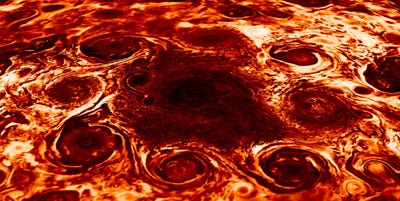

Jupiter has never been the quiet neighbor in our solar system. It is the biggest planet, the fastest-spinning giant, and, judging by its weather, the least likely to pass a calm-vibes inspection. Its cloud bands race around the planet like painted conveyor belts, its storms can swallow Earth without asking permission, and its polar cyclones arrange themselves into geometric patterns that look suspiciously like the planet hired an interior designer with a turbulence degree.
For decades, scientists thought they had a decent working picture of Jupiter’s atmosphere: bright zones, dark belts, powerful winds, and the famous Great Red Spot spinning away like the solar system’s most dramatic cinnamon roll. Then NASA’s Juno spacecraft arrived in 2016 and politely ruined everyone’s simple diagrams. Juno found that Jupiter’s jet streams plunge thousands of miles below the visible cloud tops, polar cyclones stay locked in strange polygonal formations, and massive vortices reach far deeper than expected.
The result is a new and wonderfully confusing portrait of Jupiter. Its storms are not just surface weather. They are clues to the planet’s hidden interior, its formation history, and the behavior of gas giants across the universe. In other words, Jupiter is not merely wearing a stormy outfit. Jupiter is the storm.
Why Jupiter’s Weather Looks So Wild
Jupiter is a gas giant with no solid surface like Earth’s continents and oceans. What we call its “surface” is really the upper visible layer of clouds, mostly made of ammonia ice, ammonium hydrosulfide, and water clouds deeper below. Beneath that, pressure and temperature rise dramatically until hydrogen behaves in exotic ways that do not fit neatly into a middle-school weather chart.
One of the biggest reasons Jupiter looks so striped is its rotation. The planet spins once in roughly 10 hours, even though it is more than 11 times wider than Earth. That rapid rotation organizes the atmosphere into east-west jet streams, separating bright zones and darker belts. The zones are generally associated with rising clouds, while the belts are linked with sinking, clearer regions. The visual effect is gorgeous, but the physics behind it is a heavyweight wrestling match between heat, rotation, chemistry, gravity, and fluid dynamics.
On Earth, jet streams are high-altitude ribbons of wind shaped by temperature contrasts and planetary rotation. On Jupiter, they are bigger, stronger, deeper, and less polite. They wrap around the planet in alternating directions, helping sculpt the familiar bands that even backyard telescopes can reveal on a good night.
Juno Changed the Jupiter Story
Before Juno, scientists mostly studied Jupiter from flybys, telescopes, and limited atmospheric data. Voyager, Galileo, Cassini, Hubble, and ground-based observatories all added important pieces. But Juno was designed to do something special: fly over Jupiter’s poles, measure its gravity and magnetic fields, peer below its clouds with microwave instruments, and map parts of the planet that earlier spacecraft had barely seen.
That polar orbit was a game changer. For the first time, scientists got close views of Jupiter’s north and south poles. Instead of finding a simple cap, they found a circus of cyclones. At the north pole, a central cyclone is surrounded by eight large cyclones. At the south pole, cyclones form another organized cluster. These storms are thousands of miles wide, and some winds inside them reach hundreds of miles per hour.
The strangest part is not just their size. It is their persistence. On Earth, cyclones drift, weaken, merge, and die when they run into land, cooler water, or hostile wind patterns. Jupiter has no continents to break storms apart, but scientists still expected giant polar vortices to interact chaotically over time. Instead, many of Jupiter’s polar cyclones appear remarkably stable, like angry dancers holding formation during a cosmic halftime show.
The Puzzle of Jupiter’s Polar Cyclones
Jupiter’s polar cyclones are deeply perplexing because they behave like a system that should be unstable but somehow keeps working. Imagine placing multiple spinning tops on a table and expecting them not to collide, wobble away, or knock over the snack bowl. Now make each top the size of a continent and put the whole setup on a planet rotating faster than your blender. That is the basic mood of Jupiter’s poles.
The cyclones appear to repel and balance one another through complex fluid interactions. They may be stabilized by a combination of planetary rotation, atmospheric stratification, and the way each vortex exchanges energy with its neighbors. But no single explanation has fully satisfied researchers. Computer models can reproduce some features, yet Jupiter keeps adding “yes, but what about this?” to the conversation.
The polar regions are also different from the neat belts and zones near the equator. Jupiter’s lower latitudes are dominated by east-west flow, while the poles host swirling, clustered vortices. This difference suggests that latitude, heat transport, and planetary geometry all play a role in organizing Jovian weather. The poles are not simply the ends of the planet; they are their own atmospheric laboratories.
Jet Streams That Go Shockingly Deep
One of Juno’s biggest discoveries is that Jupiter’s jet streams are not shallow cloud-top features. Gravity measurements revealed that the planet’s winds extend roughly 1,900 miles, or about 3,000 kilometers, below the visible cloud tops. That means the striped weather layer contains a huge amount of moving mass, far more than scientists once imagined.
This discovery matters because depth changes everything. A shallow jet stream can be treated mostly as weather. A deep jet stream becomes part of the planet’s internal dynamics. If winds reach thousands of kilometers down, they may interact with regions where hydrogen becomes electrically conducting and where magnetic forces start to matter. At that point, Jupiter’s weather is no longer just “clouds doing cloud things.” It becomes a window into the machinery of a giant planet.
Scientists are still working out what drives these deep jets. Heat escaping from Jupiter’s interior likely plays a major role. Unlike Earth, which receives most of its atmospheric energy from the Sun, Jupiter emits more heat than it receives. That internal heat rises through the atmosphere and helps power convection, storms, and jet streams. The Sun adds influence from above, but Jupiter’s deep interior is a major engine room.
The Great Red Spot Is Not Just a Pretty Storm
No discussion of Jupiter’s raging weather would be complete without the Great Red Spot, the planet’s celebrity storm and longtime album-cover model. This massive anticyclone has been observed for nearly two centuries in its current recorded form, and possibly longer if earlier observations refer to the same feature. It has shrunk over time, changed shape, and puzzled astronomers with its color, depth, and durability.
Juno measurements showed that the Great Red Spot extends far below the cloud tops, possibly hundreds of miles into the atmosphere. That is much deeper than many weather features on Earth and deeper than scientists expected for a visible vortex. The storm is not merely painted on Jupiter’s upper clouds; it has roots.
Hubble observations have also shown that the Great Red Spot is not perfectly steady. It can wobble, stretch, compress, and change brightness. Recent observations describe it almost like a giant atmospheric stress ball. That image may not appear in formal textbooks, but it is useful: the storm responds to surrounding jet streams and turbulence, constantly adjusting while somehow surviving.
Webb Adds Another Layer to the Mystery
The James Webb Space Telescope added a fresh twist by discovering a high-speed jet stream above Jupiter’s equator. This narrow jet, moving at about 320 miles per hour, sits above the main cloud decks in the lower stratosphere. Webb’s infrared vision allowed researchers to track features at altitudes different from those observed by Hubble and Juno.
That matters because Jupiter’s atmosphere is layered. Winds at one altitude may not match winds at another. By comparing Webb’s high-altitude observations with Hubble’s cloud-level measurements, scientists can study wind shear, which is the change in wind speed or direction with height. Wind shear is a crucial ingredient in weather systems, whether on Earth or Jupiter, but on Jupiter it plays out on a scale that makes terrestrial meteorology look like a desk fan experiment.
Webb’s discovery also shows that Jupiter still holds surprises even after centuries of observation. We have looked at this planet through telescopes since Galileo’s time, sent spacecraft past it, orbited it, mapped it, and still missed a powerful atmospheric feature until modern infrared instruments caught it in action. Jupiter is basically the solar system’s way of saying, “Nice theory. Try again.”
Why Scientists Are Perplexed
Scientists are not confused because Jupiter is random. They are perplexed because Jupiter is organized in ways that are difficult to explain. Its jet streams are deep but sharply structured. Its cyclones are violent but stable. Its Great Red Spot is shrinking but still persistent. Its atmosphere is turbulent but patterned. The planet behaves like a messy genius: chaotic at first glance, mathematically disciplined underneath.
One challenge is that Jupiter does not have a solid surface. On Earth, mountains, oceans, landmasses, and surface friction help shape and limit weather. Jupiter’s atmosphere flows into deeper layers without a hard boundary. That makes it difficult to define where weather ends and interior physics begins.
Another challenge is scale. Jupiter’s atmosphere is enormous. A storm that looks like a small oval in a telescope image may be larger than a continent. A jet stream that appears as a thin band may involve a mass of gas equivalent to multiple Earths. When scientists model Jupiter, they must account for rotation, pressure, magnetic fields, heat flow, chemistry, cloud formation, and turbulence across depths and distances that are hard to reproduce in laboratories.
What Jupiter Teaches Us About Other Worlds
Studying Jupiter is not just about understanding one dramatic planet with excellent branding. Jupiter is a natural laboratory for giant planets everywhere. Many exoplanets discovered around other stars are gas giants, and some orbit much closer to their stars than Jupiter does. Their atmospheres may be even more extreme, with supersonic winds, permanent day-night temperature contrasts, and chemistry that makes Jupiter look almost modest.
By learning how Jupiter’s jets, cyclones, and vortices work, scientists improve models for planets they cannot visit. Jupiter is close enough for spacecraft and telescopes to examine in detail, but alien enough to challenge Earth-based assumptions. It bridges the gap between familiar meteorology and exotic planetary science.
Jupiter also helps scientists understand the early solar system. As the largest planet, it influenced the formation and migration of smaller bodies. Its composition carries clues about the materials present when the planets formed. Its deep atmosphere and interior structure may reveal how giant planets accumulate gas, heavy elements, and angular momentum.
The Role of Technology in Solving the Mystery
Modern Jupiter science depends on teamwork between spacecraft and telescopes. Juno flies close and gathers gravity, magnetic, microwave, infrared, and camera data. Hubble provides long-term visible and ultraviolet monitoring. Webb observes infrared layers with remarkable sensitivity. Ground-based observatories add repeated tracking, spectroscopy, and support observations.
This combination is powerful because Jupiter changes over time. A single snapshot is useful, but a long movie is better. Scientists need to know whether storms drift, merge, intensify, fade, oscillate, or hold steady. They also need to compare different altitudes and wavelengths. Visible images show cloud tops; infrared data can reveal heat and higher-altitude structures; microwave measurements probe deeper layers.
In a sense, Jupiter is being scanned like a planetary patient with a very dramatic weather condition. The diagnosis is not complete, but the tools are getting sharper. Every close Juno pass and every new telescope campaign adds another layer to the story.
What Comes Next for Jupiter Research?
The next big step is connecting all these observations into more complete models. Scientists want to understand how deep jets form, why they stop where they do, how polar cyclones remain stable, and what powers long-lived storms like the Great Red Spot. They also want to know how water, ammonia, and other compounds move through the atmosphere, because chemistry affects cloud formation and storm behavior.
Future missions to the Jupiter system, including spacecraft focused on icy moons, will continue adding context. Even when a mission’s main target is Europa or Ganymede, observations of Jupiter’s magnetosphere, radiation belts, and atmosphere help complete the system-wide picture. Jupiter is not a planet sitting alone; it is the gravitational and magnetic boss of a complex miniature solar system.
For now, Jupiter remains a magnificent problem. Its cyclones rage. Its jet streams dive deep. Its storms refuse to behave like simple textbook examples. And scientists, rather than being discouraged, are thrilled. In science, a good mystery is not a wall. It is a doorway with equations scribbled all over it.
Experiences Connected to Jupiter’s Raging Weather
There is something humbling about looking at Jupiter through a small telescope after reading about its cyclones and jet streams. In a backyard or on a rooftop, Jupiter may appear as a bright cream-colored disk with a few dark bands and four tiny moons nearby. It looks calm, almost polite. Then you remember that those little bands are roaring atmospheric highways, and that the “small” oval you might glimpse on a lucky night is a storm system large enough to make Earth feel like a marble with weather anxiety.
For many skywatchers, Jupiter is one of the first planets that feels truly alive. Mars is fascinating, Saturn is elegant, Venus is bright and mysterious, but Jupiter changes visibly. Its moons shift from hour to hour. Its cloud belts rotate. The Great Red Spot comes and goes as the planet spins. Watching Jupiter is like watching a living weather map from hundreds of millions of miles away. It is not just a dot; it is a performance.
A memorable Jupiter-viewing experience often starts with impatience. You set up the telescope, aim at the brightest “star” in the sky, adjust the focus, bump the tripod, apologize to the universe, and try again. At first, Jupiter may shimmer because Earth’s own atmosphere is wobbling overhead. Then, during a brief moment of steady air, the bands snap into view. Suddenly, the planet is not an illustration in a science book. It is real, round, striped, and rotating in silence.
Knowing the science makes that view more powerful. Those bands are not decorative lines. They are separated by jet streams driven by rapid rotation and internal heat. The polar cyclones, invisible in most backyard views, are still there, spinning in formations so strange that scientists continue to test new models against them. The Great Red Spot, when visible, is not just a red mark. It is a deep atmospheric vortex with a history longer than many nations.
Even reading Juno mission updates can feel like following a detective story. One year, the big revelation is that Jupiter’s jet streams extend thousands of kilometers deep. Another time, the surprise is that the Great Red Spot has deeper roots than expected. Then Webb finds a fast jet stream above the equator. Each discovery adds a new floor to a building scientists thought they had already measured.
There is also a strange comfort in Jupiter’s confusion. In daily life, we often want clean answers. Jupiter reminds us that nature is under no obligation to be simple. A planet can be beautiful and baffling at the same time. It can follow physical laws while still surprising the people who study those laws for a living. That is part of the joy of science: the universe keeps its best plot twists hidden in plain sight.
For students, amateur astronomers, and curious readers, Jupiter offers a perfect gateway into planetary science. You can begin with a telescope view, move into NASA images, explore Juno data, and end up thinking about fluid dynamics, magnetic fields, chemistry, and exoplanets. Not bad for a bright object that, to the naked eye, looks like a quiet point of light.
The next time Jupiter rises in the evening sky, it is worth taking a moment to look. Somewhere inside that bright disk, cyclones larger than countries are spinning around the poles. Jet streams are racing around the planet and plunging into depths we are still trying to understand. The Great Red Spot is wobbling, shrinking, enduring, and refusing to retire. Jupiter may be far away, but its weather has a way of making the solar system feel thrillingly close.
Conclusion
Jupiter’s raging cyclones and jet streams perplex scientists because they reveal a planet far more dynamic than its cloud-top beauty suggests. Juno, Hubble, Webb, and ground-based observations have shown that Jupiter’s atmosphere is deep, layered, powerful, and surprisingly organized. Its polar cyclones form persistent geometric clusters. Its jet streams plunge thousands of miles below the clouds. Its Great Red Spot has roots that reach deep into the atmosphere and behavior that continues to evolve.
These discoveries matter because Jupiter is more than the biggest planet in our solar system. It is a key to understanding gas giants, planetary formation, extreme weather, and atmospheres on worlds beyond our Sun. The more scientists learn, the more Jupiter resists being reduced to a simple answer. And honestly, that is part of its charm. Some planets whisper their secrets. Jupiter roars them through cyclones the size of continents.
Note: This article is based on publicly available scientific information from NASA, NASA Jet Propulsion Laboratory, the Juno mission, Hubble, Webb/STScI, Southwest Research Institute, and peer-reviewed planetary science reporting.