
Before smart ovens could text you, before robot vacuums mapped the living room with the confidence of a tiny moon rover, and long before anyone asked a washing machine to connect to Wi-Fi, households faced a simpler but equally urgent question: does this thing actually work?
That question sits at the heart of the Good Housekeeping Institute. For 100 years in the United Kingdom, and for more than a century of product testing heritage in the United States, Good Housekeeping has helped consumers cut through advertising sparkle, technical jargon, and the occasional “revolutionary” gadget that is revolutionary mostly in how fast it disappoints.
The story of the Good Housekeeping Institute is not just a magazine story. It is a consumer trust story. It stretches from the age of the wireless radio to the era of Wi-Fi-enabled everything, from hand mixers and pressure cookers to air fryers, beauty serums, sleep gadgets, washing machines, sunscreens, mattresses, and smartphones. Along the way, the Institute became a practical bridge between innovation and everyday life.
A Household Brand Built on a Radical Idea: Test First, Recommend Later
Good Housekeeping began in the United States in 1885, when the magazine launched with a mission centered on improving life in the home. That may sound quaint now, but at the time it was a powerful idea. The home was changing quickly. Electricity, processed foods, factory-made appliances, patent medicines, and mass advertising were transforming what people bought and how they lived.
The problem was obvious: shoppers had more choices, but not always more reliable information. A label could promise purity. A new appliance could promise less work. A beauty product could promise miracles in a jar. But promises are easy. Proof is harder.
That is where Good Housekeeping found its lane. Rather than simply report on household trends, it moved toward testing, investigation, and consumer advocacy. In 1900, the American predecessor of today’s Good Housekeeping Institute opened as the Good Housekeeping Experiment Station. Its purpose was refreshingly practical: study the problems facing homemakers, test products and methods, and share findings that readers could actually use.
In other words, Good Housekeeping did not just ask, “Is it new?” It asked, “Is it safe, useful, durable, fairly described, and worth the money?” That question has aged beautifully.
From Food Safety to Product Claims: The Early Consumer Champion
The early Good Housekeeping testing tradition grew out of serious concerns. Food adulteration was a real threat in the late 19th and early 20th centuries. Milk could be watered down. Preservatives could be dangerous. Labels were not always honest. Consumers needed watchdogs before many modern regulatory systems existed.
Good Housekeeping became one of those watchdogs. Its pages covered food safety, mislabeling, and household hazards. The Institute’s work evolved from kitchen wisdom into scientific evaluation. It was not enough to say that a product seemed good. The brand developed a culture of evidence: test it, measure it, compare it, then explain the result in plain language.
One of the most important figures in this story was Dr. Harvey Washington Wiley, a chemist and physician who helped shape early American food safety standards. After leaving federal service in 1912, Wiley joined Good Housekeeping’s laboratories and continued his consumer-protection work. His presence reinforced the Institute’s identity as more than a lifestyle authority. It was becoming a public-interest testing organization.
The Good Housekeeping Seal: A Shortcut to Trust
The Good Housekeeping Seal became one of the best-known trust marks in consumer culture. Its power came from a simple promise: products bearing the Seal had been evaluated by experts and were backed by a limited warranty. That turned the Seal into something stronger than a decorative badge. It represented accountability.
For shoppers, the Seal offered a shortcut through confusion. A busy parent comparing appliances, a newlywed buying cookware, or a homeowner choosing cleaning products did not have to become a part-time laboratory technician. The Institute had already done the boring-but-important work: checking performance, evaluating claims, and asking whether the product held up under real use.
That is why the phrase “Good Housekeeping Seal of Approval” became part of everyday language. People use it to mean that something has passed a meaningful standard. In a world where every box shouts “premium,” “advanced,” or “game-changing,” an independent standard still matters.
The U.K. Good Housekeeping Institute Turns 100
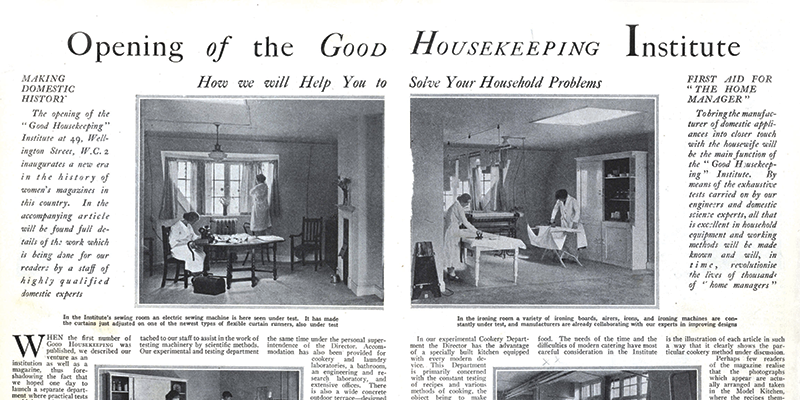
The title “From the wireless to Wi-Fi” fits especially well when looking at the Good Housekeeping Institute in the United Kingdom. Established in 1924, the U.K. Institute has spent a century reviewing products and giving consumer advice through enormous changes in technology, shopping habits, and family life.
In 1924, the “wireless” was a radio, not a router. Homes were adopting electrical appliances, but many families still relied on manual labor for cleaning, cooking, laundry, and heating. A reliable product test could save money, time, and frustration. A bad purchase was not just annoying; it could be expensive, unsafe, or impossible to return without a battle worthy of a courtroom drama.
Over the decades, the Institute’s scope expanded with the home itself. As kitchens became more electrified, testing included mixers, ovens, refrigerators, kettles, and cookware. As beauty and wellness grew into major consumer categories, experts began examining skincare, haircare, cosmetics, and personal care products. As technology entered every room, the Institute moved into televisions, phones, laptops, smart speakers, connected appliances, sleep trackers, and other digital tools.
What stayed constant was the method: test products as people really use them. Drop the suitcase. Wash the sheets. Scramble the eggs. Run the vacuum over the kind of mess a real household creates. Check whether the instructions make sense before a person starts muttering at page three with a screwdriver in one hand and regret in the other.
Testing in the Age of Wi-Fi: More Complicated, More Necessary
Modern product testing is more complex than ever. A washing machine is no longer just a drum with buttons. It may have sensors, app controls, energy settings, steam cycles, quick-wash modes, and claims about fabric care. A mattress may arrive in a box, expand like a magic trick, and promise cooling, spinal support, motion isolation, and cloud-level comfort. A serum may claim hydration, brightening, firming, smoothing, and possibly the emotional support of a small therapist.
This is where the Good Housekeeping Institute’s role becomes even more important. Consumers are not just comparing products; they are comparing claims. Performance, safety, durability, ease of use, energy efficiency, sustainability, comfort, and value all matter. The modern shopper needs clear answers, not a 47-page product description written in marketing fog.
The Institute’s modern labs combine expert analysis with real-world feedback. Scientists, engineers, registered dietitians, fiber specialists, product analysts, beauty chemists, culinary professionals, and consumer testers all help evaluate whether products live up to their promises. This mix matters because laboratory data alone cannot answer every question. A blender can crush ice beautifully but still be so loud it makes the dog reconsider its life choices. A pillow can pass a support test but feel wrong to side sleepers. A smart appliance can work well in theory but make users wrestle with an app that behaves like it was designed during a thunderstorm.
Why Independent Product Testing Still Matters
Consumers today have more information than ever, but not all information is equal. Online reviews can be helpful, but they can also be fake, biased, outdated, or based on one person’s very specific grievance. A five-star review might say, “Arrived quickly, haven’t used yet.” A one-star review might complain that the buyer ordered the wrong size. Neither tells you whether the product performs well.
Independent product testing fills that gap. It creates structure. Products are assessed against criteria, not vibes. Performance can be measured. Durability can be challenged. Claims can be checked. Ease of use can be observed. Value can be weighed against results.
That is especially important in categories where mistakes are costly. A poor mattress can affect sleep. A weak vacuum can waste money and time. A misleading sunscreen claim can matter for health. A badly designed baby product can raise safety concerns. A kitchen appliance that underperforms may become an expensive countertop statue, admired briefly and then ignored forever.
From Radio Sets to Smart Homes: A Century of Changing Consumer Questions
The consumer questions of the 1920s were different from today’s, but the underlying anxiety was familiar. Then, families wanted to know which new electrical products were safe, reliable, and useful. Today, shoppers ask whether a connected device protects privacy, whether an air fryer is easy to clean, whether a detergent works in cold water, whether a hair tool damages strands, or whether an energy-saving appliance actually saves energy.
The wireless radio was once a symbol of modern life. Wi-Fi now plays that role. It connects work, entertainment, shopping, education, security systems, thermostats, doorbells, speakers, appliances, and the tablet a child uses to watch cartoons at a volume that suggests the living room is an airport runway.
Yet the human need remains the same: people want products that make life easier, safer, healthier, and more enjoyable. The Good Housekeeping Institute’s century-long relevance comes from understanding that technology is only impressive when it serves real life. A product does not win because it is clever. It wins because it solves a problem well.
How the Institute Shaped Everyday Confidence
The Good Housekeeping Institute has influenced more than shopping lists. It has helped shape expectations. Consumers now expect claims to be tested. They expect products to be safe. They expect care labels, accurate serving sizes, clearer instructions, better standards, and practical comparisons. Those expectations did not appear out of nowhere. They grew through decades of advocacy, testing, and public pressure from organizations that insisted consumers deserved better.
Good Housekeeping’s history includes early attention to food safety, cigarette advertising, toy safety, clothing care labeling, crib sheet standards, bicycle helmet recalls, thread count accuracy, wellness claims, sunscreen performance, mattress testing, and energy use. Each example points to the same principle: when products enter the home, they should be examined with seriousness.
That seriousness does not make the subject dull. In fact, it makes it more interesting. A suitcase dropped dozens of times is not just a test; it is consumer theater with a purpose. A hand mixer whipping egg whites to stiff peaks is science wearing an apron. A vacuum pushed across cereal, pet hair, and dust is a tiny domestic obstacle course. The humor is built in because real life is messy, and good testing admits that.
The Modern Meaning of “Tried. Tested. Trusted.”
“Tried. Tested. Trusted.” works because it is short, but also because it describes a process. Tried means products are handled, used, and challenged. Tested means the evaluation goes beyond personal opinion. Trusted means the result has value because the organization has built credibility over time.
That trust is difficult to earn and easy to lose. Modern readers are skeptical, and rightly so. They know that affiliate links exist. They know brands pay for advertising. They know influencers can be enthusiastic about a product today and mysteriously enthusiastic about a competing product next week. For a testing organization to remain credible, it has to be transparent about standards, careful with claims, and consistent in its methods.
The Good Housekeeping Institute’s endurance suggests that consumers still want expert filters. They want someone to translate technical information into human terms. They want to know not just which appliance has the biggest number on the box, but which one cleans well, lasts well, saves time, fits their budget, and will not require a postgraduate degree to operate.
Experience: What 100 Years of the Good Housekeeping Institute Means in Real Life
The real experience of the Good Housekeeping Institute is not confined to a laboratory. It happens in the aisle, at the kitchen counter, in the laundry room, during a late-night online shopping scroll, and in the moment when a consumer wonders, “Is this worth it?” That moment is where trust becomes practical.
Imagine shopping for a washing machine. The product pages all sound heroic. Every model promises power, gentleness, quiet operation, smarter cycles, cleaner clothes, lower energy use, and enough advanced technology to make laundry feel like mission control. But in daily life, the questions are more ordinary. Does it remove stains? Does it rinse well? Is the quick cycle actually quick? Will it shake the floor like a marching band? Can a tired person understand the controls on a Tuesday night?
That is the kind of experience the Institute was built to study. It respects the gap between marketing language and lived reality. A product can look elegant in a showroom and still be annoying at home. A vacuum can have impressive suction but be heavy on stairs. A beauty cream can feel luxurious but do little after weeks of use. A smart gadget can sound futuristic but become useless if the app crashes, the setup is confusing, or the Wi-Fi drops every time someone microwaves soup.
For many consumers, a Good Housekeeping recommendation reduces decision fatigue. It does not remove personal preference, and it should not. People still care about budget, design, brand loyalty, space, habits, and taste. But a trusted test helps narrow the field. It says, “Start here. These products have been examined carefully. These claims were not accepted at face value.”
There is comfort in that, especially now. The modern marketplace is noisy. Search results are crowded. Sponsored posts blend into reviews. Social media can make a product famous overnight, sometimes before anyone has asked whether it survives normal use. A blender can go viral because it looks good in a video, not because it blends well for five years. A cleaning hack can spread because it is satisfying to watch, not because it is safe for the surface involved.
The Good Housekeeping Institute offers a slower, steadier kind of confidence. It is the opposite of impulse culture. It says testing matters. Evidence matters. Long-term performance matters. The person using the product matters. That approach feels almost old-fashioned, but in the best way, like a cast-iron skillet or a handwritten recipe card that somehow still beats the trendiest app.
From the wireless to Wi-Fi, the technology changed, but the household experience stayed wonderfully human. People still spill coffee, burn toast, fight stains, compare prices, worry about safety, try to sleep better, cook dinner in a hurry, and hope the new purchase will make life easier instead of creating one more chore. After 100 years, the Good Housekeeping Institute remains relevant because it understands that the home is where products meet reality. And reality, unlike advertising, does not round up.
Conclusion: A Century of Proof in a World of Promises
The Good Housekeeping Institute’s 100-year story is really a story about consumer confidence. It began in an age when the wireless radio represented modern convenience and continues in an era when Wi-Fi connects nearly every corner of the home. Through all that change, the Institute’s central mission has stayed steady: help people make better, safer, smarter buying decisions.
That mission matters because the home keeps evolving. New technologies will bring new promises, new risks, and new confusion. Artificial intelligence, connected appliances, sustainability claims, wellness products, and personalized devices will all need careful evaluation. Consumers will still need someone to ask the practical questions: Does it work? Is it safe? Is it worth the money? Does it make daily life better?
For a century, the Good Housekeeping Institute has answered those questions with testing, expertise, and a healthy respect for real-world mess. That is why its legacy is not stuck in the past. It is plugged in, switched on, and very much connected.
SEO Metadata