I Photographed Foggy Forest Roads And Paths In The Netherlands During Each Season (30 Pics)

Some people see a foggy morning and reach for the snooze button. I see one and begin searching for charged batteries, waterproof shoes, and the camera bag I was absolutely certain I left beside the door.
Over several years, I photographed forest roads and woodland paths across the Netherlands in spring, summer, autumn, and winter. The resulting collection of 30 photographs shows how the same basic ingredientstrees, mist, light, and a road disappearing into the distancecan produce completely different moods.
A green spring trail feels hopeful. A summer road glowing beneath the canopy seems almost tropical. An autumn lane becomes a tunnel of copper and gold, while a bare winter path can look like the opening scene of a mystery in which nobody has remembered to bring a flashlight.
Why Fog Transforms an Ordinary Forest Road
The Netherlands is famous for canals, bicycles, windmills, and landscapes so flat that a speed bump may qualify as local topography. Yet its forests offer an entirely different visual identity. Places such as the Veluwe, the Utrechtse Heuvelrug, Veluwezoom, and Speulderbos contain long woodland roads, sandy trails, old beech trees, pine stands, heathland, and quiet paths that can feel surprisingly remote.
Fog changes these environments by hiding visual clutter. Branches, distant trees, signs, and bends in the road gradually dissolve into pale layers. Instead of seeing the whole forest at once, the viewer receives it in stages: a dark trunk in the foreground, a softer row behind it, and finally a vague suggestion of woodland in the distance.
This natural separation creates depth without requiring dramatic mountains or giant waterfalls. The mist does most of the organizing. It is essentially an unpaid art director with unpredictable working hours.
The Road Becomes the Main Character
A road or footpath gives the eye somewhere to travel. Straight avenues create strong symmetry, while winding trails introduce curiosity. A narrow bend disappearing behind a wall of trees quietly asks, “What is around that corner?” The photograph never answers, which is precisely why the question works.
In several images from this series, the road begins wide at the bottom of the frame and narrows until it disappears into fog. This familiar use of leading lines is especially powerful in mist because the destination remains invisible. The road is not simply transportation through the composition; it becomes the story.
Fog Simplifies Color and Contrast
Dense mist reduces contrast and saturation in distant parts of a scene. Nearby trunks remain dark and textured, while background trees become progressively lighter. That tonal transition can produce a layered, almost three-dimensional effect.
The reduced color palette also makes small details more noticeable. A patch of green moss, a handful of orange leaves, or a beam of warm sunlight can become the visual anchor of an otherwise quiet frame. Fog does not remove information randomly. It edits the landscape until the essential shapes remain.
Spring: Fresh Leaves, Soft Light, and New Beginnings
Spring fog gives Dutch forests a delicate atmosphere. Newly opened leaves are bright, thin, and almost translucent. When early sunlight reaches them, the canopy glows in shades ranging from yellow-green to deep emerald.
The spring photographs in the collection feel open and optimistic. Ferns return beside the paths, damp soil darkens the forest floor, and small plants occupy every available patch of light. Even familiar roads look renewed after the restrained colors of winter.
Spring is also a season of rapid change. A location photographed one week may look dramatically fuller the next. This creates a sense of urgency. Wait too long, and the fragile first leaves mature into a thick summer canopy. Landscape photography may appear calm, but it occasionally involves racing a tree.
Photographing the First Green Canopy
For spring scenes, I often looked for roads bordered by young leaves and dark trunks. That contrast helped the fresh growth stand out. Overcast conditions produced soft, even illumination, while sunlight breaking through thinning fog created brighter, more energetic frames.
It was important not to remove all the haze during editing. The temptation to increase contrast can be strong because foggy files may initially look flat. However, aggressive processing destroys the very depth and softness that made the morning worth photographing. The goal was to reveal detail without turning a peaceful woodland into a superhero movie poster.
Summer: Dense Canopies and Fleeting Morning Mist
Summer fog can be difficult to predict and quick to disappear. When it does arrive, however, the combination of warm air, high humidity, and early light can produce spectacular conditions. The canopy is at its fullest, creating dark tunnels over roads and narrow footpaths.
Summer photographs often contain the strongest contrast between deep green vegetation and pale mist. Grass beside the roads may be wet with dew, and sunlight can create narrow beams between the trees. These rays appear most clearly when the light enters from behind or beside the subject and the air contains enough moisture to scatter it.
The useful window may last only minutes. One moment, the road is wrapped in silver mist; shortly afterward, the sun has cleared the scene and the forest looks perfectly ordinary again. Beautiful, certainlybut no longer behaving like it has been personally hired by a fantasy-film director.
Finding Order Inside the Green Chaos
A summer forest contains an impressive number of leaves, branches, grasses, and shrubs competing for attention. A longer focal length can isolate a cleaner section of the road and compress layers of trees. A wider lens, by contrast, can emphasize the path and include foreground vegetation, but it requires careful inspection of the frame edges.
I learned to move slowly and make small adjustments. A step to the left might separate two overlapping trunks. Lowering the camera could hide a distracting sign behind a fern. In woodland photography, a few inches can turn visual confusion into balance.
Autumn: The Forest Puts On Its Best Outfit
Autumn is the theatrical season. Beech, birch, and oak leaves shift toward yellow, orange, rust, and red, while fallen foliage covers roads with a textured carpet. Add fog, and the forest appears to be showing offpolitely, of course, because this is still the Netherlands.
Several of the 30 photographs focus on tree-lined lanes whose branches form natural arches. In clear weather, these locations are already attractive. Under mist, their backgrounds disappear and the warm leaves seem to float against a cool, neutral atmosphere.
The contrast between warm autumn color and blue-gray fog is especially expressive. It can make a scene feel inviting and mysterious at the same time. The path says, “Come for a walk,” while the mist adds, “The return journey has not yet been discussed.”
Why Fallen Leaves Matter
The canopy is only half of an autumn composition. Leaves on the ground help define curves, tire tracks, puddles, and the edges of a trail. Wet leaves become darker and more saturated, producing richer color after rain or during humid mornings.
I often searched for roads with an uninterrupted layer of foliage. Fresh tire marks or footprints could be useful if they strengthened the leading lines, but random disturbances sometimes weakened the simplicity of the scene. The most successful images generally had a clear visual rhythm: trunks, road, leaves, fog, and one carefully placed highlight.
Waiting for Light to Enter the Mist
Heavy fog alone can produce beautiful minimalist images, but thin fog combined with low sunlight creates a different kind of drama. As the sun rises, beams may appear between the trunks and move across the road. Their position can change quickly, so composing before the light arrives is often better than reacting afterward.
This requires patience and a willingness to look mildly ridiculous while standing beside a tripod in the cold. Fortunately, trees are famously nonjudgmental.
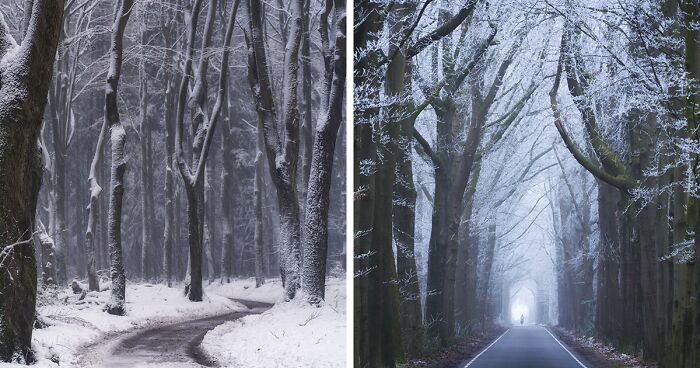
Winter: Bare Branches, Frost, and Powerful Simplicity
Winter removes many of the forest’s decorations. Deciduous trees lose their leaves, paths become more exposed, and the structure of branches takes over the composition. Without colorful foliage, shape and tone become more important.
Fog softens the network of bare branches and prevents the background from becoming too busy. Dark trunks rise from pale surroundings, creating images that can feel quiet, graphic, and slightly haunting. Evergreen trees add occasional blocks of deep green, while frost introduces a thin silver edge to grass and fallen leaves.
Snow is less dependable in much of the Netherlands than fog or rain, which makes a snowy forest morning especially valuable. When snow does arrive, roads and paths become bright leading lines through darker woodland. Camera meters may interpret all that white as excessive brightness and produce an image that looks gray, so exposure often needs careful checking.
Protecting Equipment in Cold, Damp Conditions
Winter photography is not difficult because cameras dislike beautiful scenery. It is difficult because cold batteries drain faster, fingers become less cooperative, and condensation can form when chilled equipment returns to a warm room.
I carried spare batteries close to my body, packed microfiber cloths, and kept the camera protected when moving between temperatures. Allowing cold equipment to warm gradually inside a closed bag reduces the chance of moisture forming directly on lenses and electronics. It also provides an excellent excuse to make coffee before reviewing the photographs.
How I Approached the 30-Photo Collection
This series was not built during one perfect weekend. It developed through repeated visits, failed forecasts, early alarms, changing weather, and many mornings when the predicted fog apparently had more exciting plans elsewhere.
Returning to the same locations was essential. Familiarity helped me understand where the sun would enter, which roads received the most attractive mist, and how each path changed through the year. A location that seemed unremarkable in summer might become ideal after autumn leaves fell. A road hidden beneath a dense canopy could reveal elegant tree shapes in winter.
Planning Without Trying to Control Nature
Fog commonly develops when air near the ground becomes saturated, often during calm, humid conditions. Clear nights, light wind, nearby water, and cooling temperatures can favor morning radiation fog. Forecasts, humidity readings, temperature, and dew-point information can improve the odds, but local conditions still matter.
I treated forecasts as clues rather than guarantees. The final decision often came from looking outside before sunrise and checking whether distant streetlights had developed glowing halos. That low-tech observation was surprisingly useful, although it did require being awake at an hour when even neighborhood cats appeared judgmental.
Camera Settings Were a Starting Point, Not a Rule
Most scenes were photographed at low ISO settings when the camera was supported by a tripod. Midrange apertures provided sufficient depth of field without forcing unnecessarily long exposures. Shutter speed depended on the available light, wind, and whether I wanted moving mist or leaves to remain crisp.
Exposure compensation was sometimes necessary because a bright foggy background could confuse the meter. Histograms and highlight warnings were more reliable than judging brightness from the rear screen in a dark forest.
Autofocus generally worked on nearby trunks or road edges, but very dense fog occasionally required manual focus. The key was to focus on a visible subject rather than asking the camera to lock onto a featureless wall of mist and then taking its refusal personally.
What These Foggy Roads Reveal About the Netherlands
The Dutch landscape is often described through its openness: wide fields, enormous skies, canals, coastlines, and straight horizons. Forest photography reveals its more enclosed and intimate side.
A woodland road reduces the country to a narrow corridor. The broader landscape disappears, and attention shifts to bark, leaves, light, moisture, and distance. In the fog, even a path near a town can feel isolated from modern life.
This does not mean the photographs document untouched wilderness. Many Dutch forests are managed landscapes crossed by cycling routes, walking trails, and access roads. Their beauty comes partly from the relationship between nature and human movement. Roads invite people into the woods while also providing the geometric structure that makes these images immediately readable.
Field Experiences: What Photographing the Same Paths Taught Me
The greatest lesson from this project was that familiarity does not make a landscape boring. It makes observation more precise. During my first visits, I searched for spectacular views. Later, I began noticing smaller changes: one branch leaning over a curve, moss spreading across a trunk, a puddle reflecting the canopy, or leaves gathering in a shallow tire track.
I also learned that arriving early matters more than owning exotic equipment. The most important tool was often the alarm clock, an object that has never received proper recognition in photography magazines. Being present before sunrise allowed me to watch the fog change instead of arriving after the best conditions had vanished.
Some mornings produced no usable photographs. The mist was too thin, the wind was too strong, or the sky remained uniformly dull. Those trips were not wasted. I could scout new roads, study tree arrangements, and decide where I would place the tripod if better light appeared another day.
Weather also forced me to become flexible. I might begin with a wide composition and then switch to a longer lens as the fog thickened. If the sun failed to appear, I looked for quiet, low-contrast scenes. If it broke through unexpectedly, I moved to a position where backlight could reveal rays between the trees.
The physical experience was as memorable as the photographs. Fog dampened sound, making footsteps seem unusually loud. Moisture gathered on the camera, the tripod, and occasionally my eyebrows. The forest smelled of wet bark, soil, mushrooms, and leaves. On colder mornings, breath became another drifting cloud in front of the lens, usually at the exact moment I pressed the shutter.
There were practical surprises too. Cyclists emerged silently from the mist. Dogs appeared several seconds before their owners. A perfectly empty road could become busy just as I finished arranging the composition. Rather than treating every interruption as a problem, I sometimes waited for a small figure to enter the distance. A person or bicycle could provide scale and turn a beautiful scene into a narrative.
Repeated visits encouraged restraint during editing. Early in the project, I was tempted to increase saturation, contrast, and clarity until every leaf demanded individual attention. Over time, I preferred gentler adjustments. Fog should remain soft. Distant trees should remain distant. Mystery disappears when every shadow is opened and every detail is sharpened.
Most importantly, the project changed how I understood seasonal photography. The goal was not to decide which season looked best. It was to recognize what each season contributed. Spring offered renewal, summer density, autumn color, and winter structure. Fog connected them all, turning four distinct versions of the forest into one continuous story.
The 30 photographs are therefore more than a collection of attractive roads. Together, they record repetition, change, patience, and the strange satisfaction of returning to a familiar path without knowing what it will look like this time.
Conclusion: Follow the Road Into the Fog
Foggy forest roads in the Netherlands prove that landscape photography does not require distant mountains, rare wildlife, or an expedition involving six donkeys and a satellite phone. A local path can become extraordinary when weather, timing, and careful observation meet.
Across these 30 photographs, spring softens the forest with new green leaves, summer builds deep tunnels beneath the canopy, autumn fills the roads with warm color, and winter reveals the architecture of trunks and branches. Mist gives every season depth, atmosphere, and just enough uncertainty to keep the viewer looking.
The project also offers a simple reminder: return to places you think you already know. Walk the same road in different weather. Notice where the light falls. Wait while the landscape changes. The most compelling photograph may not be hiding in another country. It may be waiting nearby on a damp morning, quietly disappearing into the fog.