
Few movie fights begin with a disastrous golf round and end with a beloved game-show host standing triumphantly over an unconscious professional golfer. Then again, few movies are Happy Gilmore.
Released in 1996, Adam Sandler’s sports comedy is packed with memorable characters, explosive tantrums, impossible drives, dangerous alligators, and one extremely judgmental miniature-golf clown. Yet the scene that remains permanently lodged in pop-culture history is the showdown between Happy Gilmore and Bob Barker.
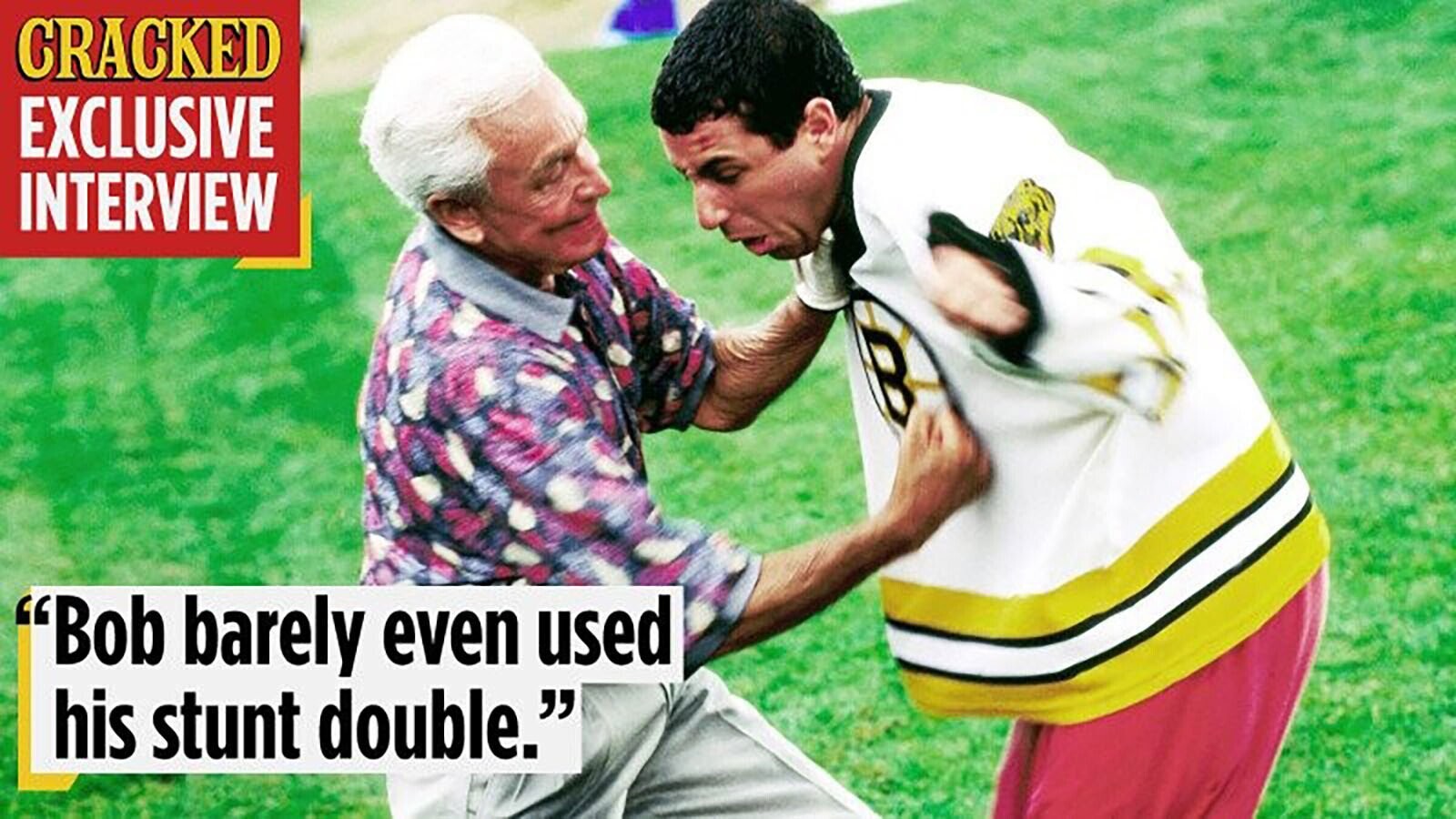
On paper, the sequence sounds ridiculous: the hotheaded hero punches the host of The Price Is Right, only to discover that the silver-haired television gentleman can fight like an action star. On screen, it becomes a beautifully paced collision of surprise, physical comedy, celebrity image, and real martial-arts ability.
The scene worked because Barker was not merely willing to participate. He wanted to throw punches, perform the action, and make absolutely certain that Bob Barker won the fight. Behind the polished game-show smile, apparently, lived a man who had been waiting decades to kick a comedian down a hill.
How the Happy Gilmore Fight Fits Into the Movie
Happy Gilmore follows an unsuccessful hockey player who discovers that his slap-shot technique allows him to hit a golf ball an astonishing distance. Happy enters professional tournaments to earn enough money to recover his grandmother’s home, but his temper, lack of etiquette, and unpredictable putting make him an unusual addition to the golf world.
During a celebrity pro-am tournament, Happy is paired with Bob Barker, appearing as himself. Barker expects to play competitive golf. Instead, he receives a front-row seat to Happy’s complete psychological collapse.
Happy’s game deteriorates rapidly. His shots wander into the wilderness, his concentration disappears, and Barker grows increasingly irritated. The comedy initially comes from their contrast. Barker is controlled, dignified, and accustomed to calmly managing excited contestants. Happy is essentially a hockey penalty wearing golf shoes.
Barker finally tells Happy that his poor performance is embarrassing both of them. Happy, who has never responded to criticism with a healthy breathing exercise, punches him. The audience expects the elderly television host to fall and remain safely outside the remainder of the scene.
Instead, Barker rises and announces that he does not merely want a piece of Happy; he wants the whole thing. The fight then races through punches, kicks, a pond, a headbutt, and a tumble down a grassy slope. Happy briefly believes he has won after delivering his famous Price Is Right insult. Barker gets back up and finishes the job.
Bob Barker Was Not the Original Celebrity Choice
The strangest ingredient in the scene almost never entered the recipe. According to director Dennis Dugan and later comments from Adam Sandler, the celebrity-golf role was originally conceived for Ed McMahon, the longtime television announcer best known for working with Johnny Carson.
McMahon did not take the part, leaving the filmmakers to search for another familiar television personality. Someone suggested Bob Barker, whose warm manner, perfectly controlled delivery, and decades of daytime television made him an even more unexpected opponent for Happy.
The substitution dramatically improved the joke. Audiences knew Barker as the calm host who invited contestants to “come on down,” explained pricing games, and handled chaotic studio audiences without losing his composure. Watching that same man unleash a combination of punches and kicks created immediate comic shock.
Why Barker’s Public Image Mattered
A celebrity cameo is funniest when the performer brings an established identity into the scene. Barker did not appear as a fictional martial-arts instructor or retired boxer. He appeared as Bob Barker, complete with the dignified personality viewers associated with his television career.
The movie then demolished that image without destroying it. Barker remained recognizable and strangely composed even while attacking Happy. He did not transform into a screaming action hero. He simply behaved as though defeating Adam Sandler was another task on the day’s production schedule, somewhere between introducing a showcase and reminding viewers to help control the pet population.
Bob Barker Agreed to Appear on One Important Condition
When Barker was approached, one of his first questions concerned the outcome of the fight. He wanted to know who won. Once he learned that Barker defeated Happy, his interest increased considerably.
That condition was not merely celebrity vanity. Barker knew that the reversal was the heart of the joke. If Happy punched an elderly television host and easily won, the scene would make Happy look cruel rather than foolish. By allowing Barker to dominate the fight, the movie punished Happy’s arrogance and gave audiences permission to enjoy every ridiculous blow.
Barker also reportedly wanted to perform the fighting rather than stand aside while a stunt double handled everything. He understood physical movement, knew how to throw convincing punches, and recognized an opportunity to reveal a side of himself that television viewers had never seen.
The Game-Show Host Had Real Martial-Arts Training
The fight looks surprisingly credible because Barker had spent years studying martial arts. He trained with action star and karate champion Chuck Norris and practiced for an extended period, not merely for a few afternoons before filming.
Sandler later recalled that Barker and Norris had even been neighbors and sparring partners. Barker’s training meant that he understood balance, timing, footwork, and how to control a strike for the camera. The punches could look sharp without becoming an unplanned visit to the emergency room.
This background also changed the filmmakers’ options. Instead of building the entire scene around editing tricks and an obvious double, director Dennis Dugan could show Barker actively participating. The audience sees enough of his face and body during the action to believe that the game-show host is genuinely responsible for Happy’s terrible afternoon.
Filming the Bob Barker and Adam Sandler Fight
The sequence was filmed on a golf course in British Columbia, where much of Happy Gilmore was produced. The coastal scenery gives the scene a grand visual scale, although the weather reportedly made the working conditions less glamorous than the finished movie suggests.
Director Dennis Dugan recalled fog, rain, wet equipment, and cold water. At one point, Happy’s golf club flies out of his hands. That moment was not originally planned; the club was wet, and Sandler lost his grip. Rather than interrupting the comedy, the accident made Happy’s collapsing performance look even more spectacularly hopeless.
The Pond Was as Unpleasant as It Looked
During the fight, Barker knocks Happy into a water hazard. The water was extremely cold, but Sandler agreed to do the fall. That willingness mattered because the gag required a wide, readable shot. The audience needed to see Barker deliver the blow and Happy travel into the pond as one continuous comic event.
Physical comedy often succeeds when performers commit to an uncomfortable action rather than protecting themselves so carefully that the illusion disappears. Sandler’s soaked clothing, awkward recovery, and growing rage make the punishment feel immediate. Happy is not losing a stylish movie duel. He is being publicly dismantled during a celebrity golf event.
Barker Used His Stunt Double Sparingly
Barker was in his early seventies when the movie was filmed, yet Dugan remembered him handling most of the physical action himself. A double may have helped with portions of the tumble down the hill, but Barker performed much of the fighting visible in the finished sequence.
That fact explains why the scene has aged better than many celebrity cameos from the same era. The camera does not have to hide Barker behind frantic cuts. Viewers can appreciate his timing, expression, and movement. He appears engaged in the action rather than digitally or editorially attached to it.
Improvisation Made the Fight Bigger and Funnier
The Bob Barker fight had a scripted foundation, but several of its best details emerged from the location and the collaborative style of Sandler’s production team.
The grassy hill, for example, inspired the filmmakers to extend the fight into a rolling struggle. Barker and Sandler repeatedly tumbled down a relatively modest slope. Through staging and editing, the final sequence makes the descent look absurdly long, as though the golf course contains a secret mountain reserved exclusively for celebrity combat.
The hill gag works because it escalates the scene beyond a conventional fistfight. Each time viewers think the confrontation has reached its natural endpoint, another stage begins. Happy punches Barker. Barker fights back. Happy falls into the water. They roll downhill. Happy delivers a headbutt. Barker rises again.
The Final Insult Was a Late Addition
After defeating Happy, Barker turns away, pauses, and delivers one last insult. According to Dugan, that final word was suggested at the last minute by producer Jack Giarraputo, one of Sandler’s longtime collaborators.
Barker’s delivery makes the tag effective. He does not shout it like Happy. He says it with the confidence of someone who has completed the physical portion of the argument and is now adding a verbal receipt.
The moment demonstrates the value of casting a performer who understands tone. Barker knew that the line would be funnier if he maintained his familiar authority. His voice still sounds like the voice of a game-show host. The only difference is that the contestant has been kicked unconscious.
Why the Showdown Became a Classic Comedy Scene
The fight is not memorable simply because Bob Barker appears in it. Its structure is remarkably efficient. Every new beat overturns an expectation and raises the level of absurdity.
It Uses the Power of Reversal
Happy begins the confrontation believing Barker is physically harmless. The audience makes the same assumption. Within seconds, both Happy and the viewer learn that they have badly misjudged him.
Comedy loves reversals because they allow a scene to surprise audiences without becoming confusing. Barker’s real-life image establishes the expectation, while his martial-arts skill destroys it. The joke is clear before the first punch lands.
Happy Deserves the Consequences
Happy starts the fight, so Barker’s victory feels satisfying rather than mean-spirited. The sequence functions as comic justice. Happy has spent much of the movie threatening people, breaking equipment, and treating golf etiquette as a personal attack. Barker becomes the unlikely figure who finally delivers a correction.
The Violence Remains Cartoonish
Although the punches look convincing, the scene operates according to slapstick logic. Characters recover from blows that would end a real tournament, and the fall down the hill becomes more exaggerated with every rotation. The violence has impact, but it does not become grim.
The editing, reactions, and escalating geography keep the sequence playful. It is less like a realistic street fight and more like a live-action cartoon that happens to feature the host of America’s most famous pricing competition.
The Fight’s Impact on Bob Barker’s Popularity
Barker already possessed an extraordinary television career before Happy Gilmore. However, the cameo introduced him to younger viewers who may not have watched daytime game shows regularly.
Barker later noted that people frequently asked him about the scene and whether he could truly defeat Adam Sandler. The questions demonstrated how completely audiences accepted the performance. Viewers understood that the fight was staged, of course, but Barker moved with enough confidence to leave just a little uncertainty.
The sequence also became a rare example of a celebrity cameo strengthening both the movie and the guest star’s public image. Happy Gilmore gained an unforgettable surprise, while Barker gained a second comic persona: the polite television legend who should never be criticized during a golf tournament.
Sandler and Barker won the MTV Movie Award for Best Fight, beating action sequences featuring conventional movie stars. The award captured the scene’s appeal. A comedy had created a more entertaining showdown than films designed around explosions, stunt teams, and professional heroes.
The Adam Sandler and Bob Barker Rematch
The original confrontation remained popular enough that Sandler and Barker reunited nearly two decades later for a comedy sketch connected to Night of Too Many Stars, a fundraising event supporting autism programs.
The rematch moved the rivalry from a golf course to a hospital room. Barker was in his nineties, but the sketch treated age as a minor administrative detail. Insults escalated, medical equipment became weaponry, and their fictional hostility resumed as though the first fight had ended only during a commercial break.
The reunion confirmed that the chemistry between Sandler and Barker had always depended on mutual trust. Their screen relationship looked hostile because both performers were committed to the joke. Away from the fictional punches, Sandler consistently spoke warmly about Barker’s humor, kindness, and willingness to participate.
What the Scene Reveals About Adam Sandler’s Comedy
The Bob Barker showdown is a compact demonstration of the comic formula that helped define Sandler’s early film career. It combines a childish emotional outburst, a recognizable celebrity, physical punishment, improvisation, and a line audiences can quote after a single viewing.
Yet the scene also reveals careful construction beneath the apparent chaos. The casting establishes the surprise. Happy’s terrible golf creates tension. Barker’s complaints push Happy toward an explosion. The first punch changes the tone, Barker’s recovery reverses the power dynamic, and each physical gag increases the scale.
The sequence feels spontaneous because the performers and director leave room for accidents and new ideas. It remains satisfying because those ideas support a clear dramatic movement: Happy starts confident and ends unconscious.
Conclusion: The Price Was Definitely Wrong
The Bob Barker and Adam Sandler fight remains one of the defining moments of Happy Gilmore because every element fits. The unexpected casting creates instant curiosity. Barker’s martial-arts training gives the action credibility. Sandler’s physical commitment makes the punishment hilarious. Improvisation expands the fight beyond the script, while Barker’s calm delivery turns every threat into a surprise.
Most celebrity cameos ask audiences to recognize a famous face. This one gives the celebrity something unforgettable to do. Barker does not wave from a golf cart, announce a tournament, or repeat a familiar television slogan. He beats the hero decisively and walks away with the dignity of a man who has correctly priced the consequences.
The Viewer Experience: Why Rewatching the Fight Still Works
Rewatching the Happy Gilmore and Bob Barker showdown is an unusual experience because the surprise remains enjoyable even after the outcome is known. First-time viewers laugh because they do not expect Barker to fight back. Returning viewers laugh because they know exactly what is about to happen and can focus on the tiny choices that make the scene work.
Watch Barker’s posture before the first punch. He looks irritated but not dangerous. His body language preserves the image audiences knew from television. He is not preparing for battle; he appears to be calculating how many strokes Happy has added to their score. That restraint makes his transformation feel more dramatic.
Then notice the pause after Happy hits him. The movie gives the audience enough time to assume the confrontation is finished. Barker rises, answers Happy’s challenge, and suddenly moves with real purpose. The timing resembles a well-designed pricing game: first comes the setup, then the reveal, followed by the contestant realizing that everything has gone terribly wrong.
The scene is also more physical than many viewers remember. It is not simply a few punches followed by the famous quote. The action travels across the course, into the water, and down the hill. Every change of location resets the comedy. Just as one gag reaches its peak, the environment provides another opportunity to humiliate Happy.
Watching the sequence with a group adds another layer. Someone usually begins quoting the dialogue before the characters say it. Another viewer points out Barker’s surprisingly clean technique. Someone inevitably asks whether Barker really knew martial arts, which leads to the delightful discovery that the television host had trained for years and was far more prepared than his gentle image suggested.
The fight also offers a lesson for comedy writers and filmmakers. A memorable scene does not always require a complicated premise. The basic idea can be expressed in a sentence: “What if Bob Barker beat up Adam Sandler?” The richness comes from execution. The filmmakers establish character, delay the reversal, use the landscape, encourage improvisation, and finish with a final verbal punch.
For longtime fans, the scene now carries a little nostalgia. It captures an early stage of Sandler’s movie career, when his screen persona was still being defined. It preserves Barker in a performance that contrasts wonderfully with his television work. It also reflects a period when a surprising celebrity appearance could remain largely secret until audiences encountered it in the theater or on home video.
Most importantly, the fight never appears embarrassed by its own silliness. Everyone commits fully. Sandler throws himself into the pond. Dugan lets the tumble continue beyond reason. Barker performs the punches with complete seriousness. Nobody signals that the audience should laugh; the situation earns the laughter naturally.
That commitment is why the showdown remains entertaining decades later. The famous line may attract the quotes, but the scene’s durability comes from pacing, performance, and contrast. It is a carefully constructed piece of comic storytelling disguised as two men ruining a perfectly respectable day of golf.