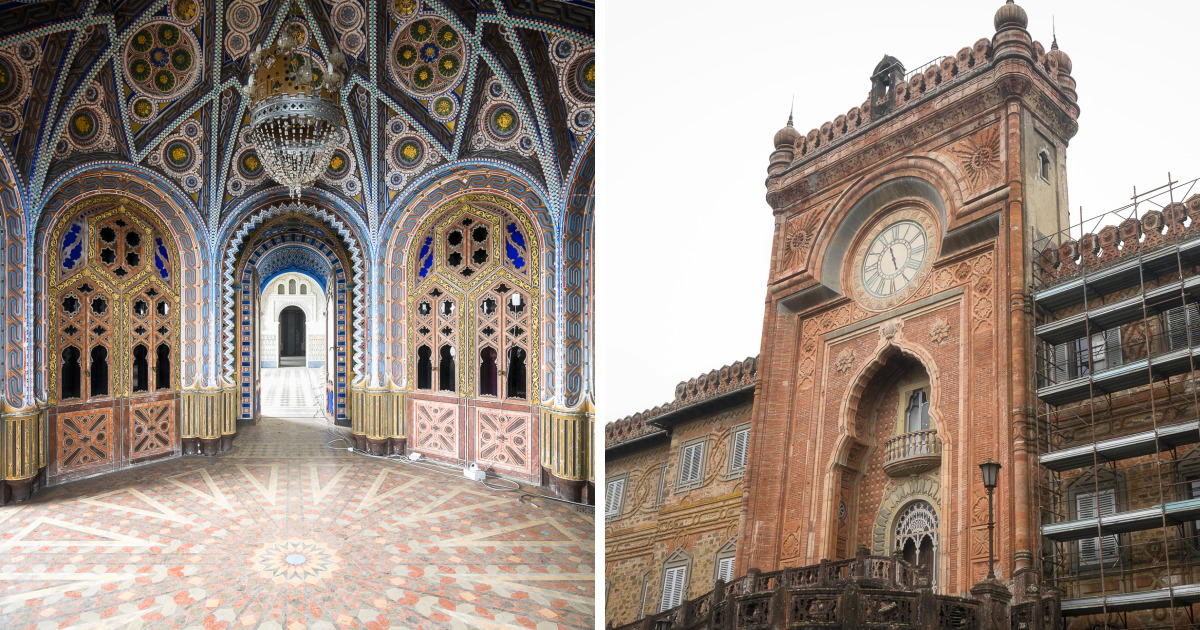

There are castles that look like fortresses, castles that look like wedding cakes, and then there is the Castle of Sammezzano, which looks as if a rainbow, a geometry textbook, and a very dramatic opera singer all moved into the same Tuscan villa and refused to leave. I went there expecting beauty. I left with a camera roll that looked like it had been dipped in saffron, turquoise, ruby, emerald, and a suspicious amount of magic.
Hidden in Leccio, a small hamlet of Reggello near Florence, Castello di Sammezzano is one of the most extraordinary examples of Moorish Revival architecture in Italy. From the outside, it has the presence of a romantic Tuscan estate. Inside, however, it becomes a kaleidoscope: carved arches, painted ceilings, arabesques, muqarnas, patterned floors, and rooms that seem to have been designed by someone who looked at minimalism and said, “Absolutely not, thank you.”
This article is part travel story, part architectural appreciation, and part love letter to a place that deserves more than a quick scroll on social media. Photographing Sammezzano Castle was not simply about pointing a lens at pretty walls. It was about learning how light behaves in forgotten rooms, how color can hold history, and how a building can feel both abandoned and very much alive.
Where Is The Castle Of Sammezzano?
The Castle of Sammezzano sits in the hills of Tuscany, in the municipality of Reggello, roughly a short drive southeast of Florence. It is surrounded by a historic parkland known for exotic trees, including giant sequoias planted during the estate’s 19th-century transformation. The setting matters. Sammezzano does not sit in the middle of a crowded city square begging tourists to admire it. It hides among trees like a very elegant secret.
That sense of concealment is part of the attraction. The approach feels cinematic: Tuscan roads, greenery, a hint of tower through branches, and then the realization that the building ahead is not just another old villa. It is a full-blown fantasy in brick, stucco, tile, and color. Even before entering, the castle carries the strange energy of a place that has seen aristocrats, artists, hotel guests, preservation campaigns, trespassers, photographers, and dreamers all project their own stories onto it.
A Brief History: From Tuscan Villa To Moorish Revival Masterpiece
The earliest version of Sammezzano dates back centuries, with the estate commonly linked to a 17th-century palazzo associated with the Ximenes d’Aragona family. But the castle we marvel at today is largely the vision of Marquis Ferdinando Panciatichi Ximenes d’Aragona, a 19th-century aristocrat, politician, engineer, collector, botanist, and creative force with the kind of résumé that makes the rest of us feel proud for remembering to water a basil plant.
Between the mid-1800s and the late 19th century, Ferdinando transformed the property into an Orientalist dreamscape. He drew inspiration from Moorish, Islamic, Andalusian, Mughal, Persian, and other decorative traditions, while filtering them through European eclectic taste. The result is not a copy of the Alhambra or any single monument. It is a personal invention: a Tuscan castle imagining the East through scholarship, fantasy, craftsmanship, and the 19th-century appetite for exotic design.
What makes Sammezzano especially fascinating is the intensity of the vision. The marquis did not add one decorative hall and call it a day. He created a sequence of spaces with distinct personalities. Some rooms feel ceremonial and grand. Others feel jewel-like and intimate. Many are covered in dense ornamentation: geometric patterns, floral motifs, inscriptions, arches within arches, and color combinations that should be illegal on paper but somehow sing in real life.
The Architecture: Why Sammezzano Looks So Otherworldly
Sammezzano Castle is often described as Moorish Revival, but that label only starts the conversation. Moorish Revival architecture in Europe frequently borrowed horseshoe arches, intricate tilework, patterned surfaces, domes, and ornamental screens from Islamic architecture, especially the architecture of Spain and North Africa. At Sammezzano, those influences are pushed into full theatrical mode.
Arches, Muqarnas, And Rooms That Refuse To Be Boring
One of the first things a photographer notices is rhythm. Arches repeat. Columns frame doorways. Doorways frame other doorways. Patterns climb walls and spill across ceilings. Muqarnas, the stalactite-like ornament often associated with Islamic architecture, creates depth and shadow. In photographs, these elements help guide the eye, producing natural leading lines that make each image feel carefully composed even before editing.
The famous Peacock Room is perhaps the castle’s celebrity chamber, and deservedly so. Its fan-like ceiling bursts with color and symmetry, producing an effect that is both architectural and almost biological, like standing inside the open tail of a mythical bird. The colors are not shy. They do not whisper. They arrive with trumpets.
Color As A Storytelling Tool
Photographing Sammezzano taught me that color can be structure. In many buildings, color is decoration applied after the architecture is complete. Here, color helps define the architecture itself. Blue outlines an arch. Gold lifts a ceiling. Red warms a shadow. White rooms glow differently from polychrome halls. The color is not merely beautiful; it tells you where to look.
This is why Sammezzano Castle photography is so addictive. Every time you think you have captured the room, you notice another layer: a tiny painted border, a flower hidden inside a pattern, a faded tile catching light from a side window, a ceiling detail that suddenly becomes the star of the frame. It is the rare place where wide-angle shots, close-ups, and abstract compositions all work beautifully.
The Challenge Of Photographing An Amazing Abandoned Castle
Sammezzano has long been associated with abandonment, closure, preservation debates, and restricted access. For years, it was admired from a distance, occasionally opened during special heritage events, and often discussed as one of Italy’s great endangered architectural treasures. That context changes the mood of the photographs. The castle is not a polished museum where every surface has been scrubbed for visitors. It has scars.
As a photographer, that creates a delicate responsibility. Decay can be visually powerful, but it should not become the whole story. Sammezzano is not beautiful because it is neglected. It is beautiful despite neglect. The peeling surfaces, dust, closed doors, and quiet corridors should remind us that places like this need care, expertise, money, and public attention. A dramatic photo may get likes; restoration work is what gives the building a future.
Light Was The Real Director
Inside the castle, natural light behaves like a mischievous tour guide. It slips through windows, falls across patterned floors, and highlights details you might otherwise miss. Some rooms are bright and airy; others are moody, with shadows pooling in corners. I quickly learned not to fight the light. Instead, I waited. A few minutes could change the entire mood of a room.
In the whiter halls, exposure was tricky because the surfaces bounced light everywhere. In the darker, more colorful rooms, the camera wanted to flatten the atmosphere unless I protected the highlights and allowed the shadows to remain a little mysterious. Sammezzano does not need to be over-brightened. Its shadows are part of its voice.
Composition Tips From The Castle Itself
The best compositions came from listening to the architecture. In the halls with repeated arches, I stood centered and let symmetry do the heavy lifting. In smaller rooms, I moved closer to surfaces, turning ceilings and walls into abstract fields of pattern. When a doorway opened into another room, I used it as a frame within the frame. The castle offers these opportunities constantly, as if Ferdinando secretly designed it for future photographers with full memory cards.
A wide-angle lens helps, but it can also distort the geometry if used carelessly. The trick is to keep vertical lines as straight as possible and avoid making the rooms look cartoonishly stretched. A tripod would be ideal where permitted, but even handheld shooting can work if you use steady technique, raise the ISO carefully, and resist the urge to sprint from room to room like an excited squirrel with a press pass.
Why Sammezzano Castle Matters Beyond Instagram
It is easy to understand why Sammezzano became famous online. The interiors are photogenic in the most immediate sense: bright, intricate, strange, and spectacular. But reducing the castle to “Instagrammable” misses the larger point. Sammezzano matters because it represents a rare and ambitious fusion of architecture, decorative art, botany, personal vision, and cultural imagination.
It also raises useful questions. How should we preserve buildings born from historical fascination with other cultures? How do we discuss Orientalist art honestly while still appreciating craftsmanship? How do private ownership, public heritage, tourism, and restoration funding work together without turning fragile monuments into theme parks? Sammezzano is beautiful, yes, but it is also complicated, which is one reason it stays in the mind after the colors fade from the camera screen.
The Park: A Green Frame Around A Painted Dream
The castle’s surrounding park deserves attention, too. Ferdinando was not only interested in interiors. He planted exotic species and shaped a landscape that complemented the building’s atmosphere. The giant sequoias are especially important, giving the estate a botanical character rare in Tuscany. Walking through the park, the castle feels less like an isolated object and more like the centerpiece of a designed world.
For photographers, the park provides a useful visual reset. After the intensity of the interiors, the trees calm the eye. Exterior shots benefit from distance, because the building’s façade needs space to breathe. The best images are not always the closest ones. Sometimes the most powerful photograph is a glimpse of the castle through branches, reminding viewers that Sammezzano is still partly hidden, still waiting, still not fully returned to public life.
A New Chapter: Restoration And Hope
Recent restoration plans have brought new hope to Sammezzano. After decades of uncertainty, failed efforts, and public concern, new ownership and renewed preservation work have pointed toward a future in which the castle and its historic park may be restored and reopened in a more stable way. Plans reported in recent coverage include museum functions, hospitality uses, events, and the recovery of the surrounding landscape.
That future must be handled carefully. A building this ornate is not a backdrop to be exploited; it is a fragile cultural object. Restoration will require skilled craftspeople, conservation knowledge, patient planning, and a balance between access and protection. The dream is not simply to let more people inside. The dream is to let people inside without destroying what they came to see.
How I Would Photograph Sammezzano Again
If I had another chance to photograph the Castle of Sammezzano, I would go slower. That is the honest answer. The first visit to a place like this makes your brain behave like a browser with 47 tabs open. Every room says, “Look at me!” Every ceiling says, “No, look up!” Every floor pattern says, “Excuse me, I also wore something special.” It is easy to take hundreds of images and still feel you missed half the story.
Next time, I would build a shot list around themes rather than rooms: symmetry, color, decay, light, doorways, ceilings, details, and the relationship between the castle and the park. I would photograph the same doorway from multiple angles. I would wait longer for light to move. I would include more human scale where allowed, because a person standing beneath those arches helps viewers understand just how grand and intricate the spaces really are.
Experience Notes: What Photographing The Castle Of Sammezzano Felt Like
Photographing Sammezzano felt less like documenting a building and more like entering a conversation already in progress. The castle seemed to speak in patterns. Some rooms shouted in color; others murmured in dust and pale light. I remember standing beneath a ceiling so detailed that my neck began negotiating terms with the rest of my body. “One more minute,” I promised. My neck did not believe me. It had seen photographers before.
The first lesson was humility. Online images make Sammezzano look almost unreal, but they also flatten it. In person, the rooms have temperature, silence, scale, and texture. You notice the unevenness of age. You notice where time has softened a color or where a decorative edge has survived against all odds. The camera captures the spectacle, but being there reveals the fragility. That difference changed the way I shot. I stopped chasing only the biggest wow moment and began looking for quieter evidence of survival.
The second lesson was patience. At first, I wanted to photograph everything immediately, which is the natural human response to walking into a room that looks like a peacock married a palace. But the better images appeared when I slowed down. A beam of light crossed a patterned floor. A dark arch suddenly framed a glowing white hall. A ceiling detail that looked chaotic from one angle became perfectly ordered from another. Sammezzano rewards the photographer who waits, breathes, and resists panic-clicking the shutter like a caffeinated woodpecker.
The third lesson was respect. Because the castle has faced neglect and limited access, every photograph carries an ethical weight. I wanted my images to inspire curiosity, not trespassing. I wanted them to say, “This place is extraordinary and should be protected,” not “Go sneak in for content.” Historic buildings are not props. They are physical memory. When they are damaged, we lose more than a pretty location; we lose craft, context, and the human effort embedded in every arch and tile.
My favorite image from the day was not necessarily the most colorful. It was a doorway leading from shadow into light, with patterns fading at the edges and a brighter room waiting beyond. It captured what Sammezzano felt like to me: a place between past and future, abandonment and revival, fantasy and responsibility. That is why the castle stays with me. It is beautiful enough to make you gasp, but vulnerable enough to make you care.
If you love architecture photography, Tuscany travel, abandoned castles, or simply places that refuse to be ordinary, Sammezzano belongs on your dream list. Whether seen in person someday through proper public access or admired through carefully made images, it reminds us that imagination can become architecture. It also reminds us that architecture needs guardians. Beauty may attract the eye, but care is what keeps the doors from closing forever.
Conclusion
The Castle of Sammezzano is not just an amazing Tuscan castle; it is a masterpiece of color, craft, eccentricity, and endurance. Its Moorish Revival interiors make it one of the most visually unforgettable places in Italy, while its history of neglect and restoration gives every photograph a deeper meaning. Photographing Sammezzano was a privilege because the castle is more than a subject. It is a reminder that wonder can be built, forgotten, rediscovered, and, with enough care, saved.