
Note: This article is a fresh, original synthesis based on established museum, art-history, folklore, and mythology references about Celtic art, Insular manuscripts, early Irish visual culture, and animal symbolism in Celtic stories.
Introduction: When Myth Walks on Four Legs, Flies Over Battlefields, and Swims Into Wisdom
Celtic mythology has never been shy about animals. In these old stories, creatures do not simply decorate the background like polite wallpaper. They speak, warn, transform, guide, challenge, bless, terrify, and occasionally make humans look hilariously underqualified for life. A salmon can carry wisdom. A raven can announce doom. A horse can represent sovereignty. A stag can step out of the forest like it owns the placebecause, symbolically speaking, it often does.
That is why artwork inspired by the animals in Celtic mythology continues to fascinate artists, illustrators, tattoo designers, sculptors, jewelers, fantasy creators, and lovers of ancient storytelling. Celtic animal art blends myth, nature, spirituality, and design into one visual language. It is mysterious without being vague, ancient without being dusty, and decorative without being merely pretty. In other words, it has range.
From the twisting creatures of illuminated manuscripts to modern digital paintings of the Morrígan’s ravens, Celtic mythology gives artists an entire forest, sky, stable, river, and underworld of inspiration. These animals are not random mascots. They carry meaning: courage, transformation, prophecy, fertility, kingship, memory, death, protection, and creative power.
This article explores how Celtic mythological animals inspire artwork, why their symbolism remains powerful, and how modern creators can use these ancient creatures in fresh, meaningful ways without turning every design into “green knotwork plus a wolf because vibes.” We love vibes. We also love depth.
What Makes Celtic Animal Art So Distinctive?
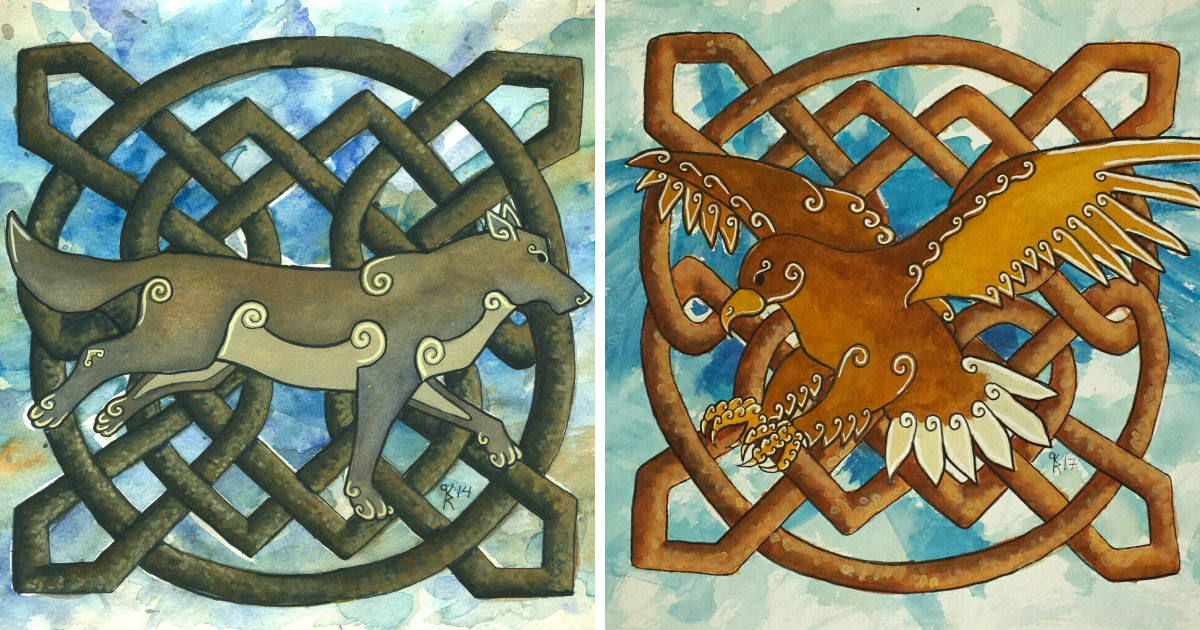
Celtic animal-inspired artwork is instantly recognizable because it often combines symbolic creatures with flowing lines, spirals, knots, interlaced bodies, and rhythmic patterns. In early medieval Insular art, especially in Irish and British manuscript traditions, animals were frequently woven into letters, borders, and sacred pages. A bird might become part of a capital letter. A serpent might curve into a knot. A lion, fish, dog, or bird could stretch, fold, and loop until it became both creature and ornament.
This style is not just decoration. It reflects a worldview in which nature, spirit, and story are interconnected. The animal body becomes a path. The line becomes a journey. The knot suggests continuity. The spiral hints at cycles of life, death, rebirth, seasons, and transformation. Basically, Celtic design looked at a straight line and said, “Cute, but what if we made it eternal?”
Artists inspired by Celtic mythology often borrow several visual features: intricate knotwork, symmetrical composition, strong silhouettes, earthy colors, gold accents, stone-like textures, manuscript-style borders, and stylized animal forms. The result can feel ancient, magical, and alive at the same time.
Common Celtic Art Elements Used With Animals
Popular design elements include triskelion spirals, interlaced knots, circular borders, tree motifs, moon shapes, torcs, antlers, feathers, braided tails, flowing manes, and abstract patterns that echo metalwork or illuminated manuscripts. These details help connect modern artwork to the wider visual heritage of Celtic art.
The Stag: Forest Majesty, Wild Wisdom, and the Horned Divine
The stag is one of the most powerful animals in Celtic-inspired artwork. With its branching antlers, quiet alertness, and commanding presence, the stag naturally lends itself to mythic design. It represents wilderness, leadership, renewal, and the mysterious intelligence of the forest.
In Celtic and Gallo-Roman imagery, the antlered figure often associated with Cernunnos has become one of the most recognizable symbols of wild nature and fertility. Although scholars remain careful about exactly how much mythology can be reconstructed around Cernunnos, the image of a horned or antlered figure surrounded by animals has deeply influenced modern Celtic art.
Artists often portray the stag standing at the edge of a misty forest, crowned with antlers that transform into branches, stars, or knotwork. In tattoo art, a stag’s antlers may contain moons, roots, or interlaced patterns. In digital fantasy illustration, the stag may glow with Otherworldly light, looking less like an animal and more like a forest that learned how to walk.
Art Idea: The Stag as a Living Gateway
A beautiful concept for Celtic mythology artwork is a stag whose antlers form a doorway into the Otherworld. Inside the antlers, an artist could paint a moonlit path, ancient stones, ravens, or a river of stars. This design suggests that nature itself is the threshold between ordinary life and sacred mystery.
The Raven and Crow: Prophecy, Battle, and the Morrígan’s Shadow
If the stag is the noble guardian of the forest, the raven is the dramatic goth poet of the battlefield. In Irish mythology, the Morrígan is strongly associated with war, fate, prophecy, and the crow or raven. These birds often appear as omens, hovering near conflict and reminding everyone that destiny has entered the chat.
Raven-inspired Celtic artwork usually carries a darker, more intense energy. Artists may show black wings crossing a blood-red sky, a raven perched on a standing stone, or a crow surrounded by knotwork and storm clouds. This imagery works especially well for themes of transformation, feminine power, prophecy, grief, and fierce protection.
However, the raven should not be reduced to “spooky bird equals death.” In Celtic-inspired art, the raven can also symbolize intelligence, watchfulness, magic, and the power to see what others cannot. Ravens are problem-solvers in real life, too, which means the ancient storytellers were clearly paying attention. Or perhaps the ravens told them. Honestly, either option feels possible.
Art Idea: The Morrígan’s Raven
A striking composition might feature a raven with one wing made of feathers and the other made of Celtic knots. Behind it, a silver moon rises over a battlefield that is suggested rather than shown. This keeps the mood mythic, not gruesome, while honoring the bird’s connection to fate and battle.
The Salmon: Wisdom From the Deep
The Salmon of Knowledge is one of the most beloved animals in Irish mythology. In the famous tale of Fionn mac Cumhaill, the salmon gains wisdom after eating hazelnuts that fall into a sacred well. Fionn accidentally tastes the salmon while cooking it and receives its knowledge. This is possibly the most legendary case of “kitchen accident turns into spiritual awakening” ever recorded.
For artists, the salmon offers a very different mood from the raven or boar. It is fluid, reflective, and luminous. Salmon-inspired Celtic art often includes water, hazel leaves, spirals, sacred wells, and shimmering scales. The fish can be drawn as a graceful curve, making it perfect for circular compositions, jewelry designs, book illustrations, and tattoos.
The salmon symbolizes wisdom, intuition, poetic inspiration, memory, and the hidden knowledge beneath the surface of life. It is an ideal subject for artwork about learning, creativity, and spiritual insight.
Art Idea: The Salmon and the Nine Hazels
An artist could create a circular design featuring a salmon swimming around a deep blue well. Around the border, nine hazel leaves or nuts could appear, each containing a tiny knot or star. This type of image would work beautifully as a print, oracle card, journal cover, or meditative wall art.
The Boar: Courage, Ferocity, and Warrior Energy
The boar appears throughout Celtic tradition as a symbol of courage, strength, abundance, and warrior power. Wild boars are not exactly known for being gentle woodland therapists. They are tough, fearless, and fully prepared to ruin someone’s afternoon. That made them excellent symbols for battle readiness and boldness.
In Celtic-inspired artwork, the boar often appears with bristling hair, curved tusks, muscular form, and a forward-charging pose. It can be rendered in bronze-like textures to echo ancient metalwork or surrounded by red and gold patterns to suggest fire, feasting, and combat.
The boar also has associations with the hunt and with elite feasting. In mythic storytelling, hunting a great boar is rarely just a sporting event. It is a test of heroism, endurance, and fate. If a hero goes after a supernatural boar, you can safely assume the day will not end with a casual picnic.
Art Idea: The Boar Shield
A powerful design could place a stylized boar at the center of a round shield, with tusks forming crescent shapes and knotwork running through the body. This would work well for fantasy concept art, heraldic-style illustration, leatherwork, or carved wood panels.
The Horse: Sovereignty, Movement, and Otherworldly Grace
Horses hold a special place in Celtic mythology and art. They are connected with travel, nobility, fertility, the land, and sovereignty. The horse goddess Epona was widely honored in the ancient Celtic and Roman worlds, and in Welsh tradition, Rhiannon is strongly associated with horses and Otherworldly movement.
In artwork, the Celtic horse is elegant, powerful, and often slightly supernatural. It may be shown running across a moonlit hill, carrying a goddess, or emerging from swirling mist. The mane can become knotwork. The hooves can spark stars. The body can be decorated with spirals that suggest speed and sacred energy.
Horse imagery is especially effective for themes of freedom, leadership, feminine divinity, transition, and the bond between human and land. A white horse, in particular, can create a strong sense of magic and royal presence.
Art Idea: Rhiannon’s White Horse
A modern illustration might show a white horse moving calmly through a landscape while no one can quite catch up to it. The background could include soft gold birds, a low moon, and flowing Celtic borders. The mood should feel graceful, elusive, and just a little smugas any mythic horse with supernatural timing has earned the right to be.
The Wolf and Dog: Loyalty, Guardianship, and the Wild Edge
Dogs and wolves appear in Celtic stories as hunters, protectors, companions, and symbols of loyalty or ferocity. The Irish hero Cú Chulainn’s name is often translated as “hound of Culann,” connecting heroic identity with canine strength and duty. In art, the hound can represent devotion, courage, and the warrior’s bond with the wild.
Wolves, while sometimes treated differently across regions and later folklore, are frequently used in modern Celtic-inspired artwork to express instinct, family bonds, wilderness, and protection. The challenge for artists is to keep the design rooted in Celtic visual language rather than drifting into generic fantasy wolf territory. Not every wolf needs a full moon and blue lightning. Sometimes a good knot border can do the heavy lifting.
Art Idea: The Guardian Hound
A strong composition could feature a hound standing before a stone circle, its body filled with interlaced patterns. The eyes might be bright amber, suggesting watchfulness. This image could symbolize loyalty to family, ancestors, or sacred duty.
The Swan: Beauty, Transformation, and Enchanted Sorrow
Swans are deeply associated with transformation in Celtic storytelling. One of the most famous Irish tales, the Children of Lir, centers on children transformed into swans for centuries. Because of this, swan artwork often carries emotional weight: beauty mixed with grief, endurance, innocence, and enchantment.
Visually, the swan is perfect for Celtic-inspired design because its long neck creates graceful curves that can echo knots and spirals. Two swans facing each other can form a heart shape, a moon shape, or a mirrored knot. Their wings can be filled with delicate patterning, making them ideal for fine-line illustration, silver jewelry, embroidery, and stained-glass-inspired art.
Art Idea: The Swan Transformation
An artist could show a human figure dissolving into a swan, with feathers becoming white knotwork. The background might include a cold lake, reeds, and a pale dawn. This design would capture both the sadness and beauty of transformation myths.
The Serpent and Dragon: Earth Energy, Mystery, and Power
Serpents and dragon-like creatures appear in Celtic and wider European mythic imagery as symbols of earth power, protection, danger, and transformation. In some ancient iconography associated with horned figures, ram-horned serpents appear as mysterious companions. In later Celtic-inspired art, dragons became especially popular, particularly in Welsh symbolism.
Serpent artwork works well with Celtic knotwork because the snake’s body naturally becomes a line. It can coil, loop, twist, and disappear into itself. This makes it perfect for designs about cycles, hidden knowledge, and regeneration. Dragon art, meanwhile, can be bold and dramatic, combining wings, claws, scales, and fiery breath with elaborate interlace.
The key is balance. A Celtic serpent does not need to look like a video game boss unless that is the goal. Sometimes the most powerful design is simple: one coiled serpent forming a knot around a stone, tree, or moon.
How Ancient Celtic Art Influences Modern Animal Artwork
Modern artists draw heavily from early Celtic and Insular art traditions. The Book of Kells, the Book of Durrow, carved crosses, metalwork, torcs, shields, brooches, and ancient coins all provide visual inspiration. These works often use abstraction rather than realism. Animals are stretched, stylized, patterned, and transformed into design systems.
This is one reason Celtic animal art feels so adaptable today. It can be traditional or modern, minimalist or highly detailed, spiritual or decorative, dark or playful. A raven can become a logo. A salmon can become a watercolor print. A stag can become a fantasy book cover. A horse can become a tattoo. A boar can become a brewery label, though the boar would probably demand royalties.
Popular Mediums for Celtic Mythology Animal Art
Artists use Celtic animal themes in digital illustration, tattoo design, linocut printing, watercolor, acrylic painting, wood carving, metal jewelry, leather tooling, embroidery, stained glass, ceramics, and fantasy concept art. The style is especially popular in book covers, oracle decks, altar art, gaming design, and heritage-inspired home decor.
Color Palettes for Celtic Mythological Animal Art
Color plays a major role in setting the emotional tone. Earthy greens, deep browns, bronze, gold, and moss tones work well for stags, boars, and forest creatures. Black, silver, crimson, and storm-gray suit ravens and battle imagery. Blues, teals, pearl, and white are perfect for salmon, swans, and water-based myths. Rich red and gold can make horse or dragon artwork feel royal and energetic.
Artists can also draw inspiration from illuminated manuscripts, using jewel-like colors: deep blue, bright red, warm yellow, soft green, and creamy parchment backgrounds. This gives the artwork an ancient manuscript feeling without copying historical pages directly.
Tips for Creating Artwork Inspired By The Animals In Celtic Mythology
1. Start With the Story, Not Just the Animal
Before drawing a raven, ask what kind of raven it is. Is it the Morrígan’s bird of prophecy? A battlefield omen? A wise watcher? A messenger from the Otherworld? The story will guide the pose, colors, symbols, and mood.
2. Use Knotwork With Purpose
Knotwork is beautiful, but it should support the meaning of the piece. Use interlace to suggest continuity, fate, ancestry, transformation, or spiritual connection. Do not just sprinkle knots everywhere like decorative parsley.
3. Respect the Mythic Source
Celtic mythology includes Irish, Welsh, Scottish, Brittonic, Gaulish, and other related traditions. They overlap, but they are not identical. A little research helps avoid mixing everything into one giant “Celtic soup.” Soup is great. Mythology deserves slightly better labeling.
4. Blend Real Animal Anatomy With Stylization
The best Celtic animal artwork often balances recognizable anatomy with ornamental design. Study the actual animal first, then stylize. A salmon should still feel like it can swim. A horse should still feel like it can run. A boar should still look like it might make poor decisions at high speed.
5. Add Symbols That Deepen Meaning
Hazelnuts, wells, antlers, torcs, standing stones, moon phases, feathers, shields, trees, and spirals can all add symbolic depth. Choose details that connect to the animal’s mythological role.
Specific Examples of Celtic Animal Artwork Concepts
The Wisdom Salmon Poster
Create a vertical poster showing a silver salmon leaping from a dark pool. Around the fish, hazelnuts fall like golden stars. The border features blue and green knotwork, while the title could be written in a manuscript-inspired font. This concept suits educational prints, library decor, or spiritual art spaces.
The Raven Queen Illustration
Design a black raven with a subtle female face suggested in the wing pattern, referring to the Morrígan without making the image too literal. Use red thread-like lines to suggest fate and battle. The result would be dramatic, symbolic, and perfect for dark fantasy art.
The Cernunnos Stag Emblem
Draw a stag head with antlers forming a circular knot. Add small animals hidden inside the antlers: a snake, bird, and deer. Use bronze and forest-green tones for an ancient sacred-object feeling.
The White Horse of Sovereignty
Paint a white horse moving across a green hill under a gold sky. Its mane becomes interlaced ribbons, and small birds follow behind. This image can represent Rhiannon, Epona, freedom, leadership, and the living power of the land.
Why These Mythological Animals Still Matter in Modern Art
Celtic mythological animals remain popular because they speak to themes people still care about: courage, wisdom, identity, grief, transformation, freedom, and connection to nature. A person who chooses a raven tattoo may be honoring survival. Someone who paints a salmon may be exploring knowledge. A stag print may express reverence for wilderness. A horse image may symbolize independence and dignity.
These animals also allow modern artists to create work that feels both personal and ancestral. You do not need to recreate ancient art exactly. In fact, you probably should not. The goal is not to photocopy the past with better software. The goal is to listen to old symbols and let them speak in a new voice.
Experiences Related to Artwork Inspired By The Animals In Celtic Mythology
Creating or viewing artwork inspired by Celtic mythological animals can feel surprisingly personal. Many people first encounter these designs through tattoos, fantasy novels, museum objects, jewelry, or illustrated folklore books. At first, the appeal may be visual: the clean curve of a salmon, the proud lift of a stag’s head, the sharp silhouette of a raven, or the elegant movement of a horse. But the longer one looks, the more the image seems to gather meaning.
One common experience is the feeling of being pulled into a story without needing a full explanation. A raven on a branch can instantly create atmosphere. Add a standing stone, a red moon, and a few strands of knotwork, and suddenly the image feels like it belongs to an old tale told beside a fire. The viewer may not know every detail of the Morrígan, but they can sense warning, intelligence, and power. That is the magic of symbolic animal art: it speaks before it teaches.
Artists often describe Celtic animal themes as both freeing and challenging. The freedom comes from stylization. A horse’s mane can become a river. A stag’s antlers can become a tree. A serpent can become a border. A swan’s wing can become a pattern of grief, memory, or hope. The challenge is that every line has to feel intentional. Celtic-inspired art does not reward laziness. A careless knot looks like a tangled phone charger, and nobody wants ancient wisdom to resemble a junk drawer.
Another meaningful experience is the connection between animal symbolism and personal identity. Someone going through a major life change may feel drawn to the swan because of its association with transformation. A student, writer, or lifelong learner may connect with the Salmon of Knowledge. A person recovering confidence may choose the boar for courage. Someone who feels protective of family or community may prefer the hound. These choices turn artwork into a kind of visual companion.
For many creators, researching the myths becomes part of the artistic process. Reading about Fionn and the salmon, Rhiannon and her horse, the Morrígan and the raven, or the antlered imagery connected with Cernunnos can change the entire direction of a piece. A simple animal drawing becomes a layered design. The artist starts asking better questions: What is this creature guarding? What does it know? Is it appearing as a warning, a guide, or a challenge? That moment is when decorative art becomes storytelling.
There is also a strong hands-on pleasure in making Celtic animal art. Repeating knots, scales, feathers, and spirals can become meditative. The process slows the artist down. Instead of rushing to finish, the artist follows the line, curve by curve. This makes the artwork feel connected to craft traditions such as manuscript illumination, carving, metalwork, embroidery, and jewelry making. Even when created digitally, the design can carry the feeling of something handmade and patiently built.
Collectors and viewers often respond to this art because it combines beauty with mystery. A minimalist stag print can make a room feel calmer and more grounded. A raven painting can add drama and intelligence. A salmon illustration can bring movement and reflection. A horse design can create a sense of freedom. These artworks do not simply fill wall space; they create mood, memory, and conversation.
The best experience, however, may be the sense of connection. Celtic mythology reminds us that animals were never just animals in the human imagination. They were teachers, omens, kin, rivals, messengers, and mirrors. Artwork inspired by them invites us to look again at the living world. The raven outside the window becomes a little more mysterious. The deer at the edge of the road becomes a little more sacred. The fish in the river becomes a symbol of hidden wisdom. And the artist, pencil in hand, gets the delightful task of turning that wonder into form.
Conclusion: Ancient Creatures, Modern Imagination
Artwork inspired by the animals in Celtic mythology continues to thrive because it offers more than attractive patterns. It gives artists a symbolic language filled with movement, mystery, and emotional depth. The stag brings wild majesty. The raven brings prophecy. The salmon brings wisdom. The boar brings courage. The horse brings sovereignty and freedom. The swan brings transformation. The serpent brings mystery and renewal.
When these animals are combined with Celtic knots, spirals, manuscript-style details, and thoughtful storytelling, they become powerful visual works that feel both ancient and contemporary. Whether used in tattoos, paintings, jewelry, book illustrations, or digital fantasy art, Celtic mythological animals invite us to see nature as alive with meaning.
And perhaps that is the real reason these creatures still inspire us. They remind us that art does not have to choose between beauty and story. It can be both. It can grow antlers, spread wings, flash silver scales, and charge through the imagination like a mythic boar with absolutely no interest in slowing down.