
Most advertisements politely ask for attention. Brilliant advertisements pick the lock, stroll into your memory, and make themselves comfortable.
The most ingenious ads do not necessarily have the largest budgets, the loudest celebrities, or the greatest number of blinking buttons. They usually begin with one unusually clear idea. A tiny car becomes proudly tiny. A billboard becomes a rain shelter. A fast-food company turns its own embarrassing mistake into an apology people actually enjoy reading.
This collection explores 50 brilliant ads and advertising campaigns praised for creative thinking, cultural influence, visual storytelling, humor, usefulness, emotional intelligence, or technological innovation. Some changed entire brands. Others transformed an ordinary bench, newspaper page, mobile app, or social media moment into something people voluntarily shared.
Classic Ads That Changed the Language of Advertising
-
1. Volkswagen “Think Small”
At a time when American automobile ads worshiped chrome, horsepower, and cars roughly the size of studio apartments, Volkswagen celebrated the Beetle’s smallness. The generous white space and self-deprecating copy made honesty look revolutionary.
-
2. Apple “1984”
Directed by Ridley Scott, Apple’s cinematic Macintosh commercial presented personal computing as rebellion against conformity. The product barely appeared, yet the ad transformed a computer launch into a cultural event.
-
3. Nike “Just Do It”
Three ordinary words became a universal motivational speech. Nike stopped talking only about shoes and began speaking to everyone who had ever postponed a workout until “tomorrow,” history’s busiest imaginary day.
-
4. Absolut “Absolut Perfection”
A simple bottle, a halo, and two words launched a long-running print concept. By repeatedly hiding, reshaping, or reimagining its bottle silhouette, Absolut turned visual consistency into a creative playground.
-
5. De Beers “A Diamond Is Forever”
This famous line connected diamonds with permanent romantic commitment. Whether one admires the strategy or raises a skeptical eyebrow at it, the campaign demonstrates how advertising can attach cultural meaning to a product.
-
6. Avis “We Try Harder”
Avis turned second place into a reason to choose the company. Instead of pretending to be the market leader, the campaign argued that being number two created greater motivation to provide excellent service.
-
7. Wendy’s “Where’s the Beef?”
A tiny hamburger patty and Clara Peller’s wonderfully impatient question gave Wendy’s a weapon against oversized competitor buns. The phrase escaped advertising and became part of everyday American conversation.
-
8. California Milk Processor Board “Got Milk?”
Rather than explaining why milk was nutritious, the campaign dramatized the terrible moment when someone desperately needed milk and had none. Suddenly, an empty carton felt like a minor domestic emergency.
-
9. Coca-Cola “Hilltop”
The commercial’s multicultural chorus presented a bottle of soda as a symbol of connection and optimism. Its idealism may feel gloriously earnest today, but its musical simplicity made it unforgettable.
-
10. Apple “Think Different”
Apple associated itself with artists, scientists, activists, and rule-breakers rather than computer specifications. The campaign sold an identity: purchasing the product meant joining the people who viewed the world differently.
These landmark campaigns are widely documented in advertising histories, brand archives, and industry retrospectives.
Brilliant Commercials Powered by Emotion and Entertainment
-
11. Dove “Real Beauty”
Dove challenged narrow beauty standards by featuring women with varied appearances, ages, and body types. The campaign moved the conversation beyond soap and into confidence, representation, and media criticism.
-
12. Always “#LikeAGirl”
Always demonstrated how an innocent phrase becomes an insult as children grow older. By asking young girls to run and throw “like a girl,” the campaign turned a stereotype into a declaration of strength.
-
13. P&G “Thank You, Mom”
Instead of focusing on Olympic champions at the finish line, P&G showed the years of early mornings, falls, laundry, encouragement, and parental sacrifice behind them. Mothers everywhere suddenly discovered something in their eyes.
-
14. Snickers “You’re Not You When You’re Hungry”
The campaign found a flexible comic formula: hunger transforms ordinary people into wildly inappropriate personalities. Betty White playing football became the perfect demonstration of both the problem and the product solution.
-
15. Old Spice “The Man Your Man Could Smell Like”
Rapid scene changes, absurd confidence, a horse, and Isaiah Mustafa’s unbroken address to the camera reinvented a traditional grooming brand. The later personalized response videos made the campaign genuinely interactive.
-
16. Dos Equis “The Most Interesting Man in the World”
The campaign created a character so sophisticated that his fictional achievements sounded like folklore told after midnight. The exaggerated storytelling made the spokesperson more memorable than any ordinary product demonstration.
-
17. Budweiser “Whassup?”
Several friends yelling one stretched-out greeting became an international catchphrase. The commercial succeeded because it felt less like polished advertising and more like viewers had accidentally joined a ridiculous phone call.
-
18. Cadbury “Gorilla”
A gorilla patiently preparing to drum along with Phil Collins had almost nothing to do with chocolate. That was precisely the magic: anticipation, music, surprise, and pure joy made the brand feel entertaining.
-
19. Guinness “Surfer”
Powerful black-and-white imagery compared waiting for the perfect wave with waiting for a pint of Guinness. The horses emerging from the surf turned patience into an epic cinematic spectacle.
-
20. Honda “Cog”
Individual car parts triggered an elaborate chain reaction that eventually revealed a Honda Accord. The commercial transformed engineering precision into visual theater, making viewers wonder how many takesand nervous breakdownsit required.
Award archives and major media retrospectives have repeatedly recognized these campaigns for emotional storytelling, entertainment value, and cultural impact.
Digital and Social Campaigns People Chose to Share
-
21. Dollar Shave Club “Our Blades Are F***ing Great”
A low-budget video used blunt humor, deliberate awkwardness, and a founder willing to become the joke. It explained the subscription model while making traditional razor advertising look unnecessarily ceremonial.
-
22. Blendtec “Will It Blend?”
Blendtec placed phones, golf balls, and other deeply uncooperative objects inside its blenders. The demonstrations were strange, inexpensive, highly watchable, and extremely effective at proving product power.
-
23. Oreo “Dunk in the Dark”
During the 2013 Super Bowl blackout, Oreo quickly posted that people could still dunk cookies in the dark. The simple image became a celebrated example of timely social media marketing.
-
24. ALS Ice Bucket Challenge
The challenge combined a visible action, public nomination, social pressure, humor, and charitable purpose. Participants became both the audience and the distribution network, producing awareness on a scale no ordinary media purchase could guarantee.
-
25. Spotify “Wrapped”
Spotify transformed listening data into colorful, personalized stories users eagerly shared. The cleverest feature is that every customer becomes a volunteer advertiser while publicly confessing to playing one embarrassing song 147 times.
-
26. Burger King “Whopper Detour”
The Burger King app offered a discounted Whopper when customers went near a McDonald’s location. By using its rival’s enormous store network as a trigger, Burger King turned competitive geography into media.
-
27. Burger King “Moldy Whopper”
Instead of presenting a flawlessly styled burger, Burger King showed a Whopper decomposing over time. The unpleasant image communicated the removal of artificial preservatives more dramatically than a cheerful ingredient chart ever could.
-
28. REI “#OptOutside”
REI closed its stores on Black Friday and encouraged employees and customers to spend the day outdoors. The decision turned an absence from retail into one of the company’s strongest brand statements.
-
29. Patagonia “Don’t Buy This Jacket”
Placed during the holiday shopping season, the ad asked readers to consider environmental costs and avoid unnecessary purchases. The apparent anti-sales message worked because it matched Patagonia’s established sustainability position.
-
30. Airbnb “We Accept”
Airbnb used portraits of people from different backgrounds to state that acceptance should not depend on race, religion, gender, or identity. The concise message connected the company’s service with a broader idea of belonging.
These campaigns illustrate how participation, personalization, brand values, and real-time relevance can generate attention beyond paid media.
Public-Service and Outdoor Ads That Used Their Surroundings
-
31. State Street Global Advisors “Fearless Girl”
A bronze girl standing confidently near Wall Street’s Charging Bull became a powerful image in discussions about women in leadership. The placement allowed the surrounding city to complete the message.
-
32. Metro Trains Melbourne “Dumb Ways to Die”
Cute animated characters, cheerful music, and hilariously terrible decisions made railway safety unexpectedly entertaining. The campaign delivered a serious warning without sounding like an angry instruction manual.
-
33. Truth Initiative “Body Bags”
Young activists placed body bags outside a tobacco company’s headquarters to represent daily smoking deaths. The confrontation turned health statistics into an image that television viewers could immediately understand.
-
34. UNICEF “Tap Project”
Participating restaurants invited diners to donate for the tap water they normally received free. Later digital versions rewarded users for leaving their phones untouched, connecting personal inconvenience with global water access.
-
35. WWF Rainforest Paper-Towel Dispenser
A dispenser showed the outline of South America through its paper supply. As towels disappeared, the green rainforest image vanished too, turning routine consumption into a miniature lesson about deforestation.
-
36. The Economist Light-Bulb Billboard
A motion-sensitive light illuminated above pedestrians as they passed beneath the billboard, visually suggesting that reading The Economist produces ideas. The audience completed the advertisement simply by walking.
-
37. British Airways “Look Up”
A digital billboard displayed a child pointing toward real British Airways flights overhead. Live flight data transformed an ordinary passing airplane into a perfectly timed product demonstration.
-
38. IBM “Smarter Cities” Billboards
IBM bent outdoor advertisements into benches, ramps, and rain shelters. Rather than merely describing useful urban design, the campaign temporarily became useful urban design.
-
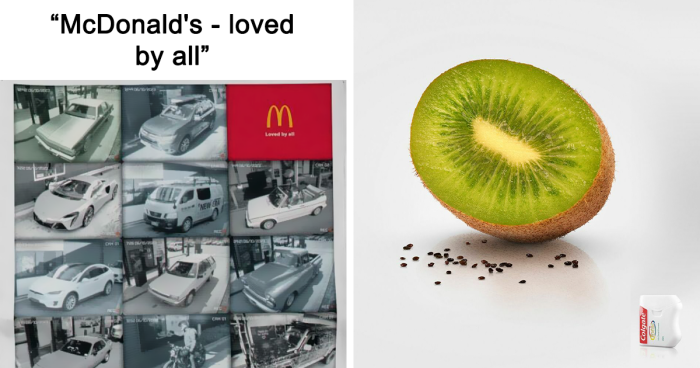
39. McDonald’s “Follow the Arches”
Sections of the Golden Arches were cropped and repurposed as directional symbols pointing toward nearby restaurants. Familiar brand geometry replaced complicated maps and unnecessary sentences.
-
40. Kit Kat Bench Advertisements
Public benches were designed to resemble partially unwrapped Kit Kat bars. The physical setting brought the “Have a break” promise to life exactly when tired pedestrians needed one.
These projects were recognized because the message, medium, and location worked as one idea rather than three separate ingredients.
Product Demonstrations, Apologies, and Unexpected Brand Stunts
-
41. Frontline Giant Dog Floor Advertisement
A huge photograph of a dog was placed on a shopping-mall floor. People walking across it looked like fleas when viewed from above, demonstrating the pet-treatment problem with real human movement.
-
42. FedEx Neighboring Continents
A FedEx print ad placed apartment windows labeled as different countries beside one another, showing a package passing effortlessly between them. International shipping suddenly looked as easy as greeting the neighbor.
-
43. IKEA “ThisAbles”
IKEA and its partners developed add-ons that made existing furniture easier for people with disabilities to use. The campaign was not merely communication; it offered downloadable designs and practical product improvements.
-
44. IKEA Pregnancy-Test Magazine Ad
A Swedish IKEA advertisement invited readers to apply urine to a pregnancy-test strip. A positive result revealed a discounted crib price, combining product relevance, technology, and an unforgettable amount of reader commitment.
-
45. Volvo Trucks “The Epic Split”
Jean-Claude Van Damme performed a split between two reversing trucks to demonstrate steering stability. The stunt was spectacular, but importantly, the spectacle remained directly connected to a product feature.
-
46. Red Bull “Stratos”
Felix Baumgartner’s jump from the stratosphere turned Red Bull’s adventurous brand promise into a real global event. The company did not interrupt entertainment with advertising; it created the entertainment.
-
47. KFC “FCK”
After a chicken shortage forced many restaurants to close, KFC rearranged the letters on its bucket to form a frank expression of frustration. The apology was concise, funny, accountable, and unmistakably on-brand.
-
48. Newcastle Brown Ale “If We Made It”
Unable to afford a giant Super Bowl commercial, Newcastle produced a campaign describing the extravagant advertisement it would have made. The imaginary production generated real publicity without purchasing the expected airtime.
-
49. Google “Parisian Love”
A sequence of Google searches quietly told the story of someone studying abroad, falling in love, moving to Paris, and starting a family. The interface itself became the narrator.
-
50. Coca-Cola “Share a Coke”
Replacing the familiar logo with popular names turned packaging into a social object. People searched for themselves, friends, partners, and occasionally names they could pretend belonged to their mysteriously absent coworkers.
Industry collections, design publications, award programs, and brand case studies continue to feature these campaigns as examples of inventive print, experiential, digital, and product-centered advertising.
Experiences and Practical Lessons From Studying Brilliant Ads
Looking through 50 ingenious ads produces a slightly uncomfortable realization: the strongest ideas often appear obvious after someone else has invented them. Of course a Kit Kat bench should look like a Kit Kat. Of course Spotify users will share attractive summaries of their own listening habits. Of course a delivery company should make distant countries appear close together. The frustrating part is that these solutions become obvious only after a creative team has performed the difficult work of simplifying them.
Begin With the Problem, Not the Advertising Format
One of the most useful experiences in campaign development is watching a team abandon its first question. “What should our video show?” is usually too narrow. A better starting point is, “What must the audience understand, feel, or do?”
IBM wanted to demonstrate smarter urban thinking, so its billboards became useful street furniture. Burger King wanted people to download and use its app, so it created a promotion activated near competing restaurants. The medium followed the strategic problem. It was not selected because someone had already booked a rectangular space and desperately needed to fill it.
Make the Product Essential to the Joke
Humor attracts attention, but unrelated humor can leave people remembering the joke while forgetting who paid for it. The best funny ads are difficult to retell without mentioning the product.
Snickers made hunger the reason characters behaved strangely. Blendtec’s destruction of expensive gadgets demonstrated blender power. KFC’s letter rearrangement worked because the company’s three-letter name and famous bucket were central to the apology. Remove the brand from any of those ideas and the concept collapseswhich is exactly what should happen.
Let the Audience Complete the Campaign
Another recurring experience is discovering how much stronger an advertisement becomes when viewers have a role. Traditional advertising says, “Look at this.” Participatory advertising says, “Do something with this.”
People shared personalized Coke bottles, nominated friends for the Ice Bucket Challenge, posted their Spotify Wrapped results, walked across the Frontline floor installation, and physically sat on Kit Kat benches. Participation gave each idea a second life beyond its original placement. More importantly, it allowed audiences to express something about themselves: their musical taste, friendships, humor, values, or willingness to have freezing water poured over their heads for charity.
Use Constraints as Creative Fuel
Small budgets, limited media space, cautious clients, and tight deadlines are commonly treated as creativity’s natural predators. Yet many memorable campaigns gained energy from restrictions.
Dollar Shave Club did not require a cinematic universe. Oreo’s blackout post did not require six months of production. Newcastle transformed its inability to purchase a conventional Super Bowl campaign into the campaign itself. Constraints forced these brands to rely on clarity, timing, personality, and nerve.
A practical exercise is to reduce a campaign to one sentence that a stranger could repeat accurately. “A billboard that becomes a rain shelter” works. “A burger discount activated near the competitor” works. When an explanation needs seventeen slides, three diagrams, and someone whispering, “You had to be in the meeting,” the idea probably needs another round.
Build Trust Before Demanding Attention
The Patagonia, REI, Dove, and Always campaigns also show that values-based advertising succeeds only when the message feels connected to consistent behavior. Audiences are excellent detectives when a company suddenly develops principles five minutes before a product launch.
Authenticity does not require solemnity. A brand can be sincere and funny, responsible and entertaining, commercially ambitious and genuinely helpful. The important experience is alignment: the campaign promise, customer experience, and company behavior must point in roughly the same direction.
The Best Test Is Retellability
Before approving a campaign, imagine someone describing it to a friend the following day. Would the retelling still contain the central message? Would the brand naturally appear in the story? Would the friend understand why the execution was clever without seeing a presentation?
Ingenious advertising creates compact stories people enjoy carrying. That is why decades-old campaigns such as “Think Small,” “Where’s the Beef?” and “Got Milk?” remain recognizable. Their execution may belong to another era, but their ideas can still travel without technical support.
Conclusion: Great Ads Make the Idea Feel Inevitable
The 50 brilliant ads in this collection succeeded in different media and different decades, but they share a common discipline. Each campaign found a direct connection between the brand, the audience, and the creative execution.
Some used humor. Some created emotional stories. Others employed data, public space, packaging, product design, cultural tension, or spectacular stunts. None became memorable merely by increasing the volume.
The central lesson is refreshingly simple: an ingenious advertisement does not decorate a marketing message. It finds the most interesting possible way to make that message visible, useful, entertaining, or impossible to ignore.
Note: This original article synthesizes documented campaign histories, advertising award archives, brand materials, and reporting from established media and creative-industry publications. Campaign descriptions have been independently rewritten for clarity and publication.