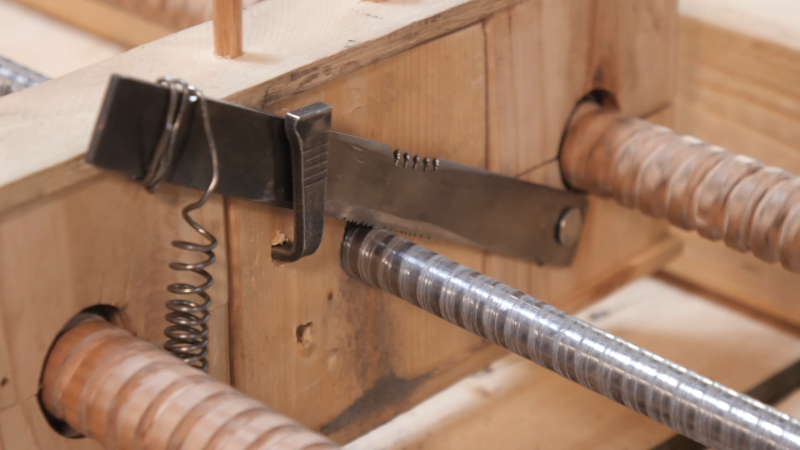

Leonardo da Vinci had a habit of sketching ideas that looked like they had accidentally fallen through a time portal. Flying machines, war devices, automated tools, clever gears, theatrical contraptionshis notebooks were less like a diary and more like a Renaissance version of a hardware store after three espressos. One of the most fascinating examples is his screw-cutting machine, a device designed to create screw threads long before modern machine shops made threaded rods, bolts, and nuts feel ordinary.
The phrase “DaVinci’s New Threads” refers to a modern maker-world revival of that old idea: building, testing, improving, and finally pushing Leonardo’s screw-threading concept toward a real metal threaded rod. It sounds simple until you remember one small inconvenience: accurate threads are not easy to make from scratch. A screw is not just a spiral groove. It is geometry, repeatability, material behavior, tool pressure, and patience all wearing a tiny metal tuxedo.
That is why this project is so compelling. It is not merely about recreating an antique machine for historical fun. It is about understanding how precision begins. Before interchangeable parts, CNC machines, 3D printers, and hardware-store bins full of 1/4-20 bolts, someone had to solve the chicken-and-egg problem of making accurate screws with tools that often needed accurate screws to become accurate themselves. Leonardo’s concept sits right in that wonderful mechanical paradox.
What Is “DaVinci’s New Threads” Really About?
At its core, DaVinci’s New Threads is about a screw-cutting machine inspired by Leonardo da Vinci’s late 15th-century design. The machine uses lead screws, gears, a crank, and a cutting tool to guide a blank rod through a controlled spiral path. The idea is beautifully logical: rotate the workpiece, move the cutter at a known rate, and you can carve a thread with a consistent pitch.
Modern viewers may shrug and say, “So, it makes a screw?” Yesbut that “so” is doing the work of an entire industrial revolution. Screw threads make vises clamp, jacks lift, lathes advance, microscopes focus, valves seal, and machines hold themselves together without needing a prayer circle. Once a workshop can make accurate threads, it gains the ability to build better tools, and those better tools can build better tools after that. Precision becomes a ladder.
The recent maker experiments around Leonardo’s machine started with wood, moved through trial-and-error methods, and eventually reached a more ambitious goal: producing metal threads accurate enough to accept a standard off-the-shelf nut. That is a big leap. Wood forgives. Metal keeps receipts.
Leonardo’s Original Screw-Cutting Vision
Leonardo’s screw-cutting machine design dates to the period around 1488–1489. The surviving model based on his drawing shows two side lead screws geared to a crank. The crank also turns the central blank, while the cutter moves according to the relationship between the gears and the lead screws. Change wheels allow different pitches to be cut, which means the machine was not simply a one-trick Renaissance pony.
The concept is surprisingly close to later screw-cutting principles: synchronize rotation with linear travel. That is the essential trick behind a screw-cutting lathe. The cutter must advance by a precise distance for every revolution of the workpiece. If it moves too fast, the thread becomes too coarse. If it moves too slowly, the thread becomes too fine. If it wanders, congratulations, you have invented decorative metal spaghetti.
Leonardo’s sketch was not perfect. Historical analysis notes that he appears to have drawn thread direction incorrectly in one detail, suggesting the machine may have been an original concept rather than something copied from an existing workshop. But the larger idea was brilliant: create a system where motion is guided by mechanical ratios instead of hand skill alone.
Why Screw Threads Were Such a Big Deal
To modern readers, screw threads are almost invisible. They are in eyeglasses, bicycles, cars, kitchen appliances, medical devices, phones, doors, furniture, and that one drawer full of mystery fasteners everyone refuses to clean out. But for centuries, making reliable screws was slow, expensive, and inconsistent.
Early metal screws were often cut by hand with files or simple tools. The quality depended heavily on the worker’s skill. A nut made for one screw might not fit another screw of similar size. That is not a minor inconvenience when you are trying to repair machinery, build scientific instruments, or standardize manufacturing. Without repeatable threads, every fastener becomes a custom relationship, and custom relationships are charming in romance but terrible in machine repair.
Accurate threads changed the world because they allowed repeatable motion and interchangeable fastening. A screw thread can hold parts together, but it can also convert rotary motion into linear motion. Turn a screw, and a nut travels. Turn a lead screw, and a carriage moves. That principle appears in lathes, presses, vises, jacks, 3D printers, CNC machines, linear actuators, and countless positioning systems.
The Chicken-and-Egg Problem of Precision
The most interesting part of DaVinci’s screw-cutting machine is the self-improvement question. If the machine uses lead screws to cut new screws, could better screws improve the machine, which then cuts even better screws? In theory, yes. In practice, every maker knows that “in theory” is where bolts never strip, wood never warps, and your drill bit is always exactly where you left it.
The early versions of the modern recreation showed the problem clearly. The machine needed reference threads. But if you are building from scratch, where do those reference threads come from? The project explored hand-cut starter threads, wooden dowels, and practical compromises. A blade mounted in a block could scribe a spiral groove into a dowel. With enough passes and refinement, that starter thread could become useful. Once two matching threaded dowels existed, they could help guide the next generation of the machine.
This is what makes the project more than a historical curiosity. It demonstrates how technology can bootstrap itself. Precision does not appear all at once. It is coaxed into existence through repeated correction, better materials, smarter fixtures, and a willingness to fail in public without throwing the whole contraption into the nearest lake.
From Wood Threads to Metal Threads
The first wooden demonstrations showed that the basic geometry could work. A wood blank, a cutter, preload force, and a guided pass could create a recognizable thread. For woodworking applications, that alone is useful. Wooden screws can power clamps, presses, and vises. Many traditional tools used wooden threads long before steel fasteners became cheap and universal.
But cutting metal is a different beast. Metal demands rigidity. The cutter must stay aligned. The blank must resist deflection. The machine must handle force without chattering, flexing, or slowly turning into a museum exhibit titled “Ambition, Before Failure.”
The later experiment behind DaVinci’s New Threads tried several approaches, including heating a bar red hot and twisting it, and casting a bronze screw using an existing screw as a mold. Those methods are creative, and the bronze casting idea showed promise. But the larger goal was not to sidestep Leonardo’s machine. The goal was to make the machine itself capable of producing accurate metal threads.
The 20 TPI Breakthrough
The breakthrough came when the machine, after significant rework and gear scaling, could cut a 20 TPI threaded rod that accepted an off-the-shelf nut. TPI means “threads per inch,” a common way to describe inch-based threads. A 20 TPI screw has twenty thread peaks along one inch of length. In familiar fastener language, a 1/4-20 bolt has a quarter-inch nominal diameter and twenty threads per inch.
That detail matters because compatibility is the true test. A thread can look nice and still fail to match a nut. A successful fit means the pitch, diameter, angle, and consistency are close enough to interact with a standardized component. In other words, the machine did not merely carve a spiral; it entered the shared language of modern hardware.
That moment is oddly satisfying. Leonardo’s 500-year-old concept meets the humble nut from the parts bin, and the nut says, “Fine, I’ll allow it.”
How Lead Screws Make Motion Useful
A lead screw converts rotation into linear movement. Imagine turning a threaded rod while a nut is prevented from rotating. The nut must travel along the rod. That travel can move a carriage, lift a platform, push a clamp, or position a tool. The distance moved per turn depends on the screw’s lead, which is related to the thread pitch.
In a screw-cutting machine, this relationship becomes a recipe. The workpiece turns, and the cutter advances in sync. Gear ratios determine how much the cutter moves per revolution. Change the gears, and the machine can cut different thread pitches. This is the same broad principle that later became central to screw-cutting lathes.
The beauty is that lead screws are both products and tools. You can cut a lead screw, then use that lead screw to make a machine that cuts other lead screws. That loop is why screw-cutting belongs in any serious discussion of manufacturing history. It is not just about fasteners. It is about making precision reproducible.
From Leonardo to Maudslay and Modern Standards
Leonardo’s design was early, imaginative, and important, but it did not immediately transform industry. That transformation required centuries of toolmaking progress. By the late 18th and early 19th centuries, figures such as Henry Maudslay helped bring the screw-cutting lathe into practical industrial use. The key features included a rigid structure, a slide rest, a lead screw, and change gears that allowed consistent thread pitches.
Once machines could cut repeatable threads, standardization became the next mountain. In the United States, William Sellers proposed a standardized screw-thread system in 1864. His 60-degree thread form was easier for machinists to cut than the British Whitworth 55-degree form, and it helped support American manufacturing. By the 1880s, standardized screw threads were widely used in U.S. machinery, railroads, typewriters, and other products.
That historical arc gives DaVinci’s New Threads a bigger meaning. Leonardo imagined a mechanism. Later toolmakers made precision practical. Standards organizations made compatibility widespread. Modern makers now revisit the beginning, not because we lack screws, but because understanding how screws became reliable reveals how civilization learned to build on itself.
Why This Project Matters Today
At first glance, rebuilding a centuries-old screw-cutting machine may seem like a charmingly unnecessary project. After all, anyone can buy threaded rod for a few dollars. But buying a thing is not the same as understanding the thing. The value of DaVinci’s New Threads is educational, historical, and deeply practical for anyone interested in engineering.
It Teaches the Cost of Precision
Precision is easy to take for granted when products arrive polished, packaged, and suspiciously affordable. This project shows the hidden difficulty behind accuracy. A straight rod, a stable cutter, consistent force, correct gear ratios, and rigid supports all matter. One weak link can turn a promising thread into a crunchy disaster.
It Shows Why Machines Need Feedback
Each attempt teaches the builder something. Too much flex? Strengthen the frame. Poor engagement? Adjust the cutter. Wrong pitch? Recalculate the gearing. This is engineering as conversation. The machine complains through bad results, and the builder learns to translate.
It Connects History to Hands-On Learning
Leonardo’s notebooks are often treated like magical artifacts, but this project makes them physical again. A sketch becomes wood, metal, friction, chips, heat, and adjustment. That is where invention becomes honest. A drawing can be brilliant, but a working machine must negotiate with reality.
Specific Examples of Where Threads Shape Everyday Life
Threads are so common that they disappear into the background. A bench vise uses a screw to turn handle rotation into clamping force. A car jack uses a screw mechanism to lift heavy weight with controlled motion. A 3D printer uses threaded rods or lead screws in some motion systems to position parts accurately. A camera tripod relies on standardized threads so cameras and accessories can connect across brands. Even a jar lid is a thread doing domestic engineering while pretending to be kitchenware.
In manufacturing, threads allow repeatability and serviceability. A machine assembled with standardized fasteners can be repaired more easily because replacement parts fit. A threaded adjustment can move a tool by predictable increments. A lead screw in a machine tool can control position with a level of precision that hand pushing cannot match. This is why screw threads are not boring. They are quiet infrastructure.
Lessons Makers Can Take from DaVinci’s New Threads
The first lesson is that old ideas are not automatically obsolete. Leonardo’s design may not compete with a modern lathe, but it contains a mechanical insight that remains powerful: controlled relationships between rotation and travel create useful geometry.
The second lesson is that materials matter. Wood can prove the concept, but metal requires more stiffness, sharper tooling, better alignment, and more controlled forces. Every material has its own personality. Wood is forgiving but inconsistent. Bronze casts well but shrinks and depends on mold quality. Steel is strong but demands respect. Aluminum is friendly until it gums up your cutter like it has emotional issues.
The third lesson is that precision is iterative. A first version rarely wins. The best machines are improved through observation, measurement, and repeated adjustment. Leonardo’s machine becomes more capable not through one heroic leap, but through many small corrections.
Experience Notes: What Working Through “DaVinci’s New Threads” Teaches
When studying a project like DaVinci’s New Threads, the most memorable experience is realizing how quickly “simple” mechanical ideas become complex when they leave the page. A screw thread looks basic until you try to make one accurately. Then the whole universe suddenly cares about alignment, stiffness, pitch, cutter angle, friction, and whether your workpiece is slightly bent because you looked at it wrong.
One practical takeaway is that historical machines reward patience. Modern tools hide many problems behind motors, bearings, hardened steel, digital readouts, and factory-ground components. A Renaissance-inspired build exposes every weakness. If the frame flexes, the cutter wanders. If the cutter is dull, the surface tears. If the gear ratio is off, the nut will not fit. This makes the process frustrating, but also unusually educational. You are not just using a tool; you are watching the logic of the tool argue with the material.
Another experience is the surprise of seeing how much can be achieved with modest components. A wooden demonstration can still produce a convincing thread if the geometry is right and the process is repeated carefully. That is encouraging for makers, students, and hobbyists. It reminds us that precision begins with principles, not price tags. A fancy machine is helpful, but a clear understanding of motion, force, and constraint is the real engine.
The metal-threading stage adds a different lesson: success often requires rethinking the supporting system, not just the cutting action. Many beginners focus on the tool tip because that is where chips appear. But the hidden heroes are the frame, bearings, guides, nuts, gears, and clamping method. If those parts cannot hold position under load, the cutter cannot do its job. In other words, the visible cut is only the final sentence of a much longer mechanical paragraph.
There is also a useful mindset lesson here. DaVinci’s New Threads shows that failure is not proof that an idea is bad. Sometimes it means the prototype is underbuilt, the material is wrong, or the process needs another pass. Heating and twisting a bar, casting bronze, hand-starting threads, adjusting gear scalingeach method contributes knowledge. Even the imperfect attempts are not wasted. They map the terrain.
For anyone writing, teaching, or creating content about engineering, this project is a gift. It turns abstract manufacturing history into a story with suspense. Will the machine cut cleanly? Will the nut fit? Will the old sketch survive modern testing? That narrative energy makes technical content easier to understand. It also reminds readers that invention is not a straight road from genius to success. It is more like a workshop floor: full of shavings, weird noises, small victories, and at least one tool that has vanished into another dimension.
Most importantly, DaVinci’s New Threads encourages respect for the ordinary screw. The next time you tighten a bolt, adjust a tripod, clamp a board, or assemble furniture with instructions written by someone who clearly fears vowels, there is a long history behind that spiral. Leonardo saw the promise. Later machinists refined it. Standards made it universal. Modern makers revived it to see what the old idea could still teach. That is the real thread running through the story.
Conclusion
DaVinci’s New Threads is more than a clever maker project. It is a compact history of precision, from Leonardo da Vinci’s imaginative screw-cutting concept to modern experiments that pushed the idea into metal. The project reminds us that screws are not merely fasteners; they are tools of motion, measurement, clamping, lifting, adjustment, and repeatable manufacturing.
By revisiting Leonardo’s design, modern builders expose the hard-won lessons behind everyday hardware. Accurate threads require geometry, rigidity, controlled motion, and standards. They also require persistence, because machines rarely become useful without a few embarrassing early chapters. That is part of the charm. A 500-year-old idea can still teach us how invention really works: sketch, build, fail, adjust, cut again, and celebrate when the nut finally fits.