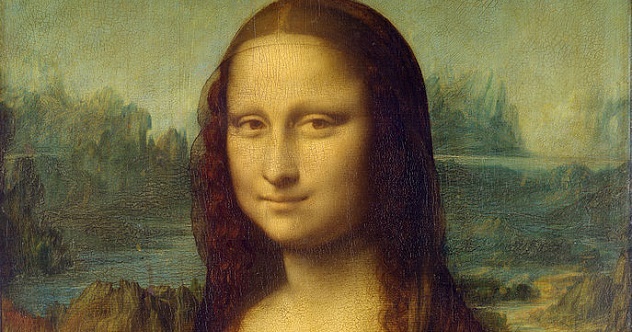

Leonardo da Vinci’s Mona Lisa has spent more than five centuries smiling her way through art history without explaining what, exactly, she finds so amusing. Painted on a poplar panel sometime between approximately 1503 and 1519, the portrait is widely believed to depict Lisa Gherardini, the wife of Florentine merchant Francesco del Giocondo. Today, the original hangs in the Louvre, protected by glass, security barriers, and a permanent crowd of raised smartphones.
Yet the Louvre painting is only one member of a much larger Mona Lisa universe. Leonardo’s workshop produced related images, collectors promoted disputed “earlier versions,” and modern artists transformed the famous sitter into a Dada joke, a Pop Art celebrity, a surreal self-portrait, and even a peanut-butter-and-jelly construction.
The following alternative versions of the Mona Lisa are not all copies in the same sense. Some are workshop paintings or drawings closely connected to Leonardo. Others are deliberate reinterpretations that borrow the composition while changing its style, meaning, medium, or cultural identity. Together, they reveal how one Renaissance portrait became the world’s most reusable visual template.
Why Are There So Many Mona Lisa Variations?
The Mona Lisa is unusually easy to recognize. The folded hands, three-quarter pose, dark clothing, distant landscape, centered figure, and mysterious expression form a visual recipe that remains identifiable even after an artist changes nearly every ingredient. Give her a mustache, enlarge her head, replace paint with sandwich spreads, or repeat her thirty times, and viewers still know who has entered the room.
Reworking the painting also allows artists to borrow its cultural authority. Leonardo’s portrait represents artistic genius, museum prestige, celebrity, beauty, mystery, and the commercial reproduction of famous images. An alternative Mona Lisa can therefore praise tradition, mock it, question it, or sell it back to the public wearing a new hat.
1. The Prado Mona Lisa
A Studio Copy Painted Alongside Leonardo’s Original
The Mona Lisa in Madrid’s Museo del Prado is among the most important early versions because evidence indicates that it was painted in Leonardo’s workshop while he was creating the Louvre portrait. It is not generally considered a work painted by Leonardo himself. Instead, scholars attribute it to a pupil or workshop associate who appears to have followed the master’s composition as it developed.
Technical examination revealed corresponding changes beneath the surfaces of the Prado and Louvre paintings. When Leonardo adjusted details in his composition, the copyist apparently made similar adjustments. This suggests that the two artists may have worked near one another rather than that the Prado painter simply copied the completed masterpiece years later.
For centuries, a dark coating concealed much of the Prado version’s background. Restoration exposed a bright landscape and clearer colors, giving viewers a tantalizing impression of how the Louvre Mona Lisa may have appeared before centuries of aging altered its tones. She looks less like a distant legend and more like someone who has just noticed you examining her from across the gallery.
2. The Isleworth Mona Lisa
The Controversial “Earlier Mona Lisa”
The Isleworth Mona Lisa depicts a younger-looking woman in a composition resembling Leonardo’s famous portrait. Unlike the Louvre painting, it was made on canvas, has a wider format, and includes visible columns at the sides. Supporters argue that it may be an earlier portrait of Lisa Gherardini produced before Leonardo completed the Louvre version.
The painting became widely known after English collector Hugh Blaker acquired it in the early twentieth century. Organizations associated with the work have promoted scientific, historical, and mathematical arguments supporting an attribution to Leonardo.
However, many Leonardo specialists remain unconvinced. The canvas support, handling of the figure, landscape, and uncertain early provenance have all contributed to skepticism. It is therefore best described as a disputed version rather than Leonardo’s confirmed first attempt. The debate has nevertheless made the Isleworth painting famous in its own right. Few artworks receive this much attention for possibly being someone else’s rough draft.
3. The Mona Vanna, or “Nude Mona Lisa”
A Workshop Drawing With a Familiar Pose
Preserved at the Musée Condé in Chantilly, France, the large charcoal drawing known as the Mona Vanna presents a partly nude figure seated in a pose strongly related to the Mona Lisa. The arrangement of the torso, head, shoulders, and arms makes the family resemblance difficult to miss.
The drawing was once attributed directly to Leonardo, although it is now generally connected to his workshop. Scientific study has suggested that Leonardo may have contributed to parts of it, but the extent of his involvement remains open to discussion. The image may have served as a preparatory study for a lost painting or as a workshop variation on a composition already admired by Leonardo’s followers.
The Mona Vanna shows that the famous pose was flexible before museums, postcards, and souvenir mugs turned it into sacred visual territory. Leonardo’s circle was already experimenting with the formula. Apparently, even Renaissance workshops understood the value of a successful sequel.
4. Marcel Duchamp’s L.H.O.O.Q.
The Mona Lisa Gets a Mustache
In 1919, French-American artist Marcel Duchamp took an inexpensive postcard reproduction of the Mona Lisa and drew a mustache and goatee on her face. Beneath the image, he wrote the letters “L.H.O.O.Q.” When pronounced in French, the title forms a provocative pun.
The physical alteration was simple enough to be performed by a bored student with a pencil. The artistic consequences were enormous. Duchamp’s “assisted readymade” challenged the belief that art required precious materials, technical virtuosity, or respectful treatment of cultural masterpieces. He transformed a mass-produced copy by changing its context and giving it a scandalous new identity.
The work also raises questions about gender, authorship, originality, and celebrity. Is the postcard still Leonardo’s image? Is the mustache the artwork? Does the joke belong to Duchamp, the printer, or the viewer who understands it? More than a century later, L.H.O.O.Q. still feels mischievous because the Mona Lisa remains famous enough to be recognizedand respected enough to be usefully vandalized.
5. Fernand Léger’s Mona Lisa With Keys
A Renaissance Celebrity Meets the Machine Age
Fernand Léger’s 1930 work commonly known as Mona Lisa With Keys, or La Joconde aux clés, places the familiar face beside an assortment of ordinary modern objects. Keys and a sardine can share the composition with one of Western art’s most prestigious images.
The strange combination was intentional. Léger was interested in the visual energy created by strong contrasts: old and new, famous and anonymous, human and mechanical. Instead of presenting the Mona Lisa as an untouchable masterpiece, he treated her reproduction as another object circulating through modern life.
The result anticipates the logic of Pop Art. A Renaissance portrait, a set of keys, and commercial packaging become equally available pieces of visual information. It is as though the Mona Lisa has emptied her purse onto a table and modern art has decided that every item deserves equal attention.
6. Salvador Dalí and Philippe Halsman’s Self-Portrait as Mona Lisa
Surrealism, Coins, and a Magnificent Mustache
In 1954, Salvador Dalí collaborated with photographer Philippe Halsman on a photomontage that inserted Dalí into the Mona Lisa. The resulting image replaces the sitter’s calm features with Dalí’s intense eyes and instantly recognizable mustache. His hands, holding coins, add another layer of surreal theatricality.
Dalí understood personal branding decades before social media gave everyone a profile picture and an urgent need for dramatic lighting. By merging himself with the world’s most famous portrait, he made a joke about artistic celebrity while promoting his own carefully constructed public image.
The photomontage also continues the playful tradition established by Duchamp’s mustached Mona Lisa. Yet Dalí does not merely draw on Leonardo’s sitter; he becomes her. The image transforms a reserved Renaissance portrait into a surreal performance involving identity, money, fame, and an artist who rarely met a masterpiece he could not somehow make about Salvador Dalí.
7. Andy Warhol’s Thirty Are Better Than One
The Mona Lisa Becomes a Mass-Media Superstar
Andy Warhol’s 1963 Thirty Are Better Than One repeats the Mona Lisa in a grid of thirty black-and-white silkscreen impressions. Its title turns artistic quantity into a cheerful advertising claim: one masterpiece is nice, but thirty must be a bargain.
Warhol created the work around the time the original Mona Lisa attracted enormous crowds during its celebrated visit to the United States. He recognized that the painting was no longer merely a Renaissance portrait. It had become a media event, a celebrity image reproduced in newspapers, magazines, television reports, posters, and consumer products.
Repetition changes the image. Viewed once, the Mona Lisa appears mysterious and unique. Repeated in a grid, she resembles a product, movie star, newspaper photograph, or endlessly printable logo. Warhol neither destroys her prestige nor treats it with traditional reverence. He reveals that fame depends on reproduction. The more often the public sees an image, the more “original” and important it can seem.
8. Fernando Botero’s Mona Lisa, Age Twelve
A Monumental Childhood Portrait
Fernando Botero’s 1959 Mona Lisa, Age Twelve reimagines Leonardo’s sitter as a young girl rendered in the Colombian artist’s distinctive language of enlarged, rounded forms. Her head, cheeks, hands, and body possess an exaggerated volume that makes the relatively small original composition feel physically monumental.
Botero’s figures are sometimes casually described as “fat,” but his purpose was broader than depicting body weight. He manipulated scale and proportion to create a heightened sense of presence, solidity, humor, and visual tension. In this painting, the Mona Lisa becomes both childlike and imposing.
The work helped attract international attention to Botero and was acquired by New York’s Museum of Modern Art in the early 1960s. Its humor is immediate, but the painting is more than a parody. Botero translates Leonardo into his own artistic language so completely that the result belongs equally to Renaissance art history and to the unmistakable world of Boterismo.
9. Yasumasa Morimura’s Monna Lisa in Its Origin
A Self-Portrait About Gender and Cultural Identity
Japanese artist Yasumasa Morimura has repeatedly inserted his face and body into famous works from Western art history. In the 1998 chromogenic print Monna Lisa in Its Origin, he occupies the role traditionally assigned to Leonardo’s sitter.
The substitution is more than a visual prank. Morimura’s self-portrait questions how museums and textbooks define beauty, gender, cultural authority, and historical importance. A Japanese male artist performs the identity of an Italian Renaissance woman whose image has become a global symbol. The categories begin to wobble.
Morimura does not simply copy Leonardo or disappear into the painting. His presence remains deliberately visible. Viewers recognize both the Mona Lisa and the contemporary artist performing her. That friction encourages us to ask who is allowed to represent whom, why certain images dominate global culture, and how identity changes when a familiar masterpiece crosses boundaries of nation, period, and gender.
10. Vik Muniz’s Double Mona Lisa (Peanut Butter and Jelly)
A Pop-Art Icon Made From Lunch
Brazilian-American artist Vik Muniz creates temporary images from unusual materials and then photographs the results. His 1999 Double Mona Lisa (Peanut Butter and Jelly), After Warhol reconstructs two Mona Lisa faces using the ingredients of a familiar American sandwich.
One portrait is formed from peanut butter and the other from jelly, creating differences in color, shine, texture, and thickness. The work refers not only to Leonardo but also to Warhol’s repeated Mona Lisa images. It is therefore a reinterpretation of a reinterpretationa cultural game of telephone conducted with pantry supplies.
The final artwork is a photograph rather than the perishable food arrangement itself. This distinction matters. From a distance, viewers recognize an art-historical icon. Up close, the illusion dissolves into sticky material that could have been spread on bread. Muniz makes perception part of the subject: art can be lofty, ordinary, permanent, temporary, serious, and wonderfully ridiculous at the same time.
What These Alternative Mona Lisas Reveal
The ten works span workshop practice, disputed attribution, Dada, Surrealism, modernism, Pop Art, photography, performance, and conceptual art. Despite their differences, they all depend on the same fact: the Mona Lisa is recognizable before viewers have time to think.
Early copies help researchers investigate Leonardo’s methods. Disputed paintings reveal the cultural and financial power of attribution. Modern reinterpretations use the portrait to explore mass production, gender, fame, national identity, consumer culture, and the difference between an original object and a reproduced image.
Parody has not weakened the Mona Lisa’s reputation. It has strengthened it. Every mustache, silkscreen, altered proportion, and spoonful of jelly reminds viewers that the original remains important enough to quote. An artwork becomes truly iconic when it can survive endless imitation without losing its identity.
Experiencing the Many Faces of the Mona Lisa
How to Look Beyond the Famous Smile
Exploring alternative versions of the Mona Lisa can be more rewarding than treating them as a collection of art-history jokes. A useful viewing experience begins by studying the basic structure shared by most versions. Look at the position of the hands, the angle of the shoulders, the placement of the head, the horizon line, and the space between the sitter and the landscape. These details function like the melody of a familiar song. Artists may change the instruments, tempo, and lyrics, but the tune remains recognizable.
Comparing the Prado copy with the Louvre original creates a particularly revealing exercise. Instead of immediately asking which painting is “better,” notice what the copy makes easier to see. Its brighter colors, clearer sleeves, and more visible background can help viewers imagine the original before varnish, age, and conservation history changed its appearance. The experience resembles finding a well-preserved photograph of a relative you previously knew only through a faded print.
The Isleworth Mona Lisa offers a different kind of encounter because uncertainty becomes part of the experience. Viewers must separate visual attraction from proof. A painting may look persuasive without possessing a secure attribution. Reading arguments from both supporters and skeptical scholars turns the work into a lesson in how art history is built from provenance, materials, scientific analysis, documentation, and informed comparisonnot merely from an enthusiastic declaration that “the smile looks Leonardo-ish.”
Modern reinterpretations invite a faster emotional response. Duchamp’s mustache may produce a laugh before its conceptual challenge becomes clear. Botero’s monumental child may seem charming until the altered proportions begin to change the portrait’s psychological mood. Warhol’s repeated faces can initially look decorative, but extended viewing makes the individual image feel less personal and more commercial. The viewer moves from recognition to amusement and then, ideally, to analysis.
Morimura’s work is best experienced by resisting the temptation to identify only what has changed. Consider what the substitution does to the authority of the original. When another body occupies the Mona Lisa’s position, the portrait becomes a stage on which gender and cultural identity can be performed rather than fixed. The famous pose no longer belongs to one presumed Florentine woman; it becomes available for reinterpretation across cultures.
Muniz’s peanut-butter-and-jelly Mona Lisas reward changes in viewing distance. From far away, the faces appear surprisingly coherent. Moving closer reveals smears, ridges, drips, and glossy patches. The eye travels back and forth between image and material. That physical movement is part of the artwork’s effect, even when the work is encountered through a high-quality reproduction.
A memorable way to compare all ten versions is to choose one recurring featurethe smile, hands, gaze, landscape, or surfaceand follow it through the list. The smile shifts from subtle to youthful, ironic, theatrical, mass-produced, culturally performed, and edible. The exercise demonstrates that the Mona Lisa is not a frozen image. She is a flexible visual language that artists continue to translate.
The best experience ends by returning to Leonardo’s original with fresh eyes. After seeing copies and parodies, details that once seemed inevitable begin to appear like deliberate choices. The folded hands feel carefully staged. The landscape seems stranger. The restrained expression becomes more powerful after encountering versions that shout their intentions. The alternatives do not distract from the original; they teach viewers how to look at it again.