
Note: This article is an original, publish-ready synthesis based on real Iceland travel, landscape, safety, and photography information, written in standard American English for web publication.
Iceland does not enter a camera politely. It storms in like a dramatic actor who has forgotten the script but brought a volcano, a glacier, three waterfalls, a black-sand beach, and an aurora for emotional support. For a Hungarian photographer, especially one arriving from the flatter, softer rhythms of Central Europe, Iceland can feel less like a destination and more like a planet auditioning for a science-fiction film.
The title Iceland – Through The Lens Of A Hungarian Photographer suggests more than a travel album. It hints at transformation: a person crossing borders not only on a map, but inside the imagination. Iceland is famous for its rugged landscapes, but what makes it unforgettable through a photographer’s eye is contrast. Fire and ice. Silence and wind. Fragile moss and violent surf. A tiny church standing against a mountain as if it signed up for a staring contest with eternity.
Hungarian photographer Czakó Balázs helped popularize this kind of visual journey when he shared images of Iceland after leaving his job as a mechanical engineer in Hungary to pursue landscape photography. His story captures the dream many creative people secretly carry around: trade fluorescent lights for northern lights, swap office routines for ice caves, and let the camera become both compass and confession booth.
Why Iceland Feels Made for Landscape Photography
Iceland is one of the rare places where the landscape does most of the posing. A photographer can turn left and find a glacier. Turn right and find a waterfall. Look up and there may be northern lights. Look down and there may be black volcanic sand, patterned ice, or a sheep silently judging your footwear.
But Iceland is not just “pretty.” Pretty is what you call a flower arrangement or a well-lit brunch. Iceland is cinematic, moody, and occasionally rude. Its beauty has elbows. The country sits in the North Atlantic, shaped by volcanic activity, glaciers, geothermal energy, ocean weather, and centuries of wind that clearly missed its calling as a sculptor.
For landscape photographers, this creates endless natural drama. The same location can look completely different within an hour. A calm blue glacier lagoon can turn silver under clouds. A waterfall can shift from soft mist to thunderous force. A mountain can disappear behind fog and then return like it was making a dramatic entrance.
The Hungarian Eye: Seeing Iceland with Fresh Wonder
A Hungarian photographer brings a distinct visual background to Iceland. Hungary has its own rich photographic tradition, from street photography to architectural composition, and its landscapes often lean toward rivers, plains, historic towns, vineyards, and the soft reflections of Lake Balaton. Iceland, by contrast, offers a wilder visual grammar.
That difference matters. A local photographer may know every famous viewpoint, but a visiting artist often notices what locals have learned to pass casually: the blue glow inside ice, the strange loneliness of a road crossing lava fields, the way a white church becomes a punctuation mark in a black landscape.
Through Hungarian eyes, Iceland becomes a study in extremes. It is not only about taking postcard-perfect shots. It is about interpreting a place where nature appears unfinished, as if creation paused halfway through and said, “Actually, let’s leave the steam vents in.”
Iconic Iceland Photography Locations
Seljalandsfoss: The Waterfall You Can Walk Behind
Seljalandsfoss is one of Iceland’s most photographed waterfalls, and for good reason. It drops from a tall cliff in a curtain of white water, with a path that allows visitors to walk behind it during suitable conditions. For photographers, this offers a rare opportunity: shooting the world through falling water.
The best images here often happen at golden hour, when sunlight slips behind the cascade and turns mist into glowing dust. At night, Seljalandsfoss can become even more magical, especially when stars or aurora colors appear above the cliff. Of course, the spray is relentless. Bring lens cloths. Bring backups. Bring emotional resilience.
Skógafoss: Power, Symmetry, and Rainbows
Skógafoss is broader, louder, and more direct. It has the kind of power that makes a photographer lower the camera for a second and simply stare. The waterfall’s clean vertical drop creates a strong symmetrical composition, while mist often produces rainbows on sunny days.
For a Hungarian photographer used to more human-scaled landscapes, Skógafoss can feel monumental. People standing near its base appear tiny, which is exactly the point. The photograph becomes not just a record of water, but a reminder that nature has never needed our permission to be impressive.
Reynisfjara: The Black Sand Beach with a Warning Label
Reynisfjara, near the village of Vík, is famous for its black volcanic sand, basalt columns, sea stacks, and dramatic Atlantic waves. It is also one of Iceland’s most dangerous tourist beaches because of sneaker waves that can surge unexpectedly up the shore.
Photographically, Reynisfjara is irresistible. The basalt columns form natural geometry. The dark sand gives the ocean a theatrical stage. The Reynisdrangar sea stacks rise offshore like stone figures from an old legend. But this is not a place to chase the perfect shot at the water’s edge. The better image is the one you live to edit.
Jökulsárlón and Diamond Beach: Ice as Jewelry
Jökulsárlón glacier lagoon is one of Iceland’s great visual treasures. Icebergs break away from the glacier, drift through the lagoon, and eventually pieces of ice wash onto nearby Diamond Beach, where they sparkle against black sand.
This is a dream location for photographers who love texture and contrast. Blue ice, clear ice, smoky ice, sunrise reflections, long-exposure waves, seals in the lagoon, and storm clouds overhead all create endless compositions. At Diamond Beach, the ice often looks like nature opened a luxury jewelry store and forgot to hire security.
Stokksnes and Vestrahorn: The Mountain That Knows Its Angles
Vestrahorn, viewed from Stokksnes, is one of Iceland’s most dramatic mountain scenes. Its sharp peaks rise above black sand dunes and tidal flats, often reflected in shallow water. For wide-angle photography, it is a gift. For anyone trying to take a bad photo, it is frankly uncooperative.
Sunrise is especially powerful here. The mountain catches soft light while the foreground offers patterns of grass, sand, or reflection. Hungarian photographers with a strong sense of structure may find Stokksnes especially rewarding because the location combines bold geometry with natural atmosphere.
Kirkjufell and Kirkjufellsfoss: The Postcard That Earned Its Fame
Kirkjufell, on the Snæfellsnes Peninsula, is among Iceland’s most recognizable mountains. Paired with nearby Kirkjufellsfoss waterfall, it creates a balanced composition that has appeared in countless travel photographs.
The challenge is not finding the shot; it is finding a fresh one. A creative photographer might use weather, seasonal changes, reflections, foreground ice, or long exposure to move beyond imitation. Iceland rewards patience, and Kirkjufell is a perfect example. The mountain may be famous, but the light is never exactly the same twice.
Búðakirkja: The Little Black Church with Big Main Character Energy
Búðakirkja, the black church on the Snæfellsnes Peninsula, is a minimalist masterpiece. Its dark wooden exterior stands against pale grass, mountains, clouds, or snow depending on the season. It is simple, graphic, and deeply atmospheric.
For photographers, Búðakirkja is a lesson in restraint. Not every Iceland image needs a roaring waterfall or exploding sky. Sometimes the strongest frame is a quiet church, a clean horizon, and a mood that says, “Yes, I have read poetry in bad weather.”
Photographing the Northern Lights in Iceland
The northern lights are one of Iceland’s most searched travel experiences, and for photographers, they are both thrilling and humbling. The aurora does not care about your itinerary, your tripod brand, or your emotional investment. It appears when solar activity, darkness, and clear skies cooperate.
The best viewing season generally runs from fall through early spring, when nights are long enough for aurora hunting. A strong composition matters as much as the sky itself. A glowing aurora over an empty field may look beautiful, but an aurora above Kirkjufell, a glacier lagoon, or a frozen waterfall tells a stronger story.
Technically, photographers often use a tripod, wide-angle lens, manual focus, high ISO, and long exposure. Artistically, the secret is restraint. The aurora is already dramatic. Oversaturating it until the sky looks like radioactive candy can turn wonder into wallpaper.
Ice Caves: Blue Cathedrals Beneath the Glacier
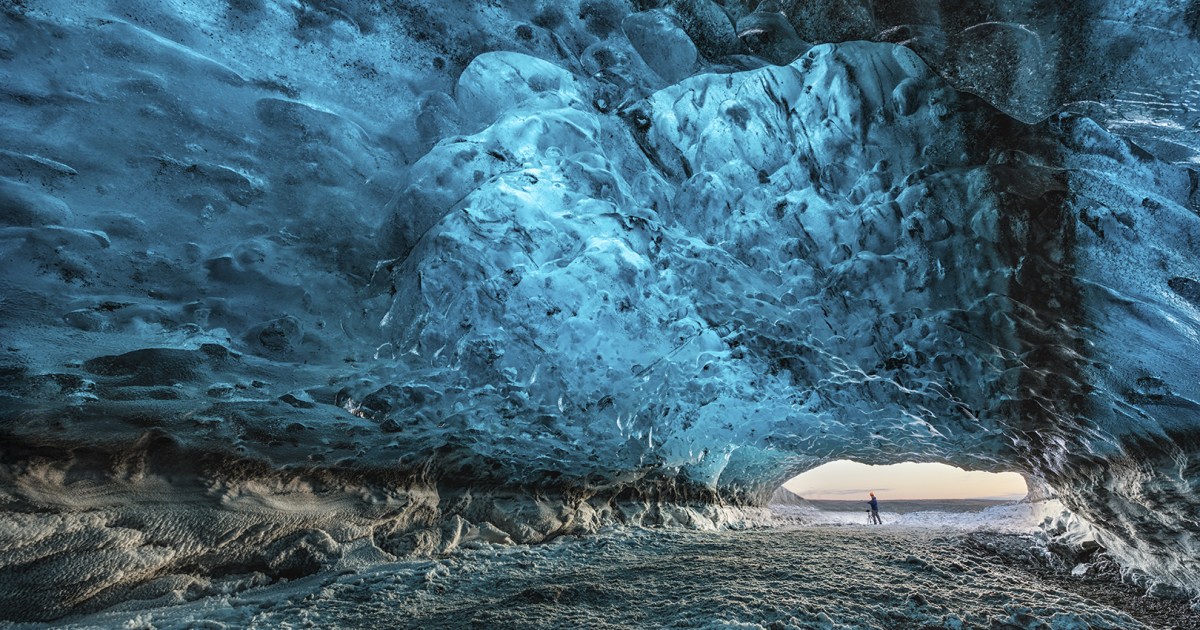
Iceland’s ice caves are among the most surreal subjects a photographer can encounter. Their walls can glow in shades of blue, white, gray, and transparent crystal. Inside, the world feels hushed and ancient, even when your boots are crunching loudly enough to ruin the spiritual moment.
Ice caves must be visited with qualified guides because glacier conditions can be dangerous and change constantly. For photography, the low light requires careful exposure, steady hands, and respect for the environment. The goal is not just to capture the blue, but to communicate scale, fragility, and the temporary nature of the cave itself.
Composition Lessons from Iceland
Use People for Scale
Iceland’s landscapes are huge. Without scale, a glacier wall or waterfall can lose its impact. Placing a person carefully in the frame can show the true size of the environment. The trick is to make the person part of the story, not a random tourist-shaped traffic cone.
Let Weather Become the Mood
Many photographers arrive hoping for perfect sunshine. Iceland laughs politely and sends sideways rain. But moody weather often creates stronger images. Fog simplifies backgrounds. Storm clouds add drama. Snow softens harsh shapes. Wind creates movement in water, grass, clothing, and occasionally your entire plan.
Find Foreground Texture
Black sand, cracked ice, moss, lava rock, tide pools, and snow patterns can turn a simple landscape into a layered composition. A Hungarian photographer trained to notice detail may use these textures to create depth, leading the viewer’s eye from foreground to horizon.
Respect Negative Space
Iceland is not crowded visually. Some of its most powerful scenes are empty: a road vanishing into fog, a lone cabin under mountains, a bird crossing a pale sky. Negative space gives the landscape room to breathe, and it gives the viewer room to feel something.
Travel Reality: Iceland Is Beautiful, Expensive, and Not Your Personal Studio
Behind every magical Iceland photograph is usually a practical reality involving cold fingers, expensive coffee, unpredictable roads, and a strong chance that the weather will change before you finish saying, “The weather looks stable.”
Responsible travel matters. Iceland’s moss can take decades to recover from damage, so stepping off marked paths for a slightly better angle is not worth it. Drone use is restricted in many areas, especially near popular sites, protected landscapes, airports, and crowds. Road conditions can change quickly, particularly in winter, and highland routes require proper vehicles and seasonal awareness.
The best photographers are not just image hunters. They are careful guests. They check forecasts, respect closures, stay away from dangerous surf, follow local signs, and understand that no photograph is worth damaging a place or putting rescuers at risk.
The Emotional Pull of Icelandic Landscapes
What makes Iceland powerful through the lens of a Hungarian photographer is not only the scenery. It is the emotional gap between where the photographer came from and what the camera now sees. Hungary carries deep cultural memory, historic cities, thermal baths, rivers, plains, and human-made beauty. Iceland offers raw geological theater, where the land seems younger, wilder, and less interested in civilization’s opinions.
That contrast can wake up a photographer’s eye. A waterfall becomes more than water. A glacier becomes more than ice. A black church becomes more than architecture. These subjects become symbols of change, risk, solitude, and courage.
For someone who left a conventional career to follow photography, Iceland is an almost perfect metaphor. It is unstable, beautiful, demanding, and full of light that only appears after darkness. Subtle? Not really. Effective? Absolutely.
What Viewers Can Learn from These Iceland Photographs
Images of Iceland often go viral because they look unreal, but the best ones do more than trigger wanderlust. They invite viewers to slow down. They remind us that the planet still contains places where scale overwhelms ego. They also show that photography is not simply about equipment. It is about timing, patience, interpretation, and the courage to stand in uncomfortable weather for a frame that may or may not happen.
A Hungarian photographer’s Iceland portfolio can inspire travelers, artists, and anyone feeling stuck in a routine. The message is not that everyone should quit their job and run toward a glacier. That would create a very crowded glacier. The message is that creative life often begins when curiosity becomes stronger than fear.
Extended Experiences: Following Iceland Through a Photographer’s Footsteps
Imagine arriving in Iceland with a camera bag, too many memory cards, and the optimistic belief that gloves will not be necessary. The airport doors open, the wind introduces itself, and suddenly you understand why Icelandic horses have such magnificent hair. The first experience is not visual but physical. Iceland is felt before it is framed.
A photographer’s journey might begin in Reykjavík, where colorful rooftops, street art, harbor reflections, and the bold shape of Hallgrímskirkja offer a gentler warm-up before the wilderness begins. Reykjavík is small compared with major European capitals, but it has personality. It is creative, walkable, and full of cafés where photographers can recharge batteries, both the camera kind and the human kind.
From there, the road becomes the real studio. Driving the South Coast, a photographer learns quickly that Iceland refuses to be scheduled neatly. You may plan ten minutes at a roadside viewpoint and lose an hour because light suddenly breaks through clouds over distant mountains. You may plan a sunset shot and get fog thick enough to make the tripod feel like a philosophical object.
One of the most memorable experiences is learning to photograph water in all its moods. At Seljalandsfoss, water becomes a curtain. At Skógafoss, it becomes power. At Jökulsárlón, it becomes a mirror for ice. At the coast, it becomes danger and rhythm. A photographer begins to understand that Iceland is not one landscape but many conversations between elements.
Another experience is solitude. Even at popular locations, early mornings and late evenings can feel strangely private. Standing before Vestrahorn at sunrise, with black sand underfoot and cold air in the lungs, the photographer is not merely collecting content. The moment becomes personal. The camera records the mountain, but the memory records the silence.
Winter brings a different education. Roads are harder, daylight is shorter, and every plan needs flexibility. Yet winter also brings blue shadows, frozen textures, snow-covered lava fields, and the possibility of northern lights. Waiting for aurora teaches patience better than any photography tutorial. You stand in the dark, checking the sky, adjusting settings, questioning life choices, and then suddenly green light begins to move above you. The cold is still cold, but now it has excellent marketing.
Summer offers long daylight, easier access, and green landscapes, but it demands a different eye. Without deep darkness, the northern lights disappear, so the photographer focuses on midnight sun, birds, lupine fields, hiking trails, and reflections. The challenge becomes controlling brightness and finding mood in a season that refuses to go to bed.
For a Hungarian photographer, the journey may also create a deeper connection to home. After Iceland, familiar places can look different. Lake Balaton in winter may suddenly reveal icy patterns. The Danube may become a study in reflections. Budapest’s architecture may feel newly dramatic under storm clouds. Travel photography works best when it does not only change how we see foreign places, but how we return to our own.
The most valuable Iceland experience is not getting the perfect photograph. It is learning how little control the photographer really has. Weather, light, ice, access, safety, and timing all have votes. The photographer’s job is to prepare carefully, respond creatively, and stay humble. Iceland rewards that humility with images that feel larger than the person who took them.
In the end, Iceland – Through The Lens Of A Hungarian Photographer is about more than dramatic scenery. It is about the moment when a camera becomes a reason to change direction. It is about leaving behind one version of life and finding another among glaciers, waterfalls, black sand, and northern skies. Iceland does not make photography easy. It makes it meaningful. And sometimes, that is much better.
Conclusion
Iceland remains one of the world’s most compelling destinations for landscape photography because it combines visual drama with emotional depth. Through the lens of a Hungarian photographer, its waterfalls, glaciers, black beaches, ice caves, mountains, and northern lights become more than beautiful scenes. They become a story of reinvention, patience, risk, and wonder.
The country challenges photographers to respect nature, adapt to unpredictable conditions, and look beyond the obvious postcard frame. Whether capturing Seljalandsfoss at night, Diamond Beach at sunrise, Búðakirkja in snow, or Vestrahorn under storm clouds, the strongest Iceland photographs are not simply taken. They are earned.
SEO Tags