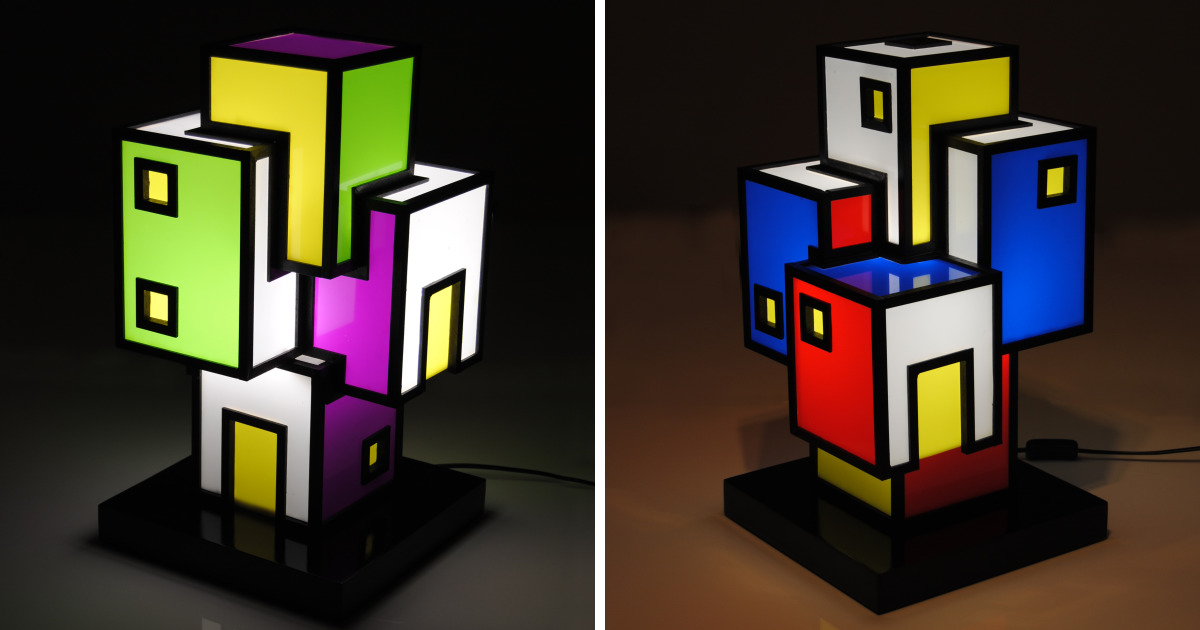

What happens when a miniature city, a sculpture, and a lamp decide to share the same electrical outlet? Fabiano Speziari’s Agglomerati series answers with glowing architectural forms made from wood and colored plexiglass. By day, each piece resembles a compact urban sculpture. At night, illuminated windows and doors transform it into a mysterious community filled with imagined residents, private stories, and perhaps one neighbor who still refuses to close the curtains.
When a Lamp Becomes a Tiny City
Most lamps are designed to disappear into a room. They sit quietly on a table, brighten a corner, and try not to cause trouble. The Agglomerati sculpture lamps take the opposite approach. They behave like miniature architectural monuments that happen to produce light.
Created by Italian artist and designer Fabiano Speziari, the series combines wooden structures with colored plexiglass elements. Each piece is treated as an individual artwork rather than an identical product rolling off an assembly line. The number and placement of doors, windows, colors, and structural blocks change from one composition to another.
The result resembles a densely packed neighborhood reduced to its most recognizable ingredients: walls, openings, stacked volumes, and glowing interiors. Some sections appear orderly, while others seem to have been added by a city planner who misplaced the ruler. That irregularity is part of the charm.
Speziari has produced the concept in both table-lamp and chandelier forms. Whether resting on furniture or suspended overhead, each sculpture creates the impression of an inhabited settlement floating inside the room.
The Meaning Behind the Agglomerati Series
The Italian word “agglomerati” can suggest clusters, accumulations, or groups of elements gathered into a larger mass. It is an appropriate name for sculptures built from compact architectural modules that appear to press against one another.
Speziari’s work is not simply an exercise in making adorable little buildings. His artistic practice frequently investigates human behavior, the natural environment, and the spaces people construct around themselves. Within the Agglomerati series, housing modules become symbols of urban existence and standardized living.
Architecture as a Portrait of Human Life
A house is never just a box. It represents privacy, security, routine, identity, memory, and sometimes a heroic amount of unpaid maintenance. When many houses are compressed into one illuminated structure, they begin to suggest the experience of living in a crowded modern city.
Every glowing window invites speculation. Is someone cooking dinner? Reading? Working late? Pretending not to hear the doorbell? The sculpture provides no residents, yet the viewer instinctively invents them.
This imaginative participation is important. The lamp becomes a stage without actors, allowing light and architecture to imply human presence. Viewers may see a cheerful neighborhood, an impersonal housing complex, or a lonely collection of people separated by thin walls.
Order, Repetition, and Individuality
Urban environments often depend on repeated forms. Apartment windows align in grids. Residential units follow similar plans. Streets are divided into predictable blocks. Repetition makes construction efficient, but it can also make daily life feel standardized.
The Agglomerati lamps play with this tension. Their geometric modules appear related, but the colors and openings prevent them from becoming completely uniform. The structures belong to the same visual family without behaving like identical twins forced to wear matching sweaters.
In this way, each sculpture reflects a familiar human contradiction: people live inside shared systems, yet each person wants a space, story, and identity of their own.
Why Wood and Plexiglass Work So Well Together
The visual strength of these sculpture lamps comes partly from the contrast between their principal materials. Wood feels natural, tactile, and grounded. Plexiglass feels smooth, modern, and capable of carrying brilliant color. One material absorbs attention through texture; the other catches light and sends it back into the room.
Wood Adds Warmth and Physical Presence
Wood gives the architectural blocks a sense of substance. Even when cut into simple geometric forms, it retains grain patterns and subtle variations that reveal its natural origin. Those details keep the sculpture from looking sterile.
The material also connects the lamp to traditional furniture and craft. A wooden object feels comfortable in a home because people already associate the material with tables, cabinets, flooring, musical instruments, and handmade objects. It brings warmth before the light is even switched on.
Against the precise shapes of the structures, minor variations in grain become especially noticeable. They remind the viewer that the miniature “city” was built from material that once grew organically rather than from an endless supply of perfectly obedient pixels.
Plexiglass Turns Openings Into Colored Light
Plexiglass, commonly used as a name for acrylic sheet, is valuable in lighting design because it can transmit, reflect, diffuse, and color light. Clear acrylic can transmit a large percentage of visible light, while pigments and surface treatments can modify how that light appears.
In Agglomerati, colored panels make the windows and doors feel active. Light does not simply escape from the sculpture; it passes through selected colors, turning each opening into a small luminous composition.
Red may feel energetic or theatrical. Blue can suggest cool evening light. Yellow and orange create warmth, while contrasting colors make neighboring sections appear to contain different atmospheres. A single internal light source can therefore generate a surprisingly varied visual experience.
A Dialogue Between Nature and Industry
Pairing wood with acrylic also creates a conversation between the organic and the manufactured. The wood carries visible evidence of nature, while the plexiglass represents industrial production, color control, and modern technology.
That contrast fits the urban theme. Cities are places where natural materials, engineered systems, human habits, and artificial light collide every day. The sculpture recreates that collision at a scale small enough to fit on a side table.
A Sculpture by Day and a New Artwork by Night
One of the most appealing qualities of illuminated sculpture is its ability to change identity. When switched off, an Agglomerati lamp can be studied as an arrangement of masses, voids, surfaces, and colors. The viewer notices construction, balance, proportion, and material.
Once illuminated, those physical details become part of a second composition. Dark wooden volumes frame bright openings. Transparent colors become more intense. Shadows appear behind projecting forms, and nearby walls may receive patches of tinted light.
The sculpture does not merely become brighter. Its visual hierarchy changes. A modest panel that receives little attention during the day may become the most prominent feature at night. A narrow opening may cast a sharp line, while a larger window creates a soft pool of color.
This double life gives the object unusual value in an interior. It is never completely finished because daylight, room lighting, viewing angle, and surrounding surfaces continually alter how it appears.
Part of a Larger Tradition of Light Sculpture
Artists and designers have long challenged the boundary between sculpture and useful lighting. Isamu Noguchi famously described his Akari designs as light sculptures, combining handmade lantern traditions with electric illumination. Other modern designers have used fabric, glass, plastic, metal, paper, and wood to create fixtures that function as artwork even when turned off.
The Agglomerati lamps belong to this broader conversation, although they speak in their own architectural language. Instead of hiding the light source behind a conventional shade, the design makes illumination essential to the meaning of the object.
Without light, the buildings appear unoccupied. With light, they seem inhabited. Electricity is therefore not an accessory added after the sculpture is complete. It is one of the artistic materials.
This is what separates a true sculpture lamp from a decorative object with a bulb attached as an afterthought. The form, material, shadows, colors, and illumination must operate as one complete idea.
How Agglomerati Changes an Interior
It Creates a Visual Focal Point
Because the lamp has recognizable architectural forms, viewers naturally inspect it more closely than an ordinary fixture. It can anchor a reading corner, console table, shelf, or low cabinet without requiring an entire wall of decoration.
The table version works especially well where it can be viewed from more than one angle. Rotating around the object reveals different combinations of windows, projections, and shadows. Placing it where only the front is visible would be like buying a sculpture and politely asking three sides of it to remain unemployed.
It Provides Atmosphere Rather Than Harsh Task Light
A sculpture lamp is generally most effective as accent or ambient lighting. Its purpose is not necessarily to illuminate tax forms, detailed drawings, or the tiny instructions printed on medicine packaging. It establishes mood and contributes to the room’s visual character.
A warm, efficient LED light source can complement the wood and reduce unnecessary heat inside a decorative fixture. However, any bulb or integrated lighting component must be suitable for the enclosure and electrical design. Properly certified components and professional wiring matter, particularly in handmade or limited-production lighting.
It Rewards a Simpler Background
Colored sculpture lamps already contain many visual elements, so they benefit from a relatively calm setting. Neutral walls, uncomplicated furniture, and a little empty space allow the illuminated architecture to remain readable.
That does not mean the room must resemble an empty gallery guarded by someone who whispers aggressively. It simply means nearby patterns and decorations should support the lamp rather than compete with every glowing window.
The Appeal of One-of-a-Kind Lighting
Mass-produced lighting is affordable, consistent, and easy to replace. Those are genuine advantages. Yet consistency can become forgettable. A handmade or individually composed sculpture lamp offers another kind of value: visible decisions.
The position of every block, color, opening, and structural gap affects the final piece. Small changes alter the imagined architecture and the distribution of light. Two lamps built around the same concept can therefore create different moods and stories.
Individuality also encourages a longer relationship with the object. Owners may remember where they discovered it, why they selected a particular composition, and how it changed the atmosphere of a familiar room. The lamp becomes part of the home’s identity rather than a temporary accessory awaiting the next trend.
This emotional durability is significant. Objects that remain meaningful are more likely to be maintained, repaired, displayed, and passed on instead of being replaced whenever the internet announces that a new shade of beige has become compulsory.
What Agglomerati Teaches Us About Product Design
The project demonstrates that function does not have to silence imagination. A lamp can provide useful illumination while discussing architecture, urban density, individuality, and isolation. It can be playful without being shallow and conceptual without becoming impossible to live with.
It also shows the value of selecting materials for both physical and symbolic reasons. Wood is not present merely because it can form a box. Acrylic is not present merely because it is available in bright colors. Their contrast strengthens the project’s themes while producing a practical lighting effect.
Finally, Agglomerati proves that familiar shapes can support complex ideas. Almost everyone understands a door, a window, and a house. Speziari rearranges those ordinary symbols until they begin asking larger questions about how people organize cities and how cities organize people.
Living With a Sculpture Lamp: An Extended Experience
The experience of sharing a room with a sculpture lamp develops gradually. On the first day, the object attracts attention because it is new. Visitors lean closer, study the colored windows, and ask whether it is a model of a real place. Someone will probably choose a favorite “apartment.” Another person may begin inventing biographies for imaginary residents. This is normal. Miniature architecture has a remarkable ability to turn sensible adults into enthusiastic neighborhood gossips.
After the novelty settles, the lamp begins to influence daily routines more quietly. During the afternoon, natural light reveals the wooden grain and construction. The plexiglass panels appear as solid areas of color, and the piece behaves mainly as a sculpture. It can look cheerful, orderly, or slightly chaotic depending on the viewing angle.
At dusk, the relationship changes. Switching on the lamp produces a small but noticeable transition in the room. The colored openings become brighter as the surrounding space darkens. Details that seemed structural during the day begin to resemble streets, balconies, towers, and private rooms. The lamp creates the emotional suggestion of a city waking up precisely when the real city outside may be slowing down.
Placement affects the experience. On a low cabinet, the sculpture can be viewed almost at eye level while someone is seated. This makes the miniature buildings feel surprisingly present. On a higher shelf, the lamp appears more like a distant skyline. Near a wall, it may cast additional shapes and colors, expanding the artwork beyond its physical boundaries.
The most successful setting usually includes enough darkness for the colored light to register without turning the rest of the room into a cave. A dimmable or appropriately selected light source can help preserve subtlety. The goal is atmosphere, not an interrogation scene conducted by tiny apartment buildings.
Maintenance becomes part of ownership as well. Acrylic surfaces can show dust, fingerprints, and fine scratches, so gentle cleaning is preferable to aggressive scrubbing. The spaces between wooden modules may also collect dust over time. Regular, careful attention protects the clarity of the colored panels and keeps the sculpture visually crisp.
More importantly, living with an artwork like Agglomerati changes the way a person notices ordinary buildings. Apartment windows seen during an evening walk begin to resemble illuminated panels. Repeated balconies, stacked rooms, and crowded rooftops look less like background scenery and more like patterns containing thousands of private lives.
That expanded awareness may be the project’s greatest achievement. The lamp remains a functional object, but it also becomes a daily reminder that cities are collections of individual experiences. Every window belongs to someone. Every apparently uniform block contains differences that cannot be seen from outside.
In the end, an Agglomerati sculpture lamp does more than brighten a room. It creates a small world and invites the viewer to complete it. Wood provides the structure, plexiglass supplies the color, and light brings the imagined inhabitants home. The switch may control the electricity, but curiosity is what truly turns the artwork on.
Note: Electrical components in handmade lighting should be properly rated, certified, and installed for the fixture’s intended use.