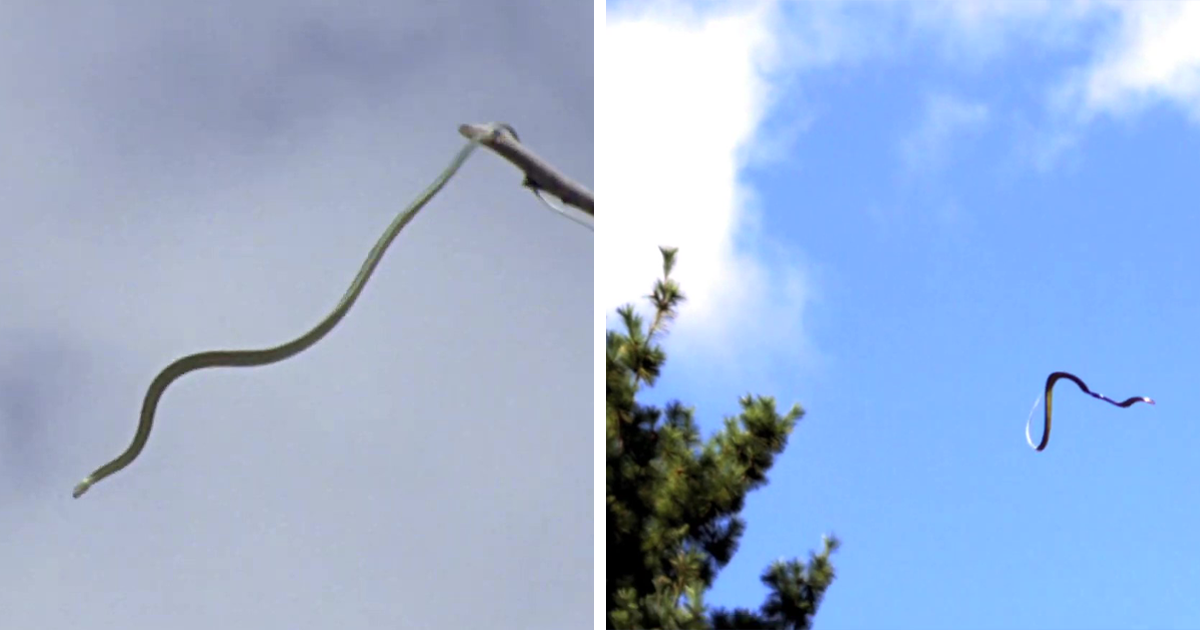
Apparently, Flying Snakes Are Now A Thing And It Proves That 2020 Isn’t Done With Us Yet

Just when you thought 2020 had thrown every possible plot twist at humanity, science quietly slid another one onto the table: flying snakes. Yes, that’s right. Not metaphorical, not Photoshop, not a rejected “Sharknado” spin-off. Real, living snakes that launch themselves from trees and glide through the air like scaly boomerangs.
Back in mid-2020, researchers took a closer look at these airborne serpents, and the internet collectively decided that this was the last straw of an already chaotic year. The headline “Apparently, Flying Snakes Are Now A Thing And It Proves That 2020 Isn’t Done With Us Yet” pretty much captured the mood: amused, horrified, and weirdly impressed all at once.
But behind the memes and “nope rope” jokes, there’s some seriously cool science going on. Flying snakes don’t have wings (obviously), yet they manage glides of up to around 100 meters in the wild. Scientists, being both curious and very brave, decided to figure out exactly how this works and what they found is equal parts nightmare fuel and aerodynamic genius.
Wait, Flying Snakes Are Actually Real?
Let’s clear this up right away: humans did not invent flying snakes in a lab in 2020. They’ve been around for a long time; we just collectively noticed them during a particularly stressful year.
Flying snakes belong to the genus Chrysopelea, a group of slender, arboreal snakes found in South and Southeast Asia, including parts of India, Sri Lanka, southern China, and the Indonesian archipelago. The species that got the most attention is the paradise tree snake (Chrysopelea paradisi), which is both stunningly patterned and suspiciously good at pretending to be a flying squirrel.
Here are a few fast facts to calm you down (or not):
- They are nonvenomous to humans, according to major reference sources.
- They live high up in trees and rarely have any reason to get anywhere near your apartment balcony.
- They don’t “fly” like birds or bats they glide, using gravity and clever body shaping.
- Under the right conditions, they can glide as far as about 30–100 meters (roughly 100–330 feet).
So yes, flying snakes are a thing. No, they’re not lining up at your front door. And yes, 2020 still felt personally attacked.
How Does a Snake Fly Without Wings?
The short answer: intense core strength, wild flexibility, and physics that would make a gymnast cry.
The Takeoff: “Yeet From a Tree” Strategy
First, a flying snake slithers out onto a tree branch, hangs off the edge, and forms itself into a J-shape. Then it launches into the air with a powerful push no branch-to-branch bridge, no zipline, just a full send into open space. Studies and high-speed footage have shown that these launches can send snakes surprising distances horizontally, especially when they leap from tall trees.
The Mid-Air Transformation: From Tube to Wing
Once airborne, the snake does something incredibly weird and clever. It flattens its body by splaying its ribs outward, changing its cross-section from round to a kind of rounded triangle. This shape creates a concave underside that acts like a lifting surface basically turning the snake’s whole body into a makeshift wing.
Researchers modeling this triangular shape in wind tunnels found that it produces surprisingly high lift while still being fairly stable, especially at the angles the snake uses in real glides. It’s a classic example of evolution hacking aerodynamics without ever reading a physics textbook.
The Aerial Undulation: Wiggling With a Purpose
Here’s where the 2020 research really shook the internet. A team at Virginia Tech used motion capture markers on live paradise tree snakes and paired the data with 3D computer models. They discovered that the snake’s iconic side-to-side wriggling in mid-air isn’t just dramatic flair it’s essential for stable gliding.
Without the undulating motion, simulations showed that the snake would become unstable and tumble. The continuous wave of motion along its body actually helps control pitch and roll, keeping the glide smooth and extending the time aloft. Smithsonian coverage of the work summed it up nicely: if the snake doesn’t wriggle, it doesn’t glide well.
In other words, this is not falling with style it’s falling with serious math behind it.
Why Do Flying Snakes Glide in the First Place?
Scientists are still debating all the reasons, but several likely benefits have emerged from field observations and expert reports.
Predator Evasion
When something with claws, teeth, or a bad attitude shows up in the canopy, going straight down the trunk is risky. Gliding allows a snake to leap away from danger and land safely on another tree a quick horizontal escape rather than a long vertical climb.
Efficient Travel Between Trees
Climbing down one tree and up another is slow and energy-intensive. If you can glide 30–100 meters directly from branch to branch, you save time and effort. That’s especially useful in dense forests where the canopy is continuous and the ground is full of additional predators.
Possible Hunting Advantages
Some experts think gliding might occasionally help in hunting small animals like lizards, birds, or bats, letting the snake approach from unexpected angles. However, the primary advantages still seem tied to movement and escape rather than aerial ambush.
2020: The Year the Internet Met Flying Snakes
Flying snakes have been known to science for decades, but 2020 gave them their viral moment. When the Virginia Tech research hit the news and sites like Bored Panda covered it with dramatic photos and punchy headlines, people collectively lost their chill.
It was the perfect storm: a stressful global year, a public already joking about “murder hornets,” and then suddenly snakes that glide. Jokes and memes practically wrote themselves:
- “Ground snakes: already terrifying. Flying snakes: hard pass.”
- “2020 DLC just dropped: airborne nope ropes.”
- “At this point, I’m just waiting for lava dolphins.”
The humor was a coping mechanism. When the world feels unpredictable, there’s something almost cathartic about exaggerating it: “Sure, why not? Of course snakes fly now. Totally normal.”
Should You Actually Be Afraid of Flying Snakes?
Let’s rate the real-world threat level: somewhere between “that spider in your bathroom” and “finding out your Wi-Fi is down.” Unsettling? Absolutely. Reason to panic? Not really.
They Don’t Live Everywhere
Flying snakes are native to specific regions in Asia not your average suburban neighborhood. Unless you live in or visit their range (parts of South and Southeast Asia), your chance of encountering one is essentially zero.
They’re Not Out to Get You
Despite their dramatic aerial skills, these snakes are not large apex predators plotting world domination. They’re relatively small, shy, and far more interested in avoiding threats than creating them. Their gliding behavior is basically a survival tool, not a reason to start drafting “Snakes in the Sky” evacuation plans.
They’re (Surprisingly) Nonvenomous to Humans
Major references list Chrysopelea as nonvenomous to people and generally harmless. They’re wild animals and deserve respect, but if you ever do see one gliding, the proper response is awe, not apocalypse-level panic.
What Flying Snakes Teach Us About Nature (and About 2020)
Once you get past the initial “NOPE,” flying snakes are a reminder that the natural world is far stranger and more inventive than we usually realize.
Evolution Is the Ultimate Engineer
The paradise tree snake didn’t get a memo labeled “Build Wings.” Instead, over many generations, natural selection refined small advantages: better body-flattening, more stable undulation, smarter launch angles. Eventually, you get an animal that can glide efficiently using nothing more than its own flexible spine and reconfigurable ribs.
Engineers have even studied the snake’s shape and motion to inspire new ideas in robotics and small gliding devices. When a creature can turn its whole body into a morphing wing, you pay attention.
The Universe Doesn’t Care About Our Narratives
From a human perspective, 2020 felt like the year the universe went off-script. Flying snakes going viral fit perfectly into that narrative: of course they would show up then. In reality, the snakes were gliding long before hashtags and doomscrolling we just happened to notice and meme them at a time when we were already on edge.
It’s a useful reminder that nature isn’t syncing itself to our news cycle. While we argue, worry, and refresh our feeds, forests quietly go on producing animals that break our mental categories: fish that walk, octopuses that solve puzzles, snakes that “fly.” The world is always weirder than our timelines.
How to Mentally Cope With Things Like Flying Snakes
If you’re still a little rattled by the idea of serpents gliding through the air, here’s a friendly, semi-serious coping guide:
1. Translate Fear Into Fascination
Instead of “this is terrifying,” try “this is incredibly clever.” The more you understand the mechanics the body flattening, the triangular cross-section, the stabilizing undulation the more it becomes an engineering marvel instead of a jump scare.
2. Remember the Context
These animals live in forests far from most people, and their abilities evolved to help them survive in that environment, not to crash your picnic. Zoom out: you’re looking at a piece of a much larger, beautiful ecosystem.
3. Laugh About the Timing
There’s something therapeutic about admitting, “Yeah, 2020 was so chaotic that flying snakes were just another Tuesday.” Humor doesn’t erase real problems, but it gives us a way to breathe and keep moving.
Bonus: of Experiences and Thoughts About Flying Snakes
Because the internet asked for flying snakes and long reads, let’s lean in.
Imagine walking along a canopy walkway in a Southeast Asian rainforest. The air is thick and warm, cicadas are doing their best impression of a broken speaker, and somewhere in the distance a hornbill is loudly announcing its own existence. A guide points to a slender green-and-black snake coiled calmly on a branch. You’re a respectful distance away close enough to see its scales, far enough that your fight-or-flight system is only mildly offended.
The guide casually says, “That’s a paradise tree snake. If it wanted to, it could glide from here to that tree over there.” You follow his hand and realize “that tree” is not exactly next door. In your head, a small voice says, “So… the snake has better air mileage than I do.”
You watch as the snake begins to move. Not in a horror-movie lunge, but in a calm, deliberate way testing the branch, negotiating leaves, finding the tipping point. The guide explains that scientists spent years filming this process with high-speed cameras, then building 3D models and even 3D-printed replicas to understand the aerodynamics. Another little voice in your brain adds, “Someone’s job was literally ‘snake flight analyst.’”
The snake edges out along a branch, hangs, and for a second freezes. This is the moment that went viral in 2020: that tiny pause before gravity takes over and an animal with no limbs decides to leave the solid world behind. Then it launches. Its body flattens, ribs splay, and suddenly it looks less like a classic snake and more like a living ribbon surfing invisible currents of air.
From your point of view, the glide is oddly graceful. There’s no flailing, no chaotic tumbling. The snake undulates in a smooth wave, adjusting its trajectory with small shifts in posture. It lands on another branch with a barely audible rustle and resumes being a normal forest resident. Your heart rate, on the other hand, takes a minute to catch up.
Later that night, back in a hotel with reliable Wi-Fi and absolutely no snakes, you search for more information. You find photos shared by wildlife photographers, YouTube clips of slow-motion glides, and that infamous Bored Panda headline that turned flying snakes into 2020 icons. People in the comments alternate between terror, awe, and jokes about uninstalling reality.
Reading deeper, you see how often flying snakes get used as metaphors. Educators mention them in science talks to show students that physics isn’t just about airplanes and rockets; it’s also written into the shape of living things. Personal development writers borrow them as a symbol of adaptation: if a legless reptile can figure out gliding, maybe we can figure out career pivots. Environmental advocates point out that creatures like this depend on intact forest canopies when we clear those trees, we erase not just habitats, but entire categories of behaviors we’re only beginning to understand.
There’s also something oddly comforting in the idea that flying snakes didn’t arrive to make 2020 worse. They were quietly zipping between trees long before global chaos trended on social media. Their world runs on seasons, predators, and prey not on notifications and breaking news banners. If anything, the 2020 spotlight reminds us that there’s still wonder out there, waiting to be discovered whenever we look away from our screens.
So the next time you see that headline about flying snakes, you can let yourself smile. Yes, the phrase “airborne nope ropes” is objectively hilarious. But behind the memes is a real animal that turned its entire body into a morphing wing, gliding through forests with a skill set that human engineers are still trying to fully decode. In a year that felt like it was constantly falling, maybe it’s fitting that one of its most memorable discoveries was a creature that fell and somehow learned to glide.