Artist Creates Hilariously Weird Comics That Might Make You Laugh (26 New Pics)

Some comics politely knock on the door, introduce themselves, and deliver a respectable punchline. The comics of Aidee Sea tend to climb through the bathroom window wearing a historical costume, carrying a cursed necklace, and asking whether anyone ordered a Trojan horse.
That unpredictable energy powers After Death Comics, a webcomic series packed with absurd situations, visual puns, pop-culture references, darkly playful twists, and characters who frequently make the worst possible decision with impressive confidence. A 2024 collection brought together 26 new comics for readers whose sense of humor lives somewhere between “clever” and “Why did my brain enjoy that?”
The original feature reported that Aidee Sea had attracted more than 61,000 Instagram followers by that point. It also revealed that the ominous name After Death Comics came from an abandoned plan to make stories about ghosts. The supernatural concept faded, but the name survived as Aidee began drawing whatever seemed funny. That accidental freedom may be the secret ingredient: the series is not trapped inside one subject, character, or universe. Anything can happen, and it usually does.
Meet Aidee Sea, the Mind Behind After Death Comics
Aidee Sea creates funny webcomics that combine simple visual storytelling with ideas that become increasingly strange as the panels progress. The drawings are clean enough to understand immediately, while the premises often pull from mythology, workplace frustrations, classic literature, horror movies, holiday traditions, fairy tales, and ordinary human foolishness.
That combination matters. A comic can contain the most elaborate joke in the world, but it will collapse like a discount lawn chair if readers cannot follow the setup. Aidee’s uncluttered panel compositions keep attention on facial expressions, dialogue, and the one suspicious detail that will become important in the final frame.
The artist has described comic-making as a way to clear crowded ideas from the mind. Turning a strange thought into a finished strip creates the same satisfaction as cleaning a chaotic room and finally discovering that the floor has existed all along. The biggest challenge is not a shortage of ideas but finding enough time and energy to draw them. Aidee has also developed a larger annual October horror project called Horrorween, which allows for longer and more intricate storytelling than the usual short comics.
That darker side of the artist’s work appears on WEBTOON as well. Aidee’s Midnight Stories is presented as a collection of short horror tales designed to puzzle and unsettle readers. Meanwhile, Patreon gives supporters access to works in progress, rejected ideas, exclusive comics, and other behind-the-scenes material. Together, these platforms show how an independent cartoonist can build several creative rooms inside the same strange house.
What Makes These 26 Weird Comics So Funny?
They Begin With Familiar Rules
The best absurd humor usually needs something normal to destroy. Aidee often begins with a situation readers instantly recognize: an employee speaking to a boss, a child visiting a witch, soldiers guarding a city, forest animals discussing the weather, or someone following a drawing tutorial.
For a few panels, the world behaves properly. The reader understands the social rules and starts predicting the outcome. Then the comic gently picks up that prediction, folds it into a paper airplane, and throws it into traffic.
Researchers and humor theorists often describe comedy through incongruity: amusement appears when expectations collide with a result that does not fit. Another explanation, known as benign violation theory, suggests that something becomes funny when it breaks a rule while still feeling safe enough to enjoy. Aidee’s weird comics repeatedly occupy that sweet spot. The situation is wrong, but it is wrong in a colorful cartoon universe where the damage is fictional and the stupidity is beautifully organized.
The Punchlines Often Change the Entire Story
One featured strip appears to show a man desperately trying to save a relationship. He insists that he cared, complains that the other person is leaving, and begs for another chance. The final panel reveals that he is addressing an employee who wants better pay. Suddenly, what looked like romantic heartbreak becomes a satire of manipulative workplace culture. The boss treats basic compensation as an unreasonable emotional demand, which is both ridiculous and painfully recognizable.
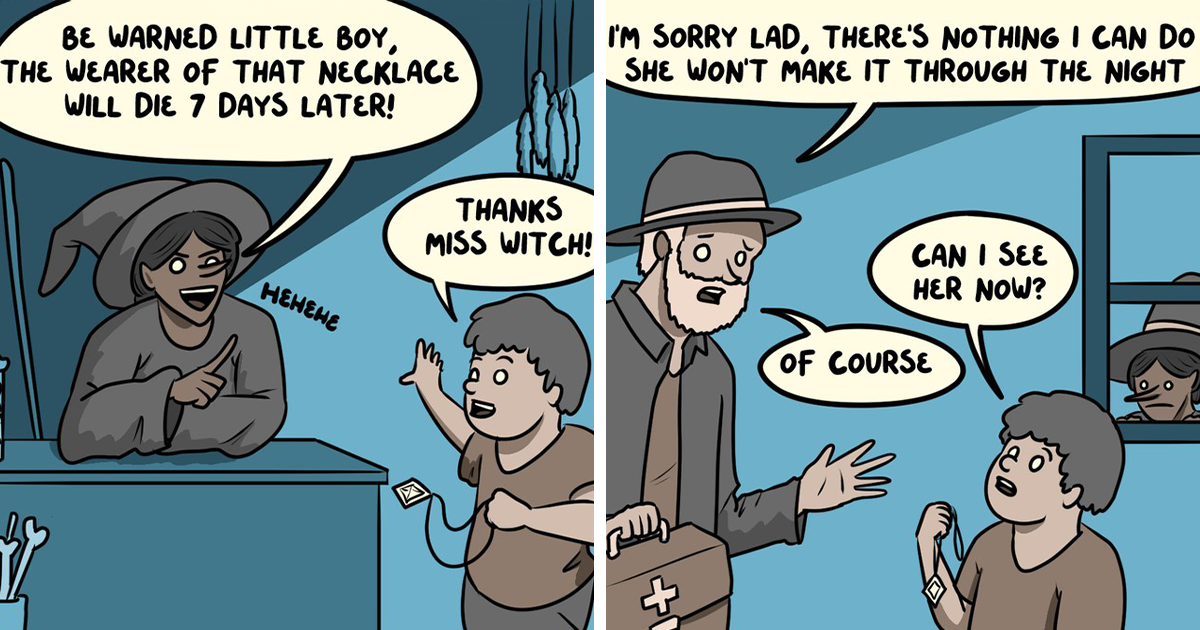
Another comic follows a boy who buys a necklace from a witch after being warned that its wearer will die within seven days. The expected victim, however, is not the child. The joke turns on grammar, assumptions, and the witch’s delayed realization that she has misunderstood her own curse. It is a compact example of how a final image can force readers to reinterpret every panel before it.
This rewind effect is one of the strongest pleasures in short-form comics. Readers reach the final panel, laugh, and mentally travel backward to admire the hidden mechanism. The story has not changed on the page, but its meaning has changed inside the reader’s head.
History and Mythology Are Treated Like Toy Boxes
Aidee does not approach famous stories with museum-glass reverence. History, mythology, and literature are raw materials waiting to be rearranged.
In one strip, Trojan guards are told that the Greeks have left a wooden horse outside the city. Suspicion briefly appears, only to disappear when the gates open and reveal a surprisingly seductive interpretation of the phrase “Trojan horse.” It is a shameless visual pun, but the buildup is handled with the solemnity of an ancient military crisis. That contrast gives the joke extra horsepowerunfortunately, that pun has now escaped too.
Another comic places Ebenezer Scrooge inside a supernatural encounter that is interrupted by professional ghost hunters. The spirits of Christmas become a low-budget attraction, complete with an admission price. The joke works because readers already know the basic structure of A Christmas Carol. Aidee only needs a few visual clues before swerving into modern pop culture and commercial opportunism.
These references reward recognition without demanding a literature degree. Readers who know the source material receive an extra layer, while everyone else can still enjoy the visual absurdity.
Animals Behave Like Cheerful Little Disasters
Animals are perfect vehicles for weird comics because they arrive with built-in personalities. Raccoons look guilty before they have committed a crime. Deer appear elegant until they run into a patio door. Dogs can stare at a sandwich as though witnessing a religious event.
In one of Aidee’s woodland strips, animals discuss an unusually hot summer while something visibly unfortunate happens in the background. A raccoon proudly reframes the disaster as a matter of perspective, announcing that the future will provide the coolest summers they are likely to experience. It is bleak environmental humor delivered with the upbeat confidence of a motivational speaker who should not be allowed near a microphone.
The comedy comes from emotional mismatch. The visual scene suggests alarm, while the character insists on optimism. Readers laugh because the positive interpretation is logically defensible and completely horrifying.
The Art Looks Simple Because the Timing Is Precise
Comic art has evolved through more than a century of newspaper strips, single-panel cartoons, printed books, independent publications, and digital platforms. The Library of Congress describes the medium as a wide range of visual and narrative storytelling styles, from early newspaper panels to contemporary comic imagery. Aidee’s work belongs to that tradition while being shaped for the fast rhythm of online reading.
The panels usually avoid unnecessary decoration. Characters are placed where readers expect them, speech balloons are easy to follow, and backgrounds provide only the information needed for the joke. This clarity allows the final frame to arrive without visual traffic.
Research into comic-page comprehension has shown that panel arrangement guides readers through an intended sequence. Even apparently simple layouts rely on learned visual rules. Readers process location, expressions, dialogue, and changes between images while predicting what comes next. A successful cartoonist controls that prediction almost like a magician controls an audience’s eyes.
Aidee frequently uses a traditional four-panel grid, which creates a dependable beat: setup, development, escalation, reversal. Once readers become comfortable with that rhythm, the artist can weaponize it. The first three panels quietly build a staircase. The fourth reveals that the staircase leads directly into a swimming pool.
Visual Puns That Refuse to Behave
Wordplay can be dangerous. A weak pun makes readers groan and reconsider literacy. A strong visual pun produces the groan and the laugh at the same time.
A comic based on the classic handprint turkey craft begins like an innocent drawing tutorial. The instructions suggest tracing a hand and adding details. The final stage interprets the activity with alarming literalness, transforming a familiar childhood project into a tiny scene of artistic chaos. It is not complicated, but the image arrives half a second after the reader thinks the joke has already finished.
This delayed second punch is common throughout After Death Comics. A caption may create one joke, while a background detail creates another. A character’s expression may become funnier after the reader notices what is happening behind them. The result encourages people to pause instead of scrolling immediately to the next post.
Why Weird Webcomics Thrive Online
Online audiences encounter an endless parade of headlines, advertisements, arguments, pet videos, recipe clips, and strangers confidently explaining subjects they discovered eleven minutes ago. A short comic offers a complete experience inside that chaos. It has a beginning, middle, and end that can be consumed in seconds.
Weird comics are especially shareable because the reaction is part of the entertainment. A reader does not simply send one to a friend. The unspoken message is usually, “This reminded me of you, and I refuse to explain why.”
Independent webcomic artists can also move quickly between subjects. A newspaper strip may be expected to maintain recurring characters and a consistent setting. A social-media cartoonist can publish a mythological parody today, an office joke tomorrow, and a disturbing raccoon on Friday. The audience follows the voice rather than a single storyline.
Aidee Sea’s creative identity is consistent even when the subject changes. Readers know that an ordinary premise will probably become surreal, a familiar reference may be turned inside out, and at least one character will misunderstand the situation with career-level dedication.
More Than Randomness: The Craft Behind Absurd Humor
Calling these comics “random” would miss the work happening underneath them. True randomness is rarely satisfying. If the last panel simply showed a refrigerator falling from space, readers might be surprised, but surprise alone is not a punchline.
Aidee’s strangest endings usually connect to something planted earlier: an ambiguous phrase, a cultural reference, a background object, a character’s selfish motivation, or an assumption the audience made without realizing it. The conclusion is unexpected, yet it feels inevitable once revealed.
That balance separates effective surreal comics from visual noise. The artist must hide the destination without removing the road. Readers need enough information to understand the twist but not enough to predict it. It is a tiny engineering problem disguised as a cartoon about ghosts, bosses, witches, or tragically optimistic wildlife.
A Personal Experience With the 26 New Comics
Reading this collection feels less like browsing a traditional comic strip and more like opening 26 doors in a hallway designed by someone who has never respected building codes. Behind one door is a workplace meeting. Behind another is ancient Troy. The next contains a witch, a cursed object, and a child whose survival instincts are somehow both excellent and terrible.
My first reaction was to read quickly because the clean artwork creates the impression that each joke will be effortless. That strategy lasted about three comics. After missing a background detail and returning to the previous panel, I began slowing down. The collection rewards suspicious readers. When a scene looks completely normal, that is usually the moment to inspect the corner for a monster, an awkward label, or a secondary character having a much worse day than the person speaking.
The workplace comic produced the sharpest laugh because its final panel turns emotional manipulation into corporate satire. The dialogue initially sounds like the end of a romantic relationship, but the revelation that the speaker is a boss makes every earlier sentence more ridiculous. It also captures a recognizable frustration: some employers speak about loyalty and “family” whenever workers request the strange luxury of being paid fairly.
The historical and literary parodies created a different pleasure. Their jokes depend on familiar cultural material, but they do not simply repeat it. Aidee treats famous stories as flexible structures. The Trojan horse can become a literal visual misunderstanding. Scrooge’s supernatural visitors can collide with modern ghost-hunting machinery and ticket sales. These strips feel like the results of questions no responsible teacher would include on an exam.
The drawing-tutorial comic was memorable because it uses childhood familiarity against the reader. Most Americans have probably encountered the hand-traced turkey craft at school or during a Thanksgiving activity. Aidee takes that harmless memory and follows the wording far beyond the point where common sense would normally intervene. The punchline is visual, immediate, and just unsettling enough to improve the joke.
The environmental animal comic lands more slowly. The raccoon’s optimistic interpretation is funny at first, then uncomfortable, then funny again because the logic is technically correct. That emotional sequence demonstrates why dark humor can be effective. It allows a serious subject to enter through a side door rather than marching into the room with a lecture and a slideshow.
After finishing all 26 comics, the strongest impression is not that Aidee Sea has a weird imagination. Plenty of people have strange thoughts. The impressive part is the discipline required to translate those thoughts into readable setups, controlled pacing, expressive characters, and endings that arrive at exactly the right moment.
The experience also makes everyday language feel temporarily unsafe. Ordinary phrases begin to look like potential comic premises. A “career ladder” might become an actual ladder that refuses promotions. A “dead-end job” could employ ghosts. “Food for thought” might require a fork. This is what good absurd humor does: it changes how readers examine familiar words long after the final panel.
Conclusion: Enter the Strange World of After Death Comics
Aidee Sea’s 26 new comics demonstrate that a joke does not need a complicated plot to be memorable. It needs a clear setup, confident timing, and a final idea strange enough to surprise readers without feeling disconnected from everything that came before.
After Death Comics blends absurd humor, dark comedy, visual puns, historical references, workplace satire, and surreal characters into short stories built for quick reading and repeat inspection. Some strips deliver an immediate laugh. Others produce a delayed chuckle after the reader notices a background detail or understands the second meaning of a phrase.
Either way, the collection proves that weirdness is not the opposite of good storytelling. When carefully constructed, weirdness is the storytellingand Aidee Sea knows exactly where to place the trapdoor.
Note: This article is an independent editorial appreciation of Aidee Sea’s comic work. The original illustrations remain the intellectual property of their creator and should be viewed or shared through authorized artist and publishing channels.