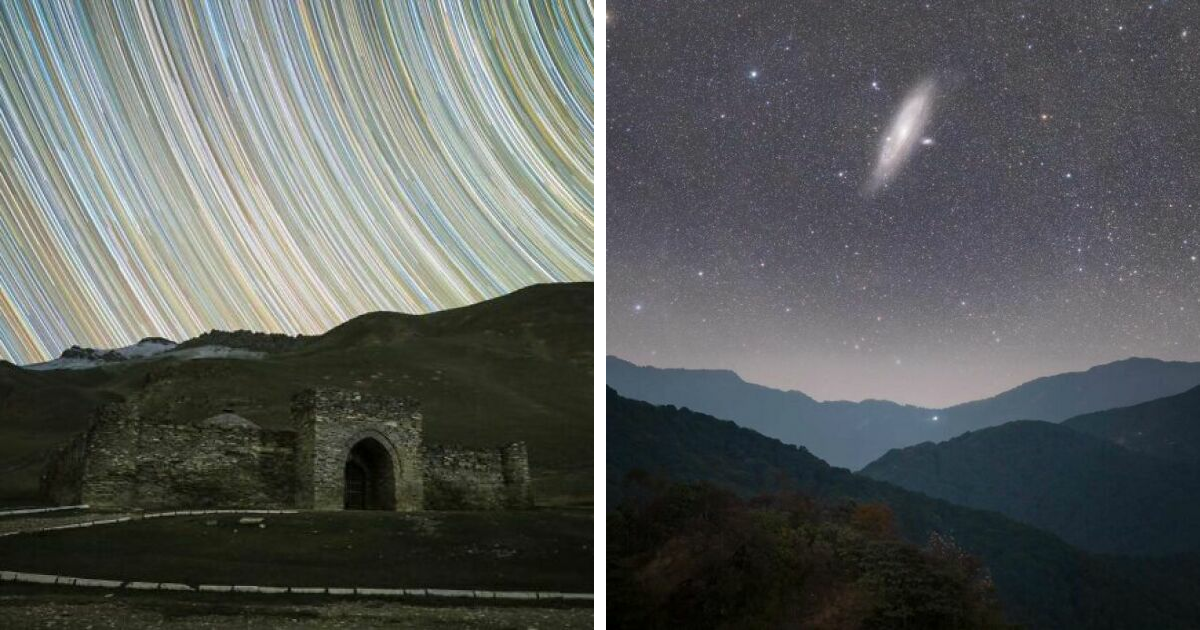

Some photographs ask you to look. Astrophotography asks you to look up, feel tiny, and briefly forgive your phone for having a “night mode” it brags about every chance it gets. The collection “Astrophotography: 45 Mesmerizing Photos Of The Night Sky By Soumyadeep Mukherjee” is a glowing reminder that the sky above us is not empty darkness. It is full of stars, dust lanes, planets, comets, galaxies, moonlight, solar drama, and the occasional cosmic spectacle that makes ordinary life feel deliciously underdecorated.
Soumyadeep Mukherjee, an award-winning astrophotographer from India, has built a visual language around patience, planning, and wonder. His night sky photos are not just pretty wallpaper for people who say “wow” and keep scrolling. They are invitations. They pull viewers toward the Milky Way, star trails, lunar textures, planetary alignments, deep-sky objects, and landscapes where Earth and space seem to shake hands across the horizon.
In a time when light pollution hides the night sky from millions of people, Mukherjee’s work feels especially important. His images do what great astrophotography should do: they make the universe feel both enormous and surprisingly personal. One minute you are looking at a mountain under a sheet of stars; the next, you are wondering whether your city’s streetlights have been stealing your birthright one LED bulb at a time.
Who Is Soumyadeep Mukherjee?
Soumyadeep Mukherjee is an astrophotographer, writer, educator, and full-time creative based in Kolkata, India. His academic background is unusually fascinating for a photographer of the cosmos: he completed a Ph.D. in Linguistics before moving more deeply into professional astrophotography. That mix of science, language, and visual storytelling may explain why his photographs often feel like complete sentences. They do not merely display stars; they communicate atmosphere, emotion, scale, and place.
His work spans multiple branches of astrophotography, including nightscape photography, deep-sky imaging, solar photography, lunar photography, planetary conjunctions, and optical atmospheric phenomena. That range matters. Many photographers specialize in one narrow corner of the night sky, but Mukherjee’s portfolio feels like a guided tour through several neighborhoods of the universe. One image may reveal the Milky Way arching over a dark landscape. Another may focus on the Sun, not as a yellow circle from a kindergarten drawing, but as a textured, active, ever-changing star.
Mukherjee gained international recognition when his solar project A Year in the Sun won the “Our Sun” category in the Astronomy Photographer of the Year 2022 competition. That project combined hundreds of solar observations into a single composition, turning daily discipline into scientific beauty. His image credit has also appeared on NASA’s Astronomy Picture of the Day, including a striking visual sequence showing Venus and Jupiter approaching conjunction over several evenings from Dhanbad, India.
Why These 45 Night Sky Photos Feel So Mesmerizing
The word “mesmerizing” gets thrown around online like confetti at a parade, but here it fits. Mukherjee’s photos are not mesmerizing because they are loud. They are mesmerizing because they reward slow looking. A star trail image may first appear as a beautiful swirl, but then you notice the rotation, the steady movement of Earth, and the quiet strength of the foreground. A Milky Way image may initially seem like a dramatic band of light, but then the dust lanes, color gradients, and landscape alignment begin to tell their own story.
1. The Milky Way Becomes A Character
In many of Mukherjee’s nightscape photos, the Milky Way is not just a background. It behaves like a central character. It rises, curves, glows, hides, and dominates the frame without crushing the landscape beneath it. The result is a cosmic stage where mountains, trees, deserts, rooftops, and human-made structures all become supporting actors.
The Milky Way is especially powerful in astrophotography because it gives viewers a visible connection to our own galaxy. We are not looking at something distant in the abstract; we are looking at the luminous structure we live inside. That is a delightful little identity crisis in photo form.
2. Star Trails Turn Time Into Design
Star trail photography is one of the most poetic forms of night sky imaging. Technically, the stars are not racing in circles above us. Earth is rotating, and long-exposure photography records that motion as arcs across the sky. Artistically, however, the result looks like the universe has decided to draw with a compass.
Mukherjee’s star trail images often combine motion with stillness: a fixed landscape under a spinning sky. That contrast gives the pictures their emotional weight. The land feels grounded. The sky feels alive. The viewer feels like they accidentally walked into a cosmic clock.
3. Deep-Sky Objects Add Mystery
Deep-sky astrophotography requires a different kind of patience. Unlike a quick landscape shot, deep-sky imaging often depends on long integration times, careful tracking, stacking, calibration frames, and detailed processing. The subjects may include nebulae, galaxies, star clusters, and faint clouds of gas that are far too dim for casual viewing.
When Mukherjee presents these objects, the photographs reveal hidden architecture: glowing clouds, stellar nurseries, spiral shapes, and color structures that would otherwise remain invisible to the unaided eye. It is part science, part art, and part “please excuse me while I rethink the size of everything.”
The Art Behind The Science
Astrophotography is often misunderstood as a simple matter of pointing an expensive camera at the sky and letting the universe do the heavy lifting. If only. The truth is much less glamorous and far more impressive. A successful night sky photo may require weather planning, moon phase tracking, dark-sky research, location scouting, manual focus, exposure testing, tripod stability, star tracking, and post-processing skills.
Mukherjee’s images show that technical control is only half the work. The other half is taste. A technically sharp Milky Way photo can still feel flat if the composition is weak. A deep-sky image can be detailed but overwhelming if color and contrast are pushed too aggressively. A solar image can be scientifically interesting but visually confusing without careful presentation. His best work avoids these traps by balancing accuracy, mood, and visual clarity.
Composition: The Earth Needs A Role
In nightscape astrophotography, the foreground is not decorative filler. It is the viewer’s doorway into the image. A tree, ridge, temple, rock formation, person, road, or mountain silhouette gives the sky scale. Without that earthly anchor, the stars may feel beautiful but distant. With it, the viewer can imagine standing there, breathing cold air, whispering too loudly, and wondering whether the snack bag crinkling in their backpack is attracting wildlife.
Mukherjee’s work often uses natural forms to strengthen this connection. Mountains become quiet witnesses. Trees frame the sky. Roads suggest travel. Rooftops remind us that even urban observers can participate in astronomy when conditions and planning allow. The landscape is never just scenery; it is part of the story.
Color: Natural, Dramatic, But Not Chaotic
Color in astrophotography can be tricky. The night sky contains real color, but cameras collect and amplify faint light in ways the human eye cannot. Processing must therefore walk a fine line between revelation and exaggeration. Mukherjee’s strongest images tend to feel vivid without becoming cartoonish. The Milky Way glows, but it does not look like someone spilled a neon smoothie across the heavens.
This restraint helps the viewer trust the image. It also keeps the emotional effect intact. When color supports the subject instead of shouting over it, the result feels immersive rather than artificial.
Light Pollution Makes These Photos More Than Beautiful
One reason this collection matters is that many people can no longer see a truly dark sky from where they live. Light pollution includes glare, light trespass, and skyglow, all of which reduce contrast and hide faint stars. In urban and suburban areas, even a clear night can look oddly empty. The sky is still full of wonders, but artificial light has pulled a curtain across the stage.
Astrophotography can become a bridge for people who have never seen the Milky Way with their own eyes. A strong image does not replace the experience of standing under a dark sky, but it can awaken the desire to seek one. Mukherjee’s photos perform that function beautifully. They remind viewers that darkness is not nothingness. Darkness is the condition that allows the universe to appear.
His images also support a larger conversation about protecting dark-sky locations. When a place offers low light pollution, clear horizons, and safe access, it becomes precious not only for photographers but also for communities, wildlife, tourism, education, and cultural memory. The night sky is a shared heritage. Losing it to careless lighting would be like painting over a national mural because someone wanted a brighter parking lot.
What Beginners Can Learn From Mukherjee’s Astrophotography
Beginners often look at astrophotography and assume they need a truck full of equipment, a degree in orbital mechanics, and a sleeping bag rated for Mars. Good gear helps, yes, but the most important lessons are more approachable.
Plan Before You Shoot
Great night sky photography begins before sunset. Photographers check weather, cloud cover, moon phase, Milky Way position, foreground options, travel routes, and safety. A beautiful sky in the wrong direction may not help if your chosen foreground faces the opposite way. Planning apps and sky maps are useful, but so is old-fashioned scouting. The universe may be infinite, but your camera battery is not.
Focus Manually And Check Often
Autofocus usually struggles in the dark. Manual focus on a bright star or planet is a standard technique, and it should be checked repeatedly. Many promising astro photos have been defeated by slightly missed focus. The heartbreak is real. The stars look like tiny potatoes, and nobody deserves that.
Use A Stable Setup
A sturdy tripod is essential for nightscapes. Long exposures magnify every vibration, from wind to clumsy hands to the emotional tremor caused by realizing you forgot your remote shutter release. For deeper sky work, tracking mounts become important because they follow Earth’s rotation and allow longer exposures without star trailing.
Respect Post-Processing
Editing is not cheating when it is used honestly. Astrophotography often requires stacking, noise reduction, contrast control, color balancing, and careful blending. The goal is not to invent a fake sky, but to reveal faint information captured by the camera. Mukherjee’s work demonstrates how processing can clarify rather than distort.
Reading The 45 Photos: A Viewer’s Guide
To fully enjoy this collection, do not rush through the photos like you are speed-reading a restaurant menu. Spend a few seconds with each frame. Ask what is moving and what is still. Notice whether the sky dominates the land or shares space with it. Look for the direction of the Milky Way, the shape of star trails, the texture of clouds, the placement of planets, and the way foreground objects create scale.
Also pay attention to mood. Some images feel grand and cinematic. Others feel quiet and intimate. Some make Earth seem fragile; others make it seem ancient and steady. The best astrophotography does not have only one emotional setting. It can be dramatic, peaceful, strange, lonely, joyful, and humbling, sometimes all before your coffee gets cold.
Why Mukherjee’s Work Connects With Modern Audiences
Social media has changed the way people encounter the night sky. Many viewers first see comets, eclipses, auroras, or planetary conjunctions not through telescopes but through images shared online. That can be both wonderful and risky. The wonderful part is access: a person in a bright city can still experience celestial beauty through a photographer’s work. The risky part is that oversaturated images can create unrealistic expectations.
Mukherjee’s appeal lies in his ability to make astrophotography feel inspiring without making it feel fake. His work has a sense of discipline behind it. You can sense the waiting, the travel, the repeated attempts, the careful technical decisions, and the respect for the subject. That seriousness gives the images emotional credibility.
Experience: What A Night With Astrophotography Feels Like
The first thing you learn during a night of astrophotography is that darkness has layers. City darkness is not real darkness; it is just daytime with worse visibility and more suspicious noises. True dark-sky darkness feels different. It arrives slowly. The last color drains from the horizon, the first bright stars appear, and then, almost without warning, the sky begins filling itself in. At first you see a few stars. Then dozens. Then hundreds. Then the Milky Way rises like a pale river, and suddenly your daily worries seem hilariously overconfident.
Setting up a camera under that kind of sky is both calming and chaotic. You unfold the tripod, tighten the legs, attach the camera, check the lens, confirm the focus, adjust the composition, and immediately realize your perfect foreground is slightly crooked. Then you fix it and discover that your headlamp is too bright, your fingers are cold, and your snack supply is not as emotionally supportive as promised. Astrophotography is glamorous in the final image and deeply practical in the moment.
The waiting is the strange part. During normal photography, you chase moments. During astrophotography, you often wait for time itself to accumulate. A single exposure may take seconds, minutes, or longer. A star trail sequence can require hundreds of frames. A deep-sky project may stretch across nights. You begin to notice small things: the sound of insects, the temperature drop after midnight, the way distant clouds threaten your plans like unpaid villains, and the peculiar joy of seeing the first usable frame appear on the camera screen.
That little preview on the screen is magic. It is not the polished final image, but it proves the sky is there. The camera sees what your eyes only partly suspected. Dust lanes appear. Star clusters sharpen. A faint glow becomes a galaxy. A planet becomes a point of intention. In that moment, astrophotography stops feeling like a technical exercise and starts feeling like a conversation with hidden light.
Looking at Soumyadeep Mukherjee’s 45 mesmerizing night sky photos can give viewers a similar feeling. You may not know the exact settings, the number of exposures, or the processing workflow behind every frame, but you can sense the experience: the travel, the patience, the disappointment of cloudy attempts, the thrill of a successful capture, and the quiet satisfaction of sharing a sky that many people may never see in person. That is the emotional power of astrophotography. It turns distance into intimacy. It turns darkness into discovery. And it reminds us that sometimes the best view in the world begins exactly where we usually forget to look: above.
Conclusion
“Astrophotography: 45 Mesmerizing Photos Of The Night Sky By Soumyadeep Mukherjee” is more than a gallery of beautiful cosmic images. It is a tribute to patience, curiosity, dark skies, and the human need to feel connected to something larger than traffic, inboxes, and whatever your neighbor is doing with those floodlights. Mukherjee’s work shows that astrophotography can be scientific without feeling cold, artistic without losing truth, and spectacular without becoming noisy.
His photos invite viewers to rediscover the night sky as a living, changing, deeply meaningful part of our world. They also remind us that dark skies deserve protection. After all, the stars are not gone. In many places, they are simply hidden. A photographer like Mukherjee helps pull back the curtain.
Note: This article is an original, fully rewritten synthesis based on publicly available information about Soumyadeep Mukherjee, astrophotography techniques, dark-sky preservation, and reputable astronomy photography resources.