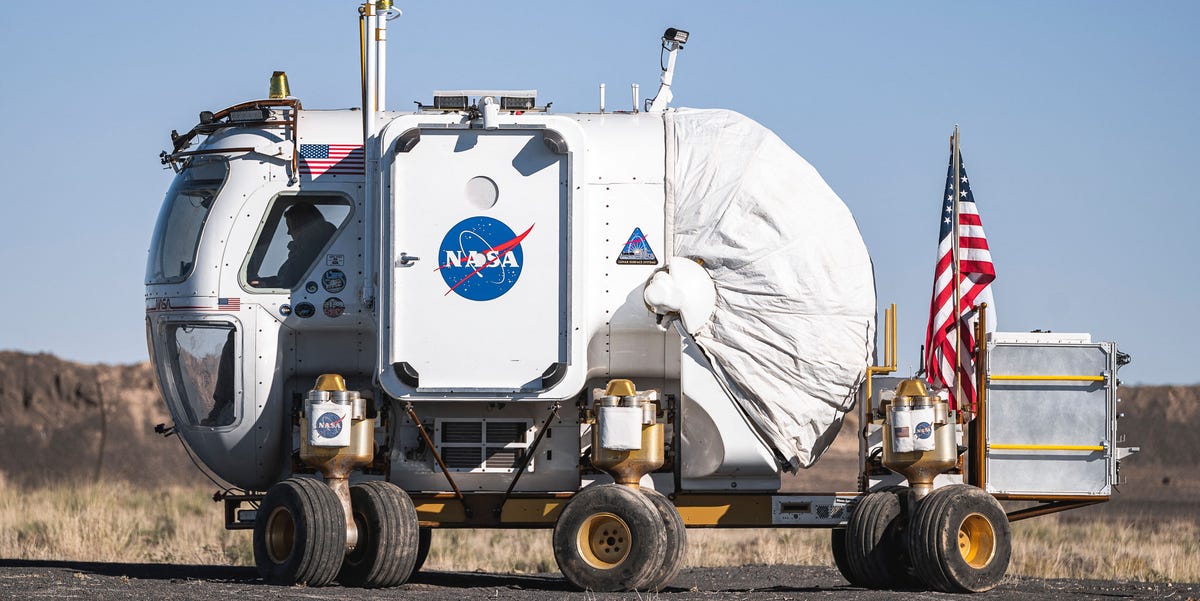

NASA’s next Moon rover is not being tested by simply rolling it around a parking lot and hoping for the best. That would be like training a submarine in a kiddie pool. Instead, engineers, astronauts, commercial space companies, suit designers, robotics experts, and mission planners are putting the new lunar rover concept through a serious obstacle course of science, safety, dust, shadows, awkward spacesuit movements, and “what happens if your crewmate suddenly cannot climb back in?” scenarios.
The vehicle at the center of this work is NASA’s Artemis-era Lunar Terrain Vehicle, or LTV. Unlike the Apollo Moon buggy, which was a brilliant but short-lived machine, the new rover is being designed for a more ambitious job: helping astronauts explore the lunar South Pole, supporting science between crewed missions, operating remotely, and eventually becoming part of a larger Moon Base transportation system. Think less “weekend golf cart” and more “electric off-road laboratory that must survive where even sunlight has commitment issues.”
Behind the scenes, NASA is testing far more than wheels and batteries. The agency is testing how astronauts climb in and out while wearing bulky lunar suits, how tools and sample bags are stored, how displays can be read through helmet visors, how autonomous driving might work in harsh shadows, how emergency rescues are handled, and how commercial rover designs can meet real mission requirements. This is where lunar exploration stops being a glossy artist rendering and becomes engineering with sweat, spreadsheets, and probably a few sore shoulders.
Why NASA Needs a New Lunar Rover for Artemis
NASA’s Artemis campaign is not built around quick visits to the Moon. The goal is to return astronauts to the lunar surface, especially the South Pole region, and learn how to live, work, explore, and build there for the long haul. That means astronauts need mobility. Walking in a spacesuit is useful, but it is slow, tiring, and limited. A rover turns a short field trip into a serious scientific expedition.
The Apollo Lunar Roving Vehicle proved the value of wheels on the Moon more than 50 years ago. Astronauts on Apollo 15, 16, and 17 traveled farther, collected more samples, and examined more diverse geology than earlier crews who had to explore on foot. NASA’s new lunar rover takes that lesson and adds modern expectations: remote operations, autonomous navigation, advanced power management, improved communications, scientific payloads, and commercial service models.
The new LTV is expected to carry two astronauts, work with modern spacesuits, transport tools and samples, and operate even when astronauts are not present. Between human missions, it may be driven remotely from Earth or perform supervised autonomous tasks. That “no crew, still useful” capability is a major difference from Apollo. The rover is not just transportation; it is a science platform, scout, cargo assistant, and lunar workhorse.
The Commercial Rover Race: NASA’s New Way to Build Moon Mobility
NASA selected three companies in 2024 to advance Lunar Terrain Vehicle concepts: Intuitive Machines, Lunar Outpost, and Venturi Astrolab. Each delivered a different interpretation of what a 21st-century Moon rover should be. Intuitive Machines developed Moon RACER, Lunar Outpost created Eagle and later Pegasus concepts, and Astrolab brought its FLEX architecture into the competition.
Instead of building every nut and bolt in-house, NASA is buying rover services from industry. That approach allows private companies to design, build, and potentially use the vehicles for commercial activities when NASA is not using them. It also pushes innovation because different teams can solve the same problem in different ways. One rover may emphasize a truck-like cockpit and utility. Another may focus on compact stowage and flexible cargo handling. Another may lean into robotic operations and modularity.
By 2026, NASA had moved toward early Moon Base mobility by awarding Phase 1 LTV work to Astrolab and Lunar Outpost. Astrolab’s CLV-1 is adapted from the company’s FLEX rover architecture and is designed to transport astronauts, carry supplies, and support remote operations. Lunar Outpost’s Pegasus is a lighter, mission-ready evolution of its earlier Eagle design, built for manual, teleoperated, and autonomous driving. In plain English: NASA wants rovers that can be driven by astronauts, controlled from Earth, and smart enough not to panic when the Moon throws a rock garden in the way.
Testing Starts on Earth, Because the Moon Has Terrible Customer Service
Once a rover is on the lunar surface, calling a tow truck is not an option. That is why NASA tests relentlessly before anything flies. The agency’s Johnson Space Center in Houston has become a key proving ground for evaluating commercial lunar rover mockups and NASA’s own Ground Test Unit, or GTU.
The GTU is not meant to go to the Moon. It is a flexible engineering prototype that helps NASA understand rover operations before committing to flight hardware. Engineers can modify it, test different crew layouts, try new control concepts, and evaluate how astronauts might interact with the vehicle. It is the lunar rover equivalent of a rehearsal stage where everyone finds the awkward moments before opening night.
NASA uses the GTU to examine crew compartment design, maintenance concepts, science payload integration, drive modes, self-leveling systems, and supervised autonomy. This allows the agency to be what its engineers call a “smart buyer.” In other words, NASA can better evaluate commercial rover proposals because it has hands-on data from its own testing.
Inside NASA’s Human-in-the-Loop Rover Tests
One of the most important parts of lunar rover testing is human-in-the-loop evaluation. That means astronauts and engineers physically interact with rover mockups while wearing spacesuits or suit prototypes. A design that looks fantastic on a computer screen may become comedy when an astronaut wearing thick gloves tries to open a latch, grab a sample bag, or read a display.
At Johnson Space Center, NASA tested commercial LTV mockups from Astrolab, Intuitive Machines, and Lunar Outpost. Astronauts and engineers performed realistic tasks such as entering and exiting the rover, reaching for geology tools, loading science payloads, handling cargo, checking displays, and practicing emergency procedures. These tests are not glamorous in the Hollywood sense, but they are exactly where mission safety is born.
Spacesuits change everything. A gloved hand does not have the dexterity of a bare hand. A helmet limits peripheral vision. A pressurized suit changes how the body bends. Even climbing into a seat can become a small engineering puzzle. NASA wants to know whether a tired astronaut can still operate controls clearly after a moonwalk, whether two suited crew members fit safely, and whether a tool drawer can be opened without turning the moment into a slow-motion wrestling match.
The ARGOS Facility: Making Earth Feel a Little More Like the Moon
The Moon’s gravity is about one-sixth of Earth’s gravity. That difference affects how astronauts move, how they climb, how they carry tools, and how they recover if they stumble. To mimic reduced gravity, NASA uses facilities such as the Active Response Gravity Offload System, known as ARGOS, at Johnson Space Center.
ARGOS can suspend a suited test subject so that the person experiences a reduced effective weight. This helps NASA simulate lunar movement during rover evaluations. While wearing a planetary spacesuit prototype, astronauts can practice tasks around the rover as if they are partially “offloaded” from Earth gravity. It is not the Moon, but it is much closer than asking someone to pretend they weigh less while standing in Texas.
During LTV testing, ARGOS allowed crew members to perform exterior tasks such as deploying science payloads, retrieving lunar geology tools, raising equipment, and moving around the rover. These exercises help engineers understand whether the vehicle supports real exploration work. After all, a lunar rover is only useful if astronauts can actually use it while dressed like highly trained marshmallows.
Testing the Spacesuit-Rover Relationship
The rover and spacesuit must behave like a team. If the rover’s controls are too small for gloves, the mission loses efficiency. If the seats are too awkward, crew fatigue increases. If displays are angled badly, astronauts may struggle to read them under harsh lighting. If storage is inconvenient, valuable science time disappears into rummaging.
NASA has tested rover mockups with its Exploration Extravehicular Mobility Unit planetary prototype spacesuit and Axiom Space’s lunar spacesuit. These evaluations help engineers study how suits and vehicles interact. The key question is simple: Can astronauts safely and efficiently drive, climb, reach, grab, store, rescue, and repair while wearing the gear required to survive outside?
This is why rover testing includes details that might sound small but matter enormously: hand-controller shape, step height, seat position, sample box placement, tool rack layout, display brightness, and emergency access. On the Moon, “slightly annoying” can become “mission-limiting.” NASA’s job is to find that out before launch.
Emergency Drills: The Part Nobody Wants, But Everybody Needs
One of the most serious parts of NASA’s lunar rover testing involves emergency rescue drills. NASA requires rover designs to support the rescue of an incapacitated crewmember. That means one astronaut may need to help another astronaut back onto or into the vehicle while both are wearing spacesuits and operating in lunar gravity.
This is not a minor checkbox. A rover may travel farther from a lander or habitat than astronauts could comfortably walk back. If something goes wrong, the vehicle must help the crew recover quickly. Engineers study whether handles are in the right place, whether the rover layout allows access to a disabled crewmate, and whether one astronaut can perform the rescue without needing three extra arms and a motivational poster.
Emergency testing also affects the design of seats, restraints, steps, access points, communication systems, and tool placement. A rover must support science, but it must first support survival. NASA’s testing philosophy is clear: if a problem can happen on the Moon, practice it on Earth until the team knows what to change.
Autonomy: Teaching the Rover to Think Before It Rolls
The next generation of lunar rovers will not be simple remote-control cars. Communication delays, limited crew time, dangerous terrain, and long-distance traverses make autonomy essential. The rover needs enough onboard intelligence to avoid hazards, assist with navigation, and potentially perform tasks between crew visits.
NASA’s broader rover research includes advanced autonomy projects like JPL’s ERNEST, the Exploration Rover for Navigating Extreme Sloped Terrain. In 2026, ERNEST completed a desert field test in Southern California, traveling about 16 miles over 37 hours of driving with minimal human intervention. The prototype tested mobility hardware and autonomy software that could inform future long-range lunar or Mars rover missions.
ERNEST is not the same vehicle as the Artemis LTV, but its testing shows the direction NASA is moving. The rover uses active suspension, four steerable wheels, and artificial intelligence trained through simulation. It can test different ways of moving across rocks, slopes, sand, and awkward terrain. For future Moon missions, that kind of autonomy could help rovers travel farther, scout safer paths, and continue collecting science when astronauts are back in orbit or on Earth.
Why Lunar Shadows Are a Nightmare for Rover Testing
The lunar South Pole is scientifically exciting because permanently shadowed regions may preserve water ice and other volatiles. Unfortunately, it is also visually brutal. The Sun can sit low on the horizon, creating long shadows, blinding glare, and confusing terrain contrast. A rock may look harmless from one angle and like a black hole from another.
That is why NASA and JPL test rover systems under difficult lighting conditions. ERNEST was tested at dusk, dawn, and nighttime to simulate the kinds of shadows expected near the Moon’s polar regions. For crewed rovers, lighting affects cameras, lidar, astronaut visibility, navigation displays, and hazard detection.
On Earth, a driver can slow down, turn on headlights, and complain about potholes. On the Moon, a rover has to interpret unfamiliar terrain where shadows may hide slopes, rocks, craters, or dust-covered hazards. Testing under bad lighting is not dramatic for fun; it is necessary because the Moon does not offer perfect studio illumination.
The Science Gear Riding Along
NASA’s lunar rover is not just a ride. It is expected to support science instruments, sample collection, and payload operations. NASA has selected instruments for the Artemis LTV that focus on mapping minerals, volatiles, subsurface structures, and possible ice. These instruments can help scientists understand what the lunar South Pole is made of and how resources might support future exploration.
One instrument, AIRES, is designed to study infrared reflectance and emission to identify minerals and volatile materials. Another, L-MAPS, combines microwave sensing and ground-penetrating radar to investigate what lies beneath the surface. Together, such instruments could help astronauts choose promising sample sites, evaluate potential water ice locations, and map terrain that matters for future Moon Base planning.
This changes the rover’s job description. It must carry people, but it must also carry knowledge-making equipment. Testing has to confirm that astronauts can deploy instruments, reach payload bays, secure samples, and operate science tools without wasting precious surface time. A lunar rover with bad storage would be like a moving laboratory where every drawer jams. NASA is trying very hard to avoid that.
Dust, Temperature, and the Moon’s Talent for Breaking Things
The Moon is beautiful from a distance and deeply rude up close. Lunar dust is abrasive, sticky, electrically charged, and capable of getting into places where no dust should have any business being. It can damage seals, scratch surfaces, coat radiators, interfere with mechanisms, and annoy engineers in ways that only fine powder can.
Temperature is another enemy. The lunar surface can swing between extreme heat and extreme cold, while shadowed regions near the poles can remain brutally cold for long periods. Electronics, batteries, joints, wheels, displays, and sensors must all be designed with thermal survival in mind. NASA’s Moon Base concepts expect early LTVs to survive extended periods in shadow and operate across difficult slopes and terrain.
Testing on Earth cannot perfectly recreate every lunar condition at once, but it can reveal weaknesses. Engineers use simulations, thermal analysis, mechanical testing, reduced-gravity analogs, regolith simulants, and field tests to understand how designs behave. The process is part science, part detective work, and part “please fail now, not 238,000 miles away.”
What NASA Learns From Every Test
Every rover test produces feedback. Astronauts may report that a handle is difficult to reach. Engineers may discover that a display angle creates glare. A suit technician may notice that a glove catches on a control. A safety team may find that rescue access needs improvement. A robotics specialist may see that autonomous navigation needs better perception in shadow.
That feedback goes back to the commercial providers and NASA teams. Designs evolve. Mockups change. Requirements are refined. The goal is not to prove that the first version is perfect. The goal is to discover what needs improvement while there is still time to fix it.
This is the real behind-the-scenes story of NASA rover testing. It is not one magical test where everyone claps and sends the rover to space. It is a long chain of evaluations, redesigns, reviews, simulations, field trials, and human factors studies. The lunar rover must satisfy scientists, astronauts, engineers, commercial operators, mission planners, and safety teams. That is a tough crowd, and rightly so.
Experience Section: What It Feels Like to Watch a Moon Rover Test Take Shape
Picture the test floor at Johnson Space Center. The rover mockup sits under bright lights, looking futuristic but not untouchable. It has tool drawers, seats, controls, rails, panels, cargo areas, and surfaces that invite questions. Around it, people move with the focused calm of a team that knows every detail matters. Nobody is treating the rover like a museum piece. They are poking, measuring, climbing, checking, adjusting, and asking the most NASA question imaginable: “What happens if this goes wrong?”
The most striking part of the experience is how physical it is. Space exploration can sound abstract when described in acronyms, contracts, and mission timelines. But rover testing is full of human motion. An astronaut tries to climb in. A suited engineer reaches for a tool. Someone watches the angle of a wrist. Another person checks whether the glove can grip the handle. A team member notes how long it takes to retrieve a sample container. Suddenly, the future of lunar exploration depends on whether a drawer opens smoothly.
There is also a strange mix of seriousness and playfulness. The rover looks like something from science fiction, but the work is practical. Can two astronauts sit side by side? Can one astronaut rescue another? Can a display be read while the helmet visor reflects light? Can a payload be reached without turning the astronaut into a slow-motion pretzel? The humor is built into the situation, but so is the danger. Everyone knows the Moon will not forgive sloppy design.
Watching reduced-gravity simulation adds another layer. When a suited test subject is partially supported to mimic lunar gravity, movements become both graceful and awkward. Steps look floaty, but tasks still require effort. A person may bounce slightly while trying to do something as ordinary as handle equipment. It becomes obvious that designing for the Moon is not just designing a vehicle. It is designing a complete choreography between body, suit, machine, tools, terrain, and time.
Then there is the rover itself. It is easy to think of it as a vehicle, but during testing it feels more like a partner being trained. It must carry astronauts, protect them, help them work, listen to commands, survive harsh conditions, and keep functioning when no one is around to tighten a bolt. Every latch, wheel, screen, sensor, and step is part of that partnership.
Field testing offers a different experience. In desert terrain, a rover prototype like ERNEST becomes a small explorer in a big, indifferent landscape. Engineers follow, observe, and collect data while the machine handles rocks, slopes, loose soil, and difficult lighting. At dusk or dawn, long shadows stretch across the ground, giving a taste of the lunar South Pole’s visual confusion. The rover’s job is to keep moving intelligently when the landscape refuses to be friendly.
The emotional takeaway is surprisingly simple: Moon rover testing is not about making a cool vehicle look cool. It is about earning trust. Before astronauts rely on a rover far from Earth, NASA needs to know how it behaves when tired humans, bulky suits, bad lighting, difficult terrain, dust, emergencies, and science goals all collide. The rover must be tough, but it must also be understandable. It must be advanced, but not fussy. It must be smart, but predictable. In space exploration, confidence is built one awkward test, one revised handle, one simulated rescue, and one dusty traverse at a time.
Conclusion: The Moon Rover Is Being Tested Like a Mission, Not a Machine
NASA’s new lunar rover testing program shows how different Artemis is from Apollo. The goal is not simply to drive farther for a few days. The goal is to build a flexible mobility system that can support astronauts, science, commercial activity, and long-term lunar operations. That requires vehicles that can be driven manually, operated remotely, and eventually trusted with more autonomous behavior.
Behind the scenes, NASA is testing the rover as part of a complete exploration ecosystem. Astronauts, spacesuits, tools, science payloads, rescue procedures, reduced gravity, lighting, terrain, thermal challenges, and commercial designs all have to work together. The result may look like a Moon buggy, but it is really a mobile science platform built for the next era of human exploration.
If Artemis succeeds, future astronauts may look back at these Earth-based tests as the quiet beginning of a new lunar road system. Before the rover leaves tire tracks in Moon dust, it must first pass through Houston test facilities, desert trials, digital simulations, suit evaluations, and countless engineering reviews. Space history often remembers the launch. Engineers remember the checklist that made the launch possible.