
Note: This article is written for news analysis and public understanding. It discusses reported events, strategic context, and media literacy without providing operational instructions or tactical guidance.
A drone video from Belarus did something rare in modern war coverage: it made a huge military aircraft look oddly small. In footage released by the Belarusian opposition-linked group BYPOL, a small drone appears to approach and land on top of a Russian Beriev A-50 Mainstay airborne early warning aircraft parked at Machulishchy Air Base near Minsk. For a plane built to detect threats across great distances, the optics were brutal. The “eyes in the sky” had apparently been visited by something much closer to “eyes on the roof.”
The episode became one of the most talked-about drone-war moments of 2023 because it combined three ingredients that instantly grab attention: a rare Russian surveillance aircraft, a Belarusian anti-government group, and video that seemed almost too simple to be real. No cinematic explosions were needed. The image of a small drone calmly sitting on a critical military aircraft carried its own message: expensive systems can still be embarrassed by cheap, agile technology when security fails.
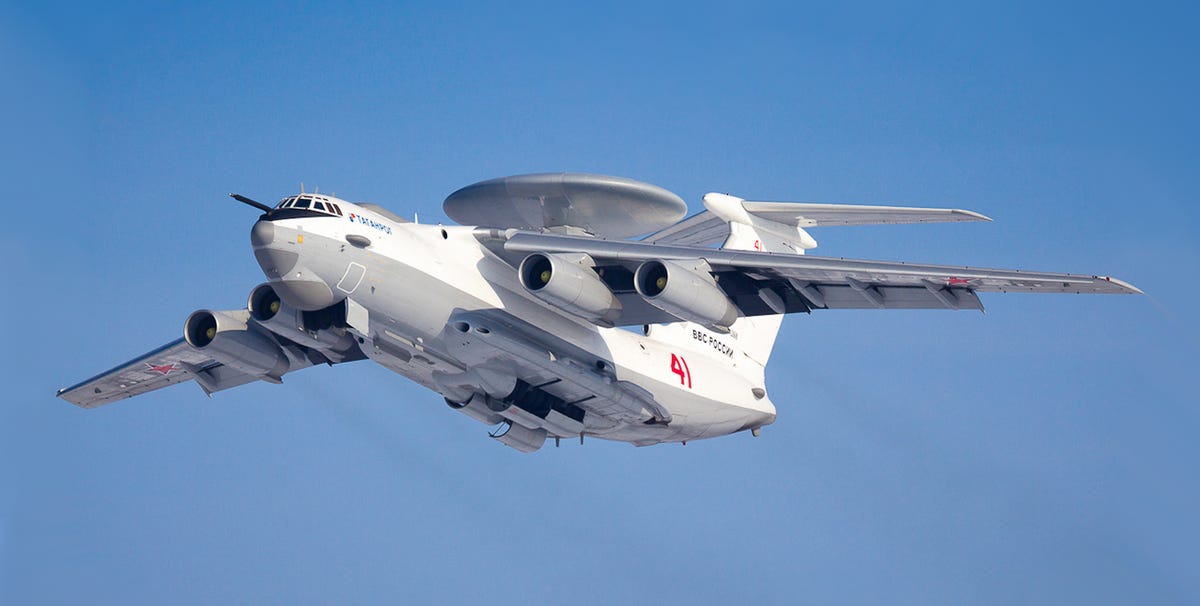
The incident centered on the Russian A-50 Mainstay, a large airborne early warning and control aircraft based on the Ilyushin Il-76 transport platform. In plain English, it is a flying radar station. Its job is to detect aircraft, missiles, and other targets, then help coordinate Russian air operations. That makes it far more important than an ordinary parked aircraft. Damaging or even temporarily sidelining one can affect how Russia monitors airspace and supports operations connected to the war in Ukraine.
What Happened at Machulishchy Air Base?
On February 26, 2023, Belarusian anti-government activists said a Russian Beriev A-50 aircraft had been damaged in a drone attack at Machulishchy Air Base, located near Minsk. BYPOL, a group associated with former Belarusian security personnel opposed to Alexander Lukashenko’s government, claimed responsibility. The group said drones had targeted the aircraft, which was parked at a Belarusian military facility used by Russian forces during the broader war against Ukraine.
At first, the situation was cloudy. Russian and Belarusian officials did not immediately confirm the claims, while outside analysts debated the extent of any damage. Satellite images and official footage later complicated the story, suggesting the aircraft may not have been destroyed. But the core event did not simply disappear. Belarusian President Alexander Lukashenko later acknowledged that the A-50 had been attacked, while insisting the damage was minor. Even that admission mattered. In military information wars, an official confirmation can be louder than a jet engine.
The video released afterward gave the story its viral spark. It appeared to show a drone flying over the airfield and landing on the aircraft’s rotodome or upper fuselage area. The rotodome is the circular radar structure mounted above the aircraft, the part that makes the A-50 look like it is carrying a giant dinner plate. That visual detail is why the clip spread so widely: viewers could instantly understand what they were seeing, even if they had never read a defense brief in their lives.
Why the Russian A-50 Mainstay Matters
The Beriev A-50 Mainstay is not a typical military plane. It is an airborne early warning and control aircraft, sometimes compared in role to the American E-3 Sentry AWACS. These aircraft do not win attention with dogfights or dramatic bombing runs. Their value comes from information. They scan large areas, track targets, and help commanders understand what is happening in the sky and on the battlefield.
For Russia, the A-50 has been especially important during the war in Ukraine. Its sensors can support air defense, fighter coordination, missile warning, and broader command-and-control functions. A single aircraft can help knit together other pieces of a military system. That is why such planes are often called “force multipliers.” A less fancy way to say it: they make other weapons and aircraft smarter. In a conflict where information moves fast, radar aircraft are not background characters. They are the people holding the map while everyone else is arguing over where to go.
The A-50U, the upgraded version often discussed in reports about the Machulishchy incident, is considered rare and valuable. Russia does not have an unlimited number of these aircraft. They are large, complex, expensive to maintain, and difficult to replace quickly. This scarcity helps explain why a claimed strike on one aircraft generated so much attention. Even limited damage could matter if it forced repairs, reduced availability, or made commanders rethink where they could safely park high-value assets.
Who Is BYPOL?
BYPOL is a Belarusian opposition-linked organization associated with former members of Belarusian security services. It emerged after the political crisis that followed Belarus’s disputed 2020 presidential election and the government crackdown on mass protests. The group has positioned itself against Lukashenko’s rule and against the use of Belarusian territory to support Russia’s war in Ukraine.
After Russia’s full-scale invasion of Ukraine in 2022, Belarus became a crucial rear area for Moscow. Russian troops, aircraft, and equipment have operated from Belarusian territory, even though Belarus has not formally joined the war as a full combatant in the same way Russia has. That arrangement created deep tension inside Belarus. Opposition activists have argued that Lukashenko allowed the country to become a launchpad for aggression. The government, meanwhile, has treated anti-war and anti-regime actions as serious crimes.
BYPOL’s claim regarding the A-50 was therefore more than a military headline. It was also political theater, resistance messaging, and psychological pressure wrapped into one dramatic clip. The group wanted to show that Russian assets in Belarus were not untouchable. It also wanted Belarusians and international audiences to see that opposition to Moscow’s use of Belarusian territory remained active.
The Video: Why It Hit So Hard Online
The phrase “Belarus group lands drone on top of Russian A-50 Mainstay” sounds almost like a movie pitch rejected for being too on the nose. But that simplicity is exactly why the footage traveled so quickly. It did not require a complicated explanation. A small drone approaches a huge aircraft. The aircraft is valuable. The drone lands. Viewers immediately understand the embarrassment factor.
Modern conflict is shaped not only by what happens physically, but by what can be documented and shared. A blurry clip can become part of a strategic narrative. In this case, the narrative was clear: a major Russian surveillance aircraft, stationed in allied Belarus, appeared vulnerable at close range. Whether the physical damage was severe, limited, or quickly repairable, the reputational damage was already airborne.
That said, responsible readers should treat wartime videos carefully. Footage released by parties to a conflict is rarely neutral. It may show real events while omitting context. It may be edited, staged, delayed, or framed to support a message. The Machulishchy video appears to have shown a drone over or on the A-50, but public reporting has remained cautious about the exact damage. The smartest response is not to shout “fake” or “confirmed total destruction” five seconds after watching. The smartest response is to ask: what does the footage prove, what does it suggest, and what remains unverified?
Damage Claims and Official Responses
BYPOL initially claimed the A-50 had been seriously damaged, including areas associated with radar and avionics. Belarusian and Russian authorities were slower to acknowledge the incident. Later, Lukashenko said the aircraft had been attacked but described the damage as insignificant. Reports also indicated the plane was sent to Russia for maintenance or repairs, which raised an obvious question: if the damage was so minor, why send the aircraft away?
That question does not automatically prove catastrophic damage. Military aircraft can require specialized inspection after even limited contact with sensitive areas. The A-50’s radar, communications systems, and upper structures are not exactly the kind of thing you patch with duct tape and a hopeful thumbs-up. Still, the competing narratives were telling. BYPOL wanted the world to see a successful strike. Belarus wanted to minimize embarrassment. Russia had little incentive to advertise vulnerability. Somewhere between those claims sits the most likely truth: the aircraft was attacked, the full damage was difficult to verify publicly, and the political effect was significant.
Why a Small Drone Could Challenge a Big Aircraft
The Machulishchy incident fit a larger trend in modern warfare: small drones have become impossible to ignore. They are used for surveillance, propaganda, targeting support, and attacks. Their value is not only that they are inexpensive compared with major military platforms. It is that they can expose weak assumptions. A base designed to protect against traditional threats may still struggle with small aerial systems flying low, slow, or unexpectedly.
For decades, militaries often thought about airbase defense in terms of missiles, aircraft, commandos, and long-range strikes. Drones changed that mental checklist. A small unmanned aircraft can create security problems that are less glamorous but extremely annoying. Think of it as the mosquito of military technology: tiny, irritating, hard to swat, and capable of ruining an otherwise respectable evening.
However, the lesson is not that drones are magic. They are not. They can fail, be jammed, intercepted, detected, or misused. The real lesson is that modern security must be layered. High-value aircraft need physical protection, surveillance, electronic defenses, rapid response teams, and disciplined procedures. If one layer fails, another should catch the problem. At Machulishchy, the publicly released footage suggested that at least some layers did not work as expected.
Strategic Impact: More Than One Aircraft
The A-50 incident mattered because it pointed to broader Russian vulnerabilities. Russia has relied on Belarus as a strategic partner and staging area. If opposition-linked actors inside Belarus can threaten valuable Russian equipment, Moscow has to consider extra protection, relocation, or operational changes. None of those choices are free. More security means more manpower. Relocation means less convenience. Reduced confidence means slower decisions.
The attack also had psychological impact. For Ukraine and its supporters, the story reinforced the idea that Russian advantages could be challenged in unexpected ways. For Belarusian opposition circles, it became a symbol of resistance. For Russia and Belarus, it was an unwelcome reminder that even rear-area bases can become part of the battlefield.
Later developments made the A-50 fleet even more important to watch. In 2024, Ukraine reported the downing of Russian A-50 aircraft, intensifying attention on how many operational radar planes Russia still had available. Each confirmed or reported loss placed more pressure on a fleet that was already limited. Against that background, the Machulishchy episode looked less like an isolated stunt and more like an early sign of a wider campaign against Russia’s airborne surveillance network.
What the Incident Reveals About Belarus
The drone landing video also reveals something about Belarus’s uncomfortable position in the war. Belarus is formally a separate country, but its government has allowed Russian forces to use its territory. That has made Belarus a strategic extension of Russia’s war effort, even as many Belarusians oppose the conflict. This tension helps explain why anti-government activists framed the A-50 incident as resistance not only to Russia, but also to Lukashenko’s alignment with Moscow.
Belarusian authorities responded harshly to alleged involvement in the attack. In 2024, a Belarusian court sentenced multiple people in connection with the Machulishchy incident, with some receiving long prison terms in absentia. The legal aftermath showed that the Belarusian state viewed the episode as far more than a prank with propellers. It treated the case as a major security and political challenge.
This is one reason the story still matters. It sits at the intersection of military technology, authoritarian politics, anti-war resistance, and information warfare. That is a crowded intersection. Someone should really install a traffic light.
Media Literacy: How to Watch Wartime Drone Footage
When a headline says “Watch,” it is tempting to treat the video as the whole story. But wartime footage should be handled like a witness with a strong opinion: useful, but not enough by itself. A clip can show location, proximity, and sometimes timing. It may not show what happened before or after. It may not prove damage. It may not reveal whether the action shown was the actual strike, a reconnaissance flight, or a separate demonstration.
For readers, a practical approach is to separate confirmed facts from claims. Confirmed: BYPOL claimed responsibility for an attack on a Russian A-50 at Machulishchy. Confirmed by later official acknowledgment: Lukashenko said the aircraft had been attacked. Strongly supported by public footage: a drone appeared to reach and land on or near the top of the aircraft. Less certain: the exact level of physical damage and the full chain of responsibility.
This distinction does not make the story less interesting. It makes it more honest. Good analysis does not need to pretend every detail is nailed down. In fact, admitting uncertainty is often what separates useful reporting from online yelling with better lighting.
Why This Story Still Gets Attention
The headline continues to attract searches because it captures a turning point in how people understand modern conflict. The image of a drone landing on a Russian A-50 Mainstay is not just about one aircraft. It is about the shrinking gap between expensive military hardware and low-cost disruption. It is about the power of video to turn a security failure into a global narrative. And it is about Belarus, a country often discussed as Russia’s ally, also containing networks of resistance that complicate Moscow’s plans.
In older wars, a damaged radar aircraft might have remained a rumor in intelligence channels. In this war, the world can see a drone’s-eye view on social media. That changes the tempo of public understanding. It also changes pressure on governments, militaries, and propagandists. Everyone now competes not only to control territory, but to control interpretation.
Experience-Based Reflections: Lessons From Watching the A-50 Drone Story Unfold
For anyone who follows defense news, the Belarus A-50 drone story is a reminder that the most important moments are not always the loudest. Some military headlines arrive with dramatic claims, huge explosions, and confident declarations. This one became memorable because of its almost casual visual absurdity. A small drone appeared to settle on top of a massive radar aircraft as if it had found the world’s most expensive parking spot. That contrast made the event easy to understand, even for readers who do not spend their weekends comparing aircraft silhouettes.
The first experience this topic teaches is patience. When the story first broke, claims moved faster than verification. Some reports suggested serious damage. Official sources initially downplayed or denied aspects of the event. Later acknowledgments and additional footage added layers, but not perfect clarity. This is common in wartime reporting. The public rarely receives a neat folder labeled “Complete Truth, Please Enjoy.” Instead, readers get fragments: activist claims, government statements, satellite images, expert analysis, and videos with limited context. The job is to build a careful picture without forcing certainty where it does not belong.
The second lesson is that symbolism matters. Even if a high-value aircraft is only lightly damaged, the fact that it was reached at all can reshape perceptions. Military organizations spend enormous effort projecting competence. A drone landing on a strategic aircraft punctures that image. It tells adversaries, allies, and domestic audiences that gaps exist. In conflict, perception can influence morale, planning, and political pressure. A small aircraft can cast a very large shadow.
The third experience is about technology’s uneven playing field. The A-50 represents a traditional model of military power: large, specialized, expensive, and crewed by trained personnel. Small drones represent a newer kind of pressure: flexible, widely available, and visually powerful. The point is not that one replaces the other. The point is that both now occupy the same battlespace. A military can own advanced aircraft and still be forced to worry about small systems that cost a tiny fraction as much. That is the uncomfortable math of modern warfare.
The fourth lesson is caution. Drone footage can be compelling, but compelling does not always mean complete. Viewers should resist the urge to turn every clip into instant certainty. Ask whether independent outlets have verified the location. Ask whether officials have acknowledged any part of the event. Ask whether later reporting changed the original interpretation. In this case, responsible coverage noted the claims, the video, the official acknowledgment, and the uncertainty over damage. That balanced approach is far more useful than treating every viral clip as either sacred proof or total fiction.
Finally, the A-50 incident shows why Belarus remains central to the Russia-Ukraine war even when front-line maps focus elsewhere. Belarusian territory, Russian military assets, anti-government resistance, and regional security all overlap. The drone video became famous because it was visually striking, but the deeper story is political. It showed that the war’s pressure extends beyond Ukraine’s borders and into the domestic vulnerabilities of Russia’s closest partners. In that sense, the small drone did not merely land on an aircraft. It landed on a much bigger question: how secure is a military machine when the ground beneath it is politically unstable?
Conclusion
The report that a Belarus group landed a drone on top of a Russian A-50 Mainstay remains one of the most striking examples of how modern warfare blends technology, symbolism, and information. The A-50 is a rare and valuable airborne early warning aircraft. BYPOL’s claim and the released footage turned a military-security incident into a global story. While the exact extent of damage has been debated, the broader lesson is clear: high-value military systems are only as safe as the security environment around them.
For Russia, the incident highlighted the vulnerability of critical surveillance assets. For Belarus, it exposed the internal tension created by hosting Russian military forces. For global readers, it offered a case study in how small drones and public video can reshape narratives faster than official statements can contain them. In short, the A-50 may be designed to watch the skies, but this time, the world was watching it.