
A damp basement can make an entire house smell like a forgotten gym bag. Moisture may also encourage mold, mildew, condensation, and damage to stored belongings. Fortunately, a well-chosen dehumidifier can pull excess water vapor from the air and help maintain a more comfortable indoor environment.
The difficult part is choosing the right machine. Product pages are crowded with pint ratings, enormous square-footage claims, pumps, hoses, smart controls, and enough technical vocabulary to make a simple appliance feel like laboratory equipment.
This dehumidifier buying guide cuts through that fog. Before spending your money, consider the room’s moisture level, the unit’s true capacity, drainage options, energy use, operating noise, maintenance requirements, and safety record. The best dehumidifier is not necessarily the largest or most expensive model. It is the one that can control humidity in your specific space without becoming a noisy, power-hungry roommate.
Why You May Need a Dehumidifier
Indoor relative humidity should generally remain below 60%, with a range of approximately 30% to 50% working well in many homes. You do not need to guess whether a room is humid. An inexpensive digital hygrometer can measure relative humidity and show how conditions change throughout the day.
Common signs of excess moisture include:
- A persistent musty odor
- Condensation on windows, pipes, or walls
- Damp-feeling furniture, bedding, or clothing
- Dark mildew spots on surfaces
- Peeling paint or swelling wood
- A clammy basement or laundry room
- Humidity readings that regularly exceed 60%
A dehumidifier can help manage airborne moisture, but it is not a repair crew in a plastic box. Fix leaking pipes, foundation seepage, blocked gutters, poor grading, and unvented dryers before expecting an appliance to solve the entire problem.
1. Match the Capacity to the Space and Moisture Level
The first and most important step is selecting the correct dehumidifier capacity. Capacity is usually measured in pints of water removed during 24 hours under standardized test conditions. It does not describe the size of the water bucket.
A 50-pint model, for example, is rated to remove up to 50 pints of moisture per day under the specified test conditions. Its bucket may hold only a fraction of that amount, which means manual emptying could be required several times a day in a wet space.
Measure the Area
Measure the length and width of the room, then multiply those figures to calculate square footage. For an irregular basement, divide the floor into smaller rectangles, calculate each section, and add the totals.
Do not shop by square footage alone. Two 1,000-square-foot basements can have radically different moisture loads. One may feel slightly damp only after summer rain, while the other may have visible condensation, wet laundry, and water seepage. The wetter room needs greater moisture-removal capacity.
Use Moisture Conditions as a Second Sizing Factor
| Room Condition | Typical Signs | General Capacity Direction |
|---|---|---|
| Slightly or moderately damp | Occasional musty odor; room sometimes feels clammy | About 20 to 30 pints for many spaces under 2,000 square feet |
| Very damp | Persistent odor; damp spots on walls or floors | About 25 to 40 pints for many spaces under 2,000 square feet |
| Wet | Visible condensation, seepage, or frequent indoor laundry drying | About 30 to 50 pints for many spaces under 2,000 square feet |
| Large or severely wet | More than 2,000 square feet, standing moisture, or a major humidity load | Consider 50-plus pints, multiple units, or a whole-home system |
When choosing between two capacities, modestly oversizing is usually more practical than undersizing. A larger unit may reach the target humidity faster and cycle off, while an undersized model may run continuously without catching up. However, buying a commercial monster for a small bedroom is unnecessary. It may cost more, occupy valuable space, and sound like a tiny airport.
Be Careful When Comparing Old and New Pint Ratings
Dehumidifier testing changed in 2019. Newer portable models are tested at a lower temperature that better represents basement conditions. As a result, an older unit labeled 70 pints may be broadly comparable in moisture-removal ability to a newer model carrying a lower rating. Compare products tested under the same standard whenever possible rather than assuming the larger printed number always wins.
2. Choose the Right Type for the Location and Temperature
Most homeowners choose between portable compressor dehumidifiers and whole-home systems. Compact thermoelectric models are also sold, but their moisture-removal ability is generally much lower. They may help in a small closet or cabinet, but they are rarely a serious answer for a wet basement.
Portable Dehumidifiers
A portable dehumidifier is usually the simplest option for one room, a basement, a garage, or a laundry area. Most have wheels, a removable bucket, a washable filter, and an adjustable humidistat. They are relatively easy to install because installation often means placing the unit correctly, attaching a hose if desired, and plugging it into a suitable grounded outlet.
Whole-Home Dehumidifiers
A whole-home unit connects to the HVAC system or uses dedicated ductwork. It can manage humidity across a larger area more evenly than a single portable machine. This option makes sense when excessive humidity affects several rooms, when doors are usually closed, or when the climate creates a persistent moisture problem throughout the house.
Whole-home systems cost more and normally require professional sizing and installation. They are not an impulse purchase to toss into the shopping cart beside paper towels.
Consider Low-Temperature Operation
Temperature matters because standard compressor models can develop frost on their coils in cool spaces. If a basement, crawl space, or garage regularly falls below approximately 65°F, look for a model specifically rated for low-temperature operation and equipped with automatic defrost.
Automatic defrost temporarily pauses the compressor while allowing the fan to help melt ice. Without this feature, the machine may spend plenty of electricity making frost while removing disappointingly little water.
3. Decide How the Collected Water Will Drain
Every pint removed from the air has to go somewhere. Before buying a dehumidifier, decide whether you want to empty a bucket, use gravity drainage, or pay for a built-in pump.
Manual Bucket
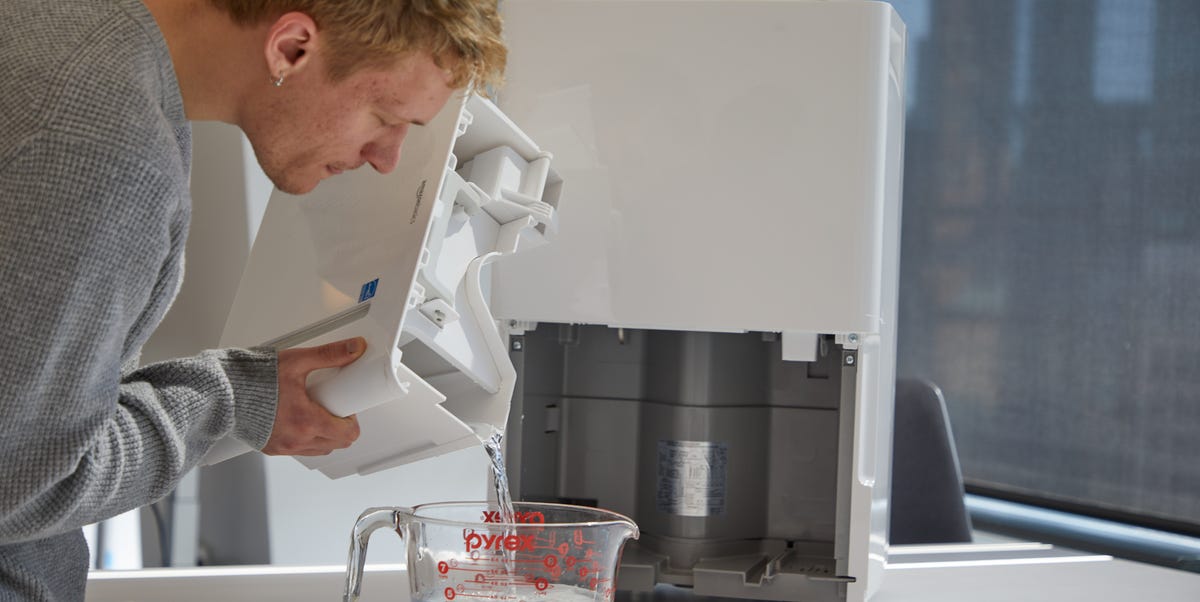
The bucket is the simplest method. When it fills, a float switch stops the unit and activates a warning light. This option works well when the machine runs occasionally or when no drain is nearby.
Check the bucket capacity and handle design. A small container may be easy to carry but require frequent attention. A large bucket reduces emptying frequency but can become heavy and awkward when full. Spilling three gallons of water on the way to the sink is a memorable lesson in irony.
Continuous Gravity Drainage
Many portable models accept a hose that carries water to a floor drain, sump, or other approved outlet. Gravity drainage is inexpensive, quiet, and convenient, but the hose must travel continuously downhill. A kink, upward loop, or clogged section can stop the flow and send water back into the bucket.
Measure the distance to the drain before purchasing. Confirm whether the hose is included, what diameter is required, and whether the drain fitting is positioned high enough for the planned route.
Built-In Pump
A pump can move condensate upward into a sink, through a window, or to another suitable drain. It is useful when the only available outlet is above the machine. Pumps add cost and may create additional noise, but they can make unattended operation possible in an inconvenient basement.
Compare maximum pumping height, hose length, warranty coverage, and accessibility for cleaning. A pump is helpful only when its hose is not blocked by algae, sludge, or the mysterious debris that appears wherever homeowners cannot easily see it.
4. Compare Energy Efficiency and Operating Costs
Purchase price is only part of the cost. A basement dehumidifier may operate for hundreds or thousands of hours per year, so energy efficiency can matter more than a modest difference at checkout.
Look for an ENERGY STAR-certified dehumidifier and compare the Integrated Energy Factor, or IEF. This metric describes how many liters of water the machine removes per kilowatt-hour of electricity. A higher IEF indicates better efficiency under the applicable test method.
ENERGY STAR-certified models use roughly 15% less energy than conventional models meeting minimum federal requirements. Actual savings depend on local electricity rates, room conditions, temperature, selected humidity level, and operating time.
Features That Can Reduce Waste
- Adjustable humidistat: Stops or cycles the compressor when the target humidity is reached.
- Multiple fan speeds: Allows quieter maintenance operation after the room dries.
- Timer: Limits operation to selected periods when appropriate.
- Auto restart: Restores operation after a power interruption.
- Dirty-filter indicator: Reminds the owner to restore airflow.
- Accurate humidity display: Makes it easier to avoid unnecessarily low settings.
Setting the humidistat extremely low does not make the room dry faster in a useful way. It often makes the compressor run longer. Begin around 50% relative humidity, check the room with a separate hygrometer, and adjust gradually.
Remember that a compressor dehumidifier releases some heat into the room. That warmth is normal. In a basement it may be harmless or welcome, but in a small living space during summer it can add to the air-conditioning load.
5. Evaluate Noise, Controls, Placement, and Everyday Convenience
A dehumidifier that performs beautifully but drives everyone out of the room is not an ideal purchase. Noise is especially important in bedrooms, offices, family rooms, and finished basements.
Manufacturers may provide sound ratings in decibels, but test methods are not always identical. Read independent reviews and look for comments about compressor vibration, fan character, rattling buckets, and pump noise. A smooth fan sound is often easier to tolerate than intermittent clicking or buzzing, even when the numerical rating is similar.
Check the Physical Design
Before ordering, examine:
- Overall dimensions and available floor space
- Power-cord length and outlet location
- Top or side air discharge
- Required clearance from walls and furniture
- Caster quality and carrying handles
- Bucket accessibility
- Filter removal direction
- Display brightness and control-panel visibility
Place the unit where air can circulate freely around the intake and exhaust. Keep doors and windows closed while it operates so it is not attempting to dehumidify the entire neighborhood. Do not position it directly against curtains, boxes, upholstered furniture, or a dusty workbench.
Do Smart Features Matter?
Wi-Fi controls can be useful in a basement, vacation property, or second home. Remote humidity monitoring, alerts, schedules, and power controls may save trips downstairs. Still, smart features should rank below capacity, drainage, reliability, and efficiency.
Check whether essential settings remain available on the physical control panel. An appliance expected to last several years should not become useless because an app disappears or a cloud service decides to retire early.
6. Review Maintenance, Safety, Warranty, and Recall History
Dehumidifiers move large amounts of air across cold coils, so filters collect dust and buckets collect more than pristine spring water. Routine cleaning protects airflow, reduces odors, and helps the machine perform properly.
Maintenance Questions to Ask Before Buying
- Is the air filter washable and easy to remove?
- Can the bucket be cleaned without special tools?
- Does the unit provide a filter reminder?
- Are replacement filters, hoses, and pump parts available?
- How often does the manufacturer recommend cleaning?
- Is the heat exchanger accessible for safe maintenance?
Wash the bucket periodically with mild soap and water according to the owner’s manual. Clean the filter on the recommended schedule and inspect drain hoses for kinks, clogs, leaks, or algae. Always unplug the unit before cleaning it.
Electrical and Product Safety
Plug the dehumidifier directly into a properly grounded outlet that meets the manufacturer’s electrical requirements. Avoid extension cords and power strips unless the manual expressly permits a suitable type. Keep the unit, cord, plug, and drainage route away from standing water.
Before buying a used or older dehumidifier, check its exact model number and date code against the U.S. Consumer Product Safety Commission recall database. Millions of older units have been recalled over the years because of overheating and fire hazards. Brand name alone is not enough because recalled machines were sold under numerous familiar labels.
Compare warranty terms carefully. A long warranty may still contain separate limits for labor, pumps, sealed refrigeration components, or commercial use. Also consider access to service, replacement parts, and responsive customer support. A bargain loses its charm quickly when its pump fails and the only available support is a chatbot experiencing personal growth.
Quick Dehumidifier Buying Checklist
- Measure the room and record its square footage.
- Use a hygrometer to confirm the normal humidity range.
- Identify whether the area is damp, very damp, or wet.
- Select a pint capacity that covers both room size and moisture load.
- Confirm low-temperature performance for cool basements or garages.
- Choose manual, gravity, or pump drainage before purchasing.
- Compare ENERGY STAR certification and IEF ratings.
- Check sound levels, dimensions, airflow clearances, and bucket access.
- Review filter cleaning, warranty terms, and replacement-part availability.
- Search the exact model number for active safety recalls.
Real-World Experience: Lessons That Product Pages Rarely Explain
The first practical lesson is that initial performance can look dramatic. Place a capable dehumidifier in a humid basement and it may fill its bucket surprisingly quickly during the first several days. That does not necessarily mean the room produces the same amount of moisture forever. The machine is drying the air as well as moisture held in concrete, wood, furniture, cardboard boxes, and other porous materials. Once conditions stabilize, water collection often slows.
A separate hygrometer is extremely helpful during this period. Built-in humidity sensors sit inside or near the appliance, where warmer exhaust air and concentrated airflow can affect the reading. A hygrometer placed several feet away provides a better picture of the room. Do not place it directly beside a wall, window, vent, or laundry appliance. Compare both readings over several days rather than reacting to every one-percent change.
Drainage setup deserves more attention than most buyers give it. A gravity hose that looks perfectly reasonable may fail because one section rises half an inch behind a storage bin. Water then backs up, the bucket fills, and the unit shuts down while everyone assumes it has broken. Secure the hose, maintain a continuous downward slope, and test the route by watching several cycles before leaving the machine unattended.
Noise also feels different in real life than it does in a showroom. A unit may seem quiet for five minutes but become distracting after an evening of compressor cycling. In a finished basement, placing the machine on a firm, level surface can reduce vibration. Do not put it on a thick rug that blocks airflow or allows the cabinet to wobble. Moving it a few feet away from hollow walls, cabinets, or stairwells may also reduce amplified sound.
Many owners initially set the humidistat to the lowest possible number, expecting faster results. A more practical approach is to run the unit continuously during the initial drying period, then set it near 50%. If the room remains comfortable and free from condensation or musty odors, there is little benefit in forcing humidity into the 30s. Excessive operation increases energy use and may make the space feel uncomfortably dry.
Filter maintenance can transform a machine that appears tired. Reduced airflow lowers moisture removal and may increase operating time. In dusty basements, workshops, or homes with pets, the filter may require attention sooner than the standard reminder suggests. Make a monthly visual inspection part of the routine, especially during humid seasons.
Finally, expect the air leaving a compressor dehumidifier to feel warmer. Owners sometimes interpret this as a defect, but a moderate temperature rise is part of normal operation. What is not normal is a burning odor, smoke, melted plastic, an unusually hot plug, repeated breaker trips, or harsh mechanical noise. Turn the machine off, unplug it safely, and seek qualified service if any of those warning signs appear.
Conclusion
A good dehumidifier buying decision begins with the room, not the product advertisement. Measure the space, confirm its humidity, evaluate the severity of the moisture problem, and select enough capacity to handle real conditions. Then compare drainage, low-temperature performance, energy efficiency, noise, maintenance, warranty coverage, and safety history.
For many homes, an ENERGY STAR-certified portable model with an adjustable humidistat, automatic defrost, continuous-drain connection, and washable filter offers the best balance of performance and convenience. A built-in pump is worth considering when gravity drainage is impossible, while a whole-home system may be more appropriate when humidity affects several rooms.
Buy the machine that fits the problem rather than the one with the loudest marketing. Your basement needs less moisture, not more adjectives.
Note: A dehumidifier controls airborne moisture but cannot correct plumbing leaks, foundation water intrusion, roof damage, or inadequate ventilation. Resolve active water sources promptly and follow the appliance manufacturer’s installation, drainage, electrical, and maintenance instructions.
{

  "meta_title": "Dehumidifier Buying Guide: 6 Smart Considerations",

  "meta_description": "Choose the right dehumidifier by comparing capacity, drainage, efficiency, noise, temperature performance, maintenance, and safety.",

  "sapo": "Buying a dehumidifier should not feel like decoding a weather satellite. This practical guide explains six factors that matter most: moisture-removal capacity, room size, operating temperature, drainage, energy efficiency, noise, controls, maintenance, and safety. Learn how pint ratings work, why modern ratings may differ from older models, when a built-in pump is useful, and how to avoid common installation mistakes. Real-world tips also reveal what happens during the first week of operation, why gravity hoses sometimes fail, and how a separate hygrometer can help you choose an effective humidity setting.",

  "keywords": [

    "dehumidifier buying guide",

    "best dehumidifier for basement",

    "dehumidifier capacity",

    "Energy Star dehumidifier",

    "continuous drain dehumidifier",

    "indoor humidity control"

  ]

}</pre