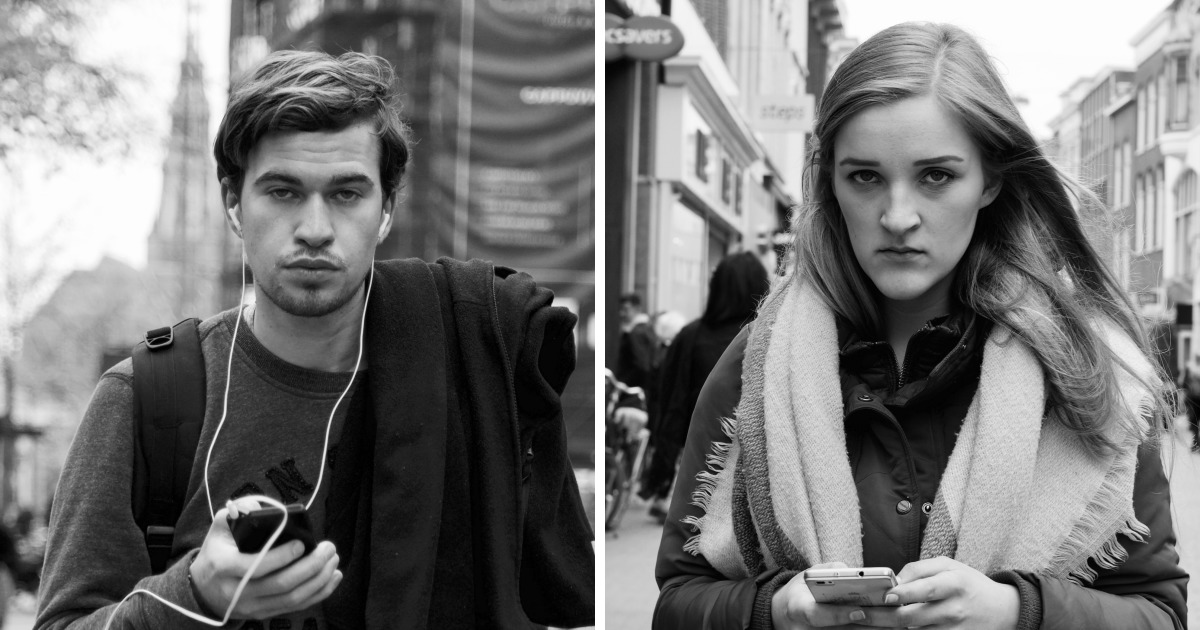

There is a special expression people wear when a smartphone has swallowed their attention. The head tilts down. The shoulders round forward. The rely checking whether a stranger liked a photo of lunch. From a distance, the posture looks less like modern communication and more like a low-budget zombie movie in which the undead have excellent data plans.
That strange public trance sits at the center of Caught in the App, a street-photography project created by Dutch photographer and social engineer Ritzo ten Cate. The series began after the Pokémon Go craze turned an ordinary walk into a small personal wake-up call. While hunting digital creatures, ten Cate became so absorbed that he lost his bearings close to home. Instead of blaming a mischievous Pikachu, he began photographing people who appeared similarly detached from the physical world around them.
The resulting portraits are funny, uncomfortable, and instantly recognizable. They do not simply document smartphone use. They capture the split second when a person seems to return from the screen and notice the photographerthe visual equivalent of waking from a tiny digital sleep.
How Pokémon Go Inspired “Caught in the App”
Pokémon Go arrived in 2016 with an irresistible promise: the game would place imaginary creatures inside real streets, parks, landmarks, and neighborhoods. Players had to walk, explore, and use their phones to catch them. It was part scavenger hunt, part exercise app, and part international outbreak of adults shouting about a rare creature near a fountain.
For ten Cate, the game revealed how easily augmented reality could overpower ordinary reality. He was physically present in his hometown but mentally occupied by Poké Balls, virtual targets, and the next reward. After recognizing his own zombie-like behavior, he started photographing Pokémon Go players. Soon, his subject expanded beyond gaming to include anyone absorbed in messaging, dating apps, news feeds, social media, or endless scrolling.
Most of the original images were made in Groningen in the Netherlands, with additional work in London. Ten Cate often photographed from only a few feet away and waited for the moment his subject noticed him. That instant matters. Before recognition, the person belongs to the screen. After recognition, the face reconnects with the street.
What the Smartphone Zombie Photos Actually Show
The phrase “smartphone zombie” sounds insulting, but the photographs work because they are not really about mocking foolish strangers. They are mirrors. Nearly everyone who sees the series can identify the posture because nearly everyone has performed it: walking while texting, checking notifications during dinner, scrolling in an elevator, or opening one app and somehow emerging 20 minutes later with no memory of the original purpose.
The Body Is Here, but the Attention Is Elsewhere
Smartphones allow people to occupy two environments at once. A commuter can stand on a crowded train while emotionally participating in a family argument hundreds of miles away. A tourist can face a famous monument while editing the photo instead of looking at the monument itself. A couple can sit across from each other while both communicate with people who are not at the table.
This split presence is the visual engine of Caught in the App. The people are surrounded by architecture, traffic, weather, strangers, and social opportunities, yet the screen creates a private tunnel. The world has not disappeared; it has simply been demoted to background scenery.
The Portraits Capture a Tiny Return to Reality
Traditional street photography often catches spontaneous gestures that subjects never realize were observed. Ten Cate’s approach adds a second layer: the subjects frequently notice him at the precise moment the image is made. Their expressions can look startled, suspicious, embarrassed, or briefly confused. It is as though the photographer has pressed a human “resume” button.
That is why the images can feel more unsettling than a standard photo of someone staring at a phone. They record a border crossing between digital absorption and physical awareness.
Why Apps Are So Good at Holding Attention
Smartphone distraction is not simply a failure of willpower. Many apps are designed to encourage repeated checking. Notifications create urgency. Red badges advertise unfinished business. Infinite feeds remove natural stopping points. Recommendations promise that the next video, post, match, headline, or digital monster might be more exciting than the last.
The brain also loves unpredictable rewards. A phone check may reveal an important message, a funny meme, a work problem, a compliment, or absolutely nothing. Because the outcome changes, checking can become automatic. The thumb develops its own career path.
Even the phone’s presence can matter. Research on attention has suggested that a nearby device may consume a small portion of mental resources, particularly when people are trying to concentrate. A buzz or vibration can interrupt a task even when the notification is ignored. The person may remain in the room physically while part of the mind wonders, “Was that important?” Usually, it is a coupon.
The Real-World Risks of Distracted Walking
The funniest smartphone-zombie moments involve harmless collisions with signposts, trash cans, or automatic doors that open a fraction too late. The serious moments involve traffic.
Pedestrian-safety research has repeatedly found that using a phone while walking can alter behavior. People may walk more slowly, shorten their steps, drift from a straight path, miss visual cues, or make poorer decisions while crossing. Texting is especially demanding because it occupies the eyes, hands, and attention at the same timea multitasking achievement with all the elegance of juggling soup.
Phones are not the only reason pedestrians are injured, and distracted walking should never be used to excuse dangerous driving, excessive vehicle speed, poor lighting, or badly designed streets. Still, reduced awareness can remove the seconds a pedestrian needs to notice a turning vehicle, changing signal, bicycle, curb, or other hazard.
Inattentional Blindness: Looking Without Seeing
One useful concept is inattentional blindness. When attention is concentrated on a demanding task, people can fail to notice something visible in front of them. The eyes may receive the information, but the brain does not fully process it. On a sidewalk, that missed information could be a friend waving. At an intersection, it could be a vehicle.
The zombie metaphor therefore has a scientific backbone. Distracted walkers are not literally unconscious, but their awareness can narrow enough to produce surprisingly mechanical movement.
Pokémon Go Was Not Simply the Villain
It would be easy to turn the story into a lecture about mobile games destroying civilization. That would also be incomplete. Pokémon Go pushed many players outdoors, increased walking for some users, encouraged exploration, and created spontaneous social gatherings. Research found short-term increases in physical activity among some players, particularly those who had previously been less active.
The game demonstrated that a smartphone can connect digital motivation with real movement. The problem was not walking with technology. The problem was surrendering so much attention that the environment became invisible.
This distinction matters. A navigation app can help someone explore a new city. A fitness app can encourage daily exercise. A messaging app can provide support during a difficult day. A camera can help people notice details they might otherwise ignore. Technology can deepen engagement with the world or replace it. Sometimes the difference is one decision: pause at the curb before catching the imaginary creature.
From Distracted Walking to Phubbing
Smartphone absorption affects more than safety. It also changes social behavior. “Phubbing”a combination of “phone” and “snubbing”describes ignoring someone nearby in favor of a device. The word is silly because the behavior is painfully ordinary.
Phubbing can happen during a date, family meal, meeting, or casual conversation. One person glances at a notification. The other person pauses. The first person says, “Keep talking, I’m listening,” which is often the conversational equivalent of a loading icon. Repeated often enough, the habit can make companions feel less important than whatever is happening on the screen.
The irony is difficult to miss: a device built for connection can create disconnection when it repeatedly interrupts face-to-face attention. The smartphone zombie is therefore not only a pedestrian figure. It may be the parent half-listening to a child, the friend scrolling during a confession, or the employee answering messages throughout a meeting that could have been an email.
Why the Photography Series Still Matters
Caught in the App appeared during an early wave of public anxiety about Pokémon Go, but its central idea has aged remarkably well. Phones have become more capable, more personalized, and more integrated into daily routines. They hold payment cards, maps, work chats, medical reminders, entertainment, cameras, tickets, and relationships. Asking people to “just put the phone away” can sound like asking them to place half their life in a drawer.
That is exactly why visual reminders remain useful. Statistics explain scale; photographs explain feeling. A portrait of someone frozen over a glowing screen communicates divided attention faster than a chart ever could. It lets viewers recognize the habit without pretending they are above it.
The series also asks an important question about public space: What happens when streets, parks, stations, and cafés become physical shells for private digital experiences? Cities were designed around people looking ahead, noticing signals, reading faces, and responding to movement. Smartphone users often look down. Some communities have experimented with pavement-level lights, warning signs, and other design responses, but infrastructure can only do so much. No sidewalk should need to compete with a group chat named “Weekend Chaos.”
How to Escape Smartphone Zombie Mode
The goal is not a dramatic breakup with technology followed by a cabin in the woods. The practical goal is to make phone use intentional rather than automatic.
Stop Before Using the Phone
When a message, map, or notification truly needs attention, step out of the pedestrian flow and stop. Stand away from curbs, stairs, bike lanes, and doorways. This simple habit prevents the brain from performing two navigation systems at once.
Remove Unnecessary Notifications
Keep alerts for people and services that may require timely action. Silence promotional notifications, social-media reactions, game reminders, and apps that behave as though every update is a small national emergency.
Use Built-In Digital Wellbeing Tools
Modern iPhones and Android phones include tools such as app limits, focus modes, downtime schedules, notification summaries, and usage reports. These features are not magical, but they add friction between an impulse and an app. Sometimes one extra tap is enough to remind the brain that it had another plan.
Create Phone-Free Social Zones
Meals, important conversations, and short meetings become noticeably different when phones are kept out of reach. Placing the device face down on the table may not be enough; its presence can still invite mental checking. A bag, drawer, or charging station creates a clearer boundary.
Practice Looking Up
On a familiar walk, keep the phone put away for ten minutes and deliberately notice storefronts, trees, architecture, sounds, weather, and faces. This sounds embarrassingly basic until you realize how much scenery has been hiding above screen level.
Experiences From the Smartphone-Zombie Zone
The following everyday scenes offer a practical way to understand the subject. They are representative experiences drawn from common public behavior rather than claims about any single photographed person.
Experience One: The Crosswalk Shuffle
A pedestrian approaches an intersection while typing. The signal changes, but the person does not notice until everyone else starts moving. Then comes the hurried shuffle: phone in one hand, apology in the eyes, and three quick steps to catch the group. Halfway across, another notification appears. The head drops again.
What makes this scene revealing is not recklessness alone. It shows how social movement becomes a substitute for awareness. The pedestrian follows the crowd instead of independently checking the signal and traffic. The phone has outsourced judgment to nearby strangers.
Experience Two: The Café With Four Separate Universes
Four friends sit at a table. At first, they talk. One person checks a message, another opens a social app, and within a minute all four are silent. Their bodies remain together, but their attention has scattered into four separate universes. Occasionally someone laughs at the screen and turns it around to share, briefly reconnecting the table before everyone disappears again.
This is the softer side of phubbing. Nobody intends to be rude. Each interruption feels temporary and harmless. Yet the conversation loses rhythm, stories become shorter, and pauses become invitations to scroll. The phone does not end the gathering; it gradually edits out its depth.
Experience Three: The Tourist Who Photographs Everything but Sees Nothing
At a landmark, a visitor raises a phone, takes several pictures, checks the framing, adjusts the exposure, records a short video, and uploads a story. Then the visitor leaves. The monument has been captured perfectly, but the experience itself may have received only a few seconds of unmediated attention.
Photography can make people more observant, but it can also turn a place into content inventory. A useful experiment is to look first, photograph second, and review later. Memory deserves a chance to load before cloud storage does.
Experience Four: The Phantom Check
Someone waiting in line unlocks a phone, scans the home screen, locks it, and repeats the sequence less than a minute later. No alert arrived. No task was completed. The movement was automatic, like checking a refrigerator after already confirming that it contains mustard and regret.
This behavior demonstrates why screen time alone does not tell the whole story. Dozens of tiny checks can fragment attention even when each session lasts only seconds. Noticing the impulse is the first step. Before unlocking, ask: “What am I opening this for?” When no answer appears, the phone can remain asleep.
Experience Five: The Ten-Minute Look-Up Test
Now reverse the experiment. Put the phone in a pocket and walk for ten minutes without audio, maps, photos, or messages. At first, the empty attention may feel uncomfortable. The hand may reach toward the device automatically. Then details begin to reappear: a dog refusing to walk in the direction selected by its owner, a reflection in a shop window, a conversation fragment, the smell of food, or a building detail that has gone unnoticed for years.
The lesson is not that offline life is always profound. Sometimes looking up reveals only construction noise and a pigeon with poor boundaries. The value lies in choosing where attention goes. That choice is the opposite of zombie mode.
Conclusion: Catch Your Attention Before an App Does
Gotta Catch ’em All: Smartphone Zombies Caught In The App is memorable because it turns an invisible habit into a visible character. Ritzo ten Cate’s subjects are ordinary people suspended between two worlds: the street beneath their feet and the app inside their hands. Their expressions are comic, eerie, and familiar because the series is not really about “those people.” It is about us.
Smartphones are extraordinary tools, and location-based games can encourage movement, discovery, and social interaction. The danger begins when convenience becomes reflex and the screen receives every spare second by default. Safer walking, stronger conversations, and better focus do not require abandoning technology. They require recovering the ability to decide when technology deserves attentionand when the person, street, signal, or sunset in front of us deserves it more.
Note: The term “smartphone zombie” is used here as cultural commentary on distracted behavior, not as a clinical diagnosis or a label for every person who uses a phone in public.