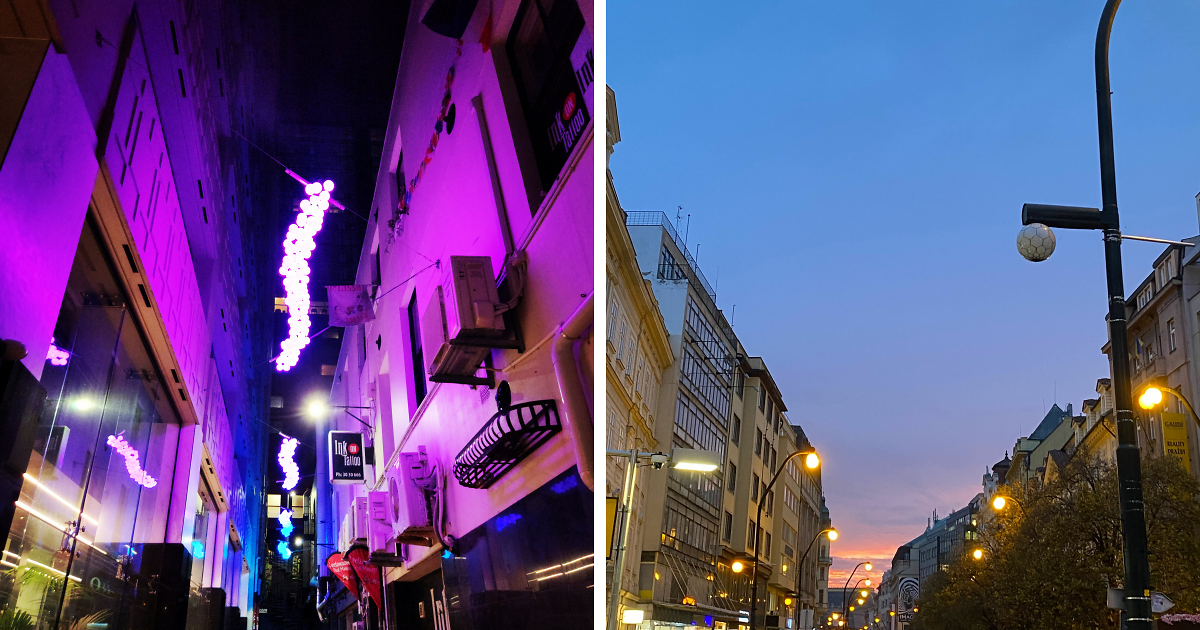
Hey Pandas, Show Us The Last Favorite Nighttime Photo You Took On Your Cellphone!

There is something wonderfully unpredictable about nighttime photos taken on a cellphone. During the day, almost everyone can point a modern smartphone at a reasonably attractive scene and get something respectable. After sunset, however, photography gets mischievous. Streetlights glow like tiny suns, shadows become mysterious, reflections suddenly matter, and that ordinary convenience store around the corner can look like the opening scene of a detective movie.
That is exactly why favorite nighttime cellphone photos can be so fascinating. They do not have to be technically perfect. Sometimes the image you treasure most is slightly grainy, dramatically dark, or decorated with an accidental streak of light. What matters is that it captured a moment worth remembering.
So, Pandas, dig into your camera roll. Find the most recent nighttime picture that made you stop scrolling and think, “Okay, I actually like this one.” Maybe it shows your sleepy dog under a porch light, a neon-soaked city street, the Moon hiding between buildings, friends around a campfire, or simply rain reflecting traffic lights on the pavement.
Before you share it, let’s explore why nighttime cellphone photography has become so much fun and how a few simple techniques can make those after-dark snapshots even better.
Why Nighttime Photos Feel Different
Night changes familiar places. A neighborhood you have walked through hundreds of times can suddenly seem cinematic once daylight disappears. Artificial lights create isolated pools of brightness while much of the environment disappears into shadow. Colors become more intense. Reflections become easier to notice. Empty spaces feel larger.
That contrast gives nighttime photography much of its personality.
A photograph of a coffee shop at noon may simply document a coffee shop. Photograph the same window at 11:30 p.m., glowing warmly against a dark street, and suddenly there is a story. Who is still inside? Is someone waiting for a friend? Is the photographer walking home after a long day?
The viewer begins filling in the blanks.
This is one reason memorable cellphone night photos do not require exotic destinations. Your own block can provide interesting subjects once the lighting changes.
Your Phone Is Doing More Work Than You Think
Modern smartphones have become surprisingly capable in low light, largely because they do much more than capture a single quick exposure.
Night modes available on devices such as recent iPhones, Google Pixel phones, and Samsung Galaxy models can use longer capture times and computational photography to gather additional light and combine information from multiple frames. The result may contain brighter shadows, less visible noise, and more detail than a conventional quick snapshot could produce.
The catch is simple: the phone needs time.
That is why your camera may politely demand that you remain still for several seconds while taking a nighttime picture. It is not being dramatic. It is trying to collect enough usable information to construct a cleaner image.
Computational photography has dramatically lowered the barrier to low-light phone photography. You no longer need to understand every detail of ISO, shutter speed, or exposure stacking to get an attractive night scene. Still, knowing a few fundamentals gives you much more control.
How to Take Better Nighttime Cellphone Photos
1. Hold Still Longer Than Feels Necessary
If there is one nighttime photography habit worth remembering, it is this: become a statue.
In darker conditions, a camera generally needs to gather light for longer. Even small movements can soften fine detail. Modern stabilization systems can compensate for some hand movement, but they cannot perform miracles if your phone is bouncing around like it has had four espressos.
Brace your elbows against your torso. Lean against a wall. Rest your phone on a railing, table, bench, car roof, or another stable object. For longer night exposures or photographs of stars, a small tripod can make a significant difference.
Using a timer can help too. When the phone is sitting on a solid surface, a short timer prevents your finger from shaking it as you press the shutter button.
2. Look for Light Instead of Fighting Darkness
Night photography is not really about photographing darkness. It is about finding interesting light inside darkness.
Search for neon signs, windows, headlights, storefronts, lamps, illuminated bridges, candles, string lights, amusement rides, vending machines, or even the glow of another cellphone screen.
Try positioning your subject near one of these sources instead of immediately turning on your phone’s flash.
A built-in flash can occasionally be useful, but direct light from a tiny source close to the camera often produces harsh highlights, deep shadows, glare, and the unmistakable aesthetic of “police evidence photo taken at a birthday party.” Available light usually creates more atmosphere.
3. Protect the Highlights
Smartphones often attempt to brighten dark scenes automatically. Sometimes they become a little too enthusiastic.
If a neon sign or streetlamp becomes a featureless white blob, tap the bright area on your screen and lower the exposure slightly. Preserving detail around important light sources often produces a richer nighttime image.
Do not be afraid of darkness. Shadows are allowed to look dark. Night does not need to impersonate 2 p.m.
4. Use the Main Camera When Possible
Many phones now contain wide, ultrawide, and telephoto cameras. They are useful tools, but they do not necessarily perform equally well in low light.
The main camera often has stronger light-gathering capabilities than secondary lenses, making it a sensible starting point for difficult nighttime scenes. If an ultrawide or telephoto image looks noisy or soft, try reframing the photograph with the main camera instead.
And be cautious with extreme digital zoom. At night, enlarging a distant subject digitally can magnify noise and reduce detail quickly. Whenever practical, move closer instead. Your feet remain one of photography’s most underrated accessories.
5. Clean the Lens
This sounds almost insultingly simple until you realize how often smartphone lenses are covered in fingerprints.
At night, greasy lens smudges can turn small lights into large glowing halos. Sometimes the effect looks dreamy. Usually it looks as though your camera recently survived an encounter with a slice of pizza.
Before photographing city lights, the Moon, or another high-contrast scene, gently wipe the camera lens with a clean microfiber cloth.
Composition Matters More Than Expensive Gear
Better technology helps, but the most expensive smartphone cannot decide what deserves to be inside your frame.
That part is still your job.
Search for Reflections
Wet pavement is one of the easiest ways to transform an ordinary street into a nighttime photography playground. Rainwater reflects signs, headlights, traffic signals, and illuminated buildings, creating color in places that would otherwise be nearly black.
Puddles can also create unusual symmetry. Move your phone close to the ground and experiment with angles. A tiny puddle photographed carefully can appear surprisingly large.
Use Silhouettes
If someone is standing in front of a bright sign, sunset glow, stadium light, or illuminated window, consider allowing the person to become a silhouette rather than forcing the camera to expose every facial detail.
Recognizable shapes can tell a story with very little information. A cyclist crossing beneath a streetlamp or a person watching fireworks may be more compelling as a dark figure against the light.
Include Something in the Foreground
Night skies can be beautiful, but a photograph containing nothing except dark sky and tiny stars may feel flat. Include trees, rooftops, mountains, tents, people, or another foreground subject to create depth and scale.
This technique is particularly useful for smartphone astrophotography.
Yes, Your Cellphone Can Photograph the Night Sky
You should probably not expect your phone to replace an observatory telescope anytime soon, but smartphone astrophotography has become remarkably accessible.
The Moon is an obvious place to begin. It is bright, easy to locate, and interesting through different phases. Stars require more effort because they are faint relative to nearby artificial lighting.
For better star photographs, move away from heavy light pollution when possible. Weather, moonlight, location, and the time of night all affect what the camera can record.
Stability becomes especially important. Some phones provide dedicated astrophotography features when they detect that the device is completely stationary. A tripod or secure support allows the camera to collect light for considerably longer than a handheld exposure.
If your phone offers manual controls, experimentation with focus, exposure time, and ISO can be educational. However, automatic night-sky modes can be an excellent starting point for beginners.
And remember one important safety rule: the perfect star photograph is not worth wandering backward over a cliff because you were staring at the screen.
Do Not Edit the Night Out of Your Night Photo
Editing is one of the pleasures of mobile night photography, especially because darker images often benefit from modest adjustments.
Try modifying exposure, highlights, shadows, white balance, contrast, saturation, and noise reduction. Small changes can recover atmosphere without making the photograph look artificial.
A common temptation is increasing brightness until every dark object becomes visible. Resist it.
Nighttime scenes need shadows. A photograph can contain deep blacks and still be successful. In fact, those dark regions often direct attention toward the important illuminated subject.
If your phone supports RAW or another minimally processed format, it may give you greater editing flexibility in some situations. On the other hand, computational night modes can outperform a single RAW frame in extremely dark environments because they combine information from multiple exposures. The “best” option depends on the scene and how much editing you want to do.
What Makes a Nighttime Photo a Favorite?
Technical quality is only part of the answer.
Your favorite nighttime cellphone picture might be objectively imperfect and emotionally priceless.
Maybe it is the final photo from a vacation. Maybe it shows your child asleep during a road trip, illuminated by passing streetlights. Maybe it is an empty restaurant table after dinner with someone you had not seen in years. Maybe you photographed the first snow under a streetlamp because everything suddenly became quiet.
Photography is powerful precisely because ordinary moments eventually stop being ordinary.
The blurred concert photo you almost deleted today might make you smile ten years from now because it reminds you exactly how that evening felt.
Nighttime Photo Ideas for Your Next Walk
If your camera roll is currently lacking after-dark creativity, you do not need to book a flight to Manhattan or sleep beneath the Milky Way in a national park. Take a short walk around somewhere familiar and give yourself a simple challenge.
- Photograph a single illuminated window surrounded by darkness.
- Capture reflections from traffic lights after rain.
- Find a silhouette against a brightly lit background.
- Photograph a quiet gas station or convenience store late at night.
- Capture your pet beside a warm household lamp.
- Look for the Moon framed between trees or buildings.
- Photograph steam rising from food beneath restaurant lighting.
- Try a moving car, train, or bicycle and intentionally embrace motion blur.
- Capture shadows created by unusual streetlights.
- Photograph something extremely ordinary and make it look mysterious.
The last challenge is especially entertaining. Trash cans, shopping carts, parking garages, laundromats, bus stops, and empty playgrounds can all become surprisingly atmospheric at night.
Why Sharing Imperfect Cellphone Photos Can Be More Interesting
Social media has trained us to expect photographs that look polished within an inch of their lives. Skies become bluer, skin becomes smoother, stars become brighter, and occasionally reality leaves the building entirely.
A casual community photo thread offers something different.
The goal is not necessarily to prove who owns the best camera. It is to see how different people notice different things.
One person might photograph a dramatic skyline. Another might submit a moth sitting beside their porch light. Someone else may share a grainy picture of friends eating burgers at midnight.
Put together, those images create a strangely wonderful catalog of everyday life after dark.
Experiences Every Nighttime Cellphone Photographer Eventually Recognizes
Anyone who regularly takes cellphone photos at night eventually experiences a few recurring little adventures.
The Photo That Looked Terrible Until You Got Home
Imagine walking through a downtown neighborhood after rain. You stop because a red restaurant sign is reflecting across the wet sidewalk. On your tiny phone screen, the picture seems too dark. You almost delete it.
Later, you open it indoors and realize that the darkness is exactly what makes the image interesting. The red reflection creates a strong line through the frame while two distant pedestrians give the scene scale. What appeared underexposed at first actually feels atmospheric.
That experience teaches an important lesson: do not evaluate every nighttime image too quickly.
The Accidental Motion Blur That Somehow Works
Another familiar scenario begins with failure.
You try to photograph a bus passing through an intersection. The exposure lasts longer than expected, so the bus becomes a streak of color. Your first reaction is disappointment. Then you notice that the blurred lights communicate movement better than a perfectly frozen vehicle might have.
Night photography often rewards accidents. Light trails, reflections, flare, silhouettes, and motion can transform technical imperfections into visual personality.
The Moon That Looked Enormous to Your Eyes
Nearly everyone has experienced this one.
You step outside and discover an enormous orange Moon hovering above the horizon. It looks spectacular. You raise your phone, take a picture, and discover that the majestic Moon has somehow transformed into a suspicious white pea.
The problem is not necessarily your photography skill. Human perception and camera perspective work differently. Instead of relying on extreme digital zoom, try including recognizable foreground objects such as trees, rooftops, towers, or people. Those elements can communicate scale and create a stronger composition.
The Five-Minute Walk That Became an Hour
This may be the most enjoyable side effect of nighttime cellphone photography.
You leave home intending to take one quick picture. Then you notice reflections underneath a bridge. After that comes a bright diner window. Then somebody rides past on a bicycle beneath a streetlamp. Suddenly you are crouching beside a puddle trying to photograph a parking garage from an angle no normal pedestrian has ever considered necessary.
Photography changes how you observe familiar environments. You start seeing geometry in buildings, complementary colors in streetlights, patterns in windows, and tiny moments of human behavior that previously disappeared into the background.
The Picture Nobody Else Understands
Sometimes your favorite photograph is not impressive to anyone else.
Maybe it shows a nearly empty road, a badly illuminated motel sign, or a plastic chair outside someone’s house. Your friends scroll past it immediately.
But you remember what happened before and after the shutter clicked.
You remember the temperature. You remember the conversation. You remember the music playing nearby. You remember why you stopped walking.
That personal context gives photography a second layer that viewers cannot always see. A cellphone camera is not merely an image-making machine; it is also a portable memory recorder that happens to live in your pocket.
The Best Night Photo Is Often the One You Actually Took
It is easy to become obsessed with equipment. Bigger sensors, brighter lenses, RAW formats, stabilization systems, AI processing, and specialized night modes can absolutely improve image quality.
But none of those features matter if the camera remains in your pocket.
The advantage of cellphone photography is availability. When an unusual moment appearsthe fog rolling beneath a streetlight, your dog staring through a window, friends laughing outside a restaurant, lightning above the cityyou probably already have a capable camera within reach.
The best response is often simply to take the picture.
Conclusion: Show Us Your Night
A favorite nighttime cellphone photo does not need perfect sharpness, professional lighting, or thousands of social-media likes. It simply needs a reason for you to remember it.
Modern night modes and computational photography have made low-light shooting easier than ever, but the most important skills remain surprisingly old-fashioned: notice interesting light, compose carefully, keep the camera steady, experiment with perspective, and pay attention to moments other people might walk past.
So now it is your turn, Pandas.
Open your camera roll and find the last nighttime photograph you genuinely loved. Maybe it is technically beautiful. Maybe it is charmingly chaotic. Maybe the story behind it is much better than the picture itself.
Show us what your corner of the world looked like after sunsetand tell us why that particular image earned a place among your favorites.
Note: Technical guidance in this article was synthesized from established smartphone and photography resources including Apple Support, Google Pixel Camera Help, Samsung Support, Adobe, NASA, the U.S. National Park Service, Consumer Reports, DPReview, B&H Photo, Tom’s Guide, Android Authority, Lifewire, and The Verge.