
Every so often, archaeology delivers a discovery so cinematic that it sounds like someone hired a screenwriter, added a dramatic soundtrack, and told the dust to sparkle on cue. That is exactly what happened at Notion, an ancient Greek city on the western coast of modern-day Turkey, where archaeologists uncovered a buried hoard of Persian gold coins that may once have been intended to pay mercenary troops. In plain English: yes, this was basically a literal pot of gold, except instead of leprechauns, the story involves empire, warfare, and a city that spent centuries stuck in the geopolitical equivalent of a revolving door.
The find matters for obvious reasons. Gold coins are exciting. Humans have been professionally unable to stay calm around gold for a very long time. But this discovery is not important just because it shines. It matters because the coins were found in a secure archaeological context, inside an ancient structure, with surrounding evidence that may help historians date them more accurately. That makes this hoard more than treasure. It is data. Beautiful, glittery, very expensive-looking data.
Researchers believe the coins are Persian darics, gold pieces associated with the Achaemenid Persian Empire and often linked in ancient sources to mercenary pay. The location of the hoard, the type of coins, and the military history of Notion all support the idea that this money may have been tied to soldiers for hire operating in or around the city. The theory is circumstantial, not carved into marble, but it is a strong and fascinating possibility.
The Discovery That Made Archaeologists Do a Double Take
The hoard was found during excavations at Notion, a site that has been under renewed archaeological investigation in recent years. Archaeologists were working in the courtyard area of a later house when they identified an older buried structure underneath. In one corner of a room within that earlier building, they discovered a small vessel containing the gold coins. That detail matters, because context is everything in archaeology. A coin found loose on the surface tells one story. A coin hoard sealed in a room beneath later architecture tells a much richer one.
What makes the discovery especially important is that the coins were not ripped out of the ground by looters and sold one by one into private collections, where their historical context would vanish faster than free pizza at a college club meeting. Instead, the hoard was recovered in a controlled excavation. That means the researchers know where the coins were found, what kind of structure they were buried in, and which associated artifacts were nearby. For ancient numismatics, that is the academic equivalent of hitting the jackpot twice.
The discovery itself was made in 2023, but it was announced publicly later, after the relevant Turkish authorities approved its release. Archaeologists have been careful about what they claim. They have not turned the hoard into a fairy tale about a single heroic soldier, a doomed general, or a secret war chest hidden in panic. Instead, they have emphasized what the evidence can reasonably support: the coins appear to date to the fifth century BCE, they are consistent with Persian darics, and they were likely buried for safekeeping and never recovered. That last part, frankly, is the heartbreak inside almost every ancient hoard. Nobody buries gold because they are done with it. They bury it because they plan to come back.
What Exactly Were These Coins?
Meet the Persian Daric
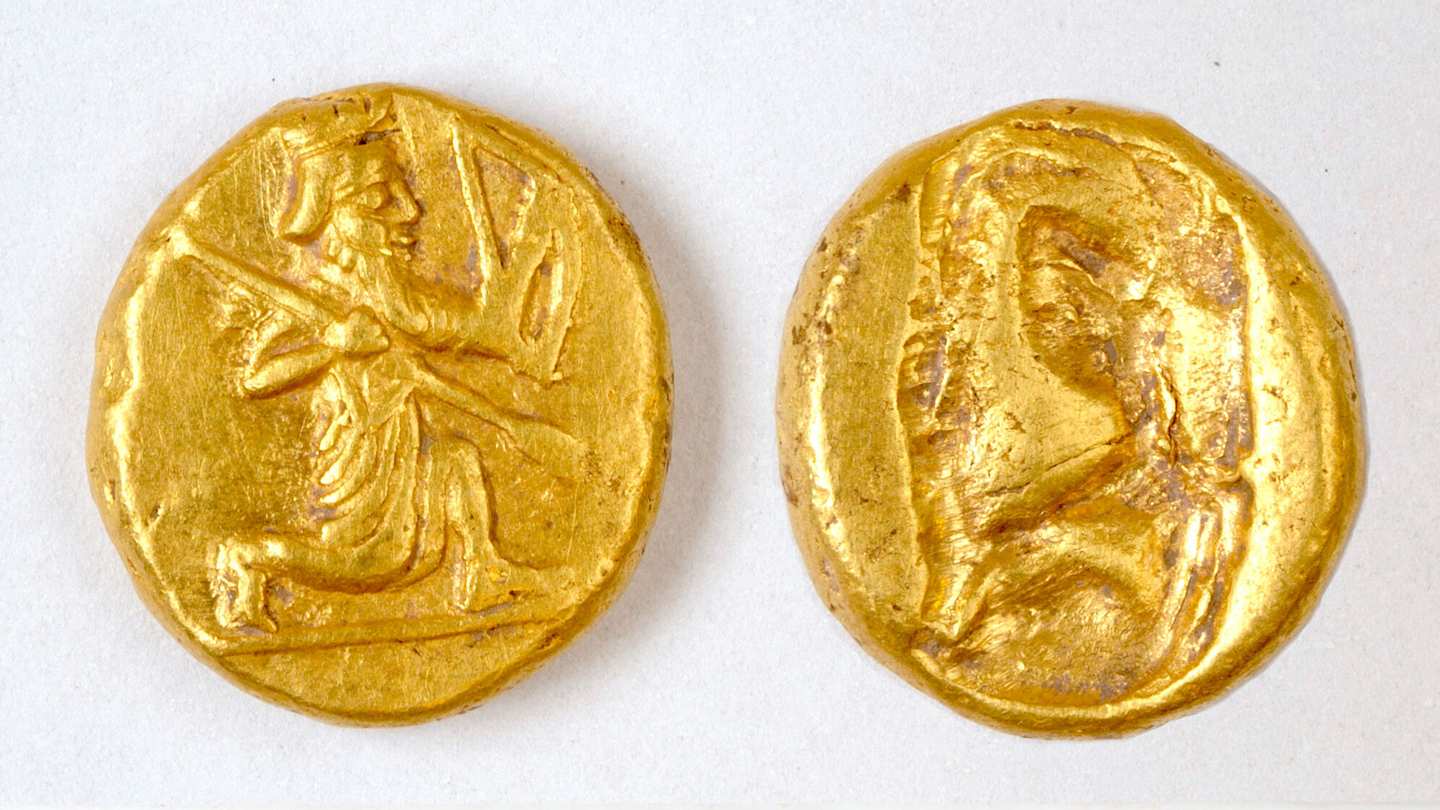
The gold coins from Notion are identified as darics, a well-known currency of the Persian Empire. Darics are famous for their design: a kneeling or running archer, often interpreted as the Persian king or a royal warrior figure. It is one of those ancient images that does not waste time trying to be subtle. You look at it and immediately understand the message: this empire has gold, weapons, and absolutely no interest in under-branding itself.
Darics were introduced in the late sixth century BCE and remained in circulation until Alexander the Great conquered the Persian Empire in the late fourth century BCE. Over that long period, the design stayed broadly consistent, though there were subtle stylistic changes. Those small variations are incredibly important to specialists, because they help build a chronological sequence. If researchers can securely date one group of darics based on excavation context, that hoard can serve as an anchor point for the larger history of Persian gold coinage.
In the case of the Notion hoard, scholars think the coins may have been minted at Sardis, a major center in western Anatolia located not far from the site. Sardis was a key administrative and economic center under Persian rule, making it a plausible minting location. That possible connection turns the hoard into more than a local curiosity. It links Notion to wider imperial systems of money, power, and military logistics.
Why Darics Matter to Historians
Ancient coins are not just money. They are tiny political billboards. They can reveal who held power, how wealth moved, what armies were paid with, and which regions were tied together through administration and trade. A gold coin like a daric was not something you casually dropped between the couch cushions of antiquity. These were high-value pieces, the kind of currency associated with state-level wealth, military payment, and serious financial activity.
Ancient sources, including Xenophon, suggest that a single daric could represent about a month’s pay for a soldier. That detail is one reason the mercenary-pay interpretation has attracted so much attention. If the Notion hoard contained a meaningful number of darics, it could represent accumulated wages, a payroll reserve, or the savings of someone connected to military service. In other words, this was not lunch money. This was the sort of stash that could shape decisions, movements, and survival in a conflict zone.
Why Researchers Think the Hoard Was Meant for Mercenaries
The headline idea that these coins were “meant for mercenaries” is not random clickbait in an ancient helmet. It grows out of two lines of evidence. First, darics are historically associated with military payments, especially in relation to mercenary service. Second, Notion was not exactly enjoying a quiet, uneventful small-town existence in the fifth and fourth centuries BCE. It sat in a region where Greek and Persian political interests overlapped, clashed, shifted, and occasionally exploded.
Mercenaries were a standard feature of ancient warfare. City-states, satraps, empires, and ambitious commanders all used hired troops. These fighters offered muscle, numbers, and flexibility, but they also required reliable payment. Armies do not run on patriotism alone. They run on logistics, food, leadership, and paydays that arrive before the grumbling turns into mutiny.
That is what makes the Notion hoard so compelling. A cluster of high-value Persian gold coins found in a city with a documented history of military conflict is exactly the kind of evidence that invites a mercenary explanation. The coins may have been intended to pay a group of troops. They may have represented the long-term savings of a soldier who had served in multiple campaigns. They may even have belonged to someone caught between political loyalties in a city where Persian and Greek interests were constantly colliding.
Researchers have also been admirably cautious. They have said the case is plausible, not proven beyond doubt. That distinction matters. Good archaeology is rarely about pretending to know everything. It is about building the strongest interpretation from the evidence at hand. In this case, the mercenary theory fits the coin type, the historical setting, and the practical realities of warfare in the region.
Notion: A City With Excellent Harbor Access and Terrible Timing
A Greek City on a Persian Frontier
To understand why this hoard matters, you have to understand Notion itself. The city stood on the west coast of Anatolia, near major centers of Greek settlement and Persian influence. It was strategically located, which is history’s way of saying it was useful, contested, and probably bad for anyone hoping to enjoy a low-stress century.
Notion, like other Greek cities in the region, moved in and out of Persian control over time. It became part of the Persian sphere in the mid-sixth century BCE, experienced shifting fortunes during the Greco-Persian conflicts of the early fifth century BCE, and later found itself once again entangled in Persian politics. By the time the coins in the hoard were circulating, Notion had already spent generations in a tug-of-war between larger powers.
That background helps explain why a stash of Persian gold in an ancient Greek city is not as strange as it might first sound. The ancient eastern Mediterranean was deeply interconnected. Greeks served Persian rulers. Persian money circulated in Greek cities. Loyalties were local, imperial, financial, and opportunistic all at once. Ancient history is rarely the tidy “Greeks over here, Persians over there” map from a school poster. It was messier, more human, and much more interesting.
Possible Historical Moments Behind the Burial
One of the most intriguing parts of the Notion story is that there are several historical episodes that could help explain why the hoard was buried and never retrieved. Ancient historians describe conflict around the city, including a period between 430 and 427 BCE when Persian sympathizers, supported by Greek and non-Greek mercenaries, occupied part of Notion. The Athenian general Paches later attacked, killed the pro-Persian mercenaries, and helped reorganize the city under Athenian control.
If you are looking for a situation in which someone might hastily hide gold and then fail to return for it, that one certainly qualifies. But it is not the only candidate. Notion was also involved in later military activity, including the famous naval battle off its coast in 406 BCE during the Peloponnesian War. Other periods of regional upheaval could also fit. The point is not that one event has been conclusively identified. The point is that Notion was exactly the kind of place where buried military money makes uncomfortable historical sense.
Why This Find Is Bigger Than Treasure
It is tempting to focus on the obvious drama: ancient city, gold coins, mercenaries, mystery. That is fair. Honestly, archaeology should get more credit for its box-office potential. But the real scholarly value of the hoard lies in what it can teach researchers about chronology and context.
Darics circulated for a long time, and their design changed only subtly. That can make dating them difficult when they are found without context. The Notion hoard is different because the coins were recovered alongside other archaeological materials in a secure setting. Those associated finds may help narrow the date of deposition and, by extension, refine the timeline of Persian gold coin production. That is the kind of detail that may sound niche until you realize it affects how historians understand imperial finance, regional warfare, and cross-cultural contact across centuries.
The discovery also highlights a point archaeologists repeat for good reason: an artifact without context loses an enormous amount of meaning. Gold pulled from the ground by looters may still be visually impressive, but it becomes historically half-amnesiac. In contrast, a hoard excavated properly can tell us about architecture, chronology, social behavior, political instability, and economic life. In that sense, the Notion coins are valuable not just because they are gold, but because they still remember where they came from.
What the Hoard Tells Us About Ancient Money, War, and Human Nature
The most moving part of the story may be the simplest. Someone buried this money on purpose. Whether that person was a mercenary, an officer, a local intermediary, or a civilian tied to military operations, the action itself feels instantly familiar across 2,400 years. A person in an unstable world took something precious, put it somewhere secret, and expected to come back later. That instinct has barely changed. Change the pottery vessel to a safe, a floorboard, or a password-protected account, and the emotional logic is still recognizably human.
This is why coin hoards fascinate people. They are financial decisions frozen by disaster. They mark a moment when someone said, in effect, “I need to protect this now.” And then history intervened. War, displacement, death, arrest, defeat, flight, or some other catastrophe prevented the return. The hoard stayed buried. The owner became anonymous. The money became evidence.
In the Notion discovery, that emotional thread runs right alongside the political one. The hoard reminds us that empires were not abstract. Their reach showed up in people’s pay, risk, movement, and survival. A Persian coin found in a Greek city tells a story about military economies and mixed worlds, about borderlands where identity and allegiance were negotiated as much as inherited. It is a reminder that history is not just kings and battles. It is also the private fear behind a buried pot.
Experience Section: Why Discoveries Like This Stay With People
There is something uniquely haunting about a hoard of coins because it feels personal in a way many archaeological finds do not. A broken wall tells you a building once stood. A temple foundation tells you a community once gathered. But a hidden cache of gold feels like it still carries the pulse of a single decision. It invites you to imagine a person’s hand, a person’s fear, a person’s calculation. If you have ever hidden something valuable in a place you believed nobody else would think to check, then you already understand the emotional core of this story better than you might think.
Imagine standing at an ancient site like Notion with the Aegean wind moving across the hill and the remains of streets, houses, and public spaces laid out below you. From a distance, ruins can look calm, almost decorative. Then a discovery like this snaps the place back into human scale. Suddenly the city is not a set of stones. It is a world of interrupted errands, political arguments, military rumors, late payments, nervous households, and people making backup plans. The hoard transforms the site from “ancient remains” into “someone’s unfinished life.” That is a powerful shift.
Even for readers who never plan to visit an archaeological site, there is a strangely modern feeling baked into this story. Think about the last time you worried about money during an uncertain moment. Think about the instinct to protect what you have when the world feels unstable. Think about how quickly grand political events become private anxiety. That is one reason stories like this travel so well. We are not just reading about Persian coinage or Greek military history. We are reading about the universal human habit of preparing for trouble and hoping it passes quickly. Sometimes it does. Sometimes it does not.
There is also the museum experience to consider. Seeing an ancient gold coin in a case can be surprisingly emotional, not because it is flashy, but because it is intimate. These are objects that were touched, counted, exchanged, hidden, and worried over. They are the opposite of abstract history. A coin is small enough to fit in a hand, and that makes the past feel closer. You are not looking at a civilization in the broad sense. You are looking at a thing somebody once trusted to carry value through an unstable world. That is a very different kind of connection.
For archaeology fans, discoveries like the Notion hoard also capture the thrill of disciplined uncertainty. The best part is not always solving every question. Sometimes the magic lies in getting just close enough to the truth to feel the outline of a life without being able to fill in every detail. We may never know the owner’s name, rank, or final fate. We may never know whether the hoard represented troop payment, personal savings, or emergency reserves. Yet that incompleteness is part of the experience. It leaves room for reflection instead of reducing the past to a tidy museum label and a shrug.
And maybe that is why this discovery lingers. It gives us both scale and intimacy. On one level, it is a story about empire, warfare, coinage, and archaeology. On another, it is a story about one hidden stash and one missing return. Gold gets the headlines, naturally. Gold has always been a shameless attention seeker. But the real lasting experience of the Notion hoard is quieter than that. It is the recognition that somewhere in the fifth century BCE, amid conflict and uncertainty, somebody made a practical, urgent, deeply human choice. More than two millennia later, we are still standing near that moment, trying to understand it.
Final Thoughts
The hoard of gold coins found at Notion is a remarkable discovery not because it confirms every theory, but because it opens so many meaningful lines of inquiry at once. It sheds light on Persian darics, the economics of mercenary warfare, the unstable history of an ancient Greek city, and the rare value of properly excavated archaeological context. It also delivers a story that is hard to shake: wealth hidden in fear, preserved by misfortune, and rediscovered centuries later.
That combination is what makes the find so compelling. It is treasure, yes, but it is also evidence. It is military history, monetary history, and human history packed into a small buried vessel. And if archaeology keeps producing stories like this, it may want to consider charging admission at the box office.