
In 2015, Hot Tub Time Machine 2 flung its characters into the distant, mysterious, deeply ridiculous year of 2025. Back then, 2025 sounded far enough away to justify holographic televisions, angry self-driving cars, celebrity humiliation shows, and Neil Patrick Harris as president. Ten years later, the real 2025 has arrived, looked around, and said, “Actually, I brought AI anxiety, robotaxis, subscription fatigue, and six different ways to accidentally mute yourself on a video call.”
So how does the real 2025 compare to the one in Hot Tub Time Machine 2? The short answer: the movie was wrong in many specific ways, but weirdly right in spirit. Our world is less shiny, less openly cartoonish, and thankfully less dependent on hot tubs as transportation infrastructure. But it is also stranger, more automated, more algorithm-driven, and more exhausting than the film probably intended.
This comparison is not about treating a raunchy comedy sequel as a sacred prophecy. That would be unfair to prophecy. Instead, it is a fun way to examine how Hollywood imagined the near futureand how real life quietly out-weirded it while wearing sweatpants.
The Movie’s 2025: A Future Built on Chaos and Chrome
In Hot Tub Time Machine 2, Lou, Nick, and Jacob travel to 2025 after Lou is attacked. Instead of returning to the past, they land in an alternate future where technology is flashier, television is crueler, and everyone seems to have agreed that subtlety is illegal.
The movie’s 2025 includes futuristic homes, translucent screens, self-driving cars with attitudes, a fictional search empire called Lougle, celebrity-obsessed media, and a game show called “Choozy Doozy,” where the crowd pushes contestants into humiliating stunts. It also gives us Jessica Williams hosting The Daily Show and Neil Patrick Harris as president, which honestly sounds less like a bad prediction and more like a group chat that got out of hand.
The film was not aiming for realistic futurism in the careful, “MIT white paper with footnotes” sense. It was doing comedy by exaggeration. The writers took 2015 trendsGoogle dominance, social media spectacle, virtual reality hype, reality TV cruelty, and Silicon Valley self-importanceand inflated them until they squeaked.
The Real 2025: Less Hologram, More Algorithm
The real 2025 did not arrive with floating screens in every living room or dogs casually riding hoverboards to brunch. Instead, it arrived through apps, AI tools, smart glasses, electric vehicles, robotaxis, and a general feeling that every device now wants to “help” you by asking for permission to collect more data.
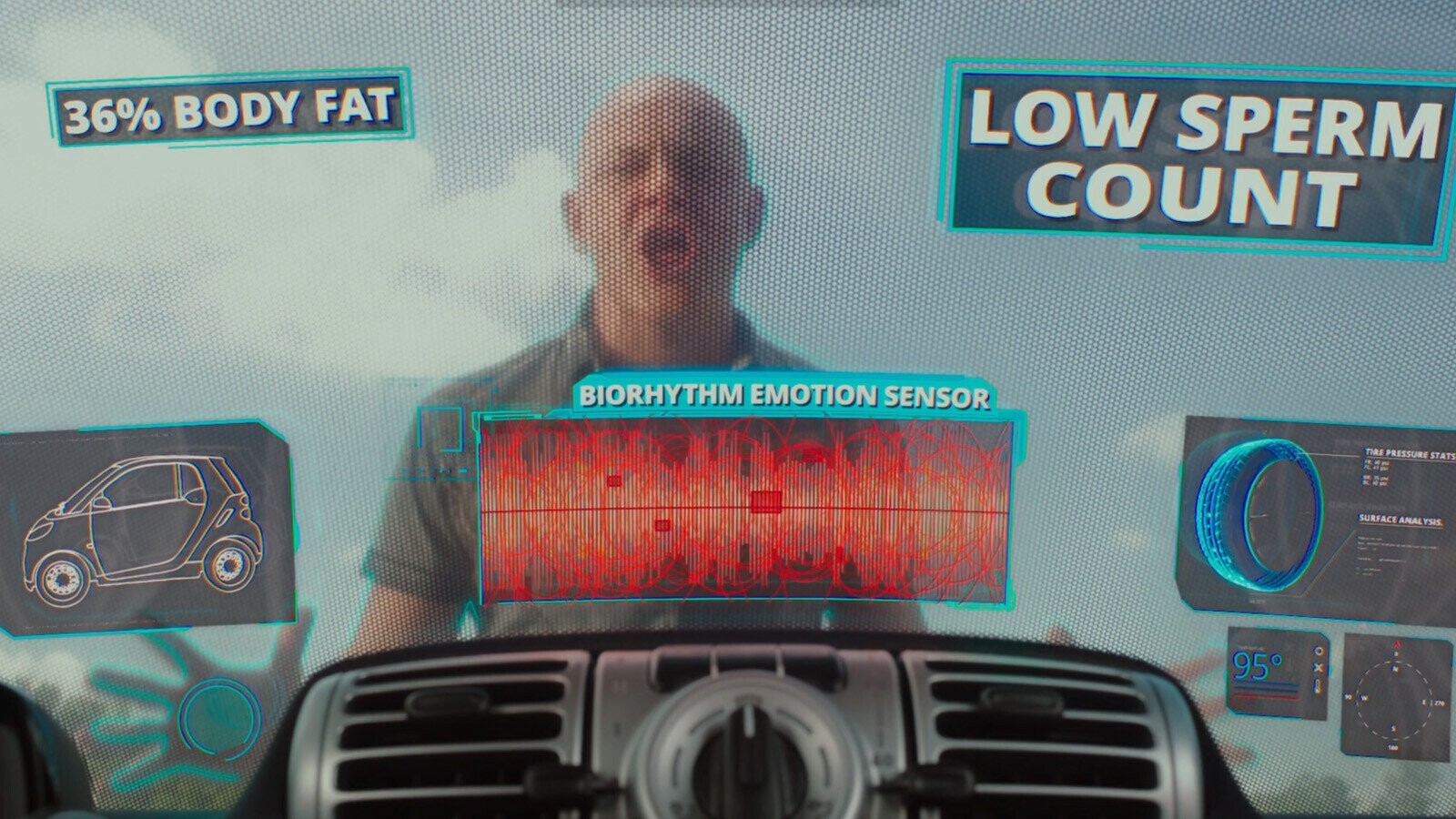
If the movie imagined the future as a nightclub designed by a billionaire with poor impulse control, the real 2025 feels more like a browser tab explosion. Artificial intelligence became a mainstream daily tool. Search engines started answering questions directly with AI summaries. Social platforms grew even more video-heavy and personality-driven. Self-driving cars became real in selected cities, although not in the “my car insulted me and diagnosed my fertility” way.
The real future is not always visually dramatic. Much of it happens inside recommendation systems, chatbots, cloud services, cameras, sensors, and data centers. It is not always cinematic, but it is powerful. Hollywood gave us glowing screens. Reality gave us invisible software making decisions at scale. One is prettier on camera; the other is better at changing your life before breakfast.
Self-Driving Cars: The Movie Was Close, Then Hit a Cone
One of the funniest pieces of Hot Tub Time Machine 2 futurism is the self-driving car. In the movie, autonomous vehicles are not just functional; they have personality problems. They act like road-raging chauffeurs with access to your medical records. It is absurd, but the basic ideathat driverless vehicles would be part of 2025was not far off.
In the real 2025, autonomous ride-hailing services existed in several U.S. markets. Waymo operated paid fully autonomous rides in cities such as Phoenix, San Francisco, Los Angeles, and Austin, and expanded its service footprint through partnerships and new city launches. That is a major milestone. A decade earlier, self-driving cars often felt like conference-demo magic. By 2025, some people could actually open an app and ride in one.
Where the movie goes wrong is personality. Real robotaxis do not have emotional meltdowns, make crude insults, or decide your social ranking. At least, not verbally. Their weirdness is more practical: pickup zones, cautious driving, awkward interactions with emergency vehicles, and the unsettling sensation of watching an empty driver’s seat behave better than your uncle after two energy drinks.
So the verdict is: partly accurate. The film correctly saw autonomous cars coming, but it imagined them as comedy characters. Real 2025 made them infrastructure experiments, business bets, and regulatory headaches.
Virtual Reality and Holograms: The Future Is Here, But Still Wearing a Headset
The movie’s 2025 leans heavily into holographic displays and virtual reality spectacle. It assumes entertainment will become more immersive, more public, and more embarrassing. On that point, the real world says: yes, kind of, but please adjust your headset strap first.
By 2025, mixed reality and virtual reality were real consumer categories. Apple Vision Pro brought “spatial computing” into the mainstream conversation, while Meta continued pushing VR headsets and AI-powered smart glasses. Ray-Ban Meta glasses gained attention because they looked like normal eyewear while adding cameras, audio, voice assistance, and AI features. That matters because the future of wearables may not look like a neon helmet. It may look like something your stylish friend insists is “not creepy, actually.”
Still, the movie overestimated how normalized VR would be. Most people in 2025 were not spending their evenings inside fully immersive holographic entertainment pods. They were watching short videos, joining video meetings, texting, scrolling, gaming, and asking AI tools to summarize things they did not feel emotionally prepared to read.
The movie pictured VR as a loud public circus. Real 2025 made it a niche-but-growing technology, strongest in gaming, training, design, entertainment experiments, and premium hardware. The more accurate prediction was not “everyone lives in VR.” It was “screens will keep escaping their rectangles.” On that, the film deserves a polite golf clap.
AI and Lougle: The Movie Missed the Biggest 2025 Story
The fictional company Lougle is one of the movie’s clearest jokes about Google-style tech dominance. In the film, Lou has exploited his knowledge of the future to become a tech billionaire. That gag works because even in 2015, audiences understood that search engines, platforms, and data empires were reshaping culture.
But the real 2025 was not defined by a goofy Google parody. It was defined by artificial intelligence going mainstream. ChatGPT had hundreds of millions of weekly users by 2025, and AI tools were being used for writing, coding, search, studying, brainstorming, customer service, marketing, image generation, and workplace productivity. Google also pushed AI deeper into Search through AI Overviews and AI Mode, changing how users find information online.
This is where reality becomes more futuristic than the film. Hot Tub Time Machine 2 imagined better screens and louder media. It did not fully anticipate that millions of people would casually ask software to draft emails, explain medical bills, plan vacations, debug code, write poems, create business plans, and summarize legal-sounding documents without needing a time-traveling hot tub or a billionaire named Lou.
The real 2025 future was not just “search is bigger.” It was “search is becoming conversation.” That is a deeper shift than a fake company name. Lougle was funny. AI search is consequential.
Reality TV, Social Media, and Public Humiliation
The movie’s “Choozy Doozy” game show is a crude exaggeration of reality television, audience voting, and celebrity humiliation. The joke is that the public will happily watch people suffer if the format is shiny enough and the host smiles confidently.
Did real 2025 become exactly that? Not literally. But emotionally? The movie was sniffing around the right dumpster fire.
By 2025, the biggest attention machines were not only television shows. They were TikTok, YouTube, Instagram, Reddit, X, livestreams, podcasts, reaction channels, and influencer ecosystems. Pew Research found YouTube remained the most widely used social platform among U.S. adults, while platforms such as TikTok, Instagram, WhatsApp, and Reddit continued growing. Public entertainment had become more participatory, more fragmented, and more algorithmic.
Instead of one outrageous TV show deciding what humiliating stunt a celebrity must perform, the real internet lets millions of micro-audiences reward embarrassment, outrage, confession, conflict, and oversharing in real time. The audience does not need a studio. It has a comment section. The buzzer has been replaced by engagement metrics.
So the movie was wrong about the format but right about the appetite. The real 2025 did not need “Choozy Doozy.” It had the For You page.
Politics: Neil Patrick Harris Did Not Become President
One of the movie’s funniest throwaway predictions is that Neil Patrick Harris becomes president. In the real 2025, that did not happen. Donald Trump was inaugurated as the 47th president of the United States on January 20, 2025. That is a much sharper reminder of how hard political prediction can be.
Hollywood often imagines future politics as celebrity-driven, absurd, and media-saturated. The twist is that real politics already became all three without needing that exact casting choice. The movie missed the name but understood the mood: politics and entertainment were increasingly tangled, public life was deeply performative, and the presidency remained a global media spectacle.
Neil Patrick Harris as president was a joke. But politics as a permanent content machine? That part aged better than expected.
The Daily Show Prediction: Funny, Close, and Wrong
The movie also imagines Jessica Williams hosting The Daily Show in 2025. That was an interesting prediction because Williams was a rising correspondent in 2015 and widely admired for her sharp comedic voice. In the real 2025, however, The Daily Show did not follow that path. Jon Stewart had returned to host Monday episodes, with other correspondents rotating through the rest of the week.
Still, the prediction was not ridiculous. If anything, it shows how plausible Williams seemed as part of the show’s future. The real media landscape simply took a messier route. Late-night television in 2025 was not a clean handoff from one host to another. It was a survival story involving streaming pressure, political intensity, changing viewer habits, and networks trying to make old formats work in a fragmented attention economy.
The movie imagined late night as still culturally central in 2025. The real world made it more complicated. Clips, podcasts, YouTube segments, and social media moments mattered as much as the broadcast desk itself.
What ‘Hot Tub Time Machine 2’ Got Right
For all its absurdity, the film accidentally understood several big trends. First, technology companies would become even more powerful. Second, transportation would move toward automation. Third, entertainment would become more interactive and more shameless. Fourth, screens would multiply. Fifth, people would continue turning fame, embarrassment, and personal chaos into monetizable content.
It also understood something broader: the future rarely feels dignified while you are living in it. People imagine tomorrow as sleek and elegant. Then tomorrow arrives, and everyone is arguing with a chatbot, filming lunch, subscribing to another streaming service, and wondering why their refrigerator needs a firmware update.
The movie’s 2025 is wrong as a forecast but useful as satire. It saw that the near future would be shaped less by flying cars than by attention, ego, platforms, and convenience. That is not a bad diagnosis for a movie whose primary scientific instrument is a magical jacuzzi.
What the Movie Got Wrong
The film’s biggest mistake is assuming the future would look obviously futuristic. Real 2025 is not a dramatic visual leap from 2015. People still use phones. Cars still mostly have drivers. Laptops still break at the worst possible moment. Many homes look the same, except now there are more smart speakers quietly waiting to misunderstand you.
The deeper changes are behavioral. People ask AI for help instead of searching ten blue links. Teenagers consume video as a first language. Workers use automation to speed up tasks and then somehow become busier. Smart glasses look less like science fiction props and more like regular glasses with privacy debates attached. Autonomous cars exist, but only in certain places. The future is unevenly distributed and occasionally stuck behind a terms-of-service update.
The movie also underestimated how anxious 2025 would feel. Its future is silly and aggressive, but not especially worried. Real 2025 is full of concern about AI, privacy, misinformation, labor disruption, platform power, political polarization, and whether every photo on the internet is now secretly training a model. The future did not just become weird. It became complicated.
Experience Section: What Living Through the Real 2025 Feels Like
The most interesting experience of comparing the real 2025 with Hot Tub Time Machine 2 is realizing that the future did not arrive with a trumpet blast. It arrived as a software update. One day, AI was a novelty. Then suddenly it was in search results, office tools, school assignments, customer support chats, image apps, coding assistants, and dinner-table arguments. Nobody stepped out of a glowing portal to announce the new era. People just started asking chatbots to rewrite awkward emails.
Real 2025 feels futuristic in small, practical moments. You see someone dictate a message to smart glasses. You watch a video made with AI effects and wonder what was real. You open a search engine and get an answer before you click anything. You hear that driverless cars are operating in certain cities, then remember that your own car still screams because the passenger seat has a grocery bag on it. The future is impressive, but it is not evenly glamorous.
There is also a strange emotional whiplash. Some tools feel magical. AI can summarize a long report in seconds. Translation apps make travel easier. Smart devices can automate chores. Maps, rideshare apps, digital wallets, and health trackers make daily life smoother than it was in 2015. At the same time, everything feels more watched, measured, ranked, recommended, and optimized. Convenience has a shadow, and that shadow is usually holding a privacy policy.
Compared with the movie’s loud 2025, real life is quieter but more invasive. Hot Tub Time Machine 2 imagined public humiliation as a TV event. The real internet made it portable. Anyone can become a main character for twelve horrible hours. A bad take, awkward clip, strange outfit, workplace rant, or restaurant meltdown can become content before the person involved has even found their car keys.
The funniest part is how normal all this becomes. People complain about AI and then use it. They worry about screen time while checking a notification. They distrust algorithms while following recommendations. They mock smart glasses until they want hands-free video at a concert. The real 2025 is not a clean line between humans and technology. It is a messy negotiation, conducted daily, usually with low battery.
That is why the movie remains fun to revisit. It got the surface wrong, but it captured the ridiculousness of trying to predict a year before living through it. From 2015, 2025 looked like a faraway sci-fi playground. From inside 2025, it feels like ordinary life with stranger tools, faster media, bigger platforms, and more opportunities to ask, “Wait, when did this become normal?”
Conclusion: The Real 2025 Is Less Ridiculousand Somehow Weirder
So, how does the real 2025 compare to the one in Hot Tub Time Machine 2? The movie missed many specifics. Neil Patrick Harris did not become president. Jessica Williams did not take over The Daily Show. Holographic screens did not dominate American living rooms. Self-driving cars did not become insult comedians on wheels.
But the film was surprisingly sharp about the direction of culture. It understood that technology would become more intimate, media would become more participatory, fame would become more unstable, and the line between entertainment and embarrassment would keep getting thinner. It simply expressed those ideas with the elegance of a cannonball into a hotel pool.
The real 2025 is not the movie’s 2025. It is less neon, less openly absurd, and less dependent on magical hot tubs. Yet in its own way, it is even stranger: AI answers our questions, cars drive themselves in select cities, glasses listen and record, social platforms shape public life, and everyone is trying to figure out whether the future is helping or just hovering nearby with a camera.
Hot Tub Time Machine 2 did not predict 2025 perfectly. But it did remind us of a useful truth: the future is never as smooth as the brochure. Sometimes it is smarter, weirder, more awkward, and much more heavily mediated by apps. Also, if anyone offers you time travel through a hot tub, maybe check the user agreement first.