
For decades, investors have treated stocks and bonds like a financial buddy-cop duo. Stocks were the wild one, chasing growth, jumping fences, and occasionally crashing through a window. Bonds were the calm partner with a clipboard, a thermos, and a plan. When stocks stumbled, bonds were supposed to help steady the portfolio. That is the classic story behind diversification and the famous 60/40 portfolio.
But then came years like 2022, when both stocks and bonds declined together and many investors stared at their statements as if their “balanced portfolio” had just eaten the emergency snacks and left town. The question became urgent: how often do stocks and bonds decline at the same time?
The short answer: it happens more often over quarters than many people expect, but full calendar years when both are down are historically rare. The longer, more useful answer is that the frequency depends on inflation, interest rates, economic growth, Federal Reserve policy, and the specific indexes used to define “stocks” and “bonds.” Let’s unpack it without turning your morning coffee into a graduate seminar in bond math.
Why Investors Expect Stocks and Bonds to Behave Differently
The traditional stock-bond relationship is built on a simple idea: stocks and bonds are driven by different forces. Stocks usually respond to corporate earnings, economic growth, investor confidence, and risk appetite. Bonds respond heavily to interest rates, inflation expectations, credit risk, and central bank policy.
In a typical growth scare, stocks may fall because investors expect weaker profits. At the same time, high-quality government bonds may rise because investors seek safety and expect the Federal Reserve to cut interest rates. When rates fall, existing bonds with higher coupons become more valuable. That is why bonds have often acted as a portfolio shock absorber.
This relationship is not magic. It is not a law of physics. It is more like a well-behaved houseplant: reliable under the right conditions, dramatic under the wrong ones. When inflation is low and stable, bonds often diversify stock risk. When inflation is high and interest rates are rising quickly, bonds can suffer at the same time as stocks.
So, How Often Do Stocks and Bonds Decline Together?
Historical research using U.S. market data back to 1926 has found that stocks and bonds have both posted negative returns in roughly 37 quarters, or just under 10% of all quarters studied. That means simultaneous quarterly declines are not common, but they are not exactly unicorn sightings either. They are more like finding a parking spot downtown: rare enough to notice, but not impossible.
On a full-year basis, however, the event is much rarer. Before 2022, only a couple of calendar years stood out in many historical datasets as years when both broad U.S. stocks and broad U.S. bonds finished negative. Depending on the bond benchmark and stock benchmark used, years such as 1931, 1969, and 2022 are often highlighted as painful examples of both sides of a diversified portfolio struggling at once.
The distinction matters. Investors may experience several months or even a quarter where stocks and bonds both decline, but a full year of double disappointment is much less frequent. Unfortunately, when it happens, it tends to arrive wearing steel-toed boots.
Why 2022 Became the Poster Child for Simultaneous Declines
In 2022, the U.S. market faced a difficult combination: high inflation, aggressive Federal Reserve rate hikes, slowing growth expectations, and geopolitical stress. The Consumer Price Index rose 9.1% over the year ended June 2022, the largest 12-month increase in about four decades. In response, the Federal Reserve raised the federal funds rate target range from near zero at the start of the year to 4.25%–4.50% by December.
That created trouble for both asset classes. Stocks fell because higher interest rates reduced the present value of future corporate earnings and increased fears of recession. Bonds fell because rising interest rates pushed down the prices of existing bonds. In other words, stocks and bonds were not fighting each other; they were both fighting the same boss: inflation.
For investors who thought bonds were supposed to “save the day,” 2022 felt especially rude. The S&P 500 declined sharply, while broad bond indexes also posted one of their worst years in modern history. A balanced portfolio still generally lost less than an all-stock portfolio, but the emotional experience was unpleasant because both major building blocks were red at the same time.
The Role of Correlation: The Word Everyone Pretends to Love
To understand why stocks and bonds sometimes fall together, investors need to understand correlation. Correlation measures how two assets move in relation to each other. A negative correlation means they tend to move in opposite directions. A positive correlation means they tend to move together. A correlation near zero means their relationship is weak or inconsistent.
For much of the early 2000s and 2010s, stock-bond correlation was often negative. When stocks fell during growth scares, high-quality bonds often rose. That helped make the 60/40 portfolio look wonderfully sensible, like a financial seatbelt.
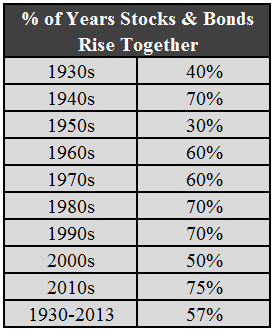
But history shows that the relationship changes. During periods such as the 1970s, the 1980s, parts of the 1990s, and the inflation shock of the early 2020s, stocks and bonds have sometimes moved in the same direction. When inflation and interest-rate uncertainty dominate the market conversation, bonds may lose their safe-haven sparkle.
Why Inflation Makes Stocks and Bonds Decline Together
Inflation is the villain in many simultaneous stock-bond selloffs. When inflation rises unexpectedly, central banks may raise interest rates to cool demand. Higher interest rates hurt bond prices directly. They also hurt stocks indirectly by increasing borrowing costs, reducing valuation multiples, and making safer assets more competitive.
Imagine a company expected to earn big profits far in the future. When interest rates are low, those future profits look valuable today. When rates jump, investors discount those future profits more heavily. That is one reason growth stocks can be hit hard during rate spikes.
Meanwhile, existing bonds become less attractive when newly issued bonds offer higher yields. A bond paying 2% looks less charming when new bonds offer 5%. It is the fixed-income equivalent of showing up to a potluck with plain crackers while someone else brings barbecue.
Quarterly Declines vs. Annual Declines
Investors often confuse short-term pain with long-term pattern changes. Stocks and bonds declining together for a month or a quarter does not necessarily mean diversification is broken. It may simply mean that both asset classes are reacting to the same macroeconomic shock.
Quarterly co-declines have appeared across many decades. They were more frequent in inflationary periods and less frequent in the post-1990 era when inflation was generally lower and the Fed had more room to cut rates during recessions. Annual co-declines are rarer because market conditions can reverse during the year. Bonds may sell off early and recover later, or stocks may rebound after a panic.
That is why investors should avoid judging an entire asset allocation strategy by one bad quarter. A single quarter can be noisy. A full market cycle tells a better story.
Does This Mean the 60/40 Portfolio Is Dead?
No. The 60/40 portfolio is not dead. It is, however, no longer allowed to pretend it is invincible.
A 60/40 portfolio, usually meaning 60% stocks and 40% bonds, has historically helped reduce volatility compared with owning only stocks. The bond allocation can provide income, lower overall risk, and offer potential gains during periods when interest rates fall. But investors should understand that bonds do not guarantee positive returns when stocks fall.
The better takeaway is not “dump bonds forever.” The better takeaway is “know what kind of bond risk you own.” Long-duration bonds are more sensitive to rising interest rates. Shorter-term bonds generally fluctuate less when rates rise. Treasury Inflation-Protected Securities, cash equivalents, high-quality short-term bonds, and diversified bond funds may behave differently depending on the environment.
What Kinds of Bonds Are Most Vulnerable?
Not all bonds react the same way during stock market declines. A short-term Treasury fund and a long-term corporate bond fund may both be called “bonds,” but they can behave very differently when interest rates jump.
Long-Duration Bonds
Long-duration bonds are highly sensitive to interest-rate changes. When rates rise quickly, long-term bonds can fall sharply. They can be powerful diversifiers when rates fall, but painful when inflation pushes rates higher.
Corporate Bonds
Corporate bonds include both interest-rate risk and credit risk. During recessions or market stress, investors may worry about companies’ ability to repay debt. That can cause corporate bond prices to fall alongside stocks.
High-Yield Bonds
High-yield bonds, sometimes called junk bonds, often behave more like stocks than safe bonds. They may offer higher income, but they can decline when risk appetite disappears.
Short-Term Treasuries
Short-term Treasuries are usually less volatile than long-term bonds. They may not provide dramatic gains during stock crashes, but they can help preserve capital and provide liquidity.
What Investors Should Watch
Investors wondering whether stocks and bonds might decline together should pay attention to a few major signals.
First, inflation trends matter. If inflation is rising faster than expected, bonds may struggle because markets anticipate higher interest rates. Stocks may also struggle because higher rates can pressure valuations.
Second, Federal Reserve policy matters. If the Fed is cutting rates because growth is weakening, bonds may help offset stock losses. If the Fed is raising rates because inflation is too high, bonds may fall with stocks.
Third, starting yields matter. When bond yields are very low, there is less income cushion to offset price declines. When yields are higher, bonds may offer better forward-looking return potential and more room to absorb volatility.
Fourth, duration matters. A portfolio loaded with long-duration bonds will react differently from one focused on short- and intermediate-term bonds.
Specific Example: A 2022-Style Scenario
Suppose an investor holds a traditional 60/40 portfolio: 60% in a broad U.S. stock index and 40% in a broad U.S. bond index. Inflation rises unexpectedly. The Fed raises rates rapidly. Stock valuations compress because investors demand higher returns. Bond prices fall because newly issued bonds now offer better yields.
In that scenario, the investor may see both sides of the portfolio decline. The stock sleeve may fall because earnings expectations and valuation multiples are under pressure. The bond sleeve may fall because rates are moving higher. Even though the portfolio is diversified, it is still exposed to macroeconomic shocks.
That does not mean the investor did something foolish. It means diversification reduces certain risks but cannot eliminate all risks. Diversification is an umbrella, not a force field.
How to Build a More Resilient Portfolio
Investors can prepare for simultaneous stock-bond declines by building portfolios that do not rely on one relationship always working perfectly.
Use Different Bond Durations
Combining short-, intermediate-, and carefully selected long-term bonds can reduce dependence on one interest-rate outcome. Shorter bonds may help when rates rise, while longer bonds may help when rates fall during recessions.
Consider Inflation-Sensitive Assets
Assets such as Treasury Inflation-Protected Securities, commodities, infrastructure, and real estate may respond differently to inflation. They are not guaranteed winners, but they can add variety to a portfolio’s return drivers.
Keep Cash for Near-Term Needs
Cash is not exciting. It will never be invited to ring the opening bell at the New York Stock Exchange. But for short-term spending needs, cash can prevent investors from selling stocks or bonds during downturns.
Rebalance Instead of Reacting
Rebalancing forces investors to buy what has fallen and trim what has risen. It sounds simple, but emotionally it feels like eating broccoli during a dessert buffet. Still, disciplined rebalancing can help maintain risk targets over time.
Common Mistakes Investors Make
One common mistake is assuming bonds are risk-free. High-quality bonds have lower default risk than stocks, but they still carry interest-rate risk and inflation risk.
Another mistake is abandoning diversification after it disappoints once. If stocks and bonds fall together for a period, some investors conclude that the entire strategy is useless. That reaction is understandable, but it may be shortsighted. Diversification works over many environments, not every single week.
A third mistake is chasing whatever worked last year. After a year when cash performs well, investors may pile into cash. After stocks rebound, they may chase stocks. After bonds recover, they may buy long bonds. This behavior often turns portfolios into a rearview mirror with transaction fees.
Practical Investor Experiences: What It Feels Like When Both Decline
One of the hardest parts of simultaneous stock-bond declines is psychological. Investors are often prepared for stocks to be volatile. They know the stock market can throw furniture. But bonds are supposed to be the quiet room in the house. When that room also starts shaking, confidence can fade quickly.
Many investors who lived through 2022 learned that “conservative” does not mean “immune.” Retirees with balanced portfolios saw declines in both growth assets and income assets. Younger investors wondered why their bond funds were negative when the stock market was already painful enough. Advisors spent a lot of time explaining duration, rate hikes, inflation, and why bond funds can lose money even when the bonds inside them are still making interest payments.
A useful experience from that period is the importance of matching investments to time horizons. Money needed in the next six months probably should not be exposed to meaningful stock or long-duration bond volatility. Money needed in ten or twenty years can usually tolerate more fluctuation. The problem arises when investors expect long-term assets to behave like short-term savings.
Another real-world lesson is that income matters. When bond yields were extremely low, there was little income cushion. A modest rise in rates could create a noticeable price decline. As yields moved higher, future bond return potential improved, but the transition was uncomfortable. Investors had to endure the price adjustment before enjoying the higher income environment.
There is also a behavioral lesson: check portfolios less often during unusual markets. This does not mean ignoring risk. It means avoiding the emotional treadmill of refreshing account balances every 14 minutes. Markets do not become kinder because investors stare at them more aggressively.
Some investors found comfort in a written investment policy statement. A simple document stating target allocation, rebalancing rules, cash needs, and risk tolerance can be surprisingly powerful during stress. When markets get loud, a written plan is the financial equivalent of noise-canceling headphones.
Investors also learned that labels can be misleading. A fund labeled “bond” may hold long-term Treasuries, corporate debt, mortgage-backed securities, or high-yield bonds. Each has different risks. Reading fund duration, credit quality, yield, and holdings is not glamorous, but neither is discovering during a selloff that your “safe” fund had more rate sensitivity than expected.
Finally, the experience showed that diversification should be broad, thoughtful, and personal. A 25-year-old investor, a 45-year-old business owner, and a 72-year-old retiree do not need identical portfolios. The right mix depends on goals, income needs, taxes, time horizon, and emotional tolerance. A portfolio is not successful because it never declines. It is successful if it helps the investor stay solvent, stay invested, and stay sane.
Conclusion: Rare Annually, Possible Quarterly, Painful Emotionally
Stocks and bonds can decline at the same time, especially when inflation shocks and rising interest rates dominate the market environment. Historically, simultaneous quarterly declines have occurred often enough that investors should expect them from time to time. Full-year declines for both stocks and bonds are much rarer, but years like 2022 prove they can happen.
The main lesson is not that diversification is broken. The lesson is that diversification is imperfect. Bonds can still play a valuable role in reducing volatility, generating income, and balancing equity risk, but they are not guaranteed to rise whenever stocks fall. Investors should understand duration, inflation risk, credit exposure, and the economic environment driving returns.
A resilient portfolio does not depend on one rule working forever. It combines growth assets, defensive assets, liquidity, discipline, and realistic expectations. That may not sound as thrilling as predicting the next market move, but it is far more useful. In investing, boring often wins. It just does not get invited onto cable news as often.