
Not every cloud arrives with a glowing silver border, a cheerful pvational quote ready for Instagram. Some clouds prefer to stay indoors. Some avoid the rest of the sky. Some pull the curtains, switch off the lights, and quietly wonder why everyone else seems to have something they do not.
That wonderfully unusual idea became the heart of I Am Not Like The Other Clouds, a children’s picture book written and illustrated by Desirae Goh. Created during Singapore’s 2020 Circuit Breaker, the project brought together two of Goh’s interests: working in Adobe Illustrator and teaching children. Its central themeshope, self-acceptance, and the courage to changewere especially meaningful during the uncertainty of the COVID-19 period.
On the surface, it is a simple story about a lonely cloud. Underneath, it explores a question that readers of almost every age understand: What happens when you believe everyone else possesses a special quality that you are missing?
A Children’s Book Born During an Uncertain Time
Creative projects do not always arrive politely. They rarely knock on the door carrying a completed outline and a tray of organized snacks. More often, they appear during inconvenient moments and refuse to leave.
For Goh, the idea emerged while normal life was temporarily suspended. Singapore’s Circuit Breaker began in April 2020, restricting movement and changing how people worked, learned, socialized, and spent their days. Instead of allowing confinement to flatten her creativity, she used it as an opportunity to attempt something she had always wanted to do: make a children’s book.
She had not written one before. That could have been a reason to postpone the project. Instead, it became part of the adventure. The unfamiliar situation outside was matched by an unfamiliar creative challenge indoors. The result was a book shaped by the emotional atmosphere of its time without becoming trapped inside it.
The story remains relatable because feeling different did not begin with lockdowns, video calls, or the sudden global shortage of sensible haircuts. Children experience loneliness, insecurity, comparison, and fear of change in classrooms, playgrounds, families, and friendships. Adults experience the same emotions but often disguise them with calendars, spreadsheets, and phrases such as “I’m just tired.”
Meet the Cloud Without a Silver Lining
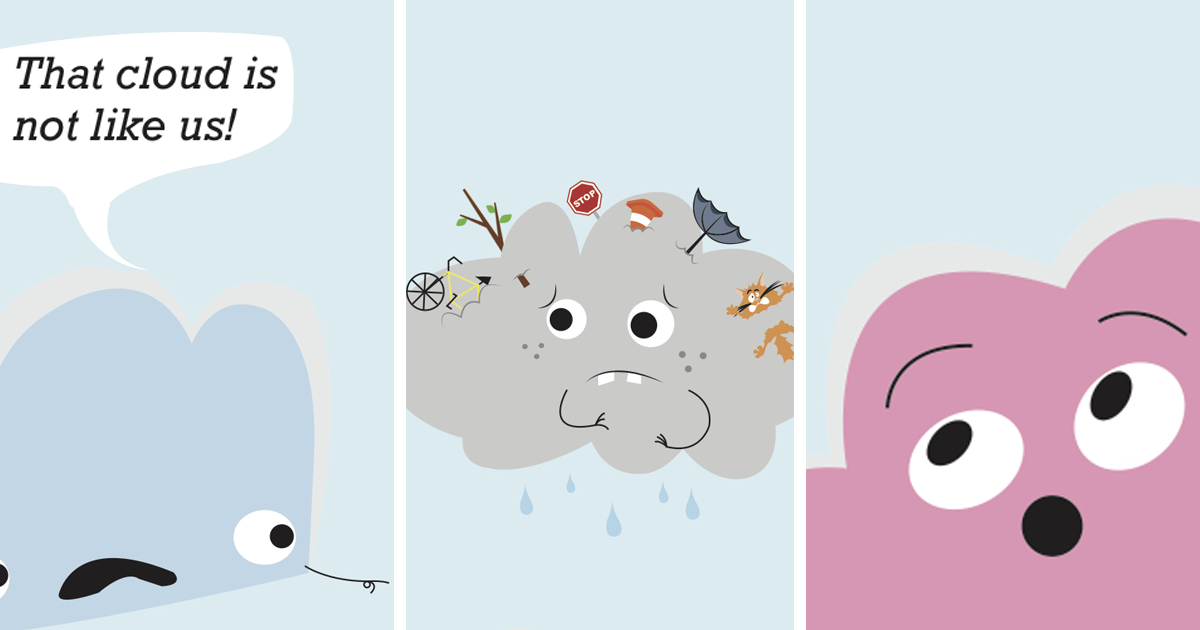
The main character does not resemble the confident clouds drifting comfortably across the sky. While the others have silver linings, this cloud does not. That difference becomes more than a visual detail; it influences how the character sees the world.
The cloud avoids company, stays away from its neighbors, closes the door, turns off the lights, and hides beneath the covers. It is an amusing image, particularly because a cloud hiding under a blanket raises several meteorological questions. Emotionally, however, the behavior is immediately recognizable.
When people feel embarrassed, inadequate, or excluded, they often withdraw. Isolation may seem safer than risking judgment. Unfortunately, hiding also prevents connection, encouragement, and the discovery that other people are usually far less perfect than they appear from a distance.
The story changes when the cloud decides it wants a silver lining and begins looking for a way to obtain one. This decision gives the character agency. The cloud is not rescued by a flawless hero descending from a deluxe section of the atmosphere. It becomes an active participant in its own transformation.
Why the Silver Lining Metaphor Works
The familiar expression “every cloud has a silver lining” suggests that difficult circumstances may contain hope, opportunity, or an unexpected benefit. The book playfully reverses that saying by imagining a literal cloud that lacks the feature everyone assumes clouds possess.
This twist turns an abstract idea into something children can see. A silver lining can represent confidence, optimism, belonging, talent, or any quality a person believes everyone else received automatically. Because the symbol is open-ended, different readers can recognize different parts of themselves in the character.
Personifying a natural object also creates emotional distance. A child who does not want to announce, “I feel lonely and different,” may still be willing to discuss why a fictional cloud hides from its neighbors. The conversation begins with weather and quietly moves toward feelings.
Why Picture Books Can Carry Big Emotions
Picture books may look simple, but simplicity is not the same as shallowness. Their combination of language, facial expressions, posture, composition, color, and page turns gives children multiple ways to understand a character’s emotional state.
Research and educational guidance consistently recognize picture books as useful tools for building emotional literacy. Images can help young readers recognize sadness, fear, joy, anger, and other feelings before they have the vocabulary to describe them precisely. Stories also allow children to experience situations from another character’s perspective, supporting conversations about empathy and self-regulation.
A cloud is especially useful as an emotional character because its shape and appearance can change so easily. It can become heavy, small, dark, bright, stretched, puffy, or nearly invisible. Its environment can echo its mood without requiring a paragraph explaining that it is having a difficult Tuesday.
Words and Pictures Should Share the Work
Strong picture-book illustrations do more than repeat the text. When the words say a character is alone, the artwork can show that loneliness through empty space, distance, scale, or a cluster of other characters gathered elsewhere. When the text becomes hopeful, the composition can open up before the character has fully explained what changed.
Visual storytelling gives readers room to notice details independently. A tiny expression, a background joke, or a gradual shift in color may communicate information that is never stated directly. The Library of Congress describes pictures as a way to strengthen a story’s imagination, humor, and emotion, while children’s-literature specialists emphasize that illustrations and text create meaning together.
That partnership is particularly important in a story about an inward-looking character. A withdrawn cloud may not deliver a five-minute speech about insecurity. Its room, posture, eyes, surroundings, and relationship to the page can speak on its behalf.
Designing an Expressive Cloud Character
Clouds appear easy to draw until one must draw the same cloud repeatedly, from different angles, while preserving a recognizable personality. A random collection of white bumps may work once. By page twelve, however, it may look as though the protagonist has been replaced by a distant cousin.
Character design requires consistency. The illustrator must decide which shapes, proportions, features, and gestures make the cloud identifiable. Rounded forms may suggest softness and vulnerability. Sharper or compressed shapes can communicate tension. Eyes, eyebrows, and the position of the mouth can convey emotion, but the entire silhouette should contribute as well.
Adobe’s character-design guidance recommends developing a distinctive visual concept from sketches and using repeatable design elements to create a compelling character. Digital vector tools are particularly convenient for clean shapes, scalable artwork, reusable components, and color adjustments.
Using Color to Show an Emotional Journey
A story about a missing silver lining naturally invites a carefully controlled color palette. Early scenes might use subdued grays, cool blues, dim interiors, or large areas of empty space. These choices can make the cloud’s world feel closed without turning every page into a weather warning.
As the character experiments, connects, or changes, warmer and brighter colors can gradually enter the illustrations. The shift does not need to be dramatic. A tiny highlight, a brighter doorway, or a more colorful background may be enough to tell readers that possibility has entered the story.
The most satisfying transformation is not necessarily a complete visual makeover. Self-acceptance does not require the character to become unrecognizable. The cloud should still look like itself at the endonly more comfortable occupying the sky.
Writing a Picture Book Means Respecting Every Page
Picture-book manuscripts are usually short, which creates the dangerous illusion that they are quick to write. In reality, fewer words give each sentence more responsibility. There is nowhere for a lazy paragraph to hide. Every line must contribute character, action, rhythm, humor, or emotion.
Page turns are part of the storytelling. They can conceal a surprise, delay an answer, increase tension, or create a comic pause. Writers and author-illustrators often make a rough “dummy”a small mock-up of the full bookto test pacing, spreads, visual variety, and the relationship between text and images.
For a story about a cloud attempting to gain a silver lining, each effort can become its own visual beat. One approach might be too complicated. Another could be ridiculous. A third might almost work before producing a harmless but spectacular mess. Repetition creates structure, while variation keeps the sequence entertaining.
Humor Keeps the Message from Becoming a Lecture
Children can detect a disguised lecture with impressive speed. Once a story begins sounding like an adult wearing a costume labeled “Important Lesson,” attention may drift toward the nearest snack.
Humor allows a book to explore insecurity without becoming heavy. A cloud trying bizarre methods to manufacture a silver lining can be funny even while the underlying emotion remains sincere. The laughter gives readers breathing room and makes the character’s vulnerability easier to approach.
The lesson should emerge from choices and consequences rather than a closing sermon. Readers understand that change is possible because they watch the cloud struggle, experiment, and grownot because a narrator suddenly produces a clipboard titled “Three Things We Learned Today.”
Self-Acceptance Does Not Mean Staying Stuck
One of the book’s most useful ideas is that self-acceptance and positive change are not enemies. Accepting yourself does not mean refusing to learn, connect, or try something new. It means recognizing that your value does not depend on becoming an exact copy of everyone around you.
The cloud initially believes belonging requires possessing the same feature as the other clouds. Its journey challenges that assumption. A silver lining may still be desirable, but the more important discovery is that difference does not make the character unworthy of friendship or visibility.
This distinction matters for children. Encouragement can easily become pressure when every difficult feeling is answered with “cheer up” or “look on the bright side.” A compassionate story first acknowledges the cloud’s sadness and isolation. Hope then grows from that honest starting point.
Books about emotions can help children name what they feel, see that others experience similar struggles, and consider healthy ways of responding. Shared reading also creates an opportunity for adults and children to discuss the pictures, ask questions, and connect the fictional situation to real life.
How Families and Teachers Can Explore the Story
A picture book becomes more powerful when reading is treated as a conversation rather than a race to the final page. Adults can pause at important illustrations and ask open-ended questions:
- Why do you think the cloud avoids the others?
- What details in the picture reveal how the cloud feels?
- Have you ever thought everyone else had something you did not?
- What could the other clouds do to make their neighbor feel welcome?
- Does a silver lining have to look the same for every cloud?
Repeated and interactive read-alouds can encourage vocabulary, comprehension, emotional discussion, and closer observation. Pediatric and early-literacy organizations also emphasize that responsive shared reading supports relationships and social-emotional development, especially when adults follow the child’s interests and respond to questions.
After reading, children might design their own cloud characters. One could have a rainbow hat. Another might collect thunder. A third may be shaped like a potato and insist that this is perfectly normal. Children can decide what makes each cloud different, what it worries about, and what helps it feel confident.
Experiences and Lessons from Creating a Book Like This
The experience behind I Am Not Like The Other Clouds offers several practical lessons for aspiring author-illustrators. The first is that a meaningful story does not require an enormous fictional universe. It may begin with one visual contradiction: a cloud without the feature people assume every cloud possesses.
The second lesson is that limitations can sharpen creativity. During a period when travel, social activity, and ordinary routines were restricted, an indoor digital project provided a constructive place to direct energy. A creator did not need a studio with dramatic windows overlooking the sea. A computer, an illustration program, an idea, and enough persistence to survive endless revisions were sufficient.
Creating the central character likely required many small decisions that readers would never consciously notice. How large should the eyes be? Should the cloud have arms? How does a floating object sit beneath a blanket? Can a cloud own a door, and if so, where is the wall? Children’s illustration repeatedly presents these extremely serious artistic questions.
The writing process also demands restraint. An author may know the character’s entire history, favorite breakfast, and opinions about thunderstorms, but the book needs only the details that serve the emotional journey. Cutting words can feel painful, especially when a sentence is clever. Unfortunately, “clever” and “necessary” are not always roommates.
A rough dummy can reveal problems that remain invisible in a text document. Several consecutive pages may look too similar. A key emotional change may happen too quickly. The funniest moment may appear before sufficient tension has developed. Moving one sentence to the next spread can transform an ordinary line into a satisfying surprise.
Reading the manuscript aloud is equally revealing. Picture books must work in the mouth as well as on the page. Awkward rhythms, repeated sounds, long sentences, and accidental tongue twisters become obvious when spoken. A line that seems elegant on a screen may sound like a washing machine swallowing a spoon.
Feedback from actual children is especially valuable. Adults may praise symbolism, composition, and thematic coherence while a seven-year-old immediately identifies the page where the cloud looks “kind of like mashed potatoes.” Neither response should be ignored. The intended audience notices clarity, humor, and emotional honesty with remarkable precision.
Another important experience is learning to tolerate imperfection. The first sketch may not match the image in the creator’s imagination. The first manuscript may explain too much. The fifteenth revision may somehow create a new problem on page six. Progress often looks less like a smooth upward line and more like a cloud being blown across the sky by indecisive wind.
Finishing the project therefore becomes part of its message. The cloud changes through experimentation, and the creator develops through revision. Both must move beyond the safety of hiding. One enters the wider sky; the other releases a personal piece of work for strangers to read, interpret, praise, question, and occasionally compare to mashed potatoes.
The most encouraging lesson is that an inexperienced children’s-book creator can still begin. Professional guidance, critique groups, illustration communities, and careful research help refine the work, but no organization can create the first imperfect draft on someone else’s behalf. The project starts when the creator gives an unusual idea permission to exist.
That is why the book’s origin matters as much as its premise. It demonstrates how a period associated with isolation produced a story about emerging from isolation. The circumstances did not magically become pleasant, but they provided space for a creative response. In that sense, the book itself became a silver liningthough, appropriately, it had to be drawn one shape at a time.
Conclusion: Making Room for Every Kind of Cloud
I Am Not Like The Other Clouds turns a familiar expression into a playful story about difference, loneliness, creativity, and personal growth. Its central image is memorable because it is both absurd and emotionally accurate. Many people have looked at others and assumed that confidence, belonging, or happiness came naturally to everyone except them.
The lonely cloud reminds readers that hiding may feel safe but cannot create the connection they need. Its decision to pursue change shows that hope is not passive. At the same time, the story suggests that genuine growth does not require erasing individuality.
A good picture book can say all of this without becoming solemn. It can use a blanket, a darkened room, a few expressive eyes, and one determined puff of weather. That is the special power of visual storytelling: a small character can carry an enormous feeling across the sky.
Editorial note: This independently written feature is a researched synthesis based on Desirae Goh’s publicly shared account and established educational and publishing guidance from Bored Panda, Reading Rockets, NAEYC, Scholastic, SCBWI, Adobe, Writer’s Digest, Penguin Random House, the Children’s Book Council, PBS, Harvard’s Center on the Developing Child, the Library of Congress, the American Academy of Pediatrics, and peer-reviewed research indexed by the National Library of Medicine. It is not a reproduction of the original article.