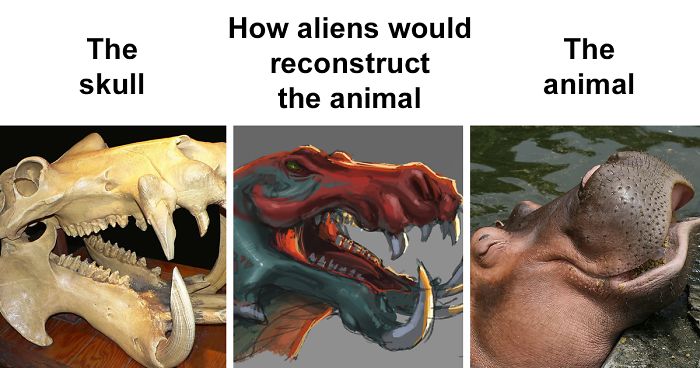

Imagine an alien scientist landing on Earth millions of years from now. The oceans have changed, the continents have shifted, and all that remains of your fluffy golden retriever is a skull with dramatic teeth, empty eye sockets, and a jaw that looks ready to star in a monster movie. The alien adjusts its space goggles, sketches carefully, and concludes: “Ah yes, a terrifying desert predator with no ears, no lips, and the facial charm of a haunted can opener.”
That is the hilariousand surprisingly educationalidea behind “If Aliens Reconstructed Animals Based On Their Skulls.” The concept asks a simple question: What would familiar animals look like if someone tried to rebuild them from skulls alone? The answer is usually part science, part nightmare fuel, and part comedy gold. Cats become tiny saber-toothed villains. Dogs look like budget werewolves. Hippos, already suspiciously intense, turn into swamp demons with dental issues.
But behind the joke is a serious point: bones do not tell the whole story. Skulls can reveal a lot about an animal’s diet, senses, bite strength, and evolutionary history. However, they often hide the soft tissues that make living animals recognizablelips, cheeks, trunks, ears, fat pads, feathers, fur, whiskers, skin folds, colors, and expressions. In other words, a skull is the blueprint, not the finished house. And if you decorate the house badly, congratulations: you have invented an alien raccoon goblin.
Why Animal Skulls Look So Misleading
Skulls are fascinating because they are both informative and deeply deceptive. A skull shows where the brain sat, where muscles attached, how the jaw moved, and where the eyes, nose, and teeth were positioned. Paleontologists and anatomists use these clues to understand extinct animals. Yet a skull rarely preserves the full shape of the living face.
Think about an elephant. Its skull has a large opening in front, but the trunkthe most elephanty part of the elephantis soft tissue. Without living elephants as a reference, an alien might imagine a short-faced creature with a strange hole in its head. The same problem happens with rhinos. A rhinoceros skull may not clearly preserve the full size and shape of its horn if the horn was made largely of keratin, the same tough protein found in hair and nails. A future alien could look at a rhino skull and miss the entire “walking tank with a nose weapon” vibe.
Soft tissue changes everything. A whale skull looks almost absurd compared with the smooth, blubbery animal we know. A bird skull does not fully explain feathers, colors, or display structures. A cat skull does not tell you that the animal had whiskers, rounded ears, soft cheeks, and the confidence of a tiny landlord. Bones whisper clues; living bodies shout personality.
The Science Behind Reconstructing Animals From Bones
Real paleontologists do not simply stare at a skull and guess wildly, although that would make an excellent reality show. They use several lines of evidence to reconstruct extinct animals. The process often begins with the skeleton. Missing bones may be estimated by comparing related species. Then scientists study muscle attachment marks, joint surfaces, tooth shape, and skull openings to understand how the animal moved, ate, breathed, and sensed its environment.
One important method is comparing extinct species with living relatives. For dinosaurs, scientists often examine birds and crocodilians because these groups help bracket what certain soft tissues may have looked like. This approach can help researchers infer muscles, air sacs, nasal structures, and other features that rarely fossilize. Modern imaging, CT scans, 3D modeling, and biomechanical studies have also made reconstructions more sophisticated than the old “draw a lizard, make it huge, add teeth” method.
Still, uncertainty remains. Fossils preserve hard parts far more often than soft parts. Skin impressions, feathers, stomach contents, trackways, and pigment traces can provide extra evidence, but these are exceptional gifts from geology, not everyday finds. That is why paleoartthe art of reconstructing prehistoric lifecombines science, anatomy, evidence, and careful imagination. It is not fantasy, but it is not a photocopy either.
What Aliens Would Probably Get Wrong
If aliens reconstructed animals based only on skulls, their biggest mistake would be “shrink-wrapping.” This means drawing skin tightly over the bones, making the animal look bony, gaunt, and dramatically underfed. Many older dinosaur reconstructions had this problem: visible skull openings, sunken faces, and bodies that looked less like living animals and more like biology homework left in the desert.
1. They Would Miss Fat, Fur, and Fluff
Fat rarely fossilizes in an obvious way, but it shapes many animals. Seals, whales, bears, and even domestic cats can look wildly different from their skeletons because fat and soft tissue round out the body. If aliens rebuilt a panda from bones alone, they might create a lean, sharp-faced climber instead of the black-and-white bamboo sofa cushion we all recognize.
2. They Would Misread Lips and Cheeks
Many mammals have lips and cheeks that cover teeth. Skulls, however, show the teeth in full display. That is why skull-based reconstructions often look permanently furious. A horse skull, for example, can seem alarming, with long jaws and big teeth. The living horse is elegant, expressive, and usually more interested in snacks than in haunting your dreams.
3. They Would Forget Ears
Ears are mostly cartilage and soft tissue. A skull can show ear openings and related structures, but not the full shape of external ears. Without modern comparisons, aliens might reconstruct rabbits without long ears, foxes without pointed ears, or elephants without broad flapping ears. That is not just a cosmetic error; ears can help with communication, temperature control, and species recognition.
4. They Would Botch Noses
Noses are reconstruction traps. Tapirs, elephants, saiga antelopes, and many other animals have fleshy nasal structures that are not obvious from skulls alone. A skull may reveal enlarged nasal openings, but the exact soft-tissue shape can be difficult to infer. This is how an alien could turn an elephant into a short-faced, confused-looking beast and still feel academically proud.
5. They Would Ignore Color and Pattern
Color almost never comes straight from ordinary bones. Scientists can sometimes infer color from preserved melanosomes in exceptional fossil feathers or skin, but many extinct animals remain chromatic mysteries. If aliens reconstructed a tiger from a skull, would they know about stripes? Probably not. They might draw a plain tan predator and completely miss the animal’s famous “walking barcode with claws” design.
Funny Examples: Familiar Animals as Alien Monsters
The internet loves this idea because familiar animals become ridiculous when viewed through incomplete evidence. A cat skull, with its forward-facing eyes and sharp teeth, could easily inspire an alien to draw a tiny ambush demon. That is not entirely wrongask any houseplant that has lived with a catbut it misses the soft fur, twitching whiskers, expressive ears, and loaf-like sitting posture.
A dog skull can look surprisingly fierce, especially in breeds with strong jaws. Reconstructed without lips, fur, and floppy ears, a friendly Labrador might become a lean scavenger-beast that looks like it charges tolls at a haunted bridge. Meanwhile, a pug skull could create real confusion. Its shortened face is already a product of selective breeding, and without knowledge of domestic dog variation, aliens might assume it was a strange, specialized burrow predator or a creature designed by committee.
A hippo skull is perhaps the easiest path to alien horror. Even in real life, hippos are powerful, territorial animals with enormous jaws. But the living hippo also has thick skin, small ears, a bulky body, and a semi-aquatic lifestyle. From the skull alone, an alien might produce a crocodile-mammal hybrid with the emotional warmth of a tax audit.
Birds would cause another category of mistakes. A parrot skull does not fully prepare you for bright feathers, social intelligence, and the ability to scream “hello” like a tiny feathered roommate. A peacock skeleton cannot fully explain the extravagant tail display. A flamingo skull and bones might suggest a strange wading creature, but not necessarily the pink, filter-feeding icon of lawn ornament history.
What This Teaches Us About Dinosaurs
The alien skull meme is funny because it turns the mirror back on us. Humans reconstruct extinct animals from incomplete evidence all the time. Dinosaurs are the most famous example. For decades, popular dinosaur art often showed scaly, reptile-like animals with exposed teeth, lean bodies, and dramatic monster poses. Modern research has complicated that image.
Some dinosaurs had feathers or feather-like coverings. Some had display structures, fat deposits, skin textures, or colors we may never fully know. A dinosaur’s skull can tell us about bite mechanics, eye position, jaw muscles, and sensory abilities, but it cannot automatically reveal whether the animal had bright facial skin, soft cheek tissue, a display crest, or a silly mating dance. Nature is rarely minimalist. If living animals teach us anything, it is that evolution loves accessories.
Consider cassowaries, turkeys, mandrills, hornbills, and elephant seals. These animals have dramatic soft-tissue features that would be easy to underestimate from bones alone. If such creatures were extinct, future reconstructions might look far too conservative. The cassowary’s vivid head and casque, the turkey’s snood, and the elephant seal’s inflatable nose remind us that real animals are often weirder than cautious artwork.
Skulls Are Powerful Clues, Not Complete Portraits
To be fair to the hypothetical aliens, skulls are not useless. Far from it. Teeth can reveal whether an animal sliced meat, crushed plants, filtered food, or gnawed through tough materials. Eye sockets can suggest predator or prey tendencies, although behavior is always more complicated than one feature. Nasal passages may hint at smell, breathing, or specialized structures. Jaw joints can reveal chewing style. Muscle scars can show where powerful tissues once attached.
In paleontology, the challenge is not that bones say nothing. The challenge is that bones say something specific, while our imaginations are tempted to fill in everything else too quickly. Good reconstruction requires humility. It asks: What do we know? What can we infer from living relatives? What is possible but uncertain? What would be cool but scientifically reckless?
That last question is important because a reconstruction can become popular even when evidence is weak. A striking image may stick in public memory for decades. This is why museums, paleoartists, and researchers work carefully to update reconstructions as new evidence appears. Science is not embarrassed by revision. Science is basically revision wearing sensible shoes.
The Role of Paleoart: Where Science Meets Imagination
Paleoart is more than decoration. It shapes how people understand extinct life. A good paleoartist studies anatomy, fossil evidence, ecology, related species, and scientific debates. The final image must feel alive without pretending that every detail is certain. That balance is difficult. Too cautious, and the animal looks like a skeleton in pajamas. Too imaginative, and it becomes a dragon with a research grant.
The best reconstructions treat extinct animals as animals, not movie monsters. A Tyrannosaurus rex was not roaring every eight seconds in perfect cinematic lighting. It slept, scratched, smelled, grew, healed, aged, and probably had plenty of ordinary animal moments. Likewise, a Triceratops was not merely a horned battle machine. It was a living herbivore with muscles, skin, behavior, and ecology.
The “alien reconstruction” idea works so well because it reminds us that modern animals are not obvious from their bones. A cow skeleton does not scream “gentle field rectangle that chews thoughtfully.” A squirrel skull does not fully reveal the twitchy park acrobat. A dolphin skull, with its long jaws and many teeth, can look surprisingly unlike the smooth marine mammal we know. Life is not just structure; it is surface, behavior, motion, and context.
Why the Meme Became So Popular
The popularity of “If Aliens Reconstructed Animals Based On Their Skulls” comes from the perfect blend of humor and revelation. First, the images are funny. It is hard not to laugh when a beloved pet becomes a skeletal space cryptid. Second, the idea is instantly understandable. You do not need a paleontology degree to see that a skull leaves out important information. Third, the meme makes people smarter without feeling like homework.
It also taps into a deeper curiosity: How much do we really know about the past? Every fossil reconstruction carries a confidence level. Some features are strongly supported. Others are educated guesses. Some are speculative possibilities. The alien meme exaggerates the problem, but exaggeration can be useful. It teaches us to look at reconstructions not as final answers, but as scientific interpretations.
Lessons for Anyone Looking at Ancient Life
When you see a reconstruction of a prehistoric animal, ask what evidence supports it. Was skin preserved? Were feathers found? Are there living relatives with similar anatomy? Is the color based on pigment evidence or artistic choice? Are muscles reconstructed from attachment sites? Are soft tissues inferred from related species? These questions do not ruin the magic. They make the magic better.
The same lesson applies to modern animal skulls in museums, classrooms, and online galleries. A skull is a beautiful object, but it is only one chapter of the animal’s biography. The full story includes movement, sound, smell, texture, environment, social behavior, and the thousand tiny details that disappear after death. A skull can tell us how an animal ate. It cannot tell us that a dog tilted its head when confused or that a cat knocked a glass off a table while maintaining eye contact.
Experience Section: What It Feels Like to See Animals Through Alien Eyes
The first time you really compare an animal skull with the living animal, it feels like discovering nature’s secret prank department. A deer skull, for example, looks delicate but strange, all narrow bone and empty spaces. Then you remember the living deer: alert ears, wet nose, soft eyes, slim legs, and that sudden ability to leap across a road at the exact moment your coffee is most vulnerable. The skull is accurate, but it is emotionally incomplete.
Visiting a natural history museum makes this experience even stronger. You walk past skulls in glass cases, and each one feels like a puzzle. The labels help, but your brain keeps trying to rebuild the animal. A bear skull looks powerful and blunt. A horse skull seems long and almost dragon-like. A beaver skull reveals orange incisors and engineering ambition. Then you realize how much your mind depends on memory. You know what these animals look like because you have seen photos, videos, cartoons, pets, documentaries, and maybe one raccoon judging you from a trash can at midnight.
Now imagine losing all that context. No videos. No fur. No zoo. No field guide. Just bones. Suddenly, the alien reconstruction problem feels less silly and more humbling. You might correctly identify a predator from sharp teeth, but would you guess its ears were rounded? You might identify a grazer from flat molars, but would you know whether it had stripes, spots, humps, wattles, a mane, or a ridiculous mustache of whiskers? Probably not. Even trained experts need comparison, evidence, and caution.
This topic is especially fun to discuss with kids, students, or anyone who loves animals. Show them a skull and ask them to sketch the creature. The results are usually wonderful chaos. Someone gives a rabbit dragon horns. Someone turns a dog into a dinosaur. Someone adds spikes because, frankly, spikes improve most imaginary animals. Then show the real animal and talk about what the skull did and did not reveal. Suddenly, anatomy becomes a detective game instead of a list of bone names.
There is also a creative writing bonus. Thinking like an alien paleontologist forces you to describe animals without taking them for granted. A cow becomes a large, four-legged fermentation specialist. A pelican becomes a flying fish-net with bones. A walrus becomes a mustached marine couch with tusks. A chihuahua becomes proof that evolution and human preference occasionally collaborate on comedy.
The experience changes how you look at fossils, too. Instead of asking, “Is this reconstruction right or wrong?” you start asking, “How confident are we?” That is a much better question. It leaves room for evidence, uncertainty, and wonder. It also makes prehistoric animals feel more real. They were not movie props waiting for humans to discover them. They were living creatures with soft bodies, odd habits, colors, scars, smells, and behaviors that bones can only partially record.
So the next time you see an animal skull, pause before you mentally shrink-wrap it into a monster. Imagine the missing ears, lips, fur, feathers, fat, skin, and swagger. Imagine the alien scientist trying its best, proudly presenting a reconstruction of a house cat as a venomous cave gremlin. Then give the alien a little sympathy. Rebuilding life from bones is hard. Rebuilding it with accuracy, humility, and imagination is one of the coolest challenges in science.
Conclusion
“If Aliens Reconstructed Animals Based On Their Skulls” is more than a funny internet idea. It is a playful doorway into anatomy, evolution, fossil science, and paleoart. Skulls reveal important truths, but they also leave out the soft tissues and behaviors that make animals recognizable. That gap explains why reconstructions of extinct animals are always evolving as new evidence appears.
The joke works because it is rooted in reality. If aliens had only skulls, they might turn pets into monsters and gentle herbivores into nightmare beasts. But humans face a similar challenge when reconstructing ancient life. The best science does not pretend bones tell everything. It listens carefully to what they do say, compares them with living animals, uses modern tools, and leaves room for mystery.
In the end, animal skulls remind us that life is wonderfully excessive. Nature adds cheeks, trunks, feathers, blubber, colors, whiskers, ears, and expressions on top of the skeleton. Bones are the framework. The living animal is the masterpiece. And sometimes, when viewed by aliensor by humans with a strong sense of humorthat masterpiece looks like it was almost reconstructed by someone who forgot the fluffy parts.