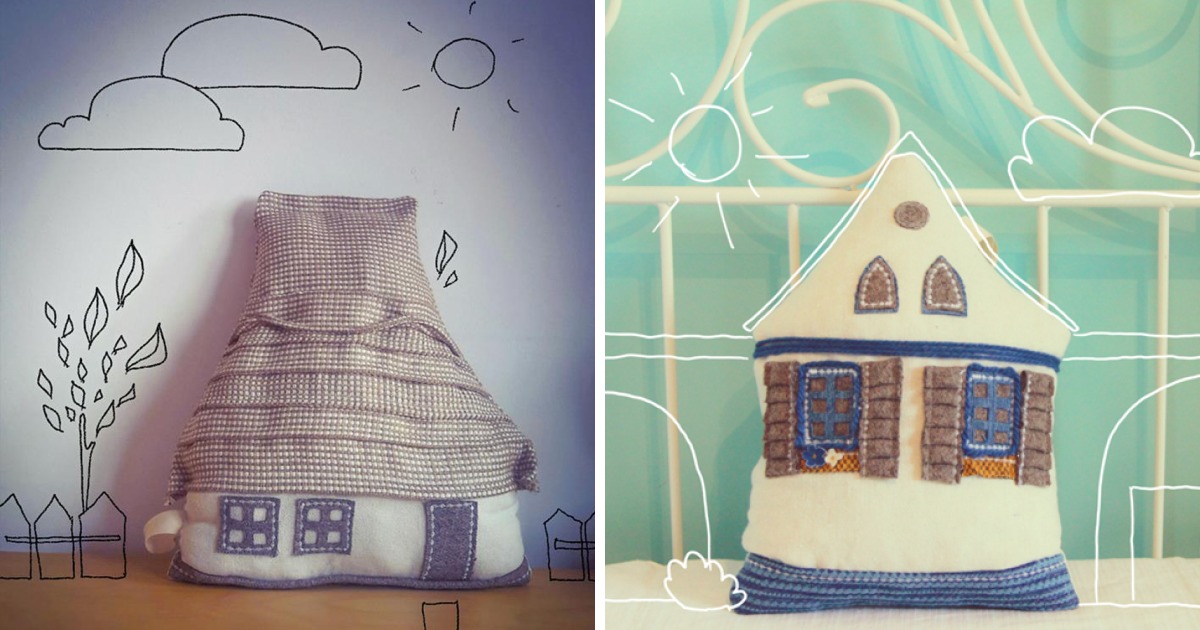

Some people make throw pillows to match a sofa. I make mine to match a memory.
Not the polite, neatly labeled kind of memory either. I mean the kind that sneaks up on you when light hits a window frame just right, when a carved gate reminds you of your grandparents’ village, or when a roofline suddenly looks so familiar you could swear your childhood is peeking around the corner. That is where my architectural pillows begin: in Romania, in the small visual details that lodge themselves into your heart and refuse to leave quietly.
As a child, I was surrounded by houses that felt alive. Their steep roofs looked protective, almost parental. Their windows were trimmed with care, not as decoration for decoration’s sake, but as a declaration that beauty belonged in everyday life. Wooden porches, painted facades, embroidered textiles, woven rugs, and layers of handmade objects gave homes a personality that modern design sometimes forgets in its sprint toward sterile perfection. In those rooms, nothing felt random. Even the smallest object seemed to carry a family story, a region, a season, or a belief.
Years later, I realized that what stayed with me most was not a single building, but the feeling architecture created. Warmth. Belonging. Texture. History. So I started translating those qualities into something softer, smaller, and wonderfully unreasonable in the best possible way: architectural pillows. Yes, house-shaped pillows. Tiny textile buildings. Soft sculptures that sit on a chair but still manage to hold an entire landscape inside them.
Why a House Became a Pillow
A pillow is intimate in a way architecture usually is not. You can lean on it, hug it, stack it on a bed, or toss it dramatically onto a reading chair after pretending you are the kind of person who has “a reading chair.” A house, by contrast, is fixed. It stands where it stands. But when you turn a house into a pillow, something magical happens: architecture becomes portable emotion.
That is what fascinates me. I am not trying to make miniature replicas for a museum gift shop. I am trying to preserve atmosphere. A dormer window becomes a stitched line. A roof pitch becomes the silhouette. A row of folk-inspired motifs becomes embroidery along the base. The softness of the pillow does not weaken the architecture; it humanizes it. It reminds us that buildings are not just structures. They are containers for rituals, arguments, Sunday lunches, winter silence, and the smell of warm bread drifting from another room.
Architectural pillows also let me break one of design’s more boring rules: that functional objects must choose between usefulness and storytelling. Mine do both. They support your back and your nostalgia. Frankly, that is more than some office chairs have ever done for humanity.
How Romanian Childhood Memories Shape My Designs
Roofs, Windows, and the Poetry of Vernacular Forms
The first thing I usually sketch is the roof. In childhood memory, roofs matter. They are how a house announces itself from a distance. In Romania, especially in rural settings, the roofline is often one of the most recognizable visual elements: sharp, sheltering, sometimes dramatic, and always practical. I love how these forms communicate resilience. They do not whisper. They say, “We know what winter is, thank you very much.”
Windows come next, because windows are where personality lives. Some of my pillows feature centered, symmetrical openings that feel calm and grounded. Others use uneven placement or tiny stitched shutters to suggest quirky village charm. I often exaggerate the windows slightly because memory does that too. Childhood rarely records a house with technical precision. It keeps the details that carried emotional weight.
Embroidery, Ornament, and Everyday Meaning
Romanian visual culture taught me early that decoration is never merely decoration. Embroidery on blouses, aprons, household linens, and wall textiles can carry rhythm, symbolism, geography, and identity. Geometric bands, repeated motifs, dense patterning, and carefully placed ornament all influence how I build the surface of a pillow. Even when a design is simplified for a modern interior, I want it to retain that sense of intention.
I am especially drawn to the tension between restraint and richness. A house silhouette may be simple, but then a border of stitched motifs adds history. A neutral linen body may be interrupted by a bold red door or dark wool roof. That contrast mirrors what I remember from Romanian homes: practical forms softened by human touch. Nothing was sterile. Even useful things had dignity.
Textures That Feel Like Home
Texture is not an afterthought in my work; it is the emotional engine. Smooth cotton alone cannot tell the whole story. I use combinations of linen, wool, embroidery thread, woven trims, and occasionally rustic-looking fabrics that feel closer to heirloom objects than mass-market decor. I want the finished piece to suggest layers accumulated over time, the way a home does.
That tactile quality matters because memory is sensory. We remember not only how a place looked, but how it felt. Cool walls. Thick textiles. Rough wood. A woven blanket folded at the edge of a bed. When I choose materials, I am really choosing which memory deserves to speak the loudest.
From Architecture to Textile Art: My Creative Process
Step One: Observe Like an Architect, Remember Like a Child
I begin with observation, but not in a rigid, documentary way. I collect visual references, sketch silhouettes, study proportions, and note the repeated features that define a region or style. Then I let memory distort things slightly. That is important. I am not drafting a preservation plan. I am making an object with feeling.
Sometimes a design starts with a real building. Other times it begins with a fragment: the trim around a window, the triangular attitude of a roof, the mood of a village street at dusk. I pull these pieces together into a form that feels truthful, even if it is not literal.
Step Two: Simplify Without Flattening the Soul
The challenge with architectural pillows is knowing what to leave out. If you include every detail, the design becomes busy and stiff. If you remove too much, it loses character and ends up looking like a cartoon house that belongs on a nursery shelf next to a suspiciously cheerful cloud. I prefer a middle path. Clean lines. Focused ornament. A silhouette strong enough to read instantly, with enough nuanced stitching to reward a closer look.
This balance makes the pillows easier to style in contemporary homes too. They can sit comfortably in modern, eclectic, bohemian, rustic, or collected interiors because they are rooted in heritage without becoming costume.
Step Three: Stitch the Story by Hand
Handmade work slows everything down, and that is part of the value. I cut, layer, embroider, and assemble each piece with attention to irregularity rather than fear of it. A hand-sewn line may have a slight variation. The roof angle may look a touch more human than machine-perfect. Good. Homes are lived in, not laser-printed. Handmade variation keeps the object honest.
That honesty also gives the pillows what I can only describe as emotional credibility. People respond to them because they sense that a real hand made choices. In a world full of furniture that arrives in a cardboard box with instructions written by a committee, that matters.
Why Architectural Pillows Speak to Modern Homes
People are craving objects with roots. We have all seen enough empty-beige sameness to last several decorative lifetimes. The renewed interest in heirloom textiles, handcrafted decor, heritage-inspired pattern, and collected interiors points to something deeper than trend chasing. People want their homes to say something. They want rooms with memory, not just matching sets.
Architectural pillows fit beautifully into that desire because they combine narrative and function. They act as decor, but they also act as conversation. Guests ask about them. They pick them up. They smile. Then comes the best part: the story. “This roof reminds me of northern villages.” “That embroidered line was inspired by traditional dress.” “This shape comes from houses I knew as a child.” Suddenly the pillow is not an accessory. It is an introduction.
They also work on a practical level. You can place one on a bed to add character without overwhelming the room. Use a pair on a bench to soften hard lines. Add one to a neutral armchair where it can do all the talking while the chair quietly enjoys the attention. In children’s spaces, they feel whimsical. In adult interiors, they read as artful and deeply personal. Not bad for something people still insist on calling “just a pillow.”
The Business of Turning Memory Into Design
Making heritage-inspired decor is not only an artistic exercise; it is also a careful business decision. Niche products succeed when they offer what mass production cannot: a point of view. My point of view is rooted in Romanian childhood memory, architectural observation, and textile craftsmanship. That combination gives the work distinction in a crowded home-decor market.
Customers today are savvy. They can sense when “heritage” is being used as a costume versus when it is being lived, studied, and translated with respect. That is why authenticity matters at every stage, from the forms I choose to the colors I avoid. I do not pile on motifs simply because they look “folk.” I edit. I consider. I ask whether the design still feels like a real home remembered by a real person.
There is also a sustainability argument here. When people buy objects that carry story and craft, they are more likely to keep them. An architectural pillow is not a disposable seasonal trend in the shape of a pumpkin wearing a scarf. It is the kind of piece people hold onto because it means something. Longevity, emotionally and materially, is one of the smartest forms of design.
What I Hope People Feel When They See My Pillows
I hope they feel curiosity first. Then warmth. Then recognition, even if they have never set foot in Romania. Because the real subject of these pillows is not only one country. It is the universal power of home as remembered through detail.
Maybe someone sees one and thinks of their grandmother’s kitchen in another part of the world. Maybe the roof shape reminds them of a village they visited once and never forgot. Maybe the embroidery makes them remember linens folded in a cedar chest. That is the beautiful thing about memory-led design: the more specific it is, the more universal it can become.
My pillows are rooted in Romanian childhood, yes. But they are also about the larger truth that architecture leaves emotional fingerprints on us. We carry buildings long after we leave them. Sometimes we carry them so long that eventually we have to sew them into something soft and place them on the couch just to keep from exploding with affection.
A Longer Reflection on the Experiences Behind These Architectural Pillows
When I think about why I make these pillows, I always return to moments rather than monuments. I remember walking through villages where the houses seemed to sit close to the earth, not fighting the landscape but belonging to it. I remember gates that felt ceremonial even when they opened onto an ordinary yard. I remember the hush of winter afternoons, when smoke rose from chimneys and every roof looked like it had a secret. As a child, I did not have the language for “vernacular architecture” or “regional decorative tradition.” I only knew that some houses felt kind.
Inside those homes, the atmosphere mattered as much as the structure. There were layered textiles, embroidered details, woven pieces arranged with care, and rooms that felt full without feeling crowded. A bed was never just a bed. It was a stage for pillows, blankets, folded fabrics, and evidence that someone had touched everything with intention. Chairs wore coverings. Shelves held practical objects that were somehow also beautiful. Even silence felt textured.
Those experiences shaped my eye long before I ever thought of design as work. They taught me that beauty does not have to be loud to be powerful. A small stitched border can carry as much emotional force as a grand painting. A humble roofline can become iconic if it is tied to safety, family, and routine. A handmade object can outlast trend after trend because it contains a human pace that fast design cannot fake.
I also remember contrast. Romania, in my memory, was never visually flat. Hard architecture met soft textiles. Dark wood met bright embroidery. Severe winters met warm interiors. Ornament sat beside utility without apology. That balance lives in every pillow I make. The house shape brings structure. The fabric brings tenderness. The embroidery brings memory. Together they become a small argument against lifeless decor.
Sometimes people ask whether making these pillows feels nostalgic. Yes, but not in a sugary way. I am not interested in polishing the past until it becomes a postcard. Childhood was real life, not an aesthetic filter. The homes I remember had beauty, but they also had work, wear, weather, and repetition. Part of what I love is precisely that honesty. These architectural pillows honor the poetry of ordinary homes, not fantasy castles. They celebrate places where people cooked, mended, hosted, worried, laughed, and kept going.
There is another layer too: distance. Memory changes when you leave a place. Details sharpen. Colors deepen. Some images disappear while others become strangely permanent. The curve of a roof. The pattern on a blouse. The way sunlight hit a wall in late afternoon. Creating pillows from those fragments is my way of staying in conversation with where I came from. Design becomes a bridge between geography and feeling.
And maybe that is why these pieces matter to me so much. They are not simply products. They are a soft archive. A tactile map. A way of saying that childhood places deserve to keep living, even when life moves on and addresses change. Every time I cut a roofline from fabric or stitch a tiny window into place, I feel like I am rescuing a detail from disappearance. Not dramatically. Just quietly. Stitch by stitch.
If someone brings one of these pillows into their home and feels a little more connected to craft, heritage, and the emotional life of objects, then I have done what I hoped to do. I have turned memory into something useful. I have made architecture huggable. Honestly, that is a ridiculous sentence, which is exactly why I love it.
Conclusion
Inspired by my childhood memories in Romania, I create architectural pillows because they let me hold onto what architecture once taught me: that home is built from form, texture, and feeling all at once. These pieces are not just decorative accents. They are stories stitched into shape, carrying rooflines, motifs, and moods from the past into the rooms we live in now.
In a design world crowded with disposable trends, architectural pillows offer something more lasting: character, craft, and emotional memory. They remind us that the best home decor does not simply fill space. It connects us to place, to history, and to the details that quietly made us who we are.