
Wall hooks rarely receive celebrity treatment. They do not lounge dramatically in the middle of a showroom, and nobody serves champagne beside a coat peg while whispering, “Notice the emotional tension.” Yet during London’s busiest design moments, even the smallest household objects can become irresistible examples of color, craftsmanship, humor, and clever problem-solving.
Playful wall hooks capture that spirit perfectly. They organize coats, bags, keys, towels, hats, and dog leashes while behaving like miniature sculptures. Instead of disappearing into the wall, they wink at you from it. Some resemble oversized bolts, colorful building blocks, abstract faces, geometric symbols, flowers, or pieces of candy that accidentally earned an interior-design degree.
The result is a useful lesson from London Design Week: good design does not have to choose between function and fun. Sometimes it can hold your raincoat and improve your mood at the same time.
Why Playful Wall Hooks Belong in the Design Spotlight
London design exhibitions are known for turning ordinary objects into conversations about materials, manufacturing, sustainability, craft, and personality. Past design-week coverage has highlighted boldly colored furniture, recycled plastics, sculptural organizers, experimental metalwork, patterned surfaces, and familiar forms reimagined in unexpected ways. In that environment, a wall hook is not merely hardware. It is a tiny stage on which a designer can explore proportion, texture, color, and movement.
A playful hook succeeds because it operates on two levels. From a distance, it may look like wall art. Up close, it reveals a practical projection, notch, curve, or peg. That small moment of discovery creates delight without demanding extra floor space, a larger decorating budget, or a formal explanation involving the phrase “post-industrial emotional geometry.”
Small Objects Can Carry Big Ideas
Designers often use compact household products to test ideas that would be expensive or impractical in full-size furniture. A bright powder-coated finish can be explored on a hook before appearing on a cabinet. A rounded wooden form can investigate tactility without becoming an enormous chair shaped like a potato. Recycled plastic, cast metal, carved timber, ceramic, resin, and cork can all be transformed into functional wall accessories.
Because hooks are relatively small, homeowners can also take aesthetic risks. A cobalt-blue sofa is a commitment. Three cobalt-blue hooks are a flirtation. If the relationship does not work out, you are left with a few screw holes rather than an identity crisis in the living room.
The Design Language of Playful Wall Hooks
Bold Color Without Visual Chaos
Color is one of the fastest ways to transform a basic coat hook into a decorative feature. Saturated orange, violet, mint, yellow, red, and ultramarine can make a narrow hallway feel intentional rather than forgotten. Powder-coated metal offers a smooth, durable surface, while painted wood introduces a softer, handcrafted character.
The smartest colorful hooks are not bright merely for attention. Their color creates rhythm across a wall, helps family members recognize assigned storage spots, or connects the entryway to nearby artwork, wallpaper, rugs, and furniture. A row of different colors can become a practical household code: green for backpacks, yellow for dog gear, red for the person who insists every chair is technically a coat rack.
Design publications have featured hooks shaped like graphic symbols, oversized paper clips, abstract dots, colorful metal loops, and familiar pieces of hardware. These examples show how color and silhouette can convert storage into a miniature installation.
Geometry That Doubles as Decoration
Circles, arches, squares, pegs, cylinders, and folded planes appear frequently in modern wall-hook design. Simple geometry works well because it can remain attractive when the hook is empty. A circular wooden hook may read as a dot in a wall composition. A bent strip of steel may create a shadow that changes throughout the day. An arrangement of blocks can resemble a piece of abstract art until winter arrives and covers it with scarves.
Spacing matters as much as shape. A perfectly straight row feels ordered and architectural. A loose cluster feels casual and artistic. A rising diagonal can lead the eye toward a staircase, while an irregular arrangement gives children several reachable heights. There is no law requiring every hook to stand shoulder to shoulder like employees waiting for an office photograph.
Humor Hidden in Familiar Forms
The most memorable wall hooks often borrow shapes from daily life. Oversized screws and bolts turn construction hardware into visual jokes. Animal heads add character to mudrooms and children’s spaces. Toy-block hooks bring nostalgia into a hallway. A giant paper-clip shape can hold magazines or towels while appearing to pin the entire room together.
This humor works best when the object remains easy to use. A charming hook that cannot securely hold a bag is simply a small sculpture with employment problems. The design should provide enough depth, grip, and surface area to support the intended item without snagging delicate fabrics.
Why Wall Hooks Work So Well in Small Homes
Entryways tend to collect an impressive variety of possessions despite occupying very little space. Keys, jackets, purses, backpacks, umbrellas, hats, headphones, reusable shopping bags, and dog leashes all arrive at the door with strong opinions about where they should live.
Wall hooks use vertical space instead of consuming valuable floor area. American home and organization publications consistently recommend them for narrow entryways, improvised foyers, mudrooms, and apartments without generous closets. Hooks keep frequently used belongings visible, accessible, and off benches, chairs, doorknobs, and the mysterious floor pile that everyone assumes belongs to someone else.
Create a Practical Drop Zone
A well-designed drop zone gives every daily item a predictable destination. Combine larger decorative wall hooks with a slim shelf, small tray, shoe basket, or bench. The hooks manage hanging items, while the shelf handles keys and sunglasses. A basket below catches shoes, gloves, or sports equipment.
The system should match actual household behavior. Installing two elegant hooks for a family that owns twelve bags will not create minimalism. It will create a competitive hanging tournament. Count the items that regularly enter the space, then provide enough capacity with a little room to spare.
Assign Hooks by Person or Purpose
Individual hooks can be organized by family member, item type, or frequency of use. Lower hooks help children manage their own coats and backpacks. A smaller hook near the door can hold keys or a dog leash. A deep, sturdy hook should be reserved for heavy totes or winter coats.
Numbered, lettered, or color-coded hooks add personality while reducing confusion. They also prevent one ambitious household member from colonizing the entire wall with six nearly identical black jackets.
How to Style Playful Wall Hooks Like a Designer
Treat the Arrangement as a Gallery Wall
Before drilling, cut paper templates in the approximate sizes of the hooks and tape them to the wall. Experiment with rows, grids, diagonals, and free-form clusters. Step back and look at the negative space between the shapes. The empty areas are part of the composition.
For a calm modern interior, repeat one hook design in several colors or finishes. For an eclectic home, mix compatible forms unified by a shared material. Three different wooden hooks can feel collected rather than random. Brass, ceramic, and neon plastic may also work together, but they require a confident eye and perhaps a cup of coffee before installation.
Coordinate With Existing Details
Wall hooks do not need to match every knob and faucet, but they should participate in the room’s visual story. Rounded hooks can echo a circular mirror. Black metal hooks can relate to a light fixture. Natural oak can warm a cool painted wall. A vivid accent color can repeat a stripe in a rug or a tone from nearby artwork.
Design guidance for entryways often emphasizes combining function with a strong first impression. Sculptural hooks, mirrors, wallpaper, benches, and compact storage can create that balance without crowding a small space.
Use Contrast Deliberately
A playful hook should either blend beautifully or contrast confidently. Pale wood on a cream wall produces a quiet Scandinavian effect. Red hooks on deep blue paint feel energetic and graphic. Glossy ceramic against textured plaster creates a sophisticated material contrast.
Avoid placing highly detailed hooks over extremely busy wallpaper unless the intention is full maximalism. Maximalism can be wonderful, but it should look like a party with a guest listnot a storage closet caught in a small tornado.
Choosing Materials for Decorative Wall Hooks
Wood
Wooden wall hooks feel warm, tactile, and adaptable. Oak, ash, walnut, maple, and painted softwoods can suit minimalist, rustic, contemporary, or midcentury-inspired interiors. Rounded wooden pegs are generally gentle on knitwear and bag straps, provided their surfaces are smoothly finished.
Powder-Coated Metal
Metal allows designers to create thin profiles, bold curves, and strong projections. Powder coating adds color and helps protect the surface. Metal hooks are particularly effective in kitchens, bathrooms, mudrooms, and modern entryways, though buyers should confirm whether a finish is suitable for humid areas.
Ceramic and Resin
Ceramic and resin hooks offer sculptural shapes and expressive colors. They can resemble stones, faces, fruit, flowers, or abstract objects. These materials are ideal for lightweight accessories, towels, jewelry, and decorative arrangements. Their mounting hardware and load ratings should be checked carefully before assigning them a backpack filled with hardcover books.
Recycled and Experimental Materials
Design events increasingly draw attention to material reuse and inventive manufacturing. Recycled plastics, composite materials, fabrication scraps, and remolded industrial waste can give small products distinctive textures and irregular forms. A wall hook made from reclaimed material may therefore provide storage while also telling a story about how objects are produced and valued.
Installation: Where Good Design Meets the Wall Stud
Even the most delightful wall hook must be installed correctly. Begin by identifying what the hook will hold and reviewing the manufacturer’s stated weight limit. Lightweight adhesive solutions may work for keys, jewelry, or a hand towel, but coats and loaded bags typically require screws and suitable wall anchors.
Drywall, plaster, masonry, tile, and wood paneling require different fasteners and drilling methods. When possible, attach heavily used hooks to wall studs or solid blocking. Measure carefully, mark the mounting points, and check alignment before drilling. Installation guidance for wall-mounted storage also recommends planning placement in advance rather than enthusiastically creating holes and developing a design concept afterward.
Recommended Placement Principles
- Place everyday coat hooks at a comfortable adult reach.
- Add lower hooks when children need independent access.
- Leave enough space between hooks for bulky coats and bags.
- Keep sharp or projecting designs away from narrow walking paths.
- Test doors, cabinets, and drawers to ensure hanging items will not block them.
- Use moisture-resistant materials in bathrooms and laundry rooms.
After installation, test each hook gradually. Start with a light item before introducing the family’s legendary tote bag containing three water bottles, a laptop, two novels, and what appears to be a small geological collection.
Room-by-Room Ideas for Playful Wall Hooks
Entryway
Create a loose cluster of colorful hooks above a bench. Use larger hooks for coats and bags, then add a smaller one near the door for keys or a leash. Keep the surrounding décor restrained so the hooks remain the focal point.
Kitchen
Install compact hooks for aprons, towels, oven mitts, or frequently used utensils. Choose washable finishes and position them away from direct heat and splashing grease. A row of fruit-shaped or geometric hooks can add humor without occupying counter space.
Bathroom
Use smooth, rounded hooks for robes and towels. Bright hooks can animate an otherwise neutral bathroom, while sculptural wood or matte metal creates a spa-like atmosphere. Confirm that the finish tolerates moisture.
Children’s Room
Animal shapes, toy-inspired blocks, clouds, stars, and oversized dots encourage children to participate in tidying. Mount them at reachable heights and avoid sharp edges. A playful wall arrangement can function as decoration even when every costume and backpack is temporarily elsewhere.
Bedroom and Closet
Small hooks can display hats, jewelry, scarves, tomorrow’s outfit, or bags that deserve better than the floor. A carefully spaced group beside a dresser may replace a standing valet in a compact room.
A Design Week Experience: Learning to Look at Hooks Differently
Imagine entering a London design exhibition after a morning of rain. Umbrellas crowd the doorway, coats appear to have doubled in weight, and every visitor is performing that awkward dance involving a tote bag, a phone, and a damp event map. In this setting, wall hooks stop being an abstract design topic. Their usefulness becomes immediately, gloriously obvious.
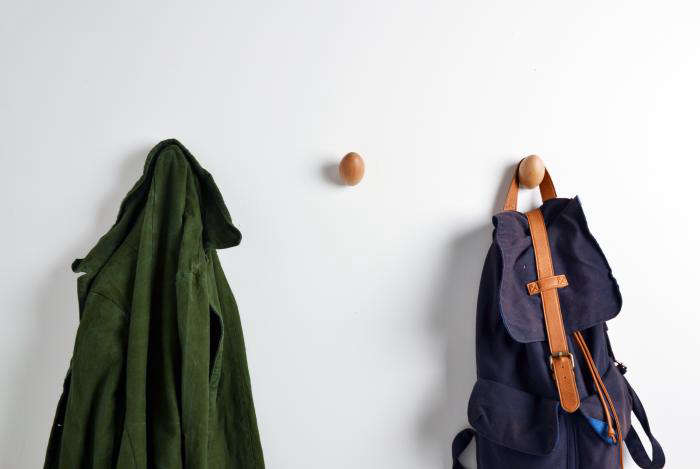
The first display might feature a row of polished wooden pegs. From across the room, they resemble a scattering of oversized dots. Moving closer reveals subtle differences in grain and diameter. One is broad enough for a coat, another holds a narrow strap, and a third contains a shallow groove for a scarf. The installation looks simple, but its simplicity is carefully engineered. Every curve has a reason.
Nearby, a group of metal hooks may appear louder and less disciplined. Bright red loops overlap yellow bars and blue folded shapes. Empty, they form an abstract wall composition. Once visitors hang bags on them, the artwork changes. Straps introduce new lines, coats add blocks of color, and shadows move across the wall. Storage becomes participatory design.
The most enjoyable display is often the one that makes people smile before they read the label. A bolt-shaped hook, a ceramic nose, a tiny hand, or an exaggerated paper clip creates an instant connection because the form is familiar. Visitors understand the joke without needing a curator to explain it. Then they test the object and discover that it is not merely amusing; it is comfortable, sturdy, and surprisingly practical.
That combination changes how you look at ordinary hardware. Back home, the plain hooks near the door suddenly seem less inevitable. Why should the objects touched every morning be selected with less care than a lamp or chair? A wall hook may be small, but it participates in a daily ritual: arriving, leaving, putting something down, and finding it again.
The experience also reveals the importance of touch. Photographs can show color and shape, but they cannot communicate the smoothness of turned wood, the coolness of cast metal, or the slight texture of powder coating. A successful hook invites the hand naturally. Its edge does not feel sharp, and its projection does not seem awkward. You understand how to use it before consciously analyzing its form.
Another lesson comes from watching different visitors interact with the displays. Children reach for colorful hooks positioned low on the wall. Adults test larger pieces with heavy bags. Designers inspect hidden mounting plates and junctions. Homeowners photograph complete arrangements, while makers focus on the small details that reveal how each object was manufactured.
By the end of the visit, playful wall hooks no longer seem like decorative extras. They feel like compact demonstrations of what good product design can accomplish. They solve a recognizable problem, occupy little space, encourage better habits, and make a room more personal. That is an impressive résumé for an object whose traditional job description was simply “hold coat.”
The practical takeaway is not that every home requires a wall covered in smiling ceramic faces. It is that frequently used objects deserve attention. Selecting a hook with the right shape, material, color, and strength can improve both the appearance and behavior of a space. When storage is visible, accessible, and enjoyable to use, people are more likely to use it.
London Design Week encourages this kind of renewed attention. It asks visitors to look again at familiar things and notice the choices hidden inside them. A playful wall hook may be one of the smallest objects in the room, but it can still deliver craftsmanship, wit, usefulness, and a surprisingly persuasive argument against throwing your jacket over a chair.
Conclusion: Let Your Walls Do More
Playful wall hooks prove that practical storage does not need to fade politely into the background. Through bold color, expressive geometry, tactile materials, and humorous references, these small objects can organize a room while adding the character of functional wall art.
The best arrangement begins with real household needs. Choose hooks strong enough for their intended loads, install them with appropriate hardware, and position them where people will naturally use them. Then have fun with the design. Build a colorful grid, create a sculptural cluster, repeat a single wooden form, or introduce one wonderfully strange hook that makes guests ask where you found it.
That is the larger lesson behind London Design Week’s playful approach: useful things can also be joyful. Your walls are already standing around doing very little. You might as well give them a joband perhaps a sense of humor.
SEO Metadata