
Note: This article is formatted as HTML body content only and is ready for web publishing.
Some vases are polite. They sit on a shelf, hold a few stems, and mind their business. The Matthias Kaiser Stack Vase is not one of those vases. It does not whisper from the corner of the room. It strolls in, clears its ceramic throat, and casually reminds everyone that functional objects can also be sculpture.
That is the magic of this piece. At first glance, the Stack Vase looks almost impossible, as if a group of porcelain bowls decided to form a union and build a tower. Look a little closer, though, and the design starts to reveal its intelligence. The vase is handmade in porcelain, built from stacked forms that fuse structure, rhythm, and utility into one unforgettable silhouette. It feels architectural, slightly eccentric, and wonderfully alive.
In today’s design world, where homeowners and collectors are increasingly drawn to pieces that blur the line between decor and art, the Stack Vase feels especially relevant. It has the visual pull of a gallery object, yet it still performs the humble job of holding flowers, branches, or even standing beautifully empty. That combination is rare. Plenty of objects are useful. Plenty of objects are beautiful. Fewer manage to be both without trying too hard.
This article takes a closer look at what makes the Matthias Kaiser Stack Vase so compelling: the maker behind it, the craftsmanship involved, the design language that gives it such presence, and the reason it continues to feel fresh in contemporary interiors. Along the way, we will also talk about how to style it, what kind of home it suits best, and why this porcelain piece has become the sort of object that design lovers remember long after they have forgotten the coffee table it sat on.
Who Is Matthias Kaiser?
To understand the Matthias Kaiser Stack Vase, it helps to understand the ceramic artist behind it. Matthias Kaiser is an Austrian ceramist whose background combines formal design education with hands-on apprenticeship and deep material curiosity. He studied product design with a focus on ceramics at Parsons School of Design in New York and also at the University of Applied Arts in Vienna. He later apprenticed with potters in Seto and Karatsu, Japan, experiences that helped shape his understanding of craft, firing, form, and restraint.
That educational path matters because Kaiser’s work never feels accidental in the lazy sense. It feels exploratory, yes, but grounded. His ceramics often reflect a balance between discipline and surprise, geometry and irregularity, tradition and invention. In interviews and profiles, Kaiser comes across as a maker deeply interested in process, materials, and the strange little miracles that happen when clay, glaze, heat, and gravity all decide to collaborate.
His work spans bowls, teapots, plates, and vases, but even when he moves into sculptural territory, he still treats pottery as something rooted in use. That attitude keeps his objects from drifting into sterile concept art. They have warmth. They have touch. They have the quiet confidence of things made by hand, by someone who understands that perfection is often less interesting than tension.
What Exactly Is the Stack Vase?
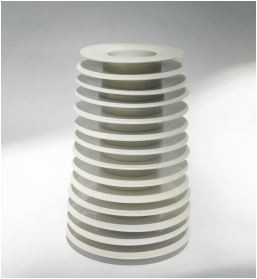
The Stack Vase is one of Kaiser’s most memorable porcelain works, and for good reason. On his official site, the piece is described as a vase whose cavity is created by 13 bottomless bowls, with another bowl serving as the base. That alone sounds like a small engineering puzzle disguised as home decor. The result is a vertical form made from repeated rounded elements, stacked one above the next, creating a vessel that feels rhythmic, playful, and oddly organic.
The proportions matter here. The vase has been listed at roughly 33 centimeters tall, and one retail description has given it a height of about 14 inches with a top diameter of around 6 inches. Those measurements place it in a sweet spot: large enough to command attention, compact enough to work on a console, stair landing, mantel, pedestal, or dining table without becoming a full-time roommate.
Material-wise, the piece is typically described as porcelain with a creamy white glaze. That finish is important because it softens the complexity of the stacked form. A louder color might have turned the vase into a novelty act. The creamy porcelain keeps it refined, allowing shadow, curvature, and repetition to do the heavy lifting. It is the design equivalent of knowing when to stop talking.
A Deliberate Kiln Accident
One of the most fascinating details about the Stack Vase is how it has been described in design coverage. Dwell famously referred to it as something like an upright clay caterpillar and quoted Kaiser calling it a “deliberate kiln accident.” That phrase captures the whole spirit of the object. It suggests risk, experimentation, and a willingness to let the firing process contribute to the final identity of the piece.
Retail descriptions add another layer to the story by explaining that each plate or bowl-like segment is made individually, stacked one on top of the other before glazing, and then bonded through the firing process. In other words, the vase is not pretending to be assembled; its very identity comes from assembly. The stacked logic is visible, honest, and central to its appeal.
This is one reason the piece feels so alive. It is not merely decorated to look layered. It is layered. The making process remains legible in the finished object, and that sense of visible construction gives the vase a kind of narrative energy. You can almost read it from bottom to top.
Why the Design Works So Well
The Matthias Kaiser Stack Vase succeeds because it combines three qualities that do not always get along: sculptural drama, functional clarity, and material restraint.
First, there is the silhouette. The repeated rounded segments create motion without actual movement. Your eye travels upward, stopping at each bulge and shadow, then continuing again. This rhythm gives the vase presence from across the room. It does not need flowers to earn attention, which is a good thing, because the best vases should still look excellent on their off days.
Second, the piece has a strong sense of structure. The repetition of bowl-like forms introduces geometry, but the slight irregularities keep it from feeling mechanical. Kaiser has spoken about the tension between rigid geometry and unsteady irregularity, and that tension is exactly what gives the Stack Vase its charm. It is orderly, but not boring. Weird, but not chaotic. Sophisticated, but not smug.
Third, the creamy white porcelain is a smart design choice. White ceramics have long been favored in interiors because they reflect light gently and work across styles, from minimal to rustic to highly collected spaces. In this case, the glaze emphasizes contour and shadow, allowing the sculptural form to feel crisp in daylight and soft at night. It reads differently as the light changes, which is one of the pleasures of living with tactile objects.
Why It Feels Current in Modern Interiors
The Stack Vase may not be a brand-new release, but it feels perfectly at home in the current design landscape. That is because today’s interiors increasingly favor fewer, better objects. Rather than filling every surface with filler decor, many designers now recommend displaying meaningful pieces with room to breathe. A sculptural vase fits beautifully into that mindset.
Design publications and stylists frequently point to the power of a single statement vessel. A bold vase can add luxury, focus, and dimension to a room, especially when the surrounding styling is edited and intentional. The Stack Vase is almost tailor-made for this approach. It does not need a supporting cast of twelve trendy accessories and a bowl of decorative moss trying very hard in the background. Give it some space, a nearby artwork, maybe a stack of books, and it does the rest.
It also works because it bridges multiple aesthetics. In a minimalist room, it adds shape without introducing visual clutter. In a traditional interior, it brings a contemporary note without feeling cold. In a more eclectic home, it can sit comfortably among vintage wood, linen upholstery, antique metal, and collected art. That flexibility is valuable. Good design should not require a room to rearrange its whole personality just to accommodate one object.
How to Style a Matthias Kaiser Stack Vase
Styling a sculptural porcelain vase is a little different from styling a generic supermarket cylinder. The vase itself already carries strong visual information, so the goal is to complement it, not bury it under a floral panic attack.
Use Fewer Stems, Not More
Because the Stack Vase already has such a distinctive silhouette, it tends to look best with a restrained arrangement. A few long branches, several tulips, a loose cluster of seasonal stems, or even a single dramatic bloom can be enough. The vase should remain visible. If the flowers completely swallow it, you have accidentally turned a design icon into a utility bucket.
Let the Vase Shape the Arrangement
Flower experts often note that the vase choice should guide the arrangement, not the other way around. That idea is especially true here. The Stack Vase’s vertical form naturally suits stems that echo its upward movement. Think dogwood branches, magnolia leaves, alliums, delphinium, or simple greenery with graceful lines. A loose, airy arrangement tends to work better than a dense, tightly packed bouquet.
Place It Where Height Helps
The vase is strong on consoles, entry tables, stair landings, mantels, and coffee tables with enough surface area to support a taller object. Designers also like mixing vessels of varying heights to create contrast and dimension, so the Stack Vase can work beautifully beside lower bowls, books, or candleholders. The trick is balance. Let it be the lead singer, not one member of a very confused boy band.
Do Not Be Afraid to Display It Empty
Some vases are only interesting when they are full of flowers. The Stack Vase is not one of them. Its form is strong enough to stand alone, and in many interiors that is exactly how it should be displayed. An empty sculptural vase can add texture, shape, and quiet drama to a room, particularly in neutral spaces where material and form carry the visual story.
Is It Art, Decor, or Functional Pottery?
The honest answer is: yes.
This is one of the reasons people respond so strongly to Kaiser’s work. The Stack Vase refuses to stay in one category. It is handmade pottery, but it also reads as sculpture. It is decor, but it avoids the disposable feeling of trend-driven accessories. It is useful, but it does not reduce itself to utility.
That in-between quality is increasingly prized by collectors and design enthusiasts. Many shoppers are less interested now in buying objects that exist only to fill empty shelves. They want pieces with authorship, craft, and a point of view. The Stack Vase delivers all three. It has a specific maker, a specific process, and a specific visual language. It is not generic, and that is the whole point.
It also helps that the piece has been shown and sold in serious design contexts, including through Richard Ostell and in editorial coverage from respected design publications. That kind of placement matters because it signals how the vase is understood in the broader design conversation: not as a random novelty item, but as a collectible object with lasting appeal.
The Experience of Living With a Matthias Kaiser Stack Vase
Living with a piece like the Matthias Kaiser Stack Vase is a different experience from living with an ordinary vase, and that difference shows up in small, daily ways. The first thing people usually notice is that the object changes the mood of a room even before flowers enter the picture. A plain tabletop suddenly feels intentional. A quiet hallway looks curated. An empty corner becomes a destination instead of a leftover patch of floor and wall that no one quite knew how to solve.
There is also a tactile pleasure to it, even when it is only being looked at. Because the vase is built from repeated stacked forms, your eye follows its curves almost like reading a line of music. Morning light tends to sharpen the shadows between the segments, while evening light softens them and makes the creamy glaze feel warmer. That means the piece never looks completely static. It is still, of course, because it is porcelain and not a tiny ceramic gymnast, but visually it keeps shifting with the room around it.
Another experience people often describe with sculptural vessels is the way they influence styling decisions throughout the home. Once a strong object like this is in place, everything nearby has to behave a little better. The pile of random mail looks more random. The cheap faux greenery starts to look like it knows what it did. In a good way, the Stack Vase raises the standards of its surroundings. It encourages editing, which is often the secret ingredient in a polished interior.
When flowers are added, the experience changes again. With a vase this distinctive, arrangements tend to become simpler and more thoughtful. Instead of stuffing it with every stem available, people are more likely to choose a few branches, seasonal blooms, or a single elegant grouping. The arrangement becomes less about volume and more about line, proportion, and movement. That shift can make flower styling feel calmer and more creative.
There is also the pleasure of conversation. Statement ceramics invite questions. Guests ask what it is, who made it, how it was formed, or whether it is vintage. The Stack Vase has the rare ability to feel both approachable and mysterious. It looks handmade, clearly, but it also looks clever enough that people want to inspect it more closely. Few home objects earn that kind of curiosity without becoming annoying, which is honestly a remarkable achievement.
Over time, a piece like this can become part of the rhythm of a home. It may hold spring branches in March, hydrangeas in summer, dried stems in fall, and nothing at all in winter except its own excellent silhouette. That year-round usefulness gives it staying power. It does not depend on one trend, one season, or one room setup to remain relevant.
Most of all, the experience of living with the Matthias Kaiser Stack Vase is the experience of having an object that rewards attention. It is functional, yes, but it is also thoughtful, strange, elegant, and slightly witty. It makes a room feel more considered without making it feel staged. And that may be the highest compliment any design object can earn.
Final Thoughts
The Matthias Kaiser Stack Vase is memorable because it turns a familiar household object into something richer. It is a handmade porcelain vase, a sculptural statement, and a lesson in how form, process, and restraint can work together. Its stacked construction gives it identity. Its creamy white glaze gives it elegance. Its balance of geometry and irregularity gives it life.
For collectors, design enthusiasts, and homeowners who want decor with actual personality, this is the kind of piece that makes sense. Not because it shouts the loudest, but because it says something specific. It reflects serious craftsmanship, material intelligence, and a refusal to separate beauty from use. In a market crowded with trendy accessories that appear, vanish, and then reappear wearing slightly different shoes, the Stack Vase feels lasting.
And maybe that is the best way to describe it: lasting. Not dusty. Not predictable. Lasting. The kind of object that still looks intriguing after the flowers are gone, the table has been restyled, and the trends have moved on to whatever shape they are pretending to discover next.
SEO Tags