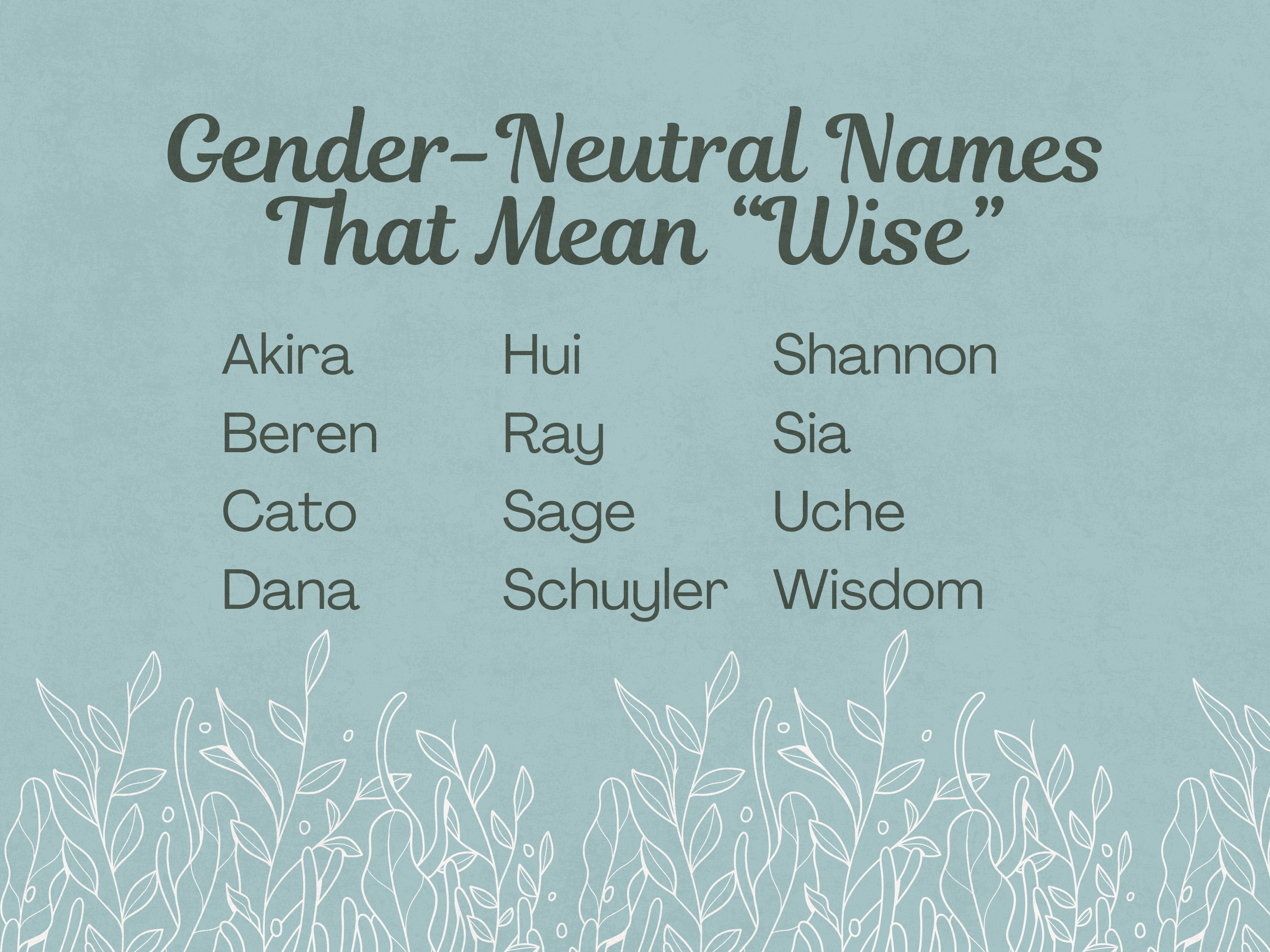

Choosing a baby name can feel like a job interview conducted by a very tiny candidate who refuses to answer questions. You want something meaningful, wearable, easy to say, and unlikely to inspire playground jokes. No pressure, right?
Names that mean wise or wisdom offer an appealing place to begin. Instead of focusing only on beauty, strength, or popularity, these names celebrate thoughtful judgment, intelligence, knowledge, and curiosity. They represent qualities that remain valuable long after the monogrammed baby blanket has been packed away.
This guide includes traditional and modern wisdom names for boys, girls, and children of any gender. Some names translate directly as “wise” or “wisdom.” Others mean intellect, understanding, good judgment, or knowledge. A few are included because of their powerful cultural association with famous figures of wisdom.
What Does a Name Meaning Wisdom Really Represent?
Wisdom is more than being good at trivia or finishing a crossword without secretly checking the answers. It combines knowledge with sound judgment. A wise person understands not only what can be done but also what should be done.
That broader idea appears in many naming traditions. Greek names may connect wisdom with philosophy and skill. Sanskrit-derived names often emphasize knowledge, discernment, or enlightened thought. Arabic names may highlight understanding, intelligence, and fair judgment. Chinese, Japanese, and Korean names can express wisdom through specific written characters.
It is also useful to distinguish literal meanings from symbolic associations. Sophia, for example, directly means “wisdom” in Greek. Athena does not literally translate as wisdom, but the name is inseparable from the Greek goddess of wisdom, strategic thinking, and crafts. Both belong on a list of wisdom-inspired baby names, but for different reasons.
Girl Names That Mean Wise or Wisdom
1. Sophia
Origin: Greek
Meaning: Wisdom
Sophia is the grand classic of wisdom names. It sounds elegant without being fussy and works comfortably from preschool cubby label to executive office door. The spellings Sofia and Sofía offer international variations, while Sophie feels lighter and more playful. Sophia ranked among the top U.S. girl names in 2025, proving that parents remain highly enthusiastic about wisdomat least during the birth-certificate stage.
2. Sonia
Origin: European form of Sophia
Meaning: Wisdom
Sonia, also spelled Sonya or Sonja, developed as a form of Sophia in several European languages. It carries the same wise roots but feels less common and slightly more energetic. Sonia is an attractive choice for families who love Sophia’s meaning but prefer a name that is unlikely to be shared by three classmates.
3. Prudence
Origin: Latin
Meaning: Foresight, practical wisdom, good judgment
Prudence is a vintage virtue name with considerable substance. It refers to practical judgment and the ability to think ahead. The nickname Pru gives it a crisp, modern option. Yes, Prudence sounds as though she may remind everyone to bring an umbrella, but she will probably be correct about the weather.
4. Farzaneh
Origin: Persian
Meaning: Wise, intelligent
Farzaneh is a graceful Persian name with a direct intellectual meaning. It offers cultural depth, a flowing sound, and a more unusual alternative to familiar European wisdom names.
5. Nuha
Origin: Arabic
Meaning: Mind, wisdom
Short, melodic, and meaningful, Nuha connects intelligence with the mind itself. Its compact spelling makes it visually simple, although families should still teach the preferred pronunciation rather than leaving relatives to conduct experiments.
6. Metis
Origin: Greek mythology
Meaning: Wisdom, skill, cunning
Metis was a Titan associated with cleverness and wise counsel and was the mother of Athena in Greek mythology. The name feels rare, mythological, and quietly powerful. Because Métis is also the name of an Indigenous people in Canada, cultural and geographic context should be considered before using it.
7. Michiko
Origin: Japanese
Possible meaning: Beautiful child of wisdom
When written with particular kanji, Michiko can combine elements meaning “beautiful,” “wisdom,” and “child.” Japanese name meanings depend on the characters selected, so parents should confirm the intended written form with a knowledgeable speaker.
8. Sumati
Origin: Sanskrit
Meaning: Wise, good mind
Sumati combines ideas of goodness and thoughtful understanding. It has a gentle rhythm and a meaning that suggests intelligence guided by character rather than mere cleverness.
9. Chieko
Origin: Japanese
Possible meaning: Child of wisdom
Chieko may incorporate a kanji character meaning “wisdom” or “intellect,” followed by the traditional element meaning “child.” As with other Japanese names, alternative character combinations can produce different meanings.
10. Manisha
Origin: Sanskrit and South Asian usage
Meaning: Thought, wisdom
Manisha is the feminine form related to Manish and is widely recognized in South Asian communities. It feels warm and established while carrying an intellectual meaning with philosophical depth.
Boy Names That Mean Wise or Wisdom
1. Hakim
Origin: Arabic
Meaning: Wise
Hakim comes from an Arabic root connected with judgment and decision-making. It is strong, dignified, and used in several cultures, including Arabic-speaking, Malay, and Indonesian communities. The related title can also refer to a learned person or physician in certain historical contexts.
2. Aqil
Origin: Arabic
Meaning: Intelligent, wise, reasonable
Aqil, sometimes written Aqeel, connects wisdom with rational thought and good sense. It is concise, distinctive, and especially meaningful for families seeking an Arabic name that directly celebrates intelligence.
3. Cato
Origin: Ancient Roman
Meaning: Wise
Cato began as a Roman cognomen associated with wisdom. It is brief and bold, with a classical style similar to Milo, Leo, and Otto. It also carries historical associations with Roman statesmen, so parents may wish to explore those figures before settling on it.
4. Frode
Origin: Old Norse
Meaning: Learned, wise
Frode is used particularly in Norway and Denmark. It has authentic Norse roots and a direct connection to learning. English speakers may need a pronunciation lesson, but that is hardly a crisis; most people can learn a name faster than they learn a new streaming-service password.
5. Kavi
Origin: Sanskrit
Meaning: Wise man, sage, poet
Kavi brings together wisdom and artistic expression. Traditionally connected with poets and seers, it suits families who value learning, creativity, and the kind of person who might own both a library card and an excellent notebook.
6. Manish
Origin: Sanskrit
Meaning: Thought, wisdom
Manish is familiar across several South Asian languages and communities. It offers a clear wisdom meaning without sounding newly invented or overly symbolic.
7. Manu
Origin: Sanskrit
Meaning: Thinking, wise
Manu is compact, approachable, and culturally significant in Hindu tradition. It is also used as a nickname or short form in several European and Latin American cultures, although those uses may have different origins.
8. Preecha
Origin: Thai
Meaning: Intelligence, wisdom
Preecha is a Thai masculine name connected with thorough knowledge. It is an excellent option for honoring Thai heritage while choosing a name with an unmistakably thoughtful meaning.
9. Pwyll
Origin: Welsh mythology
Meaning: Wisdom, reason
Pwyll appears in the Welsh collection of stories known as the Mabinogi. Its meaning is ideal for this list, although its consonant-heavy spelling may require patient pronunciation coaching outside Wales.
10. Savio
Origin: Italian
Meaning: Wise
Savio has a smooth, contemporary sound despite its traditional roots. It feels related in style to names such as Matteo and Enzo while remaining far less common in the United States.
11. Vivek
Origin: Sanskrit
Meaning: Wisdom, discernment, distinction
Vivek emphasizes the ability to distinguish wisely between different choices. That makes it an especially rich philosophical name: not simply “knows many things,” but “understands how to judge them.”
12. Zeki
Origin: Turkish, from Arabic roots
Meaning: Intelligent, clever
Zeki is lively, friendly, and easy to spell. Its direct meaning makes it suitable for parents seeking a name associated with mental sharpness rather than formal, scholarly solemnity.
Names such as Aqil, Hakim, Frode, Kavi, Manish, Preecha, Savio, Vivek, and Zeki have well-documented meanings related to wisdom, learning, or intelligence.
Unisex Names That Mean Wise or Wisdom
1. Sage
Origin: English word name
Meaning: A wise person
Sage is one of the most accessible gender-neutral names meaning wise. It refers to a person distinguished by wisdom and also names the aromatic herb. The combination gives Sage both intellectual and natural appeal. It is calm, modern, and only one syllable, which means nobody has time to shorten it into an unwanted nickname.
2. Bilge
Origin: Turkish
Meaning: Wise
Bilge is used for more than one gender in Turkish. In English-speaking settings, however, people may initially associate the spelling with a nautical term. Families living outside Turkish-speaking communities should decide whether repeated explanations would feel educational or exhausting.
3. Hikmat
Origin: Arabic
Meaning: Wisdom
Hikmat is used across multiple regions and can be masculine or feminine depending on culture. It comes from the same broad root family associated with wise judgment as Hakim.
4. Ifiok
Origin: Ibibio
Meaning: Wisdom
Ifiok is a direct and meaningful West African choice. It is traditionally used for more than one gender and offers a striking alternative to English virtue names.
5. Ji-an
Origin: Korean
Possible meaning: Wisdom and peace
Ji-an can be formed with a character meaning “wisdom” or “intellect” and another meaning “peace” or “quiet.” Its exact meaning depends on the hanja chosen, making the written characters essential rather than decorative fine print.
6. Kei
Origin: Japanese
Possible meaning: Intelligent
Kei can be written with a character meaning “intelligent,” although other kanji may give it meanings related to gemstones or celebration. It is short, internationally portable, and traditionally used across genders.
7. Seulgi
Origin: Korean
Meaning: Wisdom, intelligence
Seulgi is a native Korean name with a direct connection to wisdom. It may be used for different genders, although many international listeners know it through female public figures.
8. Sothy
Origin: Khmer
Meaning: Intelligence, wisdom
Sothy is used in Cambodia and offers a soft sound with a strong intellectual meaning. It is an appealing heritage choice that deserves accurate pronunciation and cultural respect.
9. Uche
Origin: Igbo
Meaning: Wisdom, sense, mind
Uche is a compact Igbo name used for more than one gender. Its meaning covers intelligence, awareness, and sensible thought, giving three excellent qualities for the price of four letters.
10. Wisdom
Origin: English virtue name
Meaning: Wisdom
Wisdom is direct, memorable, and occasionally used for children of any gender. It makes a bold statement, much like names such as Justice, Honor, and True. The only possible drawback is that yelling “Wisdom, stop drawing on the wall!” creates a philosophical contradiction.
11. Zhi
Origin: Chinese
Possible meaning: Wisdom, intellect
Zhi may be written with a character meaning “wisdom” or with other characters carrying different meanings. Chinese names must be understood through both pronunciation and written characters, so consultation with native speakers is particularly important.
Many Korean, Japanese, and Chinese names can be created with multiple characters, meaning a romanized spelling alone does not guarantee one fixed definition.
Wisdom-Associated Names That Do Not Literally Mean Wise
Some of the most recognizable “wise” names belong in a symbolic category rather than a literal one:
- Athena: The Greek goddess associated with wisdom, strategic warfare, handicrafts, and the city of Athens.
- Minerva: The Roman goddess of wisdom, knowledge, crafts, and strategy, commonly identified with Athena.
- Solomon: A biblical king traditionally celebrated for wise judgment, although the name itself is related to peace rather than wisdom.
- Ganesha: A Hindu deity associated with wisdom, learning, and overcoming obstacles; the name is not a literal translation of “wise.”
- Hugo or Hugh: Germanic names connected with mind, thought, or spirit, making them intellectually themed rather than direct wisdom translations.
Including these names is perfectly reasonable as long as their meanings are described accurately. A symbolic connection can be just as meaningful as a literal translation; it simply should not be dressed up in a fake etymological mustache.
How to Choose the Right Wisdom Name
Confirm the Cultural Meaning
Baby-name websites sometimes repeat attractive definitions without checking their linguistic history. Compare multiple references, especially when a name comes from a language you do not speak. A name may mean “wise” only when written with a particular character, or it may be associated with a wise figure rather than literally translating that way.
Say the Full Name Out Loud
Test the first, middle, and last name together. Then say it quickly, slowly, happily, and in the tone you might use when someone has placed crackers inside the air-conditioning vent. Listen for awkward rhymes, accidental phrases, and clashing sounds.
Consider Pronunciation and Spelling
An unfamiliar name is not automatically difficult, and a familiar name is not automatically easy. Decide how much correction you are comfortable providing. A meaningful heritage name may be worth every explanation, while a spelling chosen solely to look unusual can become tiring for the person who must repeat it for decades.
Look Beyond Current Popularity
A highly popular name such as Sophia can offer familiarity and easy pronunciation. A rare choice such as Ifiok or Preecha creates greater distinction. Neither path is inherently better. The right balance depends on whether your family values recognition, individuality, heritage, or some combination of all three.
Respect Living Cultures
Names are not decorative souvenirs. Learn how a name is used, whether it has religious significance, and whether it would be appropriate outside its home culture. Choosing thoughtfully shows more wisdom than selecting a name simply because it looked stylish in a thirty-second video.
Experiences and Lessons From Searching for a Wisdom-Inspired Name
The Favorite on Paper May Not Be the Favorite Out Loud
A common experience during the naming process is falling in love with a written name and then feeling strangely unconvinced when saying it. A couple may adore the appearance of Prudence on a list but discover that Pru fits their daily style better. Another family may initially dismiss Sage as too brief, only to realize that its simplicity works beautifully with a long last name.
The practical lesson is to live with each finalist for several days. Write it on a pretend birthday invitation. Introduce an imaginary adult with the name. Call it across the house. A baby name must survive life beyond the aesthetically pleasing notes app where it was discovered.
Relatives Will Have OpinionsSometimes Several Each
Sharing a shortlist can produce useful feedback, but it can also turn Sunday dinner into an unauthorized naming committee. One grandparent may love Sophia but consider Zhi too unfamiliar. An aunt may recommend a name belonging to someone you have never met and are now apparently expected to honor.
Listening is helpful when relatives identify a genuine pronunciation problem, unfortunate set of initials, or important cultural issue. It is less helpful when the objection is simply, “I knew a Cato once, and he borrowed my stapler.” Parents can collect information without treating every opinion as a vote.
Meaning Can Break a Tie Between Equally Good Names
Many families reach a stage where two or three names sound equally attractive. Meaning then becomes a useful tie-breaker. A family that values practical judgment may choose Prudence. Parents with Greek heritage may prefer Sophia or Athena. A multilingual household might select Sage because it is short and relatively easy for speakers of several languages.
The meaning does not need to predict a child’s personality. A baby named Wisdom may grow into a joyful chaos engineer who attempts to taste crayons. The name expresses a hope, value, or family storynot a contractual obligation.
Heritage Names Often Become More Meaningful With Research
Parents sometimes begin with a heritage name because they like its sound, then discover a deeper history while researching it. Learning that Vivek relates to discernment or that Uche can express wisdom, sense, and mind may connect a child with language, relatives, and cultural values at the same time.
This research can also prevent errors. Character-based names such as Kei, Ji-an, Michiko, and Zhi cannot be understood fully from their English spellings alone. Speaking with relatives, language teachers, or native speakers helps ensure that the intended written form and pronunciation match the meaning.
The Best Choice Usually Feels Meaningful and Usable
Parents occasionally assume that a meaningful name must be elaborate, ancient, or rare enough to require a museum placard. In reality, Sophia is meaningful. Sage is meaningful. A family surname connected with a wise and generous grandparent can be meaningful even when its dictionary definition is “person who lived near a muddy field.”
The strongest choice generally works on several levels: the parents enjoy saying it, the cultural background has been checked, the full name sounds natural, and the meaning adds emotional value. Perfection is not required. After all, the child will eventually develop personal opinions, including the shocking belief that a dinosaur backpack is formalwear.
Final Thoughts
Names that mean wise or wisdom appear across an extraordinary range of languages and traditions. Sophia offers timeless familiarity, Hakim carries direct Arabic strength, Vivek emphasizes discernment, Uche expresses wisdom and sense, and Sage delivers a modern gender-neutral option in a single memorable syllable.
The wisest naming decision is not automatically the rarest, trendiest, or most literal. It is the name that fits your family, respects its cultural roots, works comfortably in everyday life, and carries a story you will still enjoy telling years from now.