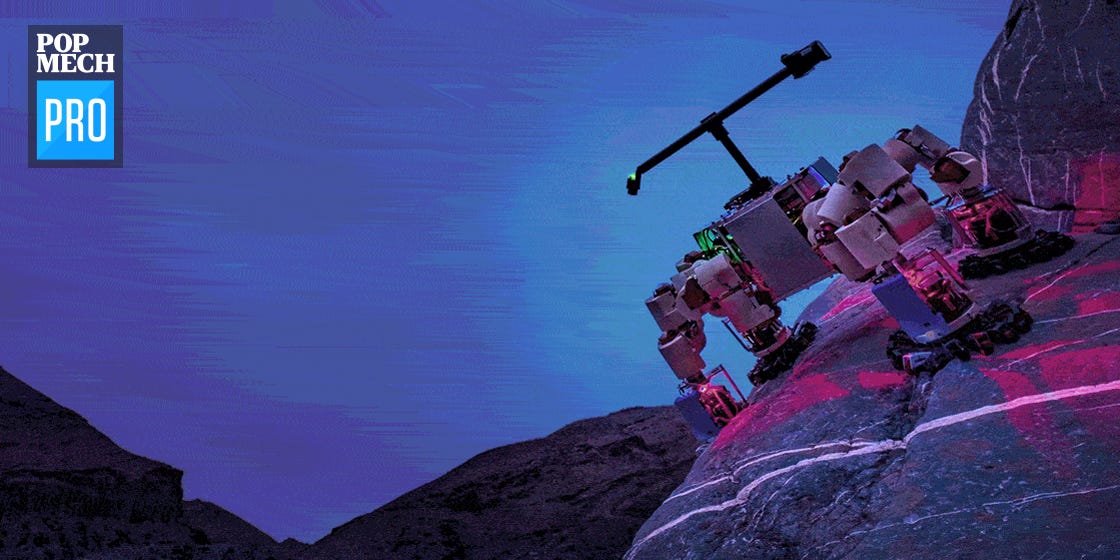

NASA cliff-climbing robots are not here to replace mountain goats, but they may one day do something even more impressive: crawl across Martian cliffs, grip icy moon walls, rappel into craters, and hunt for signs of life in places ordinary rovers politely avoid.
Why NASA Wants Robots That Can Climb Like Tiny Space Ninjas
For decades, planetary exploration has been a story of wheels. NASA’s rovers have rolled across Mars, crossed crater floors, drilled rocks, studied ancient river deltas, and generally behaved like very expensive, very patient science SUVs. But wheels have limits. A rover can be brilliant on open ground and still look at a cliff, cave entrance, icy crevasse, or loose slope and say, “Absolutely not. I was not built for this nonsense.”
That is where NASA’s Jet Propulsion Laboratory, better known as JPL, has been getting creative. Instead of designing one robot to do everything, engineers have been developing a family of experimental machines that can crawl, climb, grip, rappel, slither, perch, and survive in terrain that would make a normal rover break into a mechanical sweat.
The star of this family tree is LEMUR, short for Limbed Excursion Mechanical Utility Robot. It sounds like a small jungle animal with a graduate degree in aerospace engineering, and honestly, that is not far off. LEMUR was originally imagined as a repair robot for the International Space Station, but its technology later inspired a new generation of extreme-terrain robots for Mars, the Moon, asteroids, and icy ocean worlds.
Meet LEMUR: The Robot That Made Cliffs Look Nervous
LEMUR is a four-limbed robot designed to climb rock walls using hundreds of tiny hooks on its fingers. These hooks, often called microspines or fishhook-like grippers, catch on tiny bumps and pits in rough surfaces. To humans, a rock face may look smooth. To LEMUR, it is a giant buffet of microscopic handholds.
The robot has 16 fingers, four limbs, advanced sensors, and enough mechanical dexterity to make a Swiss Army knife feel underdressed. In field testing in Death Valley, California, LEMUR climbed cliffs while scanning ancient rock layers for fossil evidence from an old sea that once covered the region. That field test mattered because it simulated the kind of science NASA might want to do on Mars: study exposed rock layers, search for traces of ancient environments, and reach places where the most interesting geology is inconveniently located on a wall.
That is the central idea behind NASA cliff-climbing robots. The best science is not always lying politely on a flat plain. Sometimes it is tucked inside a crater wall, exposed in a canyon, hidden in a cave, frozen into an icy vent, or sitting halfway down a slope where no traditional rover should roll unless it has a very reckless insurance policy.
The Family Tree: From Rock-Climber to Ice Worms, Micro-Climbers, and Robotic Apes
Ice Worm: A Robot for Slippery Alien Worlds
One of the most fascinating descendants of LEMUR’s technology is Ice Worm. Instead of gripping dry rock, Ice Worm is designed for icy surfaces. It moves like an inchworm, stretching and contracting its body while drilling one end at a time into hard ice. It is a slow, deliberate style of motion, but on a frozen cliff or glacier-like surface, slow and secure beats fast and face-planting.
Ice Worm is especially interesting because NASA is deeply interested in ocean worlds such as Europa and Enceladus. These moons are covered in ice, and beneath that ice may be liquid water oceans. If future missions need to explore icy vents, fractures, or cliff-like surfaces, a robot inspired by Ice Worm could help stabilize itself, collect samples, and travel where wheels would slip like sneakers on a freshly polished floor.
RoboSimian: The Ape-Like Explorer
Another member of the wider family is RoboSimian, nicknamed “King Louie.” Originally built as a disaster-response robot for a DARPA challenge, RoboSimian has been adapted for extreme environments. It can walk on four limbs, crawl, move somewhat like an inchworm, and even slide on its belly. That last trick sounds silly until you remember that icy worlds do not care about elegance; they care about traction.
RoboSimian’s design explores a practical truth of space robotics: a robot does not need to look graceful to be useful. On Enceladus, Europa, or rugged lunar terrain, a belly slide may be exactly the move that keeps a mission alive. Somewhere, a penguin is probably nodding in approval.
Micro-Climbers: Pocket-Sized Wall Crawlers
NASA and JPL have also tested small climbing robots that can fit in a coat pocket, grip walls, and survive falls. Some use microspines similar to LEMUR’s hooks, while others rely on gecko-inspired adhesives. Gecko feet work through microscopic structures that create attraction at very small scales, and NASA engineers have studied similar principles for smooth surfaces in space.
Small robots could be useful because not every mission needs one heroic machine. Sometimes a swarm of tiny scouts can do the dangerous exploring first. If a small robot falls, the mission team does not have to hold a state funeral for a billion-dollar rover. It can simply learn from the failure and send another brave little climber into the dusty unknown.
Underwater Grippers: Practicing for Asteroids in Earth’s Oceans
One surprising branch of LEMUR’s technology has been used in ocean exploration. A robotic gripper based on LEMUR’s hand design has helped collect deep-sea samples from irregular surfaces. That may sound unrelated to asteroids, but the connection makes sense. In both places, a robot must grab uneven material carefully without depending on gravity to hold everything in place.
Earth’s oceans are excellent test beds for space robotics because they are remote, high-pressure, unpredictable, and very good at embarrassing overconfident machines. If a gripper can handle rocks in the deep sea, it may teach engineers valuable lessons for grabbing material from asteroids, comets, or other small bodies.
DuAxel: The Rover That Can Split in Two
While LEMUR climbs with limbs, DuAxel takes a different approach: it drives, anchors, separates, and rappels. DuAxel is made of two connected Axel rovers. In its combined form, it behaves like a four-wheeled rover that can travel across rough terrain. When it reaches a steep slope, crater wall, pit, or cliff, it can split apart. One Axel remains above as an anchor, while the other lowers itself on a tether and explores terrain that conventional rovers cannot safely reach.
This design is clever because it solves two problems at once. First, a rover needs to travel long distances to reach a target. Second, once it arrives, it may need to descend into dangerous terrain. DuAxel handles both by acting like a regular rover when it must travel and a robotic mountaineer when the ground disappears.
For planetary science, this is a big deal. Cliff walls can expose layers of rock like pages in a history book. Crater walls may preserve records of impacts, ancient water, volcanic activity, or buried materials. On Earth, geologists love outcrops because they reveal time in cross-section. On Mars, those outcrops may hold clues about habitability, climate change, and whether microbial life ever had a cozy little Martian apartment.
Why Cliffs, Caves, and Crevasses Matter for the Search for Life
The search for life beyond Earth is not just about sending robots to famous destinations. It is about sending them to the right microenvironments. A flat desert plain on Mars may be safe for driving, but it may not preserve delicate chemical or biological clues as well as sheltered locations. Caves and lava tubes could protect materials from radiation, temperature swings, and dust storms. Cliff faces may reveal older layers that were once underground. Icy vents on ocean worlds may bring material from hidden oceans closer to the surface.
Europa, one of Jupiter’s moons, is believed to have a salty ocean beneath its icy crust. Enceladus, a moon of Saturn, sends plumes of water vapor and icy particles into space through fractures near its south pole. These are the kinds of worlds where climbing, crawling, and gripping robots could become essential. A smooth rover path is nice, but lifeif it exists beyond Earthmay not be waiting in the convenient parking lot.
That is why NASA’s family of cliff-climbing robots is more than a fun engineering sideshow. It is a strategy for expanding the reachable science zone. Every new movement style gives mission planners more options. Wheels can cover distance. Legs can handle irregular surfaces. Tethers can manage cliffs. Microspines can grip rock. Screws can bite into ice. Flying vehicles can scout from above. Together, they form a toolkit for places where one robot design is not enough.
The Role of Artificial Intelligence and Autonomy
Climbing another world is not like remote-controlling a toy truck in your driveway. The communication delay between Earth and Mars can stretch from several minutes to more than 20 minutes one way, depending on planetary positions. For farther targets like Europa or Enceladus, direct joystick driving is even less practical. A robot that is gripping a cliff cannot wait for someone on Earth to say, “Try the next handhold, but not that one, it looks emotionally unstable.”
That is why autonomy matters. LEMUR used artificial intelligence to help choose routes and avoid obstacles. EELS, NASA’s snake-like robot concept, is being developed to sense its environment, calculate risk, travel, and gather data without real-time human input. JPL’s work on subterranean robotics also supports this larger goal: robots must learn to map unknown spaces, choose safe paths, recover from surprises, and keep exploring when GPS and clear communications are unavailable.
The future of space robotics will not be one giant machine waiting for instructions. It will be a team of specialized explorers that can make local decisions. Some may climb. Some may fly. Some may slither. Some may act as anchors or scouts. The mission control room will still matter, of course, but the robots will need enough onboard intelligence to avoid turning every pebble into a committee meeting.
How These Robots Could Change Mars Exploration
Mars is full of terrain that practically begs for a climbing robot. There are crater rims, layered canyon walls, steep scarps, collapsed lava tubes, gullies, and rocky outcrops. Traditional rovers can study many amazing places, but they must be routed carefully to avoid slopes, sand traps, wheel damage, and obstacles that could end a mission. Cliff-climbing robots could inspect exposed layers directly, place instruments against rock faces, collect samples from hard-to-reach sites, and descend into pits that might lead to underground voids.
Imagine a mission where a standard rover drives across the Martian surface carrying a smaller climbing robot. When it reaches a canyon edge, the smaller robot deploys, grips the wall, and begins scanning layers one by one. It maps minerals, checks for organic compounds, photographs textures, and maybe drills tiny samples. The larger rover stays safe above, while the climber does the risky work below. That is not laziness; that is excellent delegation.
Aerial robots could add another layer. NASA’s Ingenuity Mars Helicopter proved that powered flight is possible in the thin Martian atmosphere, flying far beyond its original technology demonstration goals before its mission ended in 2024. Future flying robots may scout routes, inspect cliff faces, or perch on rocks using LEMUR-inspired grippers. A flying robot that can cling to a wall and recharge with solar panels would be especially useful because hovering burns energy quickly. Perching is basically the robot version of finding a good café table near an outlet.
What Makes Microspine Grippers So Special?
Microspine grippers are among the most important technologies behind NASA’s cliff-climbing robot research. A microspine is a tiny hook that catches on small surface roughness. One hook alone is not magic. Hundreds or thousands of hooks working together can create a strong grip on natural rock.
The beauty of microspines is that they are well suited to rough, irregular surfaces. Planetary terrain is rarely smooth and polite. Rocks are jagged, dusty, fractured, and unpredictable. Instead of needing a perfectly shaped handle, microspines exploit the natural roughness already present. The robot gently loads the grippers in a direction that helps the hooks engage, then releases them when it is ready to move.
This technology is useful not only for cliff climbing but also for asteroid operations. On small bodies with extremely low gravity, a robot cannot depend on weight to stay planted. Push too hard with a drill or instrument, and the robot might shove itself away from the surface. Grippers and anchors help stabilize the robot so it can work without drifting off like a confused shopping cart in space.
Challenges NASA Still Has to Solve
Building a cliff-climbing robot for another world is difficult because every design choice creates trade-offs. Add limbs, and you gain dexterity but increase mechanical complexity. Add tethers, and you gain safety on steep slopes but must manage tangles, abrasion, and anchoring. Add autonomy, and you reduce dependence on Earth but must make the software reliable in unknown terrain. Add tiny grippers, and you gain traction but must make sure they work on many rock types, not just the cooperative rocks in a lab.
Dust is another villain. Mars dust gets everywhere. It coats solar panels, clogs mechanisms, hides hazards, and behaves like the universe’s least helpful glitter. Ice creates different headaches: slipperiness, fractures, changing temperatures, and unknown internal structure. A robot that performs beautifully in a California desert still needs years of testing before anyone trusts it near an alien cliff with a science payload and no repair shop.
Power is also a major constraint. Climbing takes energy. Drilling into ice takes energy. Running sensors, cameras, processors, heaters, and communications systems takes energy. Future cliff-climbing robots may need to pause often, recharge, conserve heat, and plan movements carefully. On another world, even a dramatic robot must learn the ancient art of battery management.
Experience Section: What Working Around Cliff-Climbing Robots Teaches You
Spending time with the idea of NASA’s cliff-climbing robots changes how you look at ordinary terrain. A wall is no longer just a wall. A boulder becomes a puzzle. A crack in the rock becomes a possible handhold. A slope becomes a negotiation between gravity, traction, and optimism. You start to understand why engineers test robots in deserts, caves, glaciers, ice rinks, and rocky analog sites. These places are Earth’s training gyms for machines that may one day crawl across Mars or descend into the icy vents of Enceladus.
The first lesson is humility. A human can look at a cliff and quickly decide where to put a hand or foot. A robot must calculate that decision through sensors, models, force feedback, and control software. What seems obvious to a climber is a complex problem for a machine. Is that rock stable? Is the surface rough enough for microspines? Will the limb angle create a safe load? Can the robot recover if one foot slips? Every movement becomes a tiny engineering exam.
The second lesson is that “ugly movement” can be brilliant. Robots like RoboSimian or Ice Worm may not move with ballet-level grace, but their strange motions are practical. Crawling, inching, sliding, anchoring, and perching are all valid strategies when the terrain is hostile. In space robotics, elegance is nice; survival is better. A robot that looks awkward but keeps collecting data is a champion.
The third lesson is that field testing matters more than imagination. A robot can perform perfectly in a clean lab and then meet a real rock that refuses to cooperate. Field tests reveal dust problems, slipping problems, cable problems, sensor blind spots, software confusion, and the timeless engineering discovery known as “that part should not have broken like that.” These failures are not embarrassing; they are the point. Each failure helps engineers build a tougher, smarter machine.
The fourth lesson is teamwork. The future is probably not one superhero robot. It is a family of robots with different talents. A wheeled rover may carry the instruments and provide communications. A tethered rover may descend a crater wall. A micro-climber may inspect a narrow crack. A drone may scout the route. A snake robot may enter a tunnel. Together, they turn impossible terrain into a series of manageable tasks.
Finally, cliff-climbing robots remind us that exploration is often about changing the question. Instead of asking, “Where can a rover safely drive?” NASA is asking, “What scientific places have we been missing because our robots could not reach them?” That shift is powerful. It opens cliffs, caves, scarps, vents, and icy fractures as possible destinations. It also makes space exploration feel more adventurous, more flexible, and, frankly, more fun. Somewhere out there may be a cliff holding clues to ancient water, hidden oceans, or possible life. NASA is building the robots that might finally climb up and ask it some very important questions.
Conclusion: The Future of Space Exploration May Have Claws
NASA’s family of cliff-climbing robots shows how planetary exploration is evolving beyond wheels alone. LEMUR proved that a robot can grip rock walls with tiny hooks and make cliff science look possible. Ice Worm suggests a path toward icy worlds. RoboSimian explores adaptable motion. Micro-climbers bring small-scale scouting. DuAxel shows how a rover can split, anchor, and rappel. EELS points toward autonomous robots that can move through unknown extreme environments without constant human control.
These machines are not just robotic curiosities. They are prototypes for a future where NASA can explore the places that matter most scientifically, not merely the places that are easiest to reach. If signs of life, ancient water, or hidden geology are waiting in cliffs, caves, crater walls, or icy vents, the next great explorer may not roll there. It may climb.
Note
This publish-ready article synthesizes publicly available information from NASA, NASA Jet Propulsion Laboratory, NASA Science, and related robotics research, rewritten in original American English for SEO-focused web publication without source-link clutter in the body.
SEO Tags