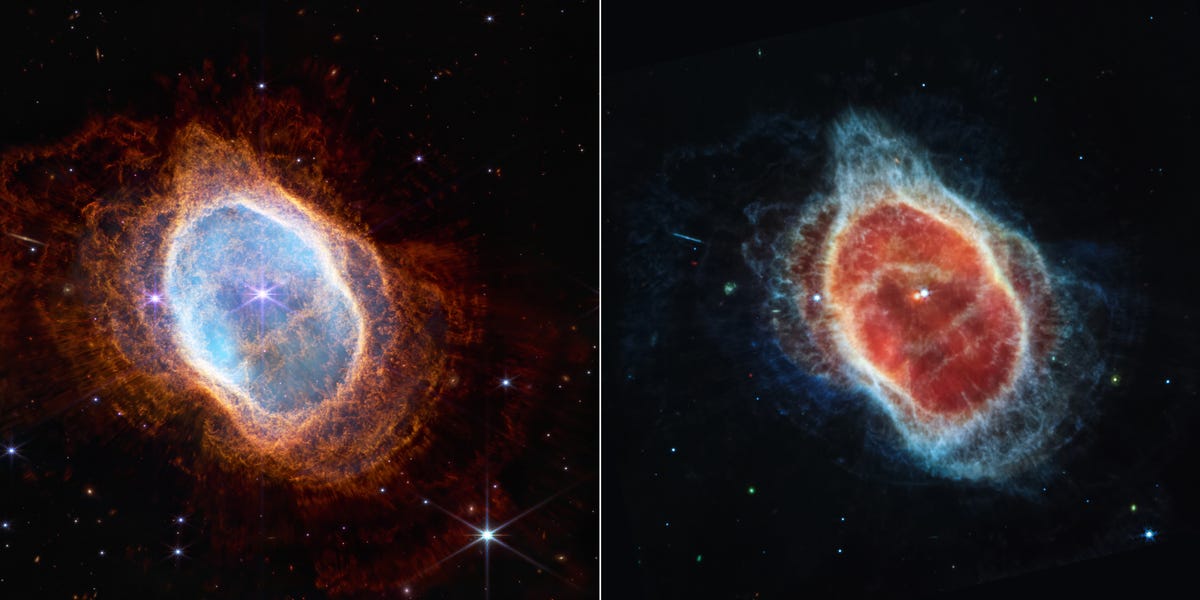

Some stars go quietly. Others apparently hire a fog machine, cue the spotlight, throw glitter across space, and make NASA call in the most powerful infrared telescope ever launched. That is the mood behind NASA’s Webb Telescope capturing a dying star’s last dance: a breathtaking look at the Southern Ring Nebula, also known as NGC 3132, where a once Sun-like star has been shedding its outer layers into space for thousands of years.
The James Webb Space Telescope did not merely snap a pretty cosmic postcard. It revealed a complicated celestial drama starring a hot white dwarf, a brighter companion star, thick curtains of dust, rippling shells of gas, and clues that other unseen stars may have joined the choreography. In other words, this is not a peaceful retirement. This is stellar evolution with backup dancers.
The image became one of Webb’s early showpieces because it demonstrates exactly why astronomers built the observatory: to see through cosmic dust, study infrared light, and uncover hidden structure in objects that looked simpler through older telescopes. The result is both scientifically rich and visually outrageous, like a space jellyfish wearing a neon tuxedo.
What Did NASA’s Webb Telescope Actually Capture?
The object in question is the Southern Ring Nebula, a planetary nebula roughly 2,500 light-years from Earth. Despite the name, a planetary nebula has nothing to do with planets. The term comes from early telescopes, when these round, glowing clouds looked a little planet-like to observers. Astronomers have since upgraded the explanation, while the old name stubbornly remains, like a mislabeled folder nobody wants to rename.
A planetary nebula forms when a medium-sized star, similar in broad life path to our Sun, runs out of the fuel needed to maintain its earlier balance. As the star evolves, it swells, sheds its outer layers, and leaves behind a dense, hot core called a white dwarf. The expelled gas and dust drift outward, creating glowing shells, rings, arcs, and sometimes wildly asymmetric shapes.
In the Southern Ring Nebula, Webb revealed two central stars. The brighter one is easier to see, but the dimmer star is the true source of the nebula. That dimmer star has become a white dwarf and has ejected layers of gas and dust over long stretches of time. Webb’s infrared vision showed, with stunning clarity, that the dying star is cloaked in dust.
Why the “Last Dance” Is More Than a Pretty Phrase
The phrase “last dance” fits because this image captures a star near the end of its active life, but the science is not sentimental. The Southern Ring Nebula appears shaped by motion, gravity, orbiting companions, jets, and repeated bursts of material. The star did not simply puff out one tidy bubble. It made a complex, layered structure that looks more like a cosmic fingerprint than a symmetrical balloon.
NASA researchers have proposed that before the dying star shed its outer layers, it interacted with one or more companion stars. During those interactions, jets may have launched in opposite directions, creating projections visible near the nebula’s outer edges. A wider-orbiting companion may also have helped stir the expanding material, producing huge outer rings.
That matters because planetary nebulae are often far messier than textbook diagrams suggest. Stars live in neighborhoods. Many have companions. Gravity does not politely stand aside while a star dies. It tugs, tilts, funnels, stirs, and sometimes turns a simple sphere into something that looks as if the universe sneezed into a kaleidoscope.
How Webb Sees What Other Telescopes Miss
The James Webb Space Telescope studies the universe primarily in infrared light. That gives it a major advantage when observing dusty regions. Visible light can be blocked or scattered by dust, but infrared wavelengths can reveal structures hidden behind or within those dusty layers.
NIRCam: The Near-Infrared View
Webb’s Near-Infrared Camera, or NIRCam, captured a view filled with sharp detail. In this version, the bright central star dominates the eye at first, but look more carefully and the image becomes a maze of rings, holes, and illuminated streaks. Some straight, bright lines appear to pierce through the gas and dust, like beams of sunlight passing through gaps in storm clouds.
NIRCam also reveals distant galaxies behind the nebula. That is one of the delightful side effects of Webb imagery: while you are studying a dying star in our galaxy, the background casually includes galaxies far beyond it. Space has no respect for minimalism.
MIRI: The Mid-Infrared View
Webb’s Mid-Infrared Instrument, or MIRI, tells a different part of the story. In the MIRI image, the dust around the dimmer white dwarf becomes much more obvious. The dying star appears redder and more prominent because MIRI is especially sensitive to cooler dust and mid-infrared wavelengths.
Comparing the NIRCam and MIRI views is like switching from a stage spotlight to thermal backstage access. One shows the glowing architecture; the other reveals hidden dust, warm material, and structures that were previously difficult to study. Together, they help astronomers understand not only what the nebula looks like, but how it formed.
The Science Hidden in the Glow
The Southern Ring Nebula is beautiful, but for scientists it is also a record of mass loss. Each shell of gas and dust is a clue. The uneven thickness of the rings, the central dust belt, the bright spokes, and the suspected jets all preserve information about the dying star’s final stages.
When a star ejects material, it enriches surrounding space with elements created or processed during its life. Carbon, oxygen, and other ingredients can become part of future clouds, stars, planets, and maybe even living chemistry billions of years later. That means a dying star is not simply disappearing. It is recycling itself into the cosmic supply chain. Very dramatic, yes, but also environmentally responsible.
Planetary nebulae help astronomers study how stars like the Sun end their lives. Our Sun is not massive enough to explode as a supernova. Instead, billions of years from now, it is expected to shed its outer layers and leave behind a white dwarf. The Southern Ring Nebula offers a preview of that quieter but still spectacular ending.
Why the Southern Ring Nebula Looks So Complicated
If a single star released material evenly in all directions, astronomers might expect a more symmetrical shell. But the Southern Ring Nebula is not perfectly symmetrical. It has jagged rings, uneven clouds, bright openings, dust lanes, and hints of directional outflows. That complexity points toward interactions among multiple stars.
The bright star near the center appears to orbit the dimmer white dwarf closely. As the dying star expelled material, orbital motion may have spread that material in changing directions, somewhat like a rotating lawn sprinkler. Except instead of watering grass, it was spraying stellar gas across interstellar space. Home improvement, but make it cosmic.
Additional companion stars may have influenced the shape further. Some may now be too faint to see clearly, hidden by glare, or even merged with the dying star. The idea that several stars helped sculpt the nebula turns the image into a forensic scene. Webb is not just taking a picture; it is helping astronomers reconstruct an ancient gravitational dance.
Why This Image Matters for Astronomy
Webb’s Southern Ring Nebula observations are important because they show how much information can be extracted from detailed infrared imaging. Astronomers can study dust distribution, gas structure, stellar companions, and the timing of mass-loss events. They can also compare Webb data with older observations from telescopes such as Hubble and Spitzer to build a more complete timeline.
That multi-telescope approach is powerful. Hubble provided iconic visible-light views of many planetary nebulae. Spitzer helped reveal infrared features. Webb adds higher sensitivity and sharper infrared detail, allowing researchers to examine structures that were previously blurred, hidden, or only partially understood.
The Southern Ring Nebula also reminds us that star death is not a single event. It is a process. A star may pulse, contract, heat, shed material, interact with companions, and illuminate its own discarded layers. What we see in the image is not an explosion frozen in time but a long performance captured mid-motion.
Webb Turns Star Death Into a Time Capsule
Every ring in the nebula acts like a timestamp. The outer material was expelled earlier, while inner regions show more recent activity. By studying the shape, density, temperature, and chemical composition of those layers, scientists can infer what happened as the star evolved from a swollen giant into a white dwarf.
The nebula is also expanding. That expansion lets researchers estimate how material moved outward and how different structures relate to earlier episodes of mass loss. The more detailed the image, the better the reconstruction. Webb gives astronomers a sharper set of clues, like upgrading from a blurry security camera to a high-definition cosmic documentary.
The dust is especially important. Dust grains can reveal how material cooled, where molecules formed, and how the dying star’s environment changed over time. In the MIRI view, the dusty white dwarf becomes a central character rather than a hidden footnote.
What It Teaches Us About Our Own Sun
The Southern Ring Nebula is not an exact portrait of the Sun’s future, but it belongs to the same broad category of stellar endings expected for Sun-like stars. The Sun will eventually exhaust hydrogen in its core, swell into a red giant, shed its outer layers, and leave behind a white dwarf. Earth’s long-term prospects in that scenario are, scientifically speaking, not great. Real estate agents may wish to avoid the phrase “red giant expansion zone.”
Still, studying objects like NGC 3132 helps scientists understand what happens when stars return material to space. The death of one star can contribute to the birth of another. That cycle is central to the evolution of galaxies. Stars are not isolated light bulbs; they are chemical factories, gravity engines, and recycling centers.
In that sense, Webb’s image is not just about an ending. It is about continuity. The dying star’s discarded layers may one day become part of new interstellar clouds. From those clouds, future stars and planets may form. The universe is very fond of leftovers.
Why the Image Captured Public Imagination
Part of the appeal is obvious: the image is gorgeous. The Southern Ring Nebula looks like a glowing oval suspended in deep space, with delicate edges, textured shells, and bright central stars. It is the kind of picture that makes people say “wow” before asking what they are looking at.
But the deeper reason is that the image connects beauty with mortality. Humans understand endings. We understand final acts, last songs, and farewell performances. Seeing a star’s final stage transformed into a luminous nebula gives cosmic scale to a familiar idea: endings can be messy, meaningful, and strangely beautiful.
Webb’s observation also makes advanced astronomy feel accessible. Terms like “white dwarf,” “mid-infrared,” and “planetary nebula” may sound intimidating, but the image provides an immediate visual hook. First you admire the glow. Then you learn the science. That is good communication, and frankly, space has an unfair advantage because its visual department never takes a day off.
Experience Section: How to Appreciate Webb’s Dying Star Image Like a Curious Skywatcher
Looking at Webb’s Southern Ring Nebula image can feel overwhelming at first. There is so much happening that your brain may simply file it under “beautiful space thing” and move on. A better experience is to slow down and explore the image layer by layer, almost like walking through a museum exhibit where the painting keeps changing every time you step closer.
Start with the center. Notice the two stars. The brighter one naturally grabs attention, but the dimmer, dustier white dwarf is the star responsible for creating the nebula. That is a useful reminder that the loudest object in a picture is not always the main character. In space, as in group projects, credit can be complicated.
Next, look at the rings. They are not smooth circles. Some regions are brighter, thinner, thicker, or more jagged than others. Imagine the dying star shedding material again and again while orbiting with a companion. Instead of one perfect puff, the system created layered, uneven shells. This is where the “last dance” metaphor becomes genuinely helpful. The pattern reflects motion over time.
Then compare the near-infrared and mid-infrared versions if you have them side by side. The NIRCam image feels sharper and star-filled, while the MIRI view emphasizes dust and cooler structures. It is like looking at the same room under daylight and then with a heat-sensitive camera. Neither version is the “real” image by itself; each reveals a different kind of truth.
For readers, teachers, students, or casual astronomy fans, this image is a perfect conversation starter. It can lead into questions about how stars live, why they die, what a white dwarf is, how infrared telescopes work, and why dust is not just “space dirt” but a key scientific clue. You can even use it to explain that our own Sun has a life cycle. It will not always shine as it does now, though thankfully its dramatic retirement party is still billions of years away.
The most rewarding way to experience the image is to treat it as both art and evidence. The colors are assigned to invisible infrared wavelengths, so the picture is not what human eyes would see from a spaceship window. But that does not make it fake. It makes it translated. Webb collects light our eyes cannot detect, and scientists process that data so we can understand structure, temperature, dust, and gas. In other words, the image is a scientific translation of an invisible universe.
Finally, let the scale sink in. The Southern Ring Nebula is thousands of light-years away, yet its story reaches us through photons gathered by a telescope operating far from Earth. The dying star began shaping those shells long before modern civilization existed. Now we are studying them on screens, sharing them in classrooms, and turning them into desktop wallpapers. If that does not make you feel tiny and lucky at the same time, check your pulse. Or maybe just zoom in again.
Conclusion: A Star’s Goodbye, Seen in Infrared
NASA’s Webb Telescope captures a dying star’s last dance not as a simple farewell, but as a complex record of stellar evolution. The Southern Ring Nebula reveals how a white dwarf, companion stars, dust, gas, and gravity can combine to produce an intricate cosmic structure. Webb’s NIRCam and MIRI instruments expose different layers of that story, showing both the glowing beauty and hidden mechanics of a star near the end of its life.
The image matters because it turns a distant astronomical object into a vivid lesson about the life cycle of stars. It shows that stellar death can seed future creation, that dust can hide important clues, and that companion stars may shape nebulae in dramatic ways. Most of all, it reminds us that the universe is not static. It dances, sheds, swirls, recycles, and occasionally poses for a telescope with impeccable timing.