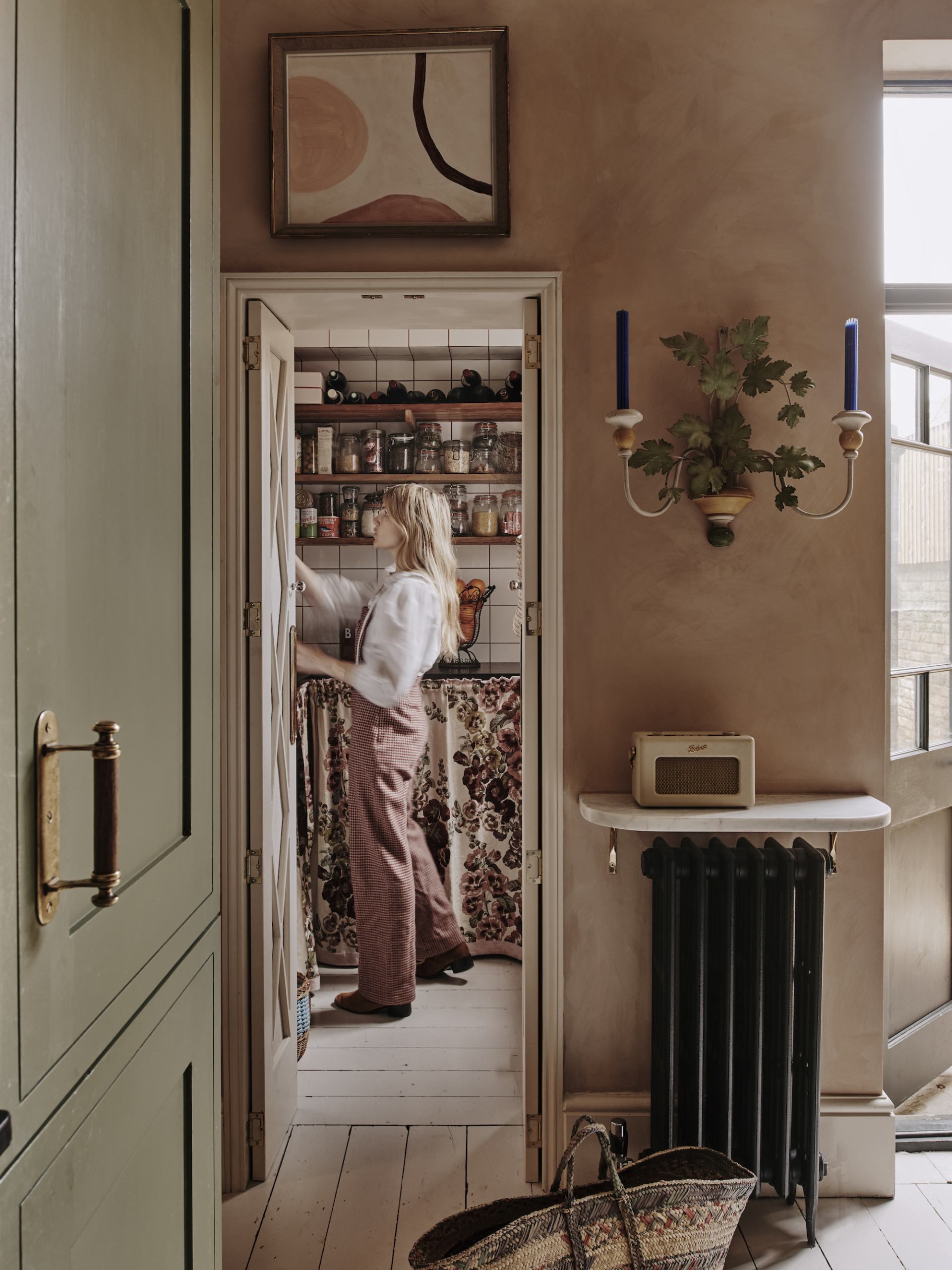

Some pantries are hardworking storage closets. Others ay signed a lease for a matching glass jar. Matilda Goad’s granny-chic larder manages to be both more useful and more interesting: a tiny, highly practical room dressed with the confidence of a favorite aunt who collects floral textiles, knows where the good chocolate is hidden, and considers beige a personal challenge.
Located just beyond the kitchen in Goad’s London home, the larder demonstrates how inexpensive materials, vintage-inspired details, strong color, and sensible storage can turn an overlooked utility space into the most memorable room in the house. It is not grand in size. It is grand in personalityand that distinction matters.
A Tiny Pantry With an Oversized Personality
Goad’s larder measures roughly two square meters, yet it contains more character than many kitchens ten times its size. The adjoining kitchen establishes the mood with sage-green cabinetry, peach-toned lime-washed walls, granite counters, a scalloped backsplash, and a graphic oxblood-and-cream checkerboard treatment behind the range. A slim doorway then leads into the pantry, which feels like a colorful secret tucked inside an already playful interior.
What makes the space compelling is not any single expensive feature. It is the accumulation of small decisions: white tiles sharpened with red grout, jars arranged on narrow shelves, fruit and vegetables displayed in baskets, patterned fabric hiding less attractive storage, and cheerful objects placed among everyday ingredients.
The result is elevated kitsch rather than theatrical clutter. Kitsch supplies the wink; disciplined planning prevents the room from becoming a garage sale with paprika.
Why “Granny-Chic” Works Here
Granny-chic interiors borrow familiar elements from traditional homeschintz, scalloped edges, gingham, ceramics, old-fashioned storage jars, rattan, decorative tins, and objects collected over time. The updated version pairs those nostalgic ingredients with cleaner silhouettes, stronger colors, and contemporary materials. Architectural Digest has described the broader trend as a blend of vintage-looking textiles and details with modern design sensibilities, rather than a literal recreation of an elderly relative’s parlor.
Goad’s larder follows that formula beautifully. The floral curtain could have wandered in from an English country house, while the red grout feels graphic, cheeky, and slightly 1980s. Glass jars suggest an old general store, but their repetition creates modern visual order. A vintage candleholder paired with bright contemporary candles captures the entire aesthetic in miniature.
The Clever Design Moves Behind the Charm
Basic Tiles, Unbasic Grout
One of the room’s smartest ideas is also one of its most affordable. Instead of buying decorative artisan tile for every surface, Goad used inexpensive white tiles and transformed them with colored grout. The red lines give the walls rhythm and make a standard building material look custom.
This is a useful lesson for any pantry renovation: when the budget is limited, spend imagination before spending money. Contrasting grout, painted trim, unusual shelf brackets, or a colorful door can create more impact than a costly finish used without conviction.
The tiles also serve a practical purpose. They are durable, easy to wipe, and visually appropriate for a room containing produce, jars, appliances, and the occasional flour-related incident. Goad has explained that she focused on the grout as the decorative hero and viewed the basic tiles as a useful, utilitarian surface.
Shallow Shelves That Prevent Food Archaeology
Deep shelves sound generous until three cans of beans disappear behind a bread maker last used during an ambitious weekend in 2019. Goad avoided this problem by creating narrow shelves from leftover floorboards. Their depth was determined by the width of a standard preserving jar.
That detail is more than charming trivia. It is an excellent example of designing around actual objects rather than abstract dimensions. Shallow pantry shelving keeps ingredients visible, reduces duplicate purchases, and makes it harder for expired baking supplies to establish a hidden civilization at the back.
Major pantry guides similarly recommend varying shelf heights, using visible containers, and making back corners accessible with pullouts, risers, or turntables. The most attractive storage system is still a failure if retrieving the rice requires a flashlight and a minor excavation permit.
A Curtain Instead of Costly Cabinetry
Below the work surface, a café-style floral curtain conceals crates and less frequently used supplies. It adds softness and pattern while avoiding the expense of fitted cabinet doors. The fabric, a traditional chintz, pushes the larder toward granny-chic territory without making the entire room feel fussy.
This approach is especially effective in a pantry because the fabric can be changed later. A striped linen creates a more tailored look; gingham feels cheerful and informal; a botanical print brings in country-house romance. The curtain also allows quick access, which is useful when both hands are occupied by groceries and one rogue baguette.
Storage Containers That Double as Decoration
Glass jars unify a pantry while keeping ingredients visible. In Goad’s larder, they reinforce the nostalgic mood and make ordinary foodsoats, rice, lentils, pasta, chocolatepart of the visual composition. She has also mentioned reusing jam jars with gingham-patterned lids, proving that good pantry design does not require purchasing a regiment of luxury canisters.
Organization experts frequently recommend decanting dry goods because it can reduce bulky packaging, reveal when supplies are running low, and calm visual clutter. Matching containers are helpful, but “matching” does not have to mean identical. A collection can feel coordinated through a shared material, lid color, label style, or overall shape. /section>
Why the Larder Feels Collected, Not Cluttered
A colorful pantry can quickly become visually noisy. Goad’s room avoids that fate because its major elements follow a loose hierarchy.
There Is a Repeating Color Story
Red appears in the grout, decorative objects, textiles, and adjoining checkerboard backsplash. Green cabinetry and warm wall tones provide a calmer background. These repeated colors connect unrelated objects and make the room feel intentional.
For a similar effect, choose two dominant colors and one quieter supporting shade. The goal is not to make every jar label obey the palette. It is to create enough repetition that the eye senses a planeven when the mustard tin has arrived wearing bright yellow and refusing to cooperate.
Useful Objects Are Allowed to Be Beautiful
The larder does not treat practical items as embarrassing evidence that people live in the house. Butter dishes, tins, jars, baskets, appliances, produce, and candles all participate in the decoration. This creates a relaxed atmosphere because the room is not pretending to be something other than a pantry.
Open shelving succeeds when displayed items support the room’s purpose. A ceramic bowl full of onions belongs. A framed print can belong. Twelve tiny ornaments placed directly in front of the flour probably need to reconsider their careers.
Some Clutter Can Disappear
The room’s slim French doors are lined with linen, allowing the pantry to be concealed during gatherings. The under-counter curtain performs a similar job inside the room. These soft barriers make it possible to enjoy open storage without requiring every package of crackers to remain camera-ready.
This balance is essential. An effective granny-chic pantry displays the charming objects and hides the chaotic ones. Beautiful olive-oil cans may stay visible. The enormous multipack of paper towels can quietly reflect on its behavior behind a curtain.
How to Recreate Matilda Goad’s Pantry Style
1. Begin With the Way You Cook
Before choosing paint or fabric, list what the pantry must hold. Consider daily ingredients, baking supplies, snacks, small appliances, produce, beverages, bulk purchases, serving pieces, and backstock. Put frequently used items between waist and eye level. Reserve high shelves for occasional equipment and low shelves for heavy containers.
A pantry organized around real routines will remain functional longer than one organized solely for a photograph. Current design guidance increasingly emphasizes personal, lasting rooms over copying short-lived micro-trendsa philosophy that fits Goad’s instinctive, collected approach.
2. Create a Strong but Limited Palette
Try cream with tomato red, pale blue with mustard, sage with dusty pink, or warm white with cobalt. Use the boldest color on a small element such as grout, trim, a shelf edge, or the pantry door. A compact room can handle more visual drama than a large kitchen because it appears in concentrated doses.
3. Combine Floral and Graphic Patterns
The sophisticated part of Goad’s granny-chic style comes from contrast. Florals are paired with checkerboards, tartan, stripes, or simple tile grids. Without graphic structure, layers of vintage pattern may feel sugary. Without a floral or curved element, the room may lose its warmth.
A reliable formula is one botanical pattern, one geometric pattern, and several plain surfaces. Let the curtain bring the flowers, the tile or floor bring the geometry, and the shelves provide visual breathing room.
4. Reuse Materials Before Buying New Ones
Leftover floorboards can become shelves. A countertop offcut can create a work surface. Jam jars can hold grains and spices. Vintage tins can organize packets. Fabric remnants can cover a cabinet opening or line a glass door.
Reused pieces naturally introduce variation, which helps a new pantry feel as though it evolved over time. They also prevent the renovation budget from developing the appetite of a hungry teenager.
5. Add One Slightly Ridiculous Detail
Elevated kitsch depends on humor. Consider a scalloped shelf, a cherry-shaped lamp, a cabbageware bowl, a tartan butter dish, a vintage enamel sign, or a candleholder that looks overdressed for guarding the oatmeal.
Only one or two such pieces are necessary. When every object is making a joke, the room becomes exhausting. Good kitsch has timing.
6. Organize in Flexible Zones
Group ingredients according to use: breakfast, baking, snacks, pasta night, beverages, entertaining, and backstock. Use erasable labels so categories can change as household habits change. HGTV, Martha Stewart Living, Better Homes & Gardens, The Spruce, Apartment Therapy, and Real Simple all emphasize variations of zoning, visibility, accessible shelving, and containers that fit the available space. /section>
Common Mistakes to Avoid
Making Everything Decorative
A pantry still needs empty space. Leave room for groceries, rotating ingredients, and the unexpected giant cereal box. Decorative accessories should occupy only a small portion of usable shelving.
Buying Containers Before Measuring
Measure shelf depth, width, and height before ordering jars or baskets. Test one container first. A beautiful storage system that prevents the door from closing is not a system; it is an intervention.
Decanting Without Labels or Dates
Write the ingredient name and, when useful, the purchase or best-by date on each container. Save cooking instructions from packaging when necessary. Mystery flour is less charming when a birthday cake is involved.
Ignoring Light, Airflow, and Food Safety
Keep dry goods in sealed containers and away from excessive heat, moisture, and direct sunlight. Store cleaning products separately from food. Decorative baskets of produce should be checked regularly, because one forgotten onion can turn a delightful larder into an investigative situation.
The Experience of Living With an Elevated Granny-Chic Pantry
The true appeal of a room like Goad’s is not fully captured in a photograph. Its value appears through repetition: opening the door in the morning, finding the coffee without moving three appliances, noticing that the oats are nearly gone, and enjoying a flash of red grout before the day has had a chance to become complicated.
The Pantry Becomes a Daily Destination
In a conventional kitchen, food storage often disappears behind identical cabinet fronts. A colorful larder creates a small transition in the cooking routine. Entering it feels like stepping into a miniature shop stocked specifically for the household. Jars make ingredients easy to scan, baskets keep produce within reach, and the decorative details turn a routine errand into a pleasant pause.
This experience can subtly encourage cooking. A visible jar of lentils suggests soup. Pasta arranged beside tomatoes and olive oil practically writes the dinner plan itself. Ingredients hidden in random cupboards rarely possess such persuasive powers.
It Changes Shopping Habits
A visible pantry makes inventory easier to understand. When containers reveal their contents, duplicate purchases become less common. Empty space also becomes informative rather than alarming: it tells the household what is needed.
At the same time, attractive storage can make shopping more selective. Instead of buying every discounted product with a cheerful label, people begin considering where an item will live and whether it supports the way they actually cook. The pantry becomes a small editor, quietly rejecting the fourth jar of novelty mustard.
Maintenance Becomes More Realistic
A lived-in granny-chic pantry should not require constant perfection. Glass jars may be orderly, but a patterned curtain can hide bulk packages. Open shelves can display the best-looking staples, while crates hold less glamorous supplies. This combination allows the room to recover quickly after a busy week.
The most sustainable routine is usually a brief weekly reset: return items to their zones, wipe one or two shelves, move older ingredients forward, and check produce baskets. A deeper seasonal clean can address expired products and forgotten backstock. The aim is not laboratory sterility. The aim is knowing where the chocolate is.
Small Imperfections Improve the Atmosphere
A slightly mismatched lid, a handwritten label, or a vintage tin with a faded illustration makes the room feel personal. These details prevent the pantry from resembling a retail display assembled by extremely anxious robots.
That freedom is central to Goad’s style. Mixing eras and price points allows the room to change naturally. A new ceramic dish can sit beside an old jar. A practical basket can become part of the color scheme. Nothing needs to arrive as a complete set.
The Room Gives Permission to Experiment
Because a pantry is small and can often be closed off, it is an ideal place to try ideas that might feel intimidating in a full kitchen. A homeowner can test colored grout, wallpaper a single wall, paint the ceiling, install a scalloped shelf, or hang an unapologetically floral curtain without redesigning the entire house.
That experimentation frequently spreads. Once a cheerful pantry proves that pattern and color can coexist with practical storage, the kitchen may receive a painted door. The dining room may gain a vintage lamp. The living room may finally welcome the strange ceramic swan that has been waiting patiently at the antiques shop.
The Best Experience Is a Sense of Ownership
Ultimately, the pleasure comes from creating a pantry that reflects the people using it. Goad’s larder works because it is not a generic interpretation of granny-chic. Its shelves, jars, textiles, produce, appliances, and playful objects respond to her taste and household habits.
Copying every detail would miss the larger lesson. The goal is not to reproduce one famous pantry exactly. It is to notice how confidently it combines usefulness with delightand then make equally confident choices based on your own cooking, collections, budget, and tolerance for floral fabric.
Conclusion: Practical Storage With a Wink
Matilda Goad’s granny-chic larder proves that utility rooms deserve imagination. Inexpensive tiles become distinctive with red grout. Leftover boards become perfectly proportioned shelves. A floral curtain replaces costly cabinetry. Glass jars, baskets, tins, and everyday ingredients supply as much atmosphere as traditional decoration.
The space succeeds because its visual charm is supported by practical thinking. Shelves are shallow enough to keep ingredients visible. Appliances are moved away from the main kitchen counters. Less attractive storage is concealed. Color and pattern are repeated just enough to make the mix feel coherent.
Most importantly, the pantry does not take itself too seriously. It is organized without being clinical, nostalgic without becoming a time capsule, and decorative without forgetting that someone still needs to reach the rice. That is elevated kitsch at its best: useful, personal, thrifty, and just eccentric enough to make fetching a can of tomatoes feel like an event.
SEO Information
Note: This article is an independently written synthesis of publicly available interior-design coverage and practical pantry-organization guidance.