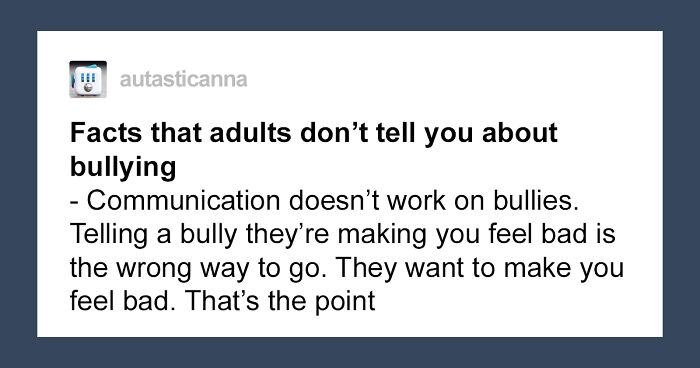
People Who Were Bullied Are Relating To These “Facts That Adults Don’t Tell You About Bullying” And Saying They’re True

Bullying has a weird public-relations problem. Adults often talk about it like it is a short, unpleasant school subplot: someone steals your lunch, a teacher gives a speech about kindness, everyone learns a lesson, and the credits roll. But people who were actually bullied know the story is rarely that tidy. The hurt can be quiet. The damage can be invisible. And sometimes the so-called “lesson” is that adults are excellent at noticing missing homework and surprisingly bad at noticing a kid slowly disappearing into themselves.
That is why so many former victims relate deeply to the “facts adults don’t tell you about bullying.” These are not dramatic exaggerations from people who need to “move on.” They are the kinds of truths that only make sense after you have sat alone at lunch, rehearsed the fastest route through a hallway, pretended not to hear a joke made at your expense, or laughed along because crying would only give the audience better material.
Bullying is not just teasing. It is repeated aggression, a power imbalance, and a pattern that can damage a person’s sense of safety, identity, trust, confidence, and belonging. It can be physical, verbal, social, emotional, or digital. In other words, it does not always arrive wearing a villain costume. Sometimes it comes as a group chat. Sometimes it is a nickname. Sometimes it is silence from everyone who sees what is happening and decides that being “neutral” is safer.
The First Fact Adults Often Miss: Bullying Is Not Always Loud
Many adults still imagine bullying as a shove against a locker or a stolen backpack. That kind of bullying happens, but some of the most painful forms are quieter. Social exclusion, rumors, “jokes,” public embarrassment, whisper campaigns, fake friendliness, group chat humiliation, and organized ignoring can hurt just as much as a bruise. The problem is that bruises are easier to prove. A child can point to a black eye. It is harder to point to a lunch table where everyone suddenly becomes fascinated by their sandwich when you walk up.
This is one reason bullied kids often sound “too sensitive” when they finally explain what is going on. A single incident may seem small to an adult: one joke, one eye roll, one comment about clothing, one invitation not sent. But bullying is not measured by one moment. It is measured by repetition. A mosquito is small too, but invite 300 of them into your bedroom and suddenly you are not sleeping like a champion.
Bullying Changes How a Person Moves Through the World
People who were bullied often remember becoming experts in risk calculation. They knew which hallway to avoid, which seat was least visible, which teacher actually paid attention, which bathroom felt safer, and which classmates laughed because they were cruel versus laughed because they were scared of becoming the next target.
That kind of constant scanning is exhausting. It teaches the brain that ordinary places are not ordinary at all. The cafeteria becomes a stage. The school bus becomes a courtroom. A notification sound becomes a tiny alarm bell. When adults say, “Just ignore them,” they often underestimate how hard it is to ignore someone who has turned your daily life into a weather forecast of humiliation with a 90% chance of anxiety.
“Just Tell an Adult” Is Not Always Simple
One of the most repeated anti-bullying messages is “tell an adult.” In theory, that is good advice. In reality, many bullied children do tell an adult and then learn an even harsher lesson: not every adult knows what to do next.
Some adults minimize the situation. Some tell the victim to toughen up. Some accidentally make things worse by confronting the bully in a way that sends retaliation straight back to the target. Some schools treat bullying as a public-relations inconvenience rather than a safety issue. And sometimes the child who reports bullying is asked what they did to “cause” it, which is like asking someone whose umbrella was stolen why they looked so rain-compatible.
People who were bullied often say this part hurt almost as much as the bullying itself. Being mistreated by peers is painful. Being ignored by adults who were supposed to protect you can feel like confirmation that you are on your own.
Why Victims Sometimes Stay Quiet
Adults may wonder, “Why didn’t you say something sooner?” There are many answers. Some kids fear revenge. Some feel embarrassed. Some worry their parents will overreact. Some have already tried speaking up and were dismissed. Some believe they deserve it because the bully has repeated the same insult so many times it starts sounding like a fact. Some do not have the words yet. Children are not tiny lawyers with emotional PowerPoint presentations ready to go.
Silence does not mean nothing is happening. A bullied child may show signs through behavior instead: stomachaches, headaches, sleep trouble, falling grades, lost interest in school, irritability, withdrawal, sudden anger, or not wanting to attend activities they used to enjoy. The child may become “difficult” at home because home is the only place safe enough to fall apart.
The Bystander Problem: Neutral Is Not Always Neutral
Another painful fact former victims often confirm is this: the people who watched mattered. Sometimes they mattered more than the bully. A bully may start the fire, but bystanders decide whether the room fills with smoke.
Not every bystander is cruel. Many are scared. They know that defending the target might move the spotlight onto them. But from the victim’s side, silence can still feel like agreement. A classroom full of people pretending not to hear can make a child feel invisible in the worst possible way.
This is why effective bullying prevention focuses not only on punishing bullies but also on empowering bystanders. A single peer saying, “That’s not funny,” sitting beside someone at lunch, reporting safely, or refusing to share an embarrassing post can change the social temperature. Kindness does not always need a marching band. Sometimes it just needs one person with a spine and decent timing.
Cyberbullying Removed the “Safe at Home” Button
Older adults sometimes say, “Bullying has always existed,” which is true in the same way storms have always existed. But cyberbullying gave the storm Wi-Fi. In the past, home could be a break from school cruelty. Now the cruelty can follow through phones, screenshots, fake accounts, comments, private messages, photo edits, group chats, and posts that spread faster than a rumor with a gym membership.
Cyberbullying can feel especially inescapable because it has an audience. A humiliating moment is no longer limited to the people in the hallway. It can be saved, replayed, shared, and rediscovered. The target may not even know who has seen it. That uncertainty can become its own form of stress.
Adults may advise kids to “just log off,” but that misunderstands modern social life. For many students, digital spaces are where friendships, class updates, clubs, jokes, invitations, and identity all live. Telling a bullied teen to simply leave the internet can feel like telling someone being harassed in town to solve it by moving to a cave.
The Long-Term Effects Are Real
One of the biggest facts adults often do not tell children is that bullying can last long after the bullying stops. Former victims may struggle with anxiety, depression, low self-esteem, people-pleasing, social mistrust, conflict avoidance, perfectionism, body shame, or a deep fear of being laughed at. Some become hyper-independent because depending on others once felt unsafe. Others become comedians, achievers, peacekeepers, or chameleons because they learned early that being “acceptable” could reduce danger.
Of course, not every person who was bullied is damaged forever. Many heal, grow, find community, and build strong lives. But healing does not mean the experience was harmless. A broken bone can heal too. That does not make the baseball bat a wellness tool.
Bullying Can Affect Learning, Not Just Feelings
Adults sometimes separate academics from emotions as if a student can be terrified in the hallway and then calmly analyze fractions five minutes later. That is not how human brains work. When a child feels unsafe, attention shifts toward survival. Learning becomes harder. Participation drops. Grades may fall. Absences may increase. The student may stop joining clubs, sports, or class discussions because visibility feels risky.
This is why bullying is not merely a “social issue.” It is an education issue. It affects attendance, concentration, confidence, motivation, and access to opportunity. A child cannot fully learn in an environment where their main goal is to avoid being humiliated before lunch.
Why “They’re Just Jealous” Does Not Always Help
Adults often comfort bullied kids by saying, “They’re just jealous.” Sometimes that may be partly true. But for a child who is being mocked, excluded, or threatened, the bully’s motivation may not matter much. If someone throws a sandwich at you, knowing they are jealous of your algebra skills does not magically remove the mustard.
Better support sounds more direct: “You do not deserve this. I believe you. We are going to document what happened. We will make a plan. You are not handling this alone.” That kind of response gives the child something jealousy theories rarely provide: safety, validation, and action.
The Myth That Bullying Builds Character
Some adults still believe bullying toughens kids up. This idea deserves to be retired, ideally in a sealed box at the bottom of the ocean. Struggle can build resilience when people have support, meaning, and recovery. Repeated humiliation without protection does not build character; it builds defense mechanisms.
Many former victims did become empathetic, observant, funny, independent, or emotionally intelligent. But those strengths came from surviving and reflecting, not because bullying was secretly good for them. Saying bullying builds character is like saying a house fire teaches architecture. Maybe, but there were better lesson plans available.
What Adults Should Say Instead
When a child reports bullying, the first response matters. Adults should avoid interrogation, blame, or instant lectures. Start with belief. Ask what happened, who was involved, where it happened, how often it occurs, whether there are screenshots or witnesses, and what the child fears might happen next. Then create a plan that includes documentation, school communication, emotional support, and follow-up.
It is also important not to force the child into solutions that make adults feel better but make the child feel unsafe. “Stand up to them” may sound heroic, but not every situation is safe for direct confrontation. “Be friends with them” can send the message that the victim must repair the harm done to them. “Ignore it” may work for one rude comment, but it is usually useless against a pattern.
What Schools Can Do Better
Schools need clear anti-bullying policies, consistent enforcement, safe reporting systems, trained staff, mental health support, and a culture where students know cruelty will not be treated as entertainment. Assemblies are not enough. A poster that says “Be Kind” cannot supervise a locker room.
Effective prevention should teach students how to recognize bullying, how to intervene safely, how to report concerns, and how to repair harm. Schools should also pay attention to vulnerable groups, including students with disabilities, LGBTQ+ students, students who are socially isolated, students who look or speak differently from peers, and students who are new to the community. Bullying often targets difference, which is why inclusion is not a decorative slogan. It is prevention.
What Parents Can Do at Home
Parents can help by becoming a safe place for honest conversation before there is a crisis. Ask specific questions, not just “How was school?” because many children will answer “fine” even if their day felt like a raccoon fight in a backpack. Try questions like: “Who did you sit with today?” “Did anyone make you uncomfortable?” “Is there a part of the day you dread?” “Are there any group chats that make you feel bad?”
Parents should also watch for changes. A child who suddenly hates school, loses appetite, has sleep problems, avoids their phone, becomes secretive, or stops enjoying old hobbies may be signaling distress. The goal is not to panic over every mood swing. The goal is to notice patterns and stay curious.
Healing After Bullying: It Is Not Silly to Still Care
Adults who were bullied sometimes feel embarrassed that old memories still hurt. They may think, “Why do I still remember something from seventh grade?” But the brain remembers moments that taught it danger, shame, or rejection. That does not mean a person is weak. It means the experience mattered.
Healing can include therapy, journaling, supportive friendships, setting boundaries, revisiting old beliefs, and learning to separate who you are from what happened to you. It can also include humor. Many former bullied kids develop elite-level sarcasm, which is not a clinical treatment plan but does make group dinners more entertaining.
The goal is not to pretend bullying never happened. The goal is to stop letting the bully’s version of you act as the narrator of your life.
Experiences Former Victims Often Relate To
Many people who were bullied describe the strange experience of becoming extremely good at reading rooms. They can sense a mood shift before anyone speaks. They notice who is uncomfortable, who is excluded, who is pretending to be okay. This sensitivity can be a gift, but it often began as survival. When you grow up needing to predict ridicule, you become a human weather radar for social danger.
Another common experience is over-apologizing. Former victims may say sorry for taking up space, asking a question, needing help, walking too slowly, replying too late, or existing near a mildly inconvenienced person. It sounds polite on the surface, but underneath it can be fear: fear of annoying someone, fear of being targeted, fear that any small mistake will become evidence in the court of public opinion.
Some bullied people become high achievers because success feels like protection. They think, “If I am impressive enough, no one can dismiss me.” Others hide their talents because standing out once attracted cruelty. Both reactions make sense. Bullying teaches people to manage visibility: be brilliant enough to escape, or invisible enough to survive.
Friendship can also become complicated. A person who was excluded may crave closeness but distrust it. They may wonder whether people secretly dislike them. They may replay conversations, analyze punctuation in text messages, or assume a delayed reply means rejection. Their friends may see insecurity, but the former victim remembers the old pattern: people smiling in your face and laughing behind your back.
There is also the experience of delayed anger. As children, many victims blamed themselves. As adults, they look back and think, “Wait. That was not normal. Why did no one stop it?” This anger can be painful, but it can also be clarifying. It helps people place responsibility where it belongs. The bullied child was not too sensitive. The adults were not always attentive enough. The bully was not “just joking.” The group was not innocent simply because they were quiet.
Former victims may also feel intense compassion for outsiders. They notice the person standing alone at a party. They invite the quiet coworker into the conversation. They defend strangers online. They become the adult they needed. This is one of the most powerful transformations after bullying: turning pain into protection for others.
Still, it is important not to romanticize the pain. Nobody should have to be bullied in order to become kind. Empathy should not require emotional dodgeball. But many survivors do build a moral radar from what happened. They know how much one kind person can matter because they remember needing one.
Some people also experience complicated reactions when they see former bullies thriving. It can feel unfair to watch someone who made your life miserable become popular, successful, or publicly “nice.” But healing often means accepting that justice is not always cinematic. There may be no dramatic apology, no courtroom confession, no slow-motion scene where everyone realizes you were right. Closure may come from building a life where their opinion no longer has voting power.
The most relatable truth may be this: bullying does not end the moment the bully stops. It ends gradually, as the person rebuilds trust in themselves and others. It ends when they speak without shrinking. It ends when they stop laughing at jokes that hurt them. It ends when they choose friends who do not make affection feel like a test. It ends when they realize survival was impressive, but peace is allowed too.
Conclusion: The Facts Adults Should Finally Admit
People who were bullied are not being dramatic when they relate to these hidden facts. They are recognizing a truth many adults still soften: bullying can change a child’s body, mind, school experience, relationships, and future sense of self. It can be quiet. It can be social. It can be digital. It can be dismissed by adults who should know better. And it can leave marks that are real even when nobody else can see them.
The good news is that bullying is not inevitable, and healing is possible. Students need adults who listen carefully, schools that act consistently, peers who refuse to reward cruelty, and communities that understand bullying is not a childhood tradition. It is preventable harm.
The next time someone says, “That happened years ago,” the better answer may be: “Yes, and it mattered.” Not because the past should control the future, but because naming the truth is often the first step toward taking away its power.
Note: This article synthesizes reputable U.S. public-health, education, child-development, and bullying-prevention information. It is written as original editorial content for web publication and does not include raw source links or citation placeholders.