
A precision voltage reference source is the quiet, disciplined adult in a circuit full of noisy teenagers. It does not flash LEDs, spin motors, or make dramatic clicking sounds. It simply produces a stable voltage and says, “You may now measure reality.” Without it, high-resolution analog-to-digital converters, digital multimeters, lab calibrators, sensor interfaces, and precision power systems would be guessing with confidencewhich is still guessing.
In electronics, a voltage reference is a known electrical potential used as a comparison point. A precision voltage reference source takes that idea further by focusing on accuracy, stability, low noise, temperature behavior, long-term drift, and predictable performance under real operating conditions. It is the difference between using a kitchen spoon to measure medicine and using a calibrated laboratory pipette. Both technically “measure,” but only one belongs in a serious system.
This guide explains what a precision voltage reference source does, how it works, where it is used, what specifications matter, and how to choose or design one without accidentally building a tiny voltage-powered drama machine.
What Is a Precision Voltage Reference Source?
A precision voltage reference source is a circuit or instrument that generates a stable voltage value such as 1.25 V, 2.5 V, 4.096 V, 5 V, or 10 V. The output is used as a fixed standard for measurement, conversion, calibration, or control. In a simple circuit, a reference might help an analog-to-digital converter decide what a sensor reading means. In a metrology lab, a reference source may support the calibration of high-end digital multimeters and voltage calibrators.
The word “precision” matters because not all references are created equal. A cheap regulator may output “about 5 V,” which is fine for powering a microcontroller. A precision reference, however, may need to hold its value within a few parts per million. At that level, even small temperature changes, board layout mistakes, solder stress, humidity, and time can nudge the output enough to matter.
Why Voltage References Matter
Every measurement system needs a trusted comparison point. If an ADC converts an analog input into a digital number, it compares the input against its reference voltage. If the reference is wrong, the measurement is wrong. The ADC may be 24-bit, gold-plated, and spiritually enlightened, but if its reference drifts, the final reading drifts with it.
For example, imagine a 16-bit ADC using a 4.096 V reference. Each code represents 62.5 microvolts. If the reference shifts by 1 millivolt, the system error can equal many counts. In temperature measurement, battery monitoring, medical instruments, industrial automation, and precision weighing, that can be the difference between a useful reading and an expensive shrug.
A precision voltage reference source is commonly used in:
- High-resolution ADC and DAC circuits
- Digital multimeters and calibrators
- Precision sensor interfaces
- Battery management systems
- Industrial control equipment
- Medical and laboratory instruments
- Automotive electronics
- Data acquisition systems
- Low-noise analog signal chains
How a Precision Voltage Reference Source Works
A voltage reference is designed to create a voltage that remains stable despite changes in supply voltage, load current, temperature, and time. Manufacturers achieve this using semiconductor structures and compensation techniques that balance physical effects against each other.
Bandgap Voltage References
Bandgap references are common in integrated circuits because they can provide useful accuracy, low cost, and practical power consumption. A bandgap reference combines voltages with opposite temperature behaviors. One voltage tends to decrease with temperature, while another increases. When carefully combined, the result is a reference voltage that stays relatively flat across temperature.
Bandgap references are widely used in ADCs, microcontrollers, sensors, and portable electronics. Modern precision bandgap references can achieve impressive initial accuracy and temperature coefficients, especially when trimming, curvature compensation, and chopper-stabilized amplifiers are used. They are a favorite when designers want a sensible balance of accuracy, size, power, and cost.
Buried Zener References
Buried Zener references are often used in higher-performance precision applications, especially where low noise and long-term stability are critical. They typically operate at higher voltages and currents than low-power bandgap references, but the reward can be excellent stability. Many high-end 10 V references and metrology-grade instruments use Zener-based architectures.
The tradeoff is that buried Zener references usually need more power and careful thermal management. They may also require warm-up time before reaching their best performance. In other words, they are not always the best choice for a coin-cell IoT sensor hiding in a mailbox, but they are excellent candidates for serious lab-grade voltage reference source designs.
Series and Shunt References
A series voltage reference sits between the supply and the load, regulating its output like a low-current precision regulator. It is easy to use, efficient in many applications, and common in modern designs.
A shunt voltage reference works more like a precision Zener diode. It is placed in parallel with the load and requires a bias current through a resistor or current source. Shunt references are simple and robust, but they can waste current if not designed carefully. They are useful when the supply and load conditions fit their operating range.
Important Specifications to Understand
Choosing a precision voltage reference source by output voltage alone is like buying a car because it has tires. Necessary, yes. Sufficient, no. The important specifications tell you how the reference behaves in the real world.
Initial Accuracy
Initial accuracy describes how close the output voltage is to its nominal value at a specified temperature, usually around 25°C. A 2.500 V reference with ±0.05% initial accuracy may be off by up to ±1.25 mV before temperature, noise, aging, and load effects are considered.
For many systems, initial accuracy can be calibrated out. If your device is factory-calibrated, the exact reference output can be measured and stored in firmware. But if calibration is not possible, initial accuracy becomes more important.
Temperature Coefficient
Temperature coefficient, often written as tempco, describes how much the output changes with temperature. It is usually expressed in parts per million per degree Celsius, or ppm/°C. Lower is better, but lower is also usually more expensive.
For example, a 5 V reference with a 10 ppm/°C temperature coefficient could shift by 50 microvolts per degree Celsius. Across a 50°C operating range, that becomes 2.5 mV. In a low-resolution system, that might be harmless. In a precision instrument, it may be the villain wearing a lab coat.
Long-Term Drift
Long-term drift describes how the reference output changes over hundreds or thousands of hours. This is especially important in calibration equipment, data loggers, and systems expected to remain accurate for years. Drift is not always linear, and many references drift most during their early life. Some designers burn in or age precision references before calibration to improve predictability.
Noise
Reference noise appears directly in the signal chain. In ADC applications, noisy references cause unstable readings, especially at high resolution. Noise is often specified over bandwidths such as 0.1 Hz to 10 Hz or over a wider frequency range.
Low-frequency noise is particularly annoying because it is difficult to filter without slowing the system response. Precision references may need careful bypassing, filtering, shielding, and layout to achieve datasheet-level performance.
Line Regulation
Line regulation tells you how much the output changes when the input supply voltage changes. A good precision voltage reference should reject supply variation well, but it still needs proper headroom. If the input voltage drops too close to the output voltage, the reference may fall out of regulation.
Load Regulation
Load regulation describes how much the output changes as load current changes. Some references can only source a small current. Others can source and sink more current. If the reference must drive multiple ADCs, DACs, or external loads, a buffer amplifier may be required.
Thermal Hysteresis
Thermal hysteresis is the change in output after the device experiences a temperature cycle and returns to the original temperature. This matters in outdoor, automotive, aerospace, and industrial applications where the circuit may repeatedly heat and cool.
Precision Voltage Reference Source vs. Voltage Regulator
A voltage regulator is designed mainly to provide power. A voltage reference is designed mainly to provide accuracy. A regulator may supply hundreds of milliamps or several amps, but its output accuracy and noise are usually not good enough for precision measurement. A reference may supply only a small current, but it is built to be stable and predictable.
Using a regulator as a precision reference is a common beginner mistake. It may work for casual circuits, but it can ruin high-resolution measurements. That is like using a garden hose as a surgical instrument: bold, memorable, and not recommended.
Common Output Voltages and Why They Exist
Precision references come in several standard values. A 2.5 V reference is common because it fits well with low-voltage analog systems. A 4.096 V reference is popular because it maps neatly to binary ADC scaling; with a 12-bit ADC, each count equals exactly 1 mV. A 5 V reference works well in classic instrumentation and industrial systems. A 10 V reference is common in calibration labs and high-performance measurement equipment.
The best output voltage depends on the ADC input range, supply voltage, sensor signal level, required resolution, and power budget. In modern low-voltage systems, references must often operate from 3.3 V or even lower supplies. In metrology systems, 10 V remains highly important because many high-accuracy instruments and calibration chains are built around it.
Design Tips for a Better Precision Voltage Reference Source
Use a Clean Layout
Precision analog layout is not the place for creative chaos. Keep the reference close to the ADC or DAC it serves. Use a solid ground strategy, short traces, and proper bypass capacitors. Avoid routing digital clock lines near the reference output. Digital noise is like glitter: once it gets everywhere, cleanup becomes a lifestyle.
Choose the Right Capacitors
Voltage references often require input and output capacitors for stability and noise reduction. Follow the datasheet recommendations carefully. Some references are stable with a wide range of capacitors, while others require specific equivalent series resistance or capacitance values.
Use low-leakage capacitors where leakage matters. For high precision, capacitor dielectric absorption, voltage coefficient, and temperature behavior can become relevant. A casual ceramic capacitor may be fine in one circuit and suspiciously troublesome in another.
Consider a Buffer Amplifier
If the reference must drive a dynamic or heavy load, use a precision buffer amplifier. The buffer should have low offset, low noise, low drift, and enough output current. It must also remain stable with the load capacitance. A poor buffer can turn a beautiful reference into an oscillator with ambition.
Control Temperature
Temperature is one of the biggest enemies of precision. Keep the reference away from heat sources such as regulators, processors, power resistors, and switching converters. Avoid placing it near board edges where air currents can cause temperature gradients.
For very high precision, thermal shielding, ovenization, or controlled warm-up procedures may be used. In many practical systems, simply placing the reference in a quiet thermal zone on the PCB makes a measurable difference.
Plan for Calibration
Even an excellent precision voltage reference source is not magic. For demanding applications, calibration is part of the design. Measure the actual output with traceable equipment, store correction values, and define recalibration intervals. This is especially important for instruments used in quality control, research, or regulated environments.
Practical Example: Reference for a 24-Bit ADC
Suppose you are designing a data acquisition system with a 24-bit ADC for precision temperature sensors. The ADC uses a 2.5 V reference. At full theoretical resolution, each code is tiny. In practice, noise, offset, gain error, and reference stability limit usable resolution.
A low-cost reference with high drift may dominate the error budget. A better reference with low noise and low tempco can improve repeatability, but only if the layout, grounding, filtering, and thermal design are also handled correctly. The reference should be close to the ADC, isolated from switching noise, and bypassed according to the manufacturer’s guidance.
If the system operates from -20°C to +60°C, temperature coefficient becomes a major selection factor. If the device is used for long-term monitoring, drift over months or years matters. If the sensor signal changes slowly, low-frequency noise matters. The best reference is not simply the one with the fanciest datasheet number; it is the one whose strengths match the system’s real error budget.
Practical Example: 10 V Lab Reference Source
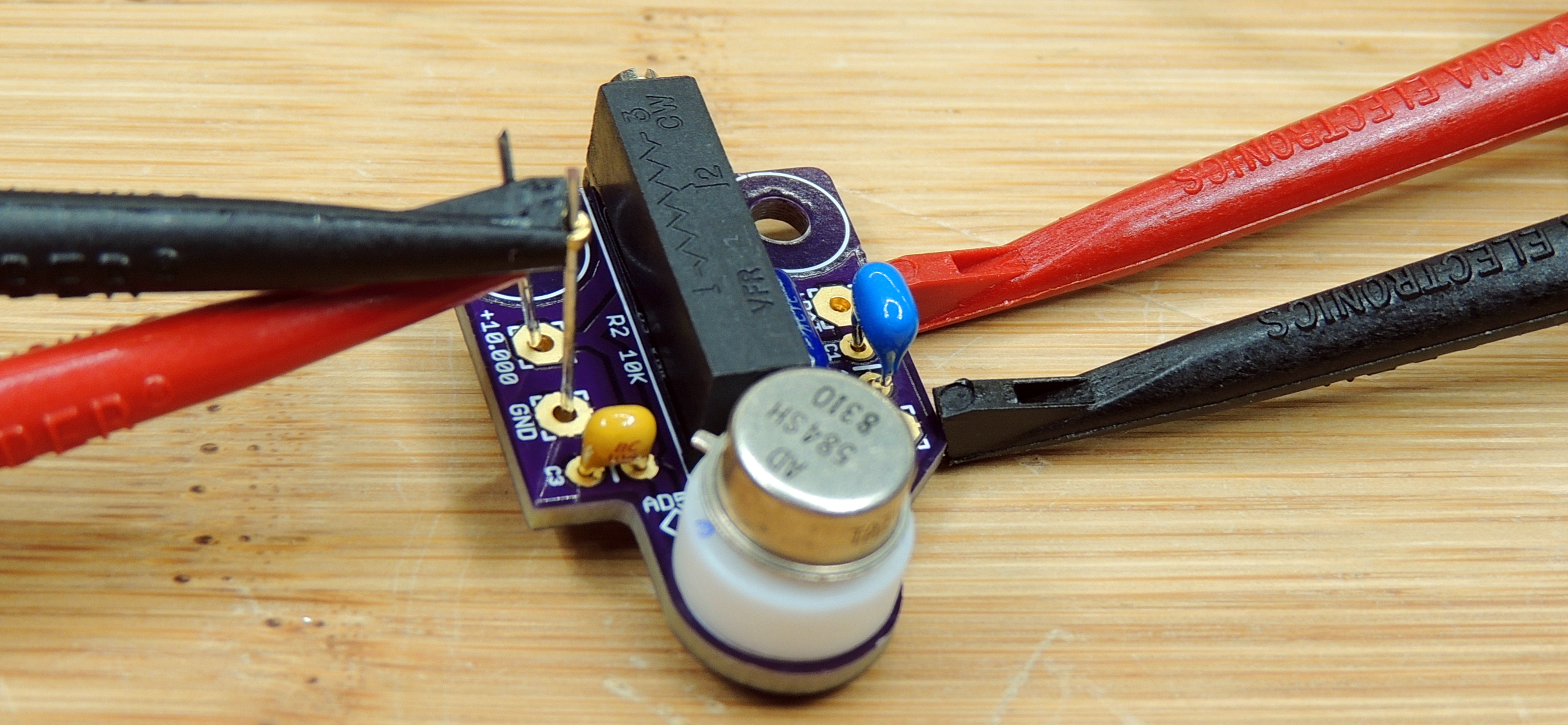
A 10 V precision voltage reference source is often used to check digital multimeters, calibrators, and measurement setups. In this role, stability and traceability are more important than low power. The design may use an ultra-stable reference core, thermal insulation, a low-noise output stage, protection circuitry, and a carefully designed enclosure.
Some lab references are left powered continuously because warm-up and thermal equilibrium affect output stability. When a reference is used as a transfer standard, it may be compared periodically against a higher-level standard. At the top of the measurement world, Josephson voltage standards connect voltage measurements to fundamental constants. For everyday engineering labs, a well-maintained 10 V reference can provide a practical and reliable local standard.
Common Mistakes to Avoid
Ignoring the Error Budget
The reference is only one part of the system error. ADC gain error, amplifier offset, resistor tolerance, thermal EMF, PCB leakage, and calibration uncertainty also matter. Build an error budget early so you know whether a premium reference will actually improve performance.
Power Cycling Without Testing Warm-Up
Battery-powered designs often switch references off to save energy. That can work, but the reference may need time to settle after power-up. Test warm-up behavior under real conditions instead of assuming the output is perfect the moment the enable pin wakes up.
Trusting Typical Specs Too Much
Datasheets often list typical and maximum values. Typical specs are helpful, but maximum specs are safer for guaranteed design limits. When building production hardware, design for worst-case behavior, not the happiest chip in the sample tray.
Forgetting Mechanical Stress
Precision references can be affected by package stress, board flex, soldering, and thermal cycling. Avoid placing the reference near mounting screws or connectors that experience mechanical force. Tiny stress can become tiny voltage error, and tiny voltage error is exactly what precision designers spend their lives chasing.
How to Choose the Right Precision Voltage Reference Source
Start with the required output voltage and supply range. Then examine initial accuracy, temperature coefficient, noise, long-term drift, load capability, package, power consumption, and cost. Consider whether the application needs automotive qualification, medical reliability, low quiescent current, or metrology-grade stability.
For portable sensor systems, a low-power bandgap reference may be ideal. For high-end data acquisition, low noise and low drift may matter more than current consumption. For calibration equipment, a carefully aged and temperature-controlled reference may be worth the cost. The right choice depends on the job, not on bragging rights.
Maintenance and Calibration
A precision voltage reference source should be treated like a measurement asset, not just another component. For lab equipment, keep calibration records, note environmental conditions, and follow a sensible recalibration interval. Avoid unnecessary thermal shock, vibration, and humidity exposure. If a reference is battery-powered, monitor battery condition because supply problems can masquerade as reference problems.
For embedded products, calibration may happen at the factory. Firmware can store gain correction values, temperature compensation tables, or serial-number-specific constants. Good documentation matters. Future engineers should know how the system was calibrated, what equipment was used, and what assumptions were made. Otherwise, troubleshooting becomes archaeology with a multimeter.
Experience Notes: Lessons from Working with Precision Voltage Reference Sources
In practical electronics work, the most important lesson about a precision voltage reference source is that the chip is only the beginning. Many designers buy a beautiful reference IC, place it on a noisy board, surround it with digital traces, feed it from a switching regulator with questionable manners, and then wonder why the readings look like they had too much coffee. Precision is a system behavior. The reference, layout, power supply, grounding, thermal design, firmware, and calibration process all have to cooperate.
One useful habit is to measure the reference output under the same conditions the final product will experience. Bench testing at room temperature is helpful, but it does not reveal everything. Heat the board gently, cool it carefully, vary the supply voltage, enable and disable nearby loads, and watch the output over time. A precision voltage reference source that looks excellent during a five-minute test may reveal drift, settling, or noise patterns during a longer run.
Another lesson is that warm-up time is real. Some references settle quickly enough for duty-cycled systems, while others perform best after reaching thermal equilibrium. If the product wakes up, takes a reading, and goes back to sleep, the reference must be tested in that exact rhythm. The question is not “What does the datasheet say in ideal conditions?” The question is “What does my board do on a cold Monday morning after sitting in a warehouse all weekend?” Electronics have moods; precision design is how we politely remove them.
For lab reference sources, cleanliness and consistency matter. Use good connectors, low-thermal EMF wiring, stable environmental conditions, and instruments with known calibration status. Avoid touching sensitive terminals right before taking a reading because body heat can create small thermal gradients. Use proper shielding when measuring low-level noise. Keep notes. The boring notebook often saves the glamorous instrument.
When selecting parts, do not chase one specification while ignoring the others. A reference with amazing initial accuracy but poor temperature drift may be wrong for outdoor equipment. A low-noise reference that consumes too much current may be wrong for battery-powered sensors. A tiny package may be convenient but more sensitive to board stress or heat gradients. Engineering is the art of choosing which problem you prefer.
Finally, remember that calibration is not an insult to a good reference. It is a partnership. Even excellent references have tolerances and drift. Measuring the real output and designing correction into the system can turn a good circuit into a dependable instrument. A precision voltage reference source gives your design a stable foundation, but careful implementation is what keeps the building standing straight.
Conclusion
A precision voltage reference source is one of the most important building blocks in accurate electronic measurement. It provides the stable comparison voltage that ADCs, DACs, calibrators, and instruments depend on. The best reference for a design is not always the most expensive one; it is the one that fits the required accuracy, temperature range, noise level, drift target, load behavior, power budget, and calibration plan.
For casual circuits, an ordinary regulator may be enough. For precision systems, the voltage reference deserves serious attention. Choose it carefully, place it thoughtfully, protect it from noise and heat, and verify it under real conditions. Do that, and your measurements will have something solid to stand on. Ignore it, and your circuit may still produce numbersbut numbers with trust issues.