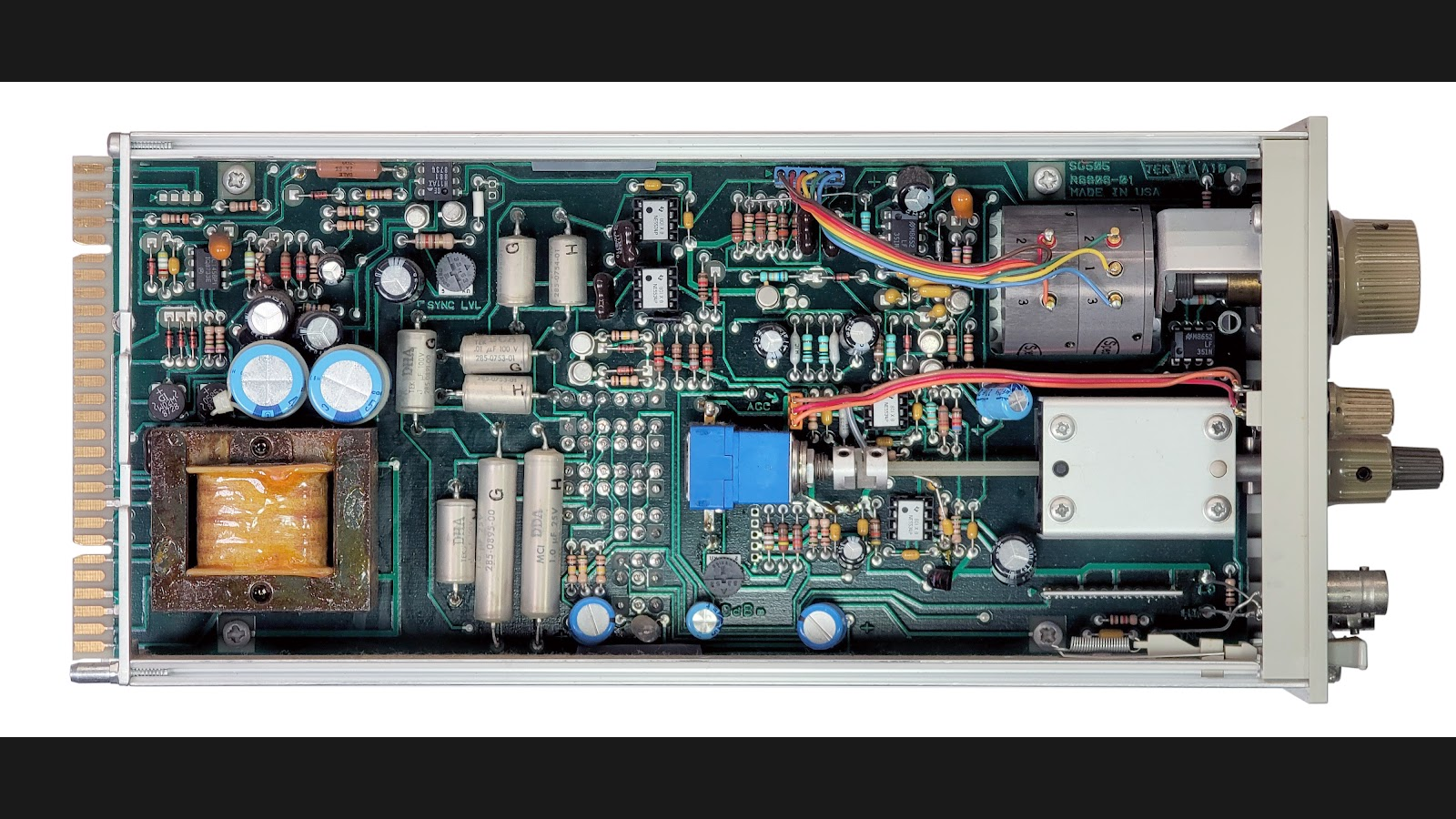

Some vintage electronics look like they were designed by engineers. Others look like they were designed by engineers who also secretly understood jazz, watchmaking, and the emotional importance of a perfectly damped knob. The Tektronix SG505 low-distortion oscillator sits comfortably in that second category. It is not just a piece of test equipment. It is a small monument to analog design, built in an era when a clean sine wave was not generated by casually clicking a dropdown menu and letting a microcontroller do the heavy lifting.
Recreating the analog beauty of a vintage Tektronix oscillator means more than copying a schematic. It means chasing the feel, stability, silence, and elegance of a machine built for people who measured distortion the way pastry chefs measure butter: carefully, seriously, and with strong opinions. The original SG505, part of Tektronix’s TM500 modular test equipment family, became respected for producing an ultra-low-distortion sine wave across the audio band and beyond. Its specifications were impressive then, and they still make modern builders raise an eyebrow today.
The challenge is simple to describe and wonderfully difficult to execute: build a modern version that captures the same analog character while using parts that are still available, affordable, and not hiding in a drawer labeled “Do Not Touch Unless It Is 1984.” That is where the fun begins.
Why The Tektronix SG505 Still Fascinates Builders
The SG505 was designed as a precision audio oscillator, not a toy signal source. Its job was to generate a very clean sine wave for testing amplifiers, filters, meters, audio equipment, and measurement systems. In practical terms, that means the oscillator had to produce a stable tone without adding much harmonic garbage of its own. If the test source is dirty, every measurement downstream becomes suspicious. It is like testing windshield clarity while wearing smudged sunglasses.
The SG505 is often remembered for its extremely low total harmonic distortion in the 20 Hz to 20 kHz audio range. Published references commonly cite distortion below 0.0008 percent, with typical performance even lower under ideal conditions. That number is not marketing confetti. For audio-frequency testing, it means the harmonics are buried so far below the fundamental signal that measuring them requires serious instrumentation and careful technique.
The unit also offered a practical frequency range from roughly 10 Hz to 100 kHz, balanced output behavior, stepped attenuation, and a 600-ohm output environment suitable for traditional audio and laboratory measurement work. In other words, the SG505 was not merely clean; it was usable. Tektronix had a gift for building instruments that felt like laboratory tools rather than science-fair contraptions with better paint.
The Analog Beauty Is Not Just Nostalgia
When people talk about the analog beauty of a vintage Tektronix oscillator, they are not only praising beige panels and old knobs, although let us admit it: Tektronix knobs had charisma. The beauty is in the engineering decisions. The SG505 used analog control loops, precision passive components, carefully selected active devices, and mechanical switching to maintain performance. The circuit had to behave well over frequency, temperature, load conditions, and output levels.
Modern digital function generators are astonishingly convenient. Many can produce sine, square, ramp, pulse, arbitrary, swept, burst, and modulated signals before your coffee has cooled. But convenience is not the same as purity. A direct digital synthesis generator may be extremely flexible, yet it can bring along quantization noise, clock artifacts, DAC limitations, reconstruction-filter behavior, and other tiny digital fingerprints. For many jobs, those fingerprints do not matter. For ultra-low-distortion audio testing, they can become the uninvited raccoon in the measurement attic.
A well-designed analog oscillator, by contrast, can produce a sine wave with a smoothness that feels almost physical. The waveform is not assembled from samples. It grows from feedback, balance, gain, and phase. That is part of the appeal. Recreating one is not about rejecting modern technology; it is about understanding why an older design still holds its ground.
The Heart Of The Design: A Low-Distortion Sine Wave
The center of this project is the sine wave oscillator itself. In a basic oscillator, the circuit must satisfy two conditions: the signal must return to the amplifier input with the correct phase, and the loop gain must settle at exactly the right amount. Too little gain and oscillation dies. Too much gain and the waveform grows until it clips, turning your elegant sine wave into something with corners and a guilty conscience.
That is why amplitude control is such a big deal. Low-distortion oscillators usually need some form of automatic gain control, or AGC. The AGC keeps the signal level steady without forcing the amplifier into clipping. In many classic designs, lamps, diodes, optocouplers, thermistors, or JFETs are used as variable resistance elements. Each option has tradeoffs. A lamp can be beautifully smooth but slow and physically awkward. Diodes are simple but can add distortion. A JFET can be elegant, compact, and controllable, but only if its behavior is understood and treated politely.
The SG505 is especially interesting because it used a state-variable oscillator approach with gain leveling designed to reduce distortion. The design was not merely “make sine wave, hope for the best.” It involved careful handling of the leveler-induced distortion that can appear when the AGC action modulates the waveform. One related Tektronix patent describes improving rejection of distortion products by using a feedforward path to cancel some of the unwanted effects created by the level-control process. That is the sort of engineering move that makes hobbyists pause and whisper, “Okay, Tek, calm down.”
Why Recreating It Is Harder Than Ordering Parts
At first glance, rebuilding a vintage oscillator sounds manageable. Find the schematic, order the components, make a printed circuit board, solder neatly, and declare victory. Sadly, analog circuits enjoy punishing optimism. The SG505 depended on parts, layouts, switches, potentiometers, and trimming methods that were selected for performance. Some are no longer manufactured. Others exist only as used parts, suspicious online listings, or mythical objects guarded by retired technicians.
One challenge is the JFET used in the automatic gain control circuit. JFETs are not as broadly available as they once were, and modern substitutions can behave differently. Parameters such as pinch-off voltage, noise, resistance range, leakage, and linearity matter. A “close enough” replacement might oscillate, but it may not achieve the original distortion performance. In a circuit chasing numbers below one-thousandth of a percent, close enough can be miles away wearing a fake mustache.
Another challenge is the frequency control. Vintage precision oscillators often used high-quality potentiometers or multi-section controls with specific mechanical behavior. Recreating a smooth frequency dial is not just about electrical value. It is about tracking, resolution, feel, repeatability, and the absence of irritating dead spots. A modern digital encoder could solve some practical problems, but then the project starts drifting away from its analog soul. The builder must decide where authenticity matters and where modern practicality deserves a seat at the bench.
Mechanical Design: The Forgotten Half Of Precision
Many people underestimate the mechanical side of vintage Tektronix equipment. The SG505, like other Tektronix modules, was not just a schematic in a box. The panel layout, switches, shielding, connectors, grounding, service access, and calibration points were all part of the instrument’s identity. Tektronix equipment often had a crisp, modular, deliberate feel because the company understood that a measurement instrument is used by human hands, not floating equations.
One famous difficulty in recreating old Tektronix gear is the mechanical switching. Precision attenuators and range switches are not casual parts. They must preserve signal integrity, maintain contact reliability, reduce leakage, and switch cleanly between ranges. A cheap rotary switch may work in a guitar pedal. In an ultra-low-distortion oscillator, it may behave like a raccoon again, only this time it brought friends.
A modern recreation can use relays, sealed switches, gold contacts, or digitally controlled analog switches, but each solution changes the design. Relays introduce coil drive and layout concerns. Analog switches may add resistance, capacitance, and distortion. Manual switches can preserve the vintage experience but may be difficult to source in the exact form required. This is why a faithful rebuild becomes a series of engineering negotiations rather than a shopping list.
Modern Parts, Vintage Standards
The smartest recreations do not blindly worship the past. They respect it. Modern builders have advantages Tektronix engineers of the original era did not always have: improved PCB design tools, affordable spectrum analysis, precision metal-film resistors, low-noise op-amps, simulation software, better capacitors in some categories, and online communities that can identify a mystery component before lunch.
Still, newer is not automatically better. An op-amp with dazzling bandwidth may not behave nicely in the original topology. A capacitor with excellent headline specs may have voltage coefficient or dielectric absorption issues. A modern potentiometer may fit the board but fail the feel test. The point of recreating the SG505 is not to stuff it with the most expensive parts available. The point is to understand which characteristics matter: noise, distortion, temperature stability, matching, parasitic capacitance, grounding, shielding, and repeatable adjustment.
A good modern design strategy begins with the original architecture, then identifies which parts are critical and which can be adapted. The oscillator core, AGC element, output amplifier, attenuator, power supply, grounding scheme, and calibration method deserve separate attention. This is not one project. It is several small projects wearing the same front panel.
Measuring Success: THD, THD+N, And The FFT Reality Check
To know whether a recreation is truly close to the original, the builder must measure it properly. Total harmonic distortion, or THD, describes harmonic energy added to the signal. THD+N includes both distortion and noise. The distinction matters because a very clean oscillator can appear worse if the measurement setup has a noisy floor. In ultra-low-distortion work, the analyzer, cables, grounding, load, shielding, and test method can dominate the result.
An FFT display is useful because harmonics appear at integer multiples of the fundamental frequency. Feed a pure 1 kHz sine wave into a system, and distortion might show up at 2 kHz, 3 kHz, 4 kHz, and so on. But FFT measurement is not magic. Windowing, sample rate, resolution bandwidth, input overload, noise floor, and grounding all affect what you see. A beautiful-looking spectrum can lie by omission, and a messy-looking one can be blaming the test setup instead of the oscillator.
For a serious SG505-style project, measurement should include several frequencies across the audio band: 20 Hz, 100 Hz, 1 kHz, 10 kHz, and 20 kHz are common checkpoints. Output levels should be tested into appropriate loads. The oscillator should be allowed to warm up. The power supply should be checked for hum and regulation problems. The FFT should be supported by notch-filter or audio-analyzer methods when possible. The goal is not to win an internet screenshot contest. The goal is to know what the circuit is actually doing.
What Makes The SG505 Design Feel So “Tektronix”
Tektronix earned its reputation by building instruments that combined high performance with serviceability and thoughtful construction. A vintage Tektronix oscillator or oscilloscope often feels different from generic test gear because it was designed as part of a measurement ecosystem. The knobs have purpose. The markings make sense. The circuits are documented. The performance is not accidental.
That mindset matters when recreating the SG505. A clone that produces a clean sine wave but has awkward controls, unstable calibration, noisy grounding, or a flimsy output stage misses part of the point. The Tektronix beauty is holistic. It is the union of circuit theory, manufacturing discipline, repairability, and human-centered design.
This is also why the project appeals to both engineers and collectors. The SG505 is a reminder that analog design can be elegant in ways that software rarely is. Software can simulate, correct, and automate. Analog must negotiate with physics directly. When it succeeds, it has a kind of grace.
Practical Steps For A Modern Recreation
1. Start With The Original Specifications
Before drawing a new board, define the target. Frequency range, output level, impedance, distortion, noise, floating or grounded operation, sync output, and calibration method should be written down. Without targets, the project becomes a decorative oscillator-shaped adventure.
2. Study The Oscillator Core
Understand the state-variable oscillator topology and the gain-control loop. Do not treat the AGC as an accessory. In a low-distortion oscillator, AGC behavior is central. Study how the level detector, JFET, integrators, and output stage interact.
3. Choose Components For Behavior, Not Bragging Rights
Precision resistors, stable capacitors, suitable op-amps, and carefully selected JFETs matter more than fashionable parts. The best component is the one that behaves correctly in the circuit. Sometimes that means a humble part with predictable characteristics beats an exotic one with a heroic datasheet.
4. Prototype In Stages
Build and test the oscillator core first. Then add range switching, output buffering, attenuation, sync output, and power supply refinements. Debugging a complete instrument all at once is how good weekends go to a small, smoky place.
5. Respect Layout And Grounding
Ultra-low distortion is sensitive to layout. Keep signal paths short where needed, manage return currents, separate noisy switching or power sections, and avoid routing sensitive nodes near aggressive signals. Shielding and grounding are not decorations. They are circuit elements with less glamorous job titles.
6. Measure Patiently
Use the best analyzer available, but also learn its limits. Check the measurement floor by testing a known low-distortion source or by using notch methods. Warm up the instrument. Repeat measurements. If the third harmonic moves when you touch the cable, congratulations: you have discovered the hobby’s unofficial handshake.
Why This Project Matters In A Digital Age
Recreating a vintage Tektronix oscillator is not the fastest way to get a sine wave. It may not even be the cheapest. A modern function generator can be delivered to your door with more features than most labs had decades ago. But the SG505 project matters because it teaches a kind of engineering that cannot be learned from menu navigation alone.
It teaches feedback control. It teaches component selection. It teaches that distortion is not an abstract number but a fingerprint of circuit behavior. It teaches humility, because the circuit will absolutely know when you cut corners. It also teaches appreciation for the engineers who created precision instruments with slide rules, analog intuition, and documentation thick enough to stop a small door.
For audio builders, the project is especially meaningful. A low-distortion oscillator is a reference point. It helps test amplifiers, preamps, equalizers, filters, transformers, and converters. It can expose noise, harmonic coloration, clipping behavior, bandwidth limits, and grounding problems. In a world full of plug-ins and presets, a clean analog sine wave remains one of the most honest questions you can ask a circuit: “What do you do when I give you something simple?”
Experience Notes: Living With The Project At The Bench
Spending time with a Tektronix-inspired oscillator project changes how you look at test equipment. At first, the work feels technical: collect schematics, compare parts, calculate values, check transistor curves, and stare at distortion plots until your eyes begin generating their own harmonics. After a while, though, the project becomes more tactile. You start noticing how a frequency control should feel when it crosses from 100 Hz to 1 kHz. You notice how a front-panel switch should land with confidence, not with the emotional uncertainty of a cheap flashlight.
One of the most memorable experiences is the first stable sine wave. It appears on the scope as a calm, bright curve, and for a moment the whole project seems easy. Then you open the FFT view and the circuit becomes brutally honest. A tiny second harmonic sits where you hoped there would be silence. A little power-line hum waves from the noise floor like it owns the place. The third harmonic changes when the output level moves. Suddenly the project is not finished; it is introducing itself.
That is where the real learning happens. You swap a component and nothing improves. You move a ground connection and everything improves. You try a different JFET and the AGC behaves like it finally had a good night’s sleep. You shorten a cable, shield a node, clean a switch contact, or discover that the measurement analyzer was contributing more drama than the oscillator. Each fix makes the design feel less like a copied circuit and more like an instrument you understand.
The vintage Tektronix spirit also shows up in calibration. There is something satisfying about trimming a circuit slowly toward a specification. Modern devices often hide calibration behind firmware, passwords, and menus that sound like airport codes. A vintage-style analog build invites you to participate. You adjust. You measure. You wait. You adjust again. It is slower, but it builds trust. You know why the result is good because you watched it become good.
The project also encourages respect for old parts without becoming trapped by them. A rare original component can be exciting, but a thoughtful substitute can be just as rewarding. The goal is not museum obedience. The goal is performance with character. If a modern part preserves the low-distortion behavior, improves reliability, and keeps the user experience intact, it belongs in the conversation.
In the end, recreating the analog beauty of a vintage Tektronix oscillator feels less like cloning a product and more like restoring a design language. It is about clean signals, honest measurements, graceful controls, and the pleasure of making electrons behave without asking a processor to apologize for them afterward. The finished instrument may sit quietly on the bench, but it carries a loud message: precision can be beautiful, and analog is not old-fashioned when it is done this well.
Conclusion
Recreating the analog beauty of a vintage Tektronix oscillator is a demanding but deeply rewarding project. The SG505 represents an era when precision audio test equipment was built with careful analog design, thoughtful mechanics, and performance standards that still command respect. A modern recreation must balance authenticity with practicality, replacing obsolete parts where necessary while preserving the design principles that made the original special.
The lesson is larger than one oscillator. Great analog engineering is not magic. It is feedback, stability, layout, measurement discipline, mechanical quality, and patience. The Tektronix SG505 remains fascinating because it turns those principles into a usable instrument. Rebuilding it today is not just an act of nostalgia; it is a practical education in how clean signals are made, measured, and respected.
SEO Tags