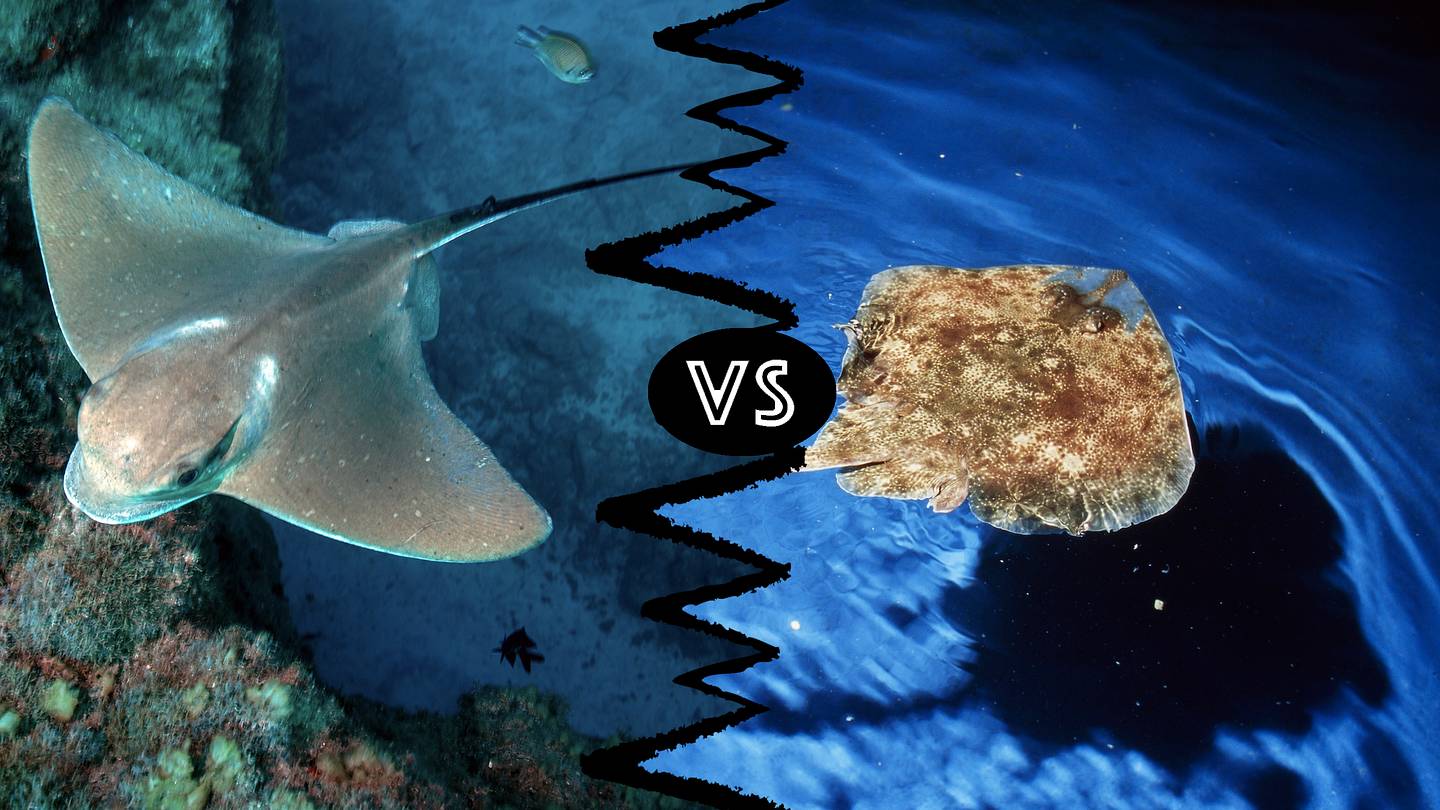

At first glance, telling a skate from a ray can feel like trying to identify two pancakes that learned to swim. Both are flat. Both havost humans cannot achieve while simply walking into a coffee shop.
But skates and rays are not exactly the same. They are close relatives, and both belong to the broader group of cartilaginous fishes known as batoids. Their skeletons are built primarily from cartilage rather than bone, linking them to sharks within the class Chondrichthyes. However, skates and the animals commonly called rays differ in several important ways, especially in reproduction, tail anatomy, defensive structures, teeth, habitat, and swimming behavior. flat marine creature cruises past you at an aquarium, how do you decide whether you’re looking at a skate or a ray? Let’s dive into the skates vs. rays difference without getting tangled in a fishing net of scientific vocabulary.
Skates and Rays Are Close Relatives
Before examining their differences, it helps to understand why skates and rays look so similar. Both are batoids, a group of flattened cartilaginous fishes closely related to sharks. Their enlarged pectoral fins are connected to or closely associated with the head, creating the broad disc-like appearance that makes them instantly recognizable.
Unlike most bony fish, skates and rays do not have skeletons made primarily of hard bone. Their supportive framework is cartilagethe firm but flexible material also found in the human nose and ears. This lighter skeletal system is a defining feature shared with sharks. also usually have their eyes on the upper surface of the body and their mouths and gill openings underneath. Many bottom-dwelling species use openings called spiracles, located behind the eyes, to draw in water for respiration while resting or partially buried in sediment. In a southern stingray, for example, the spiracles are so obvious that aquarium visitors sometimes mistake them for a second pair of eyes. rds, skates and rays share the same basic family blueprint. Evolution simply remodeled the kitchen, added different tail accessories, and made some major changes to the nursery.
Skates vs. Rays: The Quick Comparison
| Feature | Skates | Rays |
|---|---|---|
| Reproduction | Typically lay eggs in leathery cases | Most commonly give birth to live young |
| Tail | Usually thicker and fleshier | Often slender or whip-like |
| Stinging spine | Generally absent | Present in stingrays, but not all rays |
| Defense | Often have thorns or prickles | May use a tail spine, electricity, size, or other defenses |
| Teeth | Often small and pointed or arranged for grasping | Many bottom-feeding rays have crushing dental plates |
| Typical lifestyle | Frequently bottom-associated | Extremely diverse; bottom-dwelling and open-water species exist |
These are useful identification clues rather than unbreakable universal rules. Batoids are remarkably diverse, and marine biology has a charming habit of producing an animal that looks at a convenient rule and says, “That’s cute.”
The Biggest Difference: Skates Lay Eggs
Skate Eggs Come in “Mermaid’s Purses”
Reproduction is one of the strongest clues in the difference between skates and rays. Skates are oviparous, meaning females lay eggs. Each developing embryo is enclosed in a tough, leathery egg capsule.
These capsules are popularly called mermaid’s purses. They often have a rectangular or oblong shape with horns, tendrils, or projections at the corners. Empty cases sometimes wash onto beaches, where they look suspiciously like something a tiny sea witch might carry to a formal event.
NOAA describes winter skate eggs as developing inside hard, leathery cases, with incubation potentially lasting six to 12 months. Young skates hatch with the basic form of miniature adults. New England Aquarium materials similarly describe the distinctive rectangular egg cases produced by little skates. Give Birth to Live Young
The animals commonly called rays generally follow a different reproductive strategy. Many are live-bearing, with embryos developing within the female before pups are born.
The exact reproductive biology varies substantially among ray species. Scientists therefore avoid assuming that every ray handles embryo nutrition and development in precisely the same way. Even among closely related cartilaginous fishes, reproductive physiology can be surprisingly specialized. l observer, however, the egg-versus-live-young distinction remains valuable: skates characteristically lay external egg cases, while many rays produce live pups.
Look at the Tail
Skates Usually Have Stout, Fleshy Tails
A skate’s tail tends to be relatively thick, muscular, and fleshy. Small dorsal fins may be visible toward the end of the tail in many species. The tail often seems like a gradual extension of the body rather than an extremely thin whip attached to the disc.
Skates may also carry rows of thorn-like structures along the back or tail. Thorny skates deserve no award for misleading advertising: they really are equipped with thorns. These structures can injure someone who carelessly handles or steps on the animal, although skates generally lack the venomous tail spines associated with stingrays. Have Long, Slender Tails
Many familiar rays, particularly stingrays and whiptail rays, have a much thinner, elongated tail. Some tails dramatically exceed the length of the main body disc. New England Aquarium, for instance, describes leopard whiptail rays whose tails account for a large share of their impressive total length. s one of the easiest visual shortcuts. A broad, flat animal with a remarkably thin, whip-like tail is more likely to be a ray than a skate.
But remember: not every ray has the classic stingray tail. Electric rays, manta rays, and other batoids demonstrate how diverse ray body plans can be.
Do All Rays Sting?
No. This is probably the most important myth to remove from the discussion.
A stingray is a type of ray, but not every ray is a stingray. Stingrays possess one or more specialized defensive spines associated with the tail. The spine is a modified dermal structure and can cause an intensely painful wound. Research and educational material from the California State University Long Beach Shark Lab emphasizes that the caudal barb is primarily a defensive feature. enerally do not roam beaches with tiny villain mustaches plotting attacks on ankles. Injuries frequently occur when a hidden ray is stepped on or feels trapped. In areas where stingrays are common, beach safety organizations and aquariums often recommend shuffling the feet through shallow sand rather than taking high steps. The vibration and contact can alert a buried ray and give it an opportunity to move away. Birch Aquarium notes this advice when discussing round rays along the California coast. contrast, generally lack a venomous stinging barb. Their rough skin, thorns, and prickles may provide protection.
Then there are electric rays, which clearly decided that barbs were too conventional. Some species can produce electrical discharges for hunting and defense. Monterey Bay Aquarium describes Pacific electric rays using electrical charges to stun fish before manipulating and swallowing their prey. : Skate or Ray?
Body shape can provide another clue, although it should be combined with other features.
Skates Often Look More Triangular or Diamond-Shaped
Many skates have a distinctly diamond-shaped disc and a pointed snout. Their pectoral fins can create angular outer edges. The big skate, found in the northeastern Pacific, is a dramatic example. Some individuals have prominent dark spots on their fins that resemble oversized eyes and may help confuse predators. in a Wild Variety of Shapes
Rays are difficult to squeeze into one visual description. Southern stingrays have broad diamond-shaped bodies. Round rays are, unsurprisingly, rather round. Butterfly rays can be extraordinarily wide compared with their body length. Cownose rays possess distinctive front lobes that create a head shape resembling a cow’s nose. take the basic batoid plan and scale it up to “underwater aircraft” proportions. NOAA identifies the giant manta ray as the world’s largest ray and reports a wingspan reaching up to 30 feet. lying on size alone is a dangerous identification strategy. Some skates become surprisingly large, while some rays are compact enough to look like swimming dinner plates.
Skate Teeth vs. Ray Teeth
Food preferences have helped shape differences in batoid teeth.
Skates commonly have numerous relatively small teeth that can help grasp worms, crustaceans, small fish, and other prey. Many rays that specialize in hard-shelled animals possess broad, flattened teeth organized into crushing surfaces.
The Florida Museum notes the general contrast between smaller skate teeth and the plate-like crushing teeth seen in many rays. New England Aquarium describes whiptail rays using rows of blunt teeth to crush shellfish such as clams and crabs. e difference as seafood utensils. One mouth is better suited to grabbing. The other has something closer to a built-in shellfish press. Neither fish has requested garlic butter, but that may simply be a lack of opportunity.
How Do Skates and Rays Swim?
The “wings” of skates and rays are actually greatly enlarged pectoral fins. However, different species move those fins in different ways.
Many bottom-associated skates create wave-like undulations along the edges of their pectoral fins. This movement helps them glide close to the seafloor.
Some active-swimming rays flap their fins more like birds moving wings. Monterey Bay Aquarium describes bat rays using their wing-like pectoral fins to swim and to disturb sediment while searching for buried prey. Cownose rays also use pronounced wing-like movements while cruising through the water. rays can be extraordinarily graceful. Watching a manta or cownose ray swim makes human swimming techniques seem unnecessarily frantic. We kick, splash, gasp, and adjust goggles. The ray performs three elegant fin strokes and appears to arrive in another ZIP code.
Where Do Skates and Rays Live?
Both groups are found in a wide range of aquatic environments, but there are broad differences in habitat diversity.
Skates are primarily marine animals. Many are associated with ocean bottoms, including sandy, muddy, gravelly, and deeper offshore habitats. They can occur in cold and temperate seas, and some species spend substantial time in deep water.
Rays occupy marine habitats ranging from shallow coastal lagoons to the open ocean. Some also tolerate estuarine environments, and particular species live in freshwater. The Florida Museum points to Atlantic stingray populations in Florida’s St. Johns River system that can complete their life cycle in freshwater. therefore provide a clue. A skate is overwhelmingly likely to be marine. A ray might be cruising an ocean reef, buried in a coastal sand flat, traveling through an estuary, or living surprisingly far from salt water.
What Do Skates and Rays Eat?
Many skates are bottom feeders. Their diets can include worms, shrimp, crabs, clams, and small fish. They use sensory systems to detect prey that may be hidden in or resting against the seafloor.
Bottom-dwelling rays often pursue similar foods. Bat rays, for example, use their broad fins to expose clams and other animals buried in sediment. Cownose rays eat a range of benthic prey and possess dental structures suited to hard items. Chesapeake Bay research summaries characterize cownose rays as opportunistic feeders and note their consumption of several kinds of clams. have dramatically different diets. Manta rays consume plankton rather than crushing crabs. Electric rays may hunt fish. The word “ray” therefore describes an evolutionary group with far more culinary variety than the standard image of a shellfish-crushing stingray suggests.
Are Skates and Rays Dangerous to Humans?
For most people, neither skates nor rays represent animals that actively hunt humans.
Skates generally present little danger when left alone. Their thorns may cause injury if the animal is stepped on or handled improperly.
Stingrays deserve greater caution because a defensive tail strike can produce a serious wound. The smartest approach is simple: watch wild batoids without grabbing, chasing, cornering, or attempting to pose with them for a social media photograph titled “Nature Loves Me.”
In shallow stingray habitat, follow local beach guidance and use the recommended foot-shuffling technique when appropriate. If a stingray injury occurs, seek medical attention because puncture wounds, retained spine material, tissue damage, and infection may require professional evaluation.
Why the Difference Matters
Correct identification is more than marine trivia. Skates and rays can have different reproductive rates, habitat requirements, migration patterns, and vulnerabilities to fishing pressure.
For example, NOAA notes that winter skates mature relatively late and produce few offspring despite laying eggs throughout the year. Research summarized by NOAA also highlights concern about ray species with reproductive strategies that can make population recovery slow when mortality rises. ecies identification helps scientists study populations and supports better fisheries and conservation decisions. Misidentifying a cownose ray as a skate, for instance, is not merely a vocabulary mistake. Chesapeake Bay research materials specifically emphasize that the cownose ray is not a skate and describe its slow growth and low reproductive output as important management considerations. l a Skate From a Ray in Seconds
When you see a flat batoid, start with the tail. A thick, fleshy tail with possible dorsal fins and thorny structures suggests a skate. An extremely slender or whip-like tail suggests a ray, particularly a stingray or related form.
Next, look for a visible defensive spine on the tailbut do not get close enough to conduct an enthusiastic personal inspection. A tail barb points toward a stingray. The lack of a barb does not automatically prove the animal is a skate because many non-stinging rays also exist.
Finally, consider body shape and behavior. A skate creeping or undulating close to the bottom may display a more classic skate profile. A ray powerfully flapping broad fins through open water may be a cownose, eagle, manta, or another active-swimming ray.
And if you find a leathery rectangular “mermaid’s purse” with a developing batoid embryo, an egg-laying skate becomes a very strong possibility.
My Experience Learning the Difference Between Skates and Rays
My first memorable lesson in skates vs. rays came from the most scientific method imaginable: confidently guessing wrong while looking through aquarium glass. A flat animal was resting on the sand with its eyes pointing upward. “Stingray,” I thought. Easy. Marine identification career successfully launched.
Then I noticed its tail.
It was not the thin whip I associated with stingrays. The tail looked heavier and more muscular. Small structures were visible along its body, and the animal seemed to move with subtle ripples along the margins of its fins rather than dramatic wing beats. Reading the exhibit information revealed that I was looking at a skate.
That experience changed the way I observe batoids. Before then, I had unconsciously classified every flattened cartilaginous fish as a stingray. Apparently my personal taxonomy consisted of “shark,” “stingray,” and “fish that probably has an unnecessarily complicated scientific name.”
Once I learned to examine tails, the differences became much easier to notice. At another aquarium exhibit, cownose rays continuously cruised past the viewing window. Their pectoral fins moved in broad, confident strokes. They rarely looked as though they were crawling across the bottom. They were flying underwater.
Comparing that motion with a bottom-resting skate made the textbook description instantly meaningful. One animal seemed designed to work the seafloor. The other looked ready for an aquatic air show.
The reproduction difference was even more memorable. Seeing an empty skate egg case for the first time explained why “mermaid’s purse” is such an effective nickname. The leathery capsule did not look like a familiar fish egg. It looked like a miniature science-fiction package with pointed corners. Knowing that a skate embryo can develop inside such a structure for months made the ordinary beach discovery seem considerably more impressive.
I also became more cautious about using the word “stingray” for every ray. A manta ray is a ray. An electric ray is a ray. A cownose ray is a ray. They do not all carry the same kind of stinging equipment. Learning that simple distinction was a reminder that common names can create mental shortcuts, and shortcuts occasionally drive directly into a biological pothole.
Perhaps the best practical experience is simply taking a few extra seconds to observe. Look at the tail. Notice whether the body is highly angular or rounded. Watch how the fins move. Is the animal buried in sediment? Is it cruising well above the bottom? Can you see thorns? Does the exhibit label mention egg cases or live birth?
Those details turn a quick glance into genuine identification. More importantly, they make the animal more interesting. A skate is no longer “a stingray without a stinger.” A ray is no longer just “the flat thing at the touch tank.” Each represents a diverse evolutionary story with specialized feeding methods, reproductive strategies, sensory abilities, and habitat preferences.
Now, when I see a skate or ray, I resist the urge to make an instant declaration. I observe first. Admittedly, this approach would have saved me considerable embarrassment during my first aquarium encounter. But being wrong is sometimes an excellent teacherespecially when the teacher is a flat cartilaginous fish silently judging you from beneath three feet of water.
Conclusion: Skates and Rays Are Similar, but Definitely Not Identical
In the skates vs. rays comparison, reproduction provides the clearest biological distinction: skates lay eggs in leathery cases, while many rays give birth to live young. Tail structure is another helpful clue. Skates generally have thicker tails and may be protected by thorns, whereas many familiar rays have thin, whip-like tails. Stingrays possess defensive tail spines, but not all rays are stingrays.
Teeth, body shape, swimming style, and habitat offer additional hints. No single visual trick works for every species, because batoids are wonderfully diverse. The best identification strategy combines several clues.
So the next time a pancake-shaped fish glides past, take a closer look before shouting “stingray!” You may be staring at a skateand unlike your friends, the skate will probably be too polite to correct you.
Note: This article synthesizes established information from U.S. government fisheries resources, university marine research programs, natural history institutions, and accredited aquarium educational materials.