
A weathered deck can be charming. A deck that sways when someone walks across it is less “rustic retreat” and more “unscheduled amusement-park ride.” Unfortunately, the difference between harmless aging and a serious structural problem is not always obvious from the surface.
Faded stain, small cracks, and a few loose boards often call for straightforward deck repair. Widespread rot, unstable supports, poor ledger connections, or recurring structural problems may justify complete deck replacement. The smartest decision depends on where the damage is located, how much of the structure is affected, and whether the remaining deck has enough useful life to make repairs worthwhile.
This guide explains how to inspect an aging deck, recognize safety hazards, compare deck repair costs with replacement costs, and decide when it is time to bring in a qualified contractor or structural engineer.
The Short Answer: Repair Local Damage, Replace Systemic Damage
Repair is usually the sensible choice when damage is limited to a few accessible components and the deck’s primary structure remains dry, stable, and properly connected. Replacement becomes more practical when deterioration affects multiple structural areas or when fixing one problem merely reveals three more waiting underneath.
| Deck condition | Likely solution |
|---|---|
| Faded finish or surface staining | Clean, sand, stain, or seal |
| One or two damaged deck boards | Replace individual boards |
| Loose fasteners or an isolated railing problem | Repair with compatible structural hardware |
| Sound framing beneath worn decking | Consider deck resurfacing |
| Rot in several joists, beams, or support posts | Consider major reconstruction or replacement |
| Deck pulling away from the house | Stop using it and obtain a professional inspection |
| Sagging structure or failing footings | Professional repair or full replacement |
Age provides useful context, but it should not make the decision by itself. A carefully maintained older deck may be safer than a relatively young deck built with bad flashing, incorrect fasteners, or poor drainage.
Inspect the Deck From the Ground Up
A proper deck inspection should cover more than the boards visible from a patio chair. The supporting structure underneath carries the load, while the connection to the house is one of the most consequential areas on an attached deck.
Footings and support posts
Begin where the deck meets the ground. Look for cracked concrete, erosion, leaning posts, sinking footings, and wood buried directly in damp soil. Posts should be firmly supported and should not shift when moderate pressure is applied.
Dark discoloration alone does not prove that wood is rotten. Probe suspicious areas gently with a screwdriver or awl. Healthy wood usually resists penetration and produces splinters. Decayed wood may feel soft, spongy, or crumbly. Pay special attention to the bottoms of posts and any location that remains wet after rain.
Beams, joists, and connections
Inspect the beams and joists for cracks, sagging, fungal growth, insect channels, and rot around screw or nail holes. Water frequently collects where pieces of lumber touch, making joints and beam tops especially vulnerable.
Joist hangers should be firmly attached with the fasteners specified for those connectors. Ordinary deck screws, drywall screws, and improvised hardware are not automatic substitutes for rated structural fasteners. Heavy rust, empty hanger holes, loose connections, or separated members warrant professional attention.
Ledger board and flashing
The ledger is the horizontal board that connects an attached deck to the house. Examine it for rot, movement, widening gaps, missing bolts, and failed flashing. Flashing should direct water away from the joint instead of allowing moisture to reach the house framing.
A ledger fastened primarily with nails is a major warning sign. Likewise, a deck that appears to be pulling away from the building should not be used until it has been evaluated. Ledger failure can involve both the deck and concealed portions of the house, turning an innocent barbecue platform into a very expensive physics lesson.
Decking, railings, and stairs
Walk the surface carefully and note soft spots, excessive bounce, protruding fasteners, deep splits, and boards that sag between joists. Then test railings and stair guards without leaning your full weight against them. They should feel rigid, not wobbly.
Check stair stringers, treads, handrails, and connections at both ends of the staircase. Stair problems deserve prompt action because users place concentrated loads on a relatively narrow part of the structure.
When Deck Repair Is the Better Choice
The damage is cosmetic
Gray wood, peeling stain, dirt, and superficial weather checking can make a structurally healthy deck look ancient. Cleaning and refinishing may restore its appearance without major construction. Before applying a finish, however, confirm that discoloration is not hiding decay.
Only a few deck boards are damaged
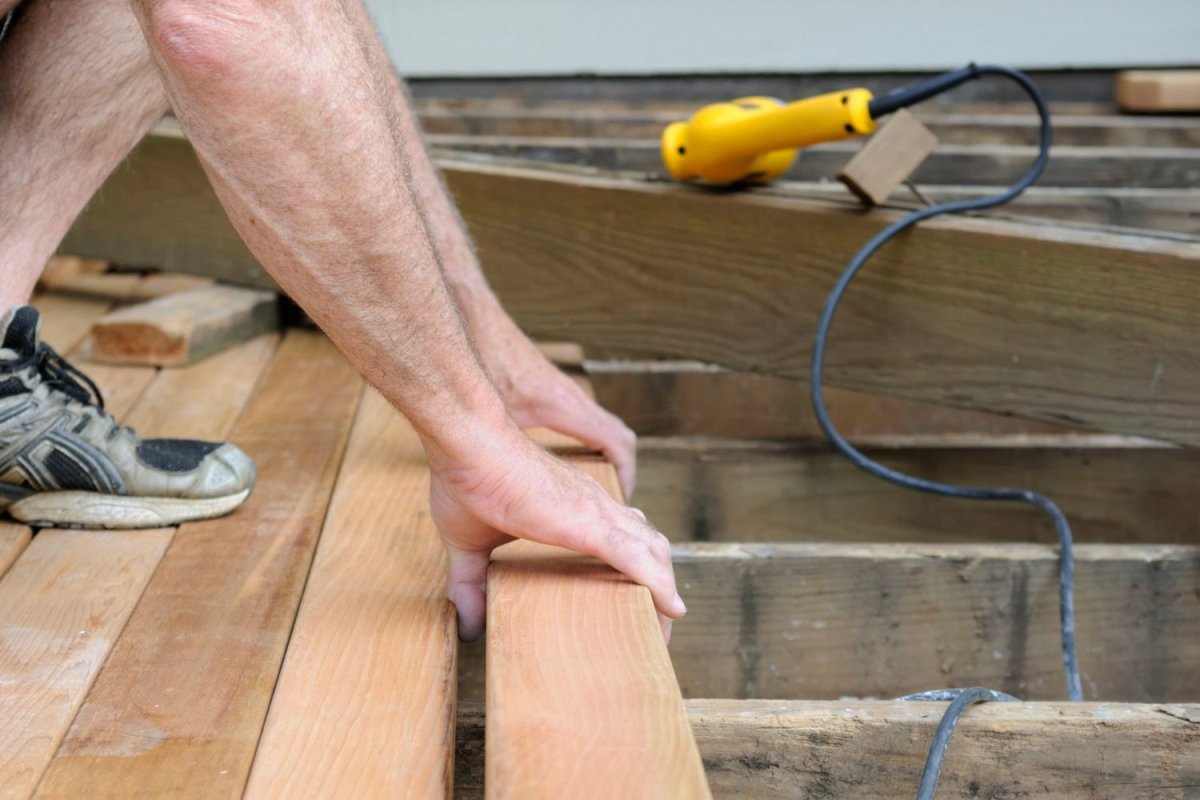
Replacing several cracked, splintered, or rotten boards is usually reasonable when adjacent decking and the frame are sound. Match the thickness and dimensions of the original boards, use compatible fasteners, and inspect the joists exposed during removal.
New pressure-treated lumber may look brighter than older boards at first. It generally becomes less conspicuous as it dries and weathers, although an exact color match is not guaranteed.
A problem is isolated and accessible
A loose railing section, damaged stair tread, corroded connector, or small joist-end problem may be repairable when deterioration has not spread. Structural repairs must restore the intended load path, so simply placing another board beside rotten lumber is not always an adequate fix.
The frame can support resurfacing
Deck resurfacing removes the old surface boards while preserving a usable frame. It can save labor and materials, but only when the posts, footings, beams, joists, ledger, and connections pass inspection.
If wood decking will be replaced with composite or PVC boards, verify the manufacturer’s requirements for joist spacing, ventilation, fasteners, picture framing, and stair construction. A frame designed for wood may need additional blocking or joists to support another product correctly.
When You Should Replace the Deck
Rot has spread through structural components
Widespread rot in posts, beams, joists, or the ledger is a strong argument for rebuilding. Replacing scattered surface boards will not solve decay underneath them. If numerous structural members must be replaced, labor-intensive repairs can approach the cost of a new deck while leaving other aging components in service.
The deck moves, sags, or separates
Visible sagging, leaning posts, excessive sway, or separation from the house indicates more than a beauty problem. Keep people off the deck and arrange an inspection. Temporary braces should not be treated as a permanent solution unless they are part of a professionally designed repair.
Several major systems need work
A project involving new decking, multiple joists, railings, stairs, posts, and footings is effectively a partial rebuild. At that point, complete replacement may offer better value, a clearer warranty, and a structure built consistently under one plan.
The existing deck no longer fits your needs
Replacement also makes sense when the deck is too small, has an inconvenient staircase, blocks access to the yard, or cannot safely accommodate planned features. Hot tubs, roofs, outdoor kitchens, and heavy masonry elements can impose substantial loads that an existing structure was never designed to carry.
Old construction creates safety or code concerns
Building requirements have changed, and local jurisdictions do not all adopt the same code edition. A contractor or building official may identify deficient guards, unsuitable footings, improper ledger attachment, inadequate lateral connections, or unsafe stairs.
A minor repair may not require the entire deck to be upgraded, but major reconstruction frequently needs permits and inspections. Ask the local building department before demolition rather than after a neighbor becomes unusually interested in your pile of lumber.
Compare Deck Repair and Replacement Costs
U.S. pricing varies considerably by region, deck height, accessibility, material, demolition requirements, permit fees, and design complexity. Recent national cost guides place many ordinary repairs in the hundreds to several thousands of dollars, while professionally built replacement decks commonly cost about $30 to $60 per square foot. Premium materials, second-story construction, custom railings, and complex layouts can exceed that range.
| Project | Typical cost influence |
|---|---|
| Replace several boards | Board material, access, fasteners, and finish matching |
| Repair a railing or staircase | Length, height, structural connections, and code compliance |
| Resurface an existing frame | Deck area, framing repairs, joist spacing, and decking material |
| Repair structural framing | Extent of decay, shoring, engineering, and accessibility |
| Replace the entire deck | Size, elevation, demolition, footings, material, railing, and permits |
Compare itemized estimates instead of looking only at the final totals. A repair proposal should identify which components will be replaced, how hidden damage will be handled, and what warranty applies. A replacement proposal should clarify demolition, debris removal, permits, footings, framing, decking, railings, stairs, and finishing.
A practical rule of thumb is to reconsider repair when its cost becomes a large portion of the price of a comparable new deck. This is not a building-code formula. It is a financial checkpoint that should also consider the age of the remaining structure and the likelihood of additional repairs.
Wood, Composite, or PVC for a Replacement Deck?
Pressure-treated wood
Pressure-treated lumber is widely available and usually offers the lowest initial material cost. It still needs cleaning and periodic protection from moisture and ultraviolet exposure. Neglected wood can crack, splinter, cup, and decay.
Cedar and other natural woods
Cedar, redwood, and dense hardwoods offer distinctive appearance and natural resistance to certain pests or decay. Prices, maintenance demands, and sustainability considerations vary significantly by species.
Composite and PVC decking
Composite and PVC boards resist the rot and splintering associated with wood decking and generally require less routine maintenance. They cost more upfront, can become warm in direct sun, and must be installed according to product-specific requirements. Remember that low-maintenance surface boards do not magically protect an old wood frame underneath.
Can You Repair the Deck Yourself?
A capable homeowner may be able to clean and refinish a deck, tighten appropriate fasteners, or replace an isolated surface board. Structural work is different. Ledger repairs, post or footing replacement, major framing changes, elevated-deck repairs, and modifications involving permits should generally be handled by a qualified professional.
Stop using the deck and seek professional advice if it is separating from the house, visibly sagging, supported by badly decayed posts, or moving under ordinary foot traffic. A structural engineer may be appropriate when the cause of movement is uncertain, hidden house framing is damaged, or a new feature will add substantial weight.
A Simple Repair-or-Replace Decision Checklist
- Remove furniture and inspect the surface, stairs, railings, and entire substructure.
- Identify whether each problem is cosmetic, localized, or structural.
- Stop using the deck if it moves, sags, separates, or contains extensive rot.
- Ask a professional to evaluate the ledger, flashing, footings, posts, and framing.
- Obtain itemized repair and replacement estimates based on the same scope.
- Check permit requirements with the local building department.
- Consider the useful life of every component that will remain after repair.
- Choose the option that delivers a safe structure and sensible long-term cost.
How to Help a Repaired or New Deck Last Longer
Inspect the deck at least annually and after severe storms, flooding, or unusual movement. Clear leaves and debris from board gaps, keep downspouts from discharging beneath the structure, and correct drainage that leaves posts or framing chronically damp.
Clean the surface with a method approved for the material. Excessive pressure can damage wood fibers and certain manufactured boards, so more force is not always more helpful. Maintain wood finishes on an appropriate schedule, replace loose or corroded hardware with compatible products, and address small problems before moisture turns them into structural ones.
Final Verdict
Repair your deck when the problems are limited, accessible, and surrounded by sound construction. Replace it when structural decay is widespread, supports or connections are failing, several major systems need simultaneous work, or the existing design cannot safely serve its intended purpose.
If the choice remains unclear, pay for a professional inspection before committing to either option. The inspection may confirm that a modest repair is sufficientor prevent you from spending thousands of dollars dressing up a frame that is already auditioning for a collapse video.
Experience Notes: What Realistic Deck Projects Teach Us
Scenario 1: The ugly deck that did not need rebuilding
Consider a 14-by-16-foot pressure-treated deck that looks terrible after years of postponed maintenance. Its stain is peeling, two boards have deep splits, and several fastener heads have risen above the surface. From the yard, complete replacement seems inevitable.
A ground-up inspection changes the diagnosis. The concrete footings are stable, posts remain firm, beams and joists resist probing, and the ledger is properly fastened and flashed. The damage is concentrated on the walking surface, particularly where a planter trapped moisture.
The sensible project is to replace the damaged boards, correct the planter setup, secure appropriate loose fasteners, clean the deck, and apply a compatible finish after the wood dries. The result is not a brand-new structure, but it is safe, functional, and much less expensive than demolition. The lesson is simple: appearance alone is a poor replacement test.
Scenario 2: The attractive surface hiding a bad frame
Now picture an elevated deck that was stained recently and looks respectable from the kitchen door. The railing moves slightly, and one corner feels bouncy. Underneath, several joist ends are dark and soft. The ledger flashing is incomplete, fasteners are heavily corroded, and water has damaged the house rim board.
Replacing the loose railing and installing fresh decking would improve appearances without addressing the failed load path. Because decay affects the ledger area, framing, and part of the house, the project needs professional evaluation, controlled demolition, and structural repair. Depending on the findings, a full deck replacement may be safer and more economical than preserving scattered sections of old framing.
This scenario demonstrates why inspections must include concealed and inconvenient locations. The prettiest board on top cannot compensate for rotten lumber below.
Scenario 3: When resurfacing becomes the sweet spot
A third common situation involves an older wood deck with badly checked surface boards but a dry, straight frame. The homeowners want composite decking to reduce future staining and splinters. After the boards are removed, the contractor inspects every joist, replaces a small damaged section, adds blocking, protects vulnerable joist tops, and confirms that spacing meets the new decking manufacturer’s instructions.
Keeping the frame reduces demolition and construction time while still producing a dramatically improved outdoor space. The key is that resurfacing follows structural verification; it does not replace it. If the frame had been undersized, rotten, or improperly connected, installing premium boards over it would have been the home-improvement equivalent of putting designer sunglasses on a raccoon.
The shared lesson
Successful deck decisions start with diagnosis rather than a preferred product or an arbitrary age cutoff. Homeowners tend to focus on boards because those are the parts they see. Experienced inspectors begin with footings, posts, beams, joists, the ledger, and connections because those components determine whether the platform can safely carry people.
It also helps to budget for uncertainty. Removing boards may expose hidden rot, insect damage, or unsuitable hardware. A written contingency in the contractor’s proposal can explain how additional work will be priced and approved. That small administrative detail can prevent a large disagreement once the deck is open and everyone is staring at the same unpleasant joist.
Note: These experience-based examples are representative scenarios synthesized from common deck inspections and repair projects; they are not presented as the author’s personal job-site experiences. Costs and code requirements vary by location, so structural concerns should be evaluated by a qualified local professional.
SEO Metadata